Question 6
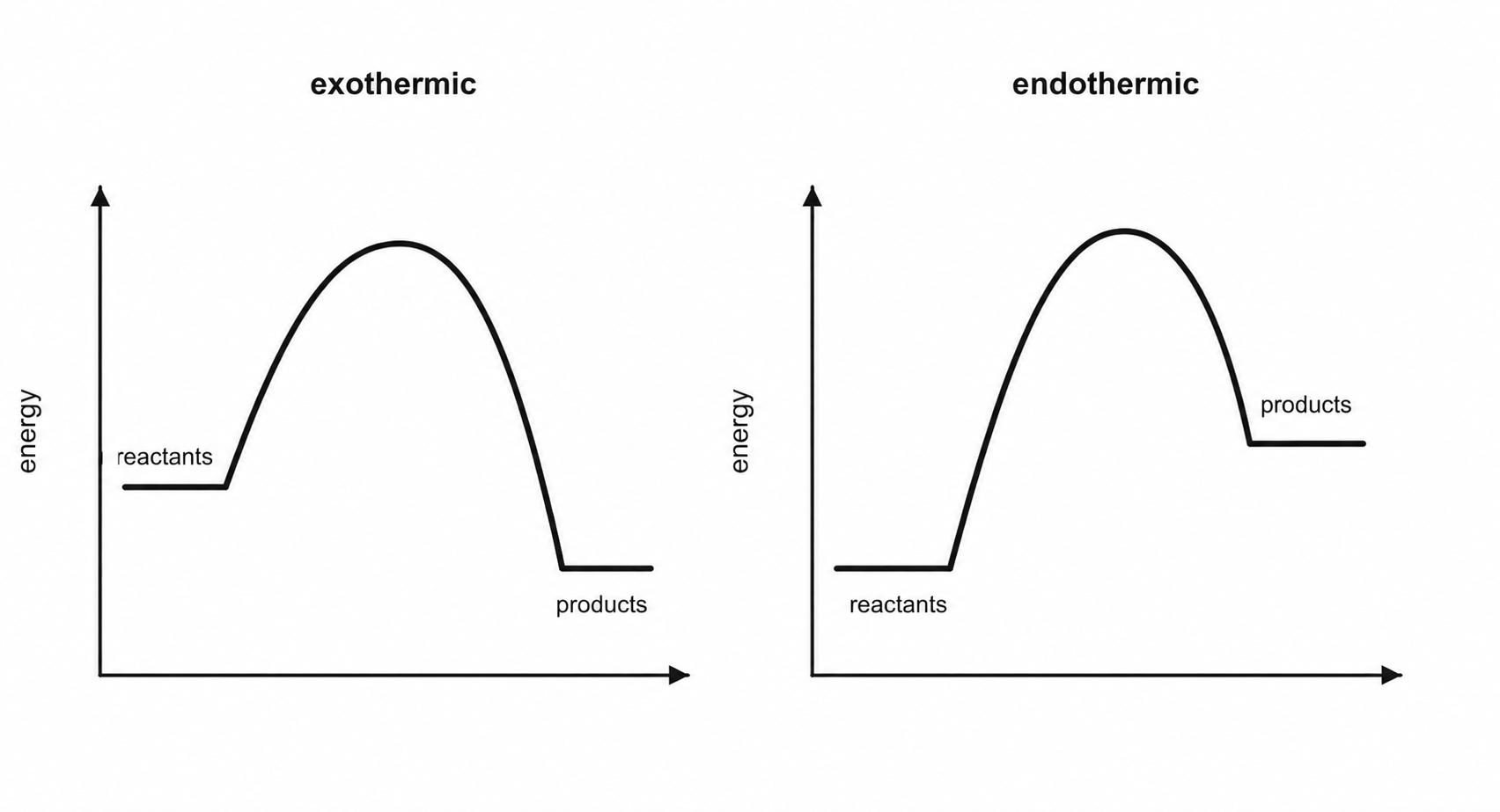
HThe diagrams show general reaction profiles. The horizontal arrows represent the progress of a reaction.
Methane reacts with chlorine in the following reaction:
CH4(g)+Cl2(g)→CH3Cl(g)+HCl(g)\mathrm{CH_4(g)+Cl_2(g)\rightarrow CH_3Cl(g)+HCl(g)}CH4(g)+Cl2(g)→CH3Cl(g)+HCl(g)
The energy change is −102 kJ mol−1-102\,\mathrm{kJ\,mol^{-1}}−102kJmol−1 for the reaction as written. Use the bond energies below. Only one C–H bond is replaced by a C–Cl bond in each methane molecule.
| Bond | Bond energy / kJ mol−1\mathrm{kJ\,mol^{-1}}kJmol−1 |
|---|---|
| C–H | 413 |
| Cl–Cl | 243 |
| H–Cl | 432 |
| C–Cl | xxx |
a.[4]
Calculate xxx, the C–Cl bond energy. Show your working.
b.[3]
The activation energy of the forward reaction is 80 kJ mol−180\,\mathrm{kJ\,mol^{-1}}80kJmol−1. Identify which profile represents this reaction and calculate the activation energy of the reverse reaction. Explain your calculation using the relative energy levels.
c.[3]
A catalyst is proposed for this reaction. Describe how a catalysed pathway would differ from the appropriate profile shown, and explain why the overall energy change would remain unchanged.
8.2 Heat energy changes in chemical reactions Questions
53 exam-style questions on Edexcel GCSE Chemistry 8.2 Heat energy changes in chemical reactions, covering 8.2.1 Exothermic and endothermic changes, 8.2.2 Bond breaking, bond making and overall energy change, 8.2.3 Calculating energy change from bond energies, and 8.2.4 Activation energy and reaction profiles. Each one has a worked solution and a mark scheme showing where the marks go.