Question 7
FA laboratory compares two reactions using the insulated-cup arrangement shown. The same total mass of solution starts at 21.0 ∘C21.0\,^\circ\mathrm{C}21.0∘C in each experiment. Reaction A reaches 29.5 ∘C29.5\,^\circ\mathrm{C}29.5∘C; reaction B reaches 15.5 ∘C15.5\,^\circ\mathrm{C}15.5∘C.
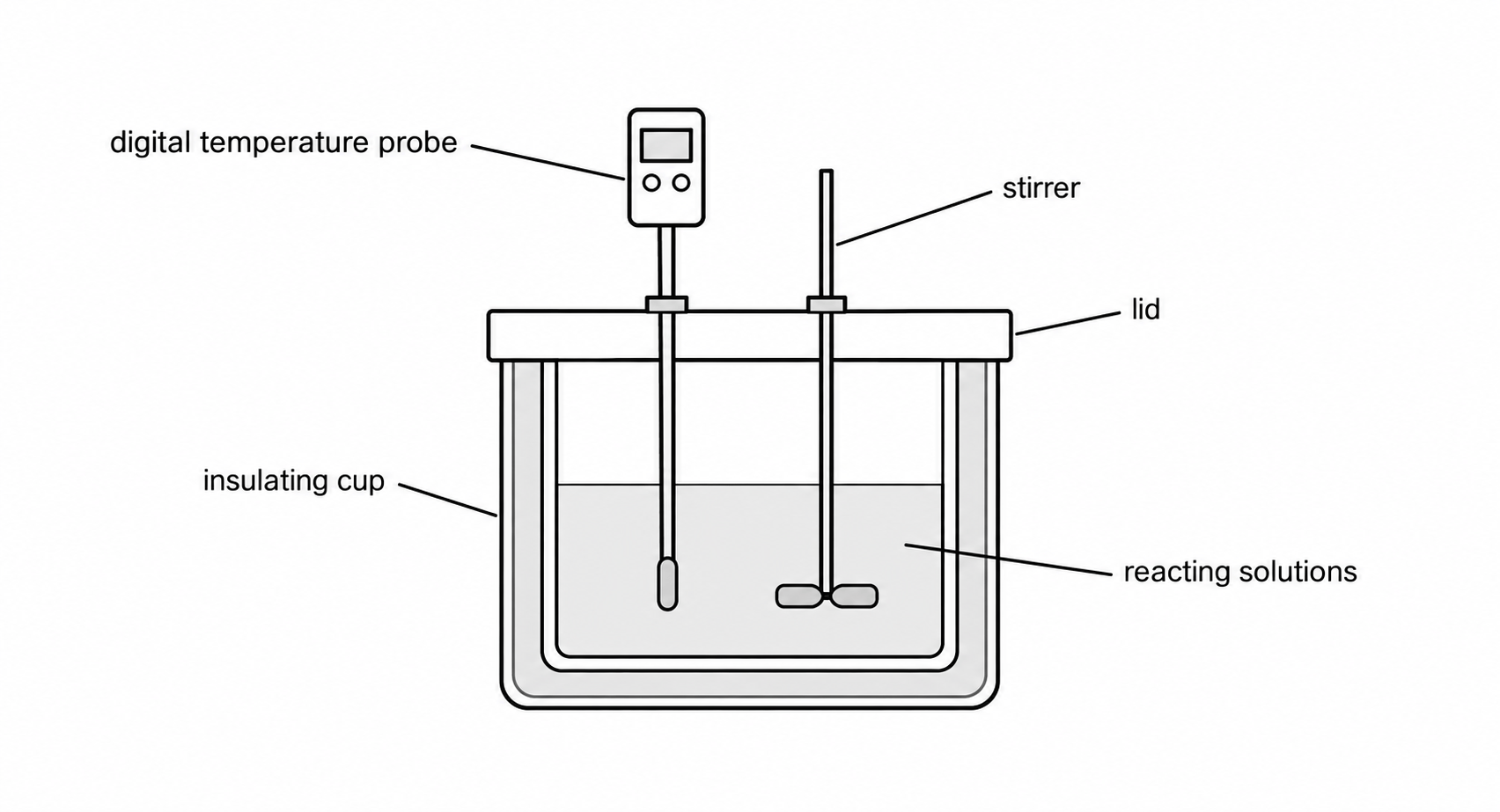
a.[4]
Classify each reaction as exothermic or endothermic, calculate each temperature change, and state the direction of energy transfer between the reaction and the solution.
b.[2]
Use two visible features of the apparatus to explain how the setup helps obtain a representative maximum or minimum temperature.
c.[2]
A technician records A only after it has cooled back to 25.0 ∘C25.0\,^\circ\mathrm{C}25.0∘C. Explain how this affects the measured temperature rise and whether it changes the correct classification of the reaction.
8.2 Heat energy changes in chemical reactions Questions
53 exam-style questions on Edexcel GCSE Chemistry 8.2 Heat energy changes in chemical reactions, covering 8.2.1 Exothermic and endothermic changes, 8.2.2 Bond breaking, bond making and overall energy change, 8.2.3 Calculating energy change from bond energies, and 8.2.4 Activation energy and reaction profiles. Each one has a worked solution and a mark scheme showing where the marks go.