Skip to content
MathsGenie logo
Old site
Open app

Course home

  1. GCSE
  2. Chemistry Edexcel
  3. Question bank

Heat energy changes in chemical reactions

EasyMedium
1234567891011121314151617181920212223242526272829303132333435363738394041424344454647484950515253545556575859606162636465666768697071727374757677787980818283848586878889909192939495969798
Question 87

A student wants to investigate the temperature change during the reaction between hydrochloric acid and magnesium ribbon in a polystyrene cup.
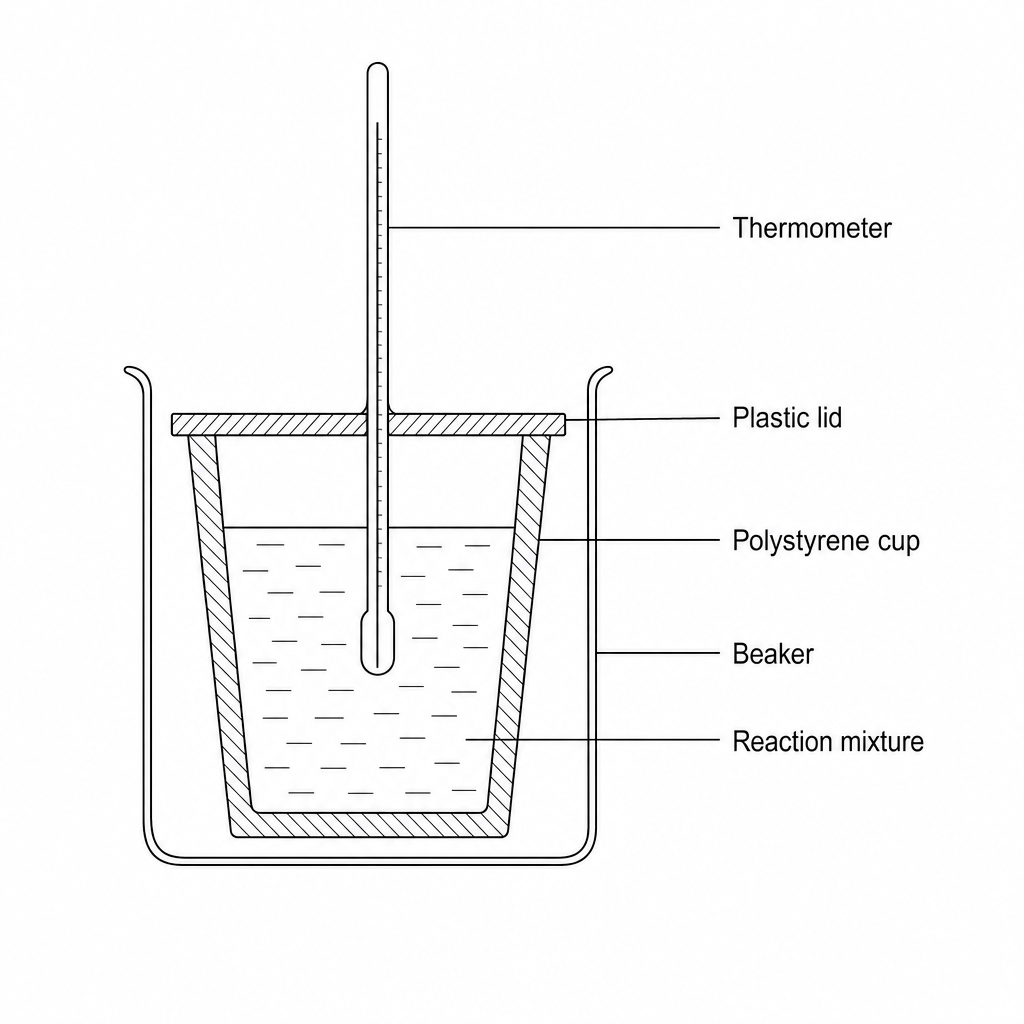
A diagram of a simple beaker-supported calorimeter. An insulated polystyrene cup sits inside a 250 cm³ glass beaker. A plastic lid is placed on top of the cup. A thermometer passes through a small hole in the lid, dipping into the liquid inside the cup.

The steps needed to carry out this investigation are A, B, C, D and E. They are not in the correct order:

  • A: Record the maximum temperature reached by the reaction mixture.
  • B: Add the magnesium ribbon to the acid and stir.
  • C: Measure 25 cm3 of dilute hydrochloric acid using a measuring cylinder.
  • D: Pour the hydrochloric acid into the polystyrene cup.
  • E: Record the starting temperature of the hydrochloric acid.

Write the letters of the steps in the correct order, from first to last.

[2]

Heat energy changes in chemical reactions Questions

  1. GCSE
  2. /Chemistry
  3. /Heat energy changes in chemical reactions

Practise Edexcel GCSE Chemistry Heat energy changes in chemical reactions with exam-style questions for Foundation and Higher tier. 130 questions, matched to the Edexcel GCSE Chemistry (1CH0) specification and written in Paper 1 and Paper 2 style. Every question includes a full worked solution and mark scheme, so you can see where marks are awarded rather than just whether you got the answer right.


Question bank