A student investigates the heat energy change during a neutralisation reaction between dilute hydrochloric acid and sodium hydroxide solution. They use the polystyrene cup calorimeter shown in the diagram below.
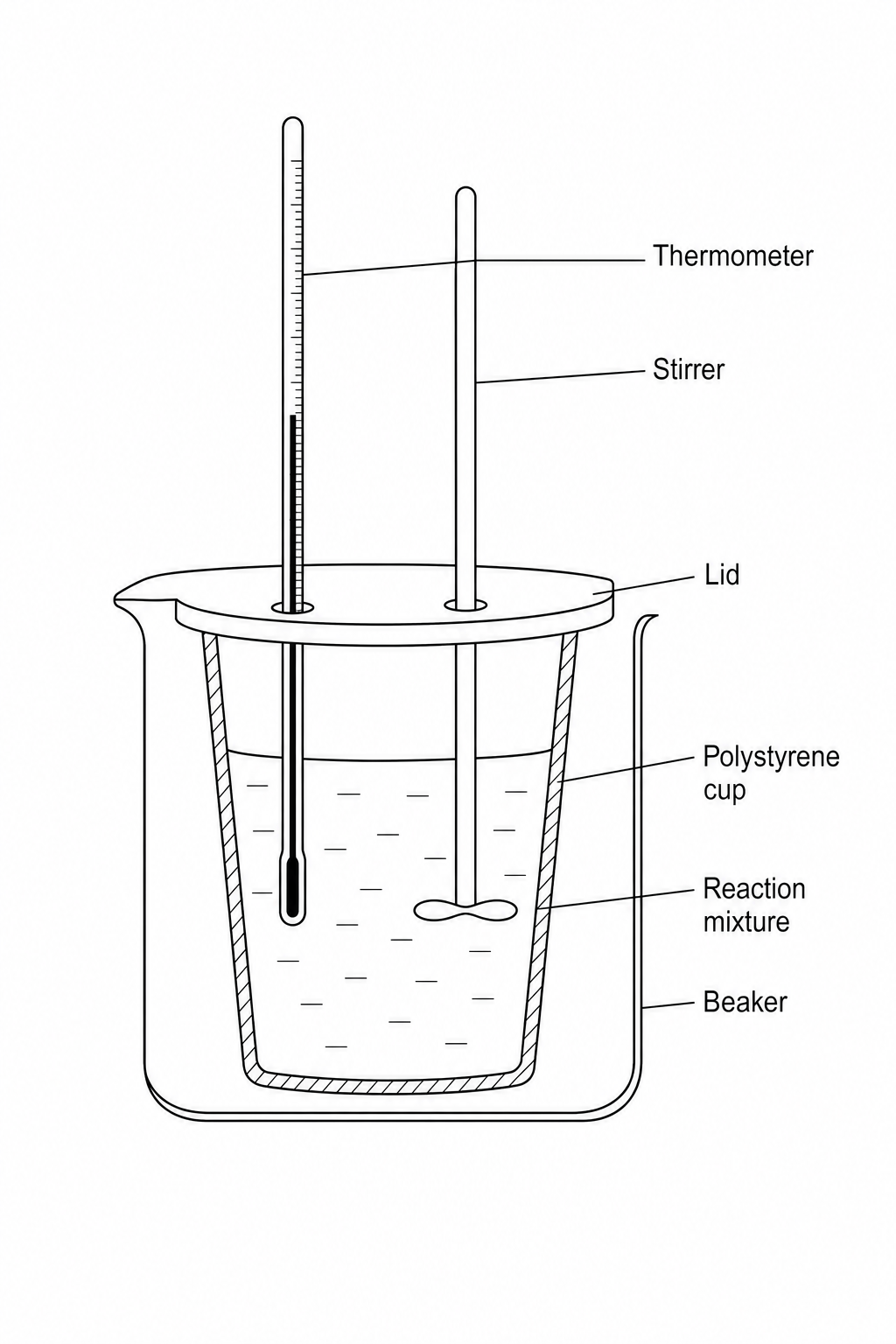
A known volume of hydrochloric acid is added to the polystyrene cup, and its initial temperature is recorded. An equivalent volume of sodium hydroxide solution is then added, the mixture is stirred, and the maximum temperature reached is recorded.
The theoretical temperature rise calculated for this neutralisation reaction is 6.4∘C6.4^\circ\text{C}6.4∘C.
In the student's experiment, the actual temperature rise was only 5.1∘C5.1^\circ\text{C}5.1∘C.
Give one reason why, even if the solutions are mixed rapidly and completely, the actual temperature rise is still less than the theoretical value.
Practise Edexcel GCSE Chemistry Heat energy changes in chemical reactions with exam-style questions for Foundation and Higher tier. 130 questions, matched to the Edexcel GCSE Chemistry (1CH0) specification and written in Paper 1 and Paper 2 style. Every question includes a full worked solution and mark scheme, so you can see where marks are awarded rather than just whether you got the answer right.

