Skip to content
MathsGenie logo
Old site
Open app

Course home

  1. GCSE
  2. Chemistry Edexcel
  3. Question bank

Heat energy changes in chemical reactions

EasyMedium
1234567891011121314151617181920212223242526272829303132333435363738394041424344454647484950515253545556575859606162636465666768697071727374757677787980818283848586878889909192939495969798
Question 82

Dissolving potassium nitrate in water is an endothermic process.

Figure 1 shows the reaction profile for this process.
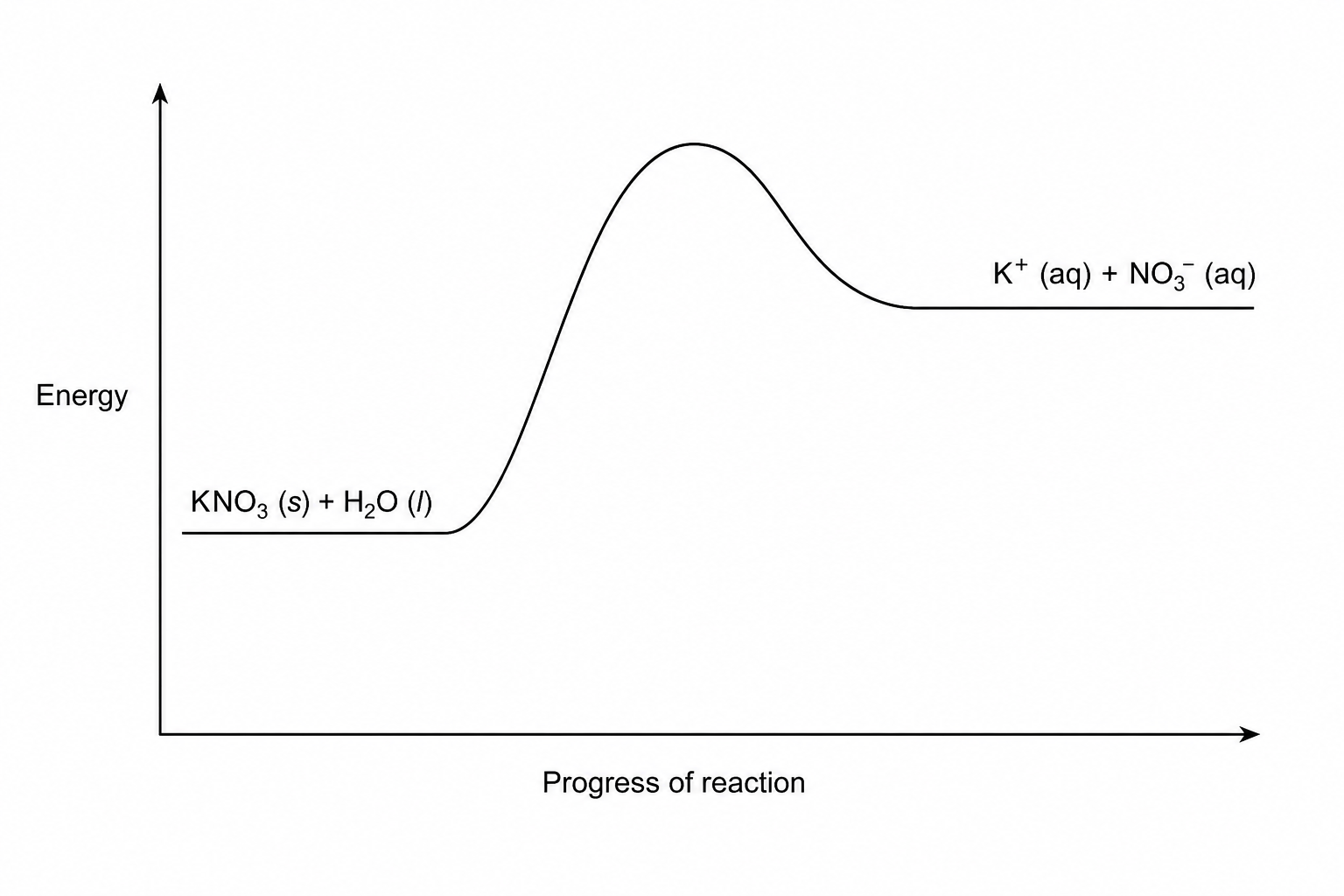
A reaction profile diagram with energy on the vertical y-axis and progress of reaction on the horizontal x-axis. On the left, a horizontal line represents the energy level of the reactants: KNO_3(s) + H_2O(l). The curve goes upwards, peaks, and then ends on a horizontal line representing the products: K^+(aq) + NO_3^-(aq). The products line is clearly higher up on the y-axis (at a higher energy level) than the reactants line.

Explain how Figure 1 shows that dissolving potassium nitrate in water is an endothermic process.

[2]

Heat energy changes in chemical reactions Questions

  1. GCSE
  2. /Chemistry
  3. /Heat energy changes in chemical reactions

Practise Edexcel GCSE Chemistry Heat energy changes in chemical reactions with exam-style questions for Foundation and Higher tier. 130 questions, matched to the Edexcel GCSE Chemistry (1CH0) specification and written in Paper 1 and Paper 2 style. Every question includes a full worked solution and mark scheme, so you can see where marks are awarded rather than just whether you got the answer right.


Question bank