The synthesis of ammonia from nitrogen and hydrogen is a reversible exothermic reaction:
N2(g)+3H2(g)⇌2NH3(g)ΔH=−92 kJ mol−1 \text{N}_2(\text{g}) + 3\text{H}_2(\text{g}) \rightleftharpoons 2\text{NH}_3(\text{g}) \quad \Delta H = -92\text{ kJ mol}^{-1} N2(g)+3H2(g)⇌2NH3(g)ΔH=−92 kJ mol−1Figure 1 shows the reaction profile for this chemical system.
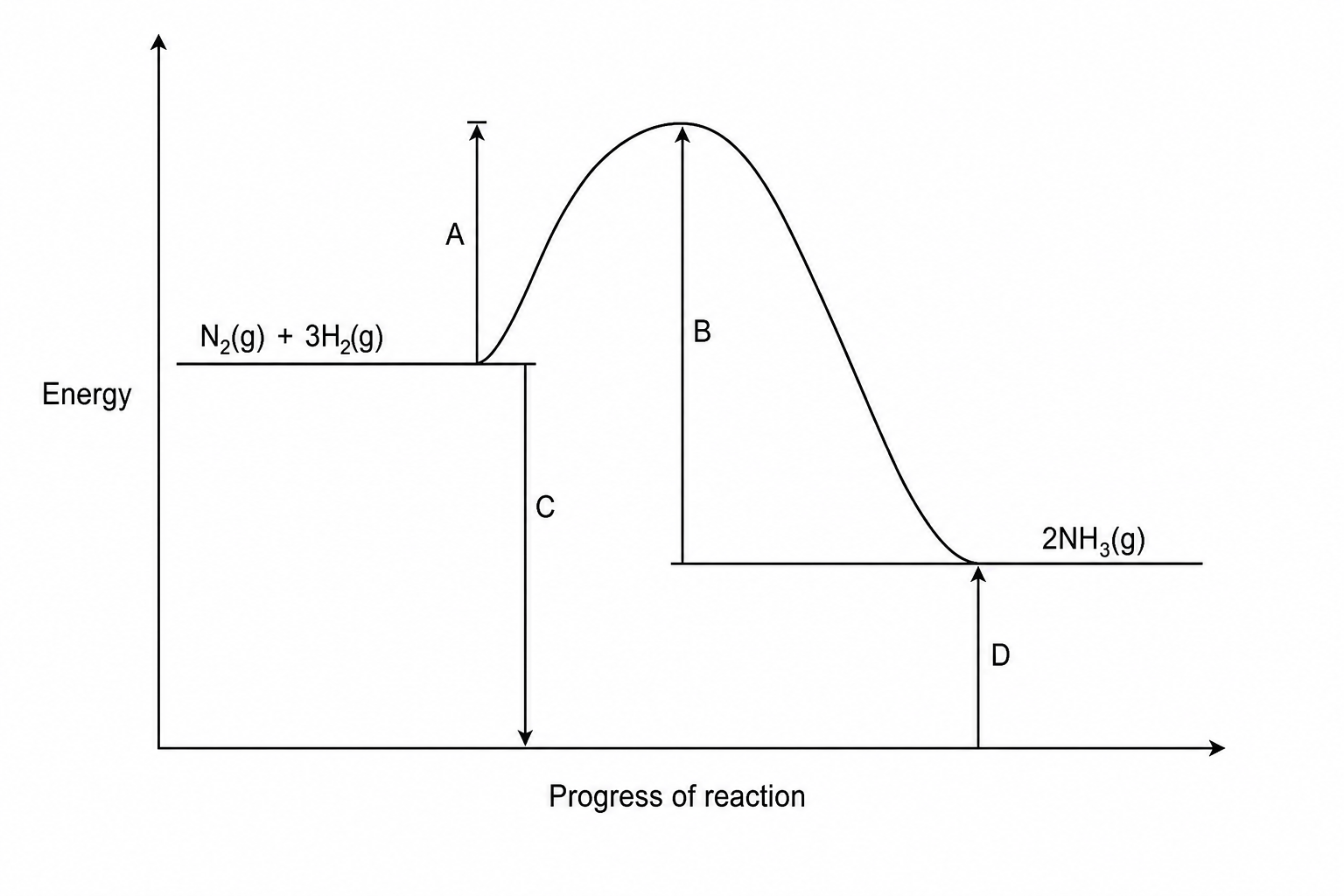
Which arrow represents the activation energy for the reverse reaction (the decomposition of ammonia into nitrogen and hydrogen)?
Arrow A
Arrow B
Arrow C
Arrow D
Practise Edexcel GCSE Chemistry Heat energy changes in chemical reactions with exam-style questions for Foundation and Higher tier. 130 questions, matched to the Edexcel GCSE Chemistry (1CH0) specification and written in Paper 1 and Paper 2 style. Every question includes a full worked solution and mark scheme, so you can see where marks are awarded rather than just whether you got the answer right.

