Question 30
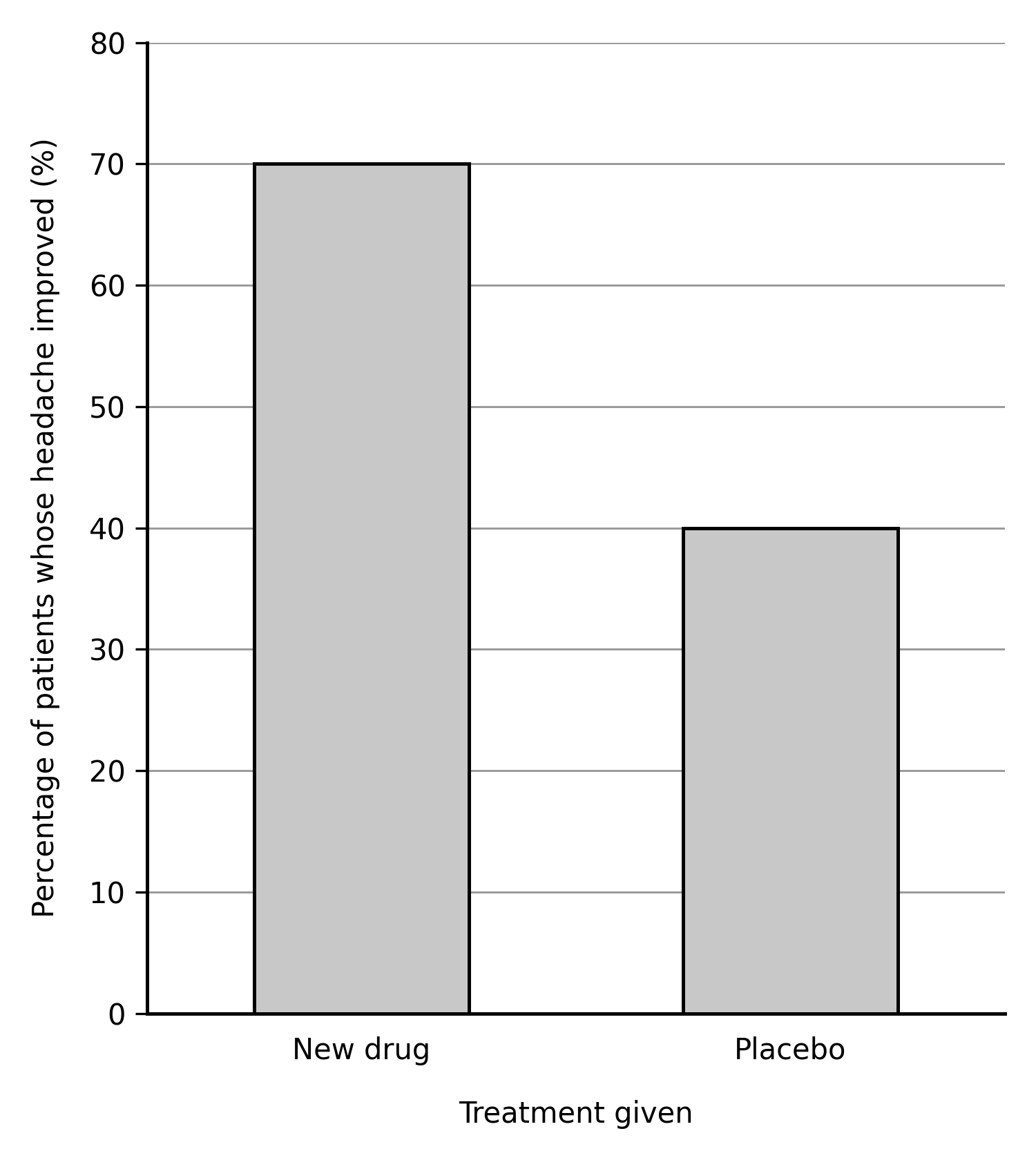
FA new drug for treating headaches was tested. 200 patients were given the new drug and 200 patients were given a placebo. Neither the patients nor the doctors knew which treatment each patient had been given.
Figure: The percentage of patients whose headache improved after being given the new drug or a placebo
a.[1]
What is meant by a placebo?
b.[2]
Use the figure to calculate how many more patients had an improvement after being given the new drug than after being given the placebo.
c.[2]
The trial was a double blind trial. Explain why the doctors were not told which patients had been given the new drug.
d.[2]
Some of the patients given the placebo said that their headache improved. A student concluded that the new drug does not work. Explain why the student is wrong.
3.1 Communicable diseases Questions
176 exam-style questions on AQA GCSE Biology 3.1 Communicable diseases, covering 3.1.1 Communicable (infectious) diseases, 3.1.2 Viral diseases, 3.1.3 Bacterial diseases, 3.1.4 Fungal diseases, 3.1.5 Protist diseases, 3.1.6 Human defence systems, 3.1.7 Vaccination, 3.1.8 Antibiotics and painkillers, and 3.1.9 Discovery and development of drugs. Each one has a worked solution and a mark scheme showing where the marks go.