Question 102
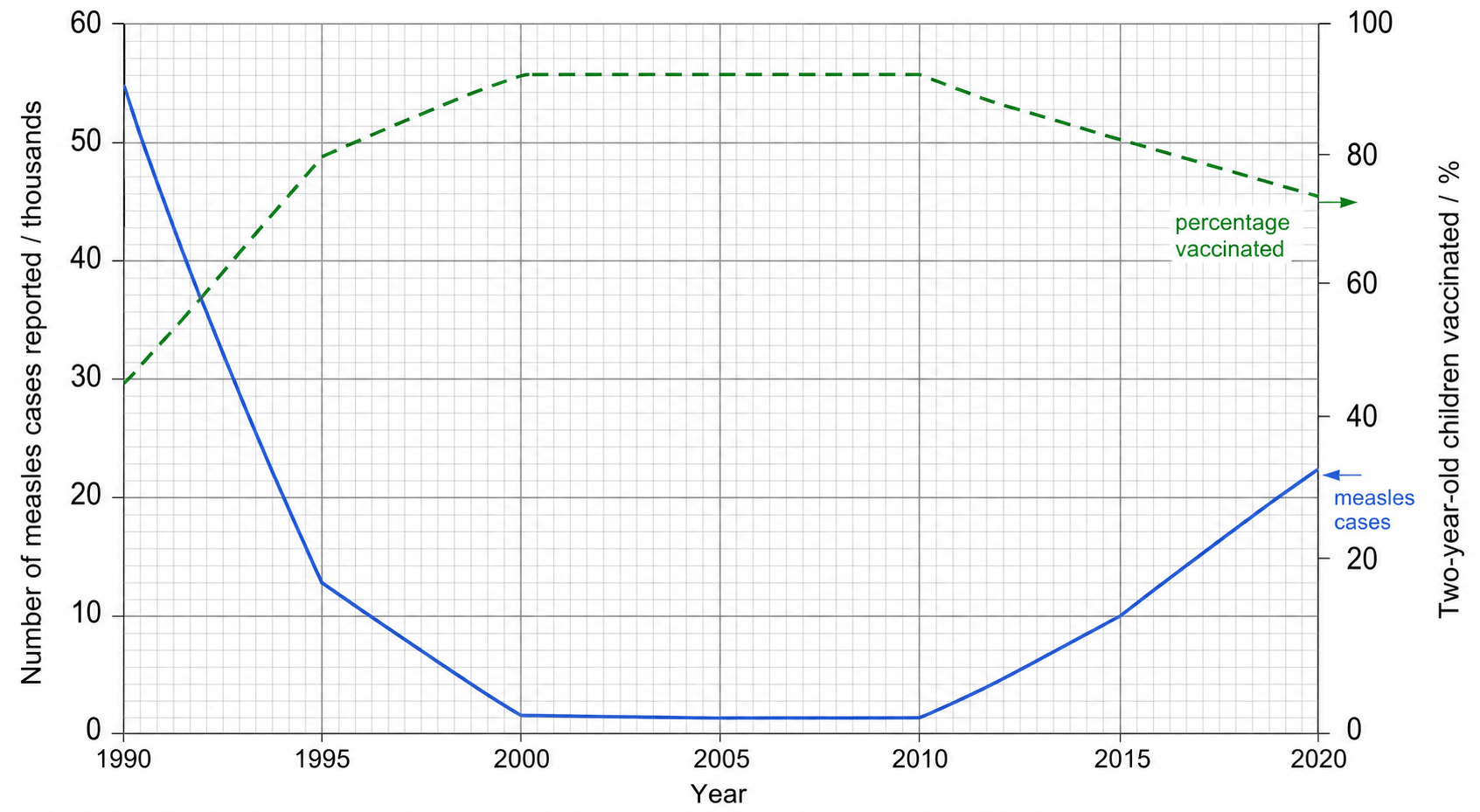
FA national vaccination programme against measles began in one country in 1990. The figure shows the number of measles cases reported in that country each year and the percentage of two-year-old children vaccinated against measles.
Figure: The number of measles cases reported each year in a country and the percentage of two-year-old children vaccinated against measles
a.[2]
Describe the change in the number of measles cases reported between 1990 and 2000. Use data from the figure in your answer.
b.[6]
Use the figure and your knowledge of measles to explain why the number of reported measles cases rose after 2010, and why public health doctors are concerned about this rise.
3.1 Communicable diseases Questions
176 exam-style questions on AQA GCSE Biology 3.1 Communicable diseases, covering 3.1.1 Communicable (infectious) diseases, 3.1.2 Viral diseases, 3.1.3 Bacterial diseases, 3.1.4 Fungal diseases, 3.1.5 Protist diseases, 3.1.6 Human defence systems, 3.1.7 Vaccination, 3.1.8 Antibiotics and painkillers, and 3.1.9 Discovery and development of drugs. Each one has a worked solution and a mark scheme showing where the marks go.