Question 16
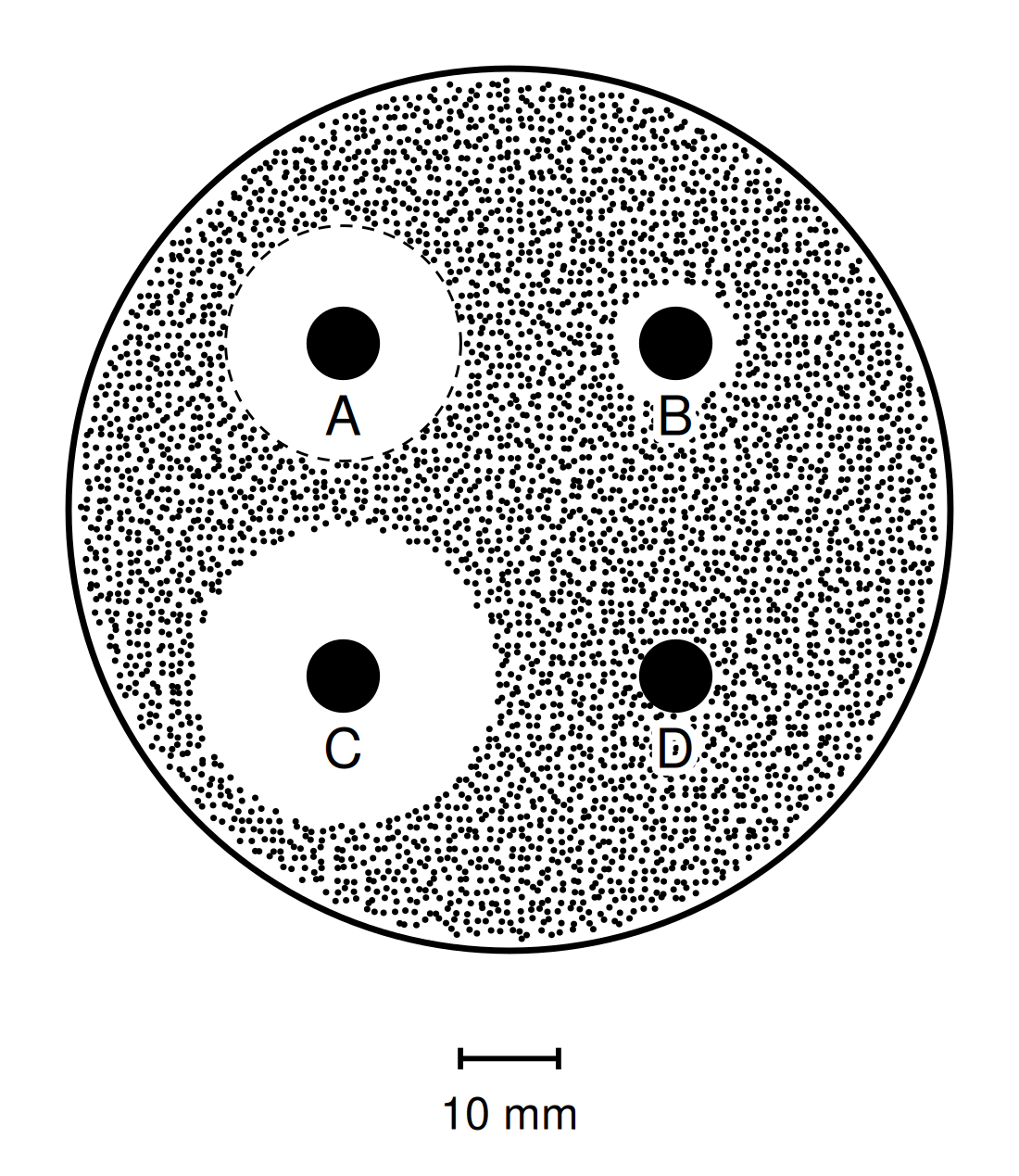
FA scientist investigated four antibiotics, A, B, C and D. She spread bacteria over an agar plate and placed a paper disc soaked in a different antibiotic at each of four positions. The plate was then incubated. The figure shows the plate after incubation.
Figure: An agar plate spread with bacteria after incubation, showing four antibiotic discs and the clear zones around them
a.[2]
Explain what the clear zone around a disc shows.
b.[2]
Give the letter of the antibiotic that was most effective against this species of bacterium. Give a reason for your answer.
c.[3]
The clear zone around disc A had a diameter of 24 mm. Calculate the area of this clear zone. Use the equation: area=πr2\text{area} = \pi r^2area=πr2
d.[2]
Antibiotic D produced no clear zone. Suggest what this tells the scientist about treating an infection caused by this species of bacterium.
3.1 Communicable diseases Questions
176 exam-style questions on AQA GCSE Biology 3.1 Communicable diseases, covering 3.1.1 Communicable (infectious) diseases, 3.1.2 Viral diseases, 3.1.3 Bacterial diseases, 3.1.4 Fungal diseases, 3.1.5 Protist diseases, 3.1.6 Human defence systems, 3.1.7 Vaccination, 3.1.8 Antibiotics and painkillers, and 3.1.9 Discovery and development of drugs. Each one has a worked solution and a mark scheme showing where the marks go.