Question 41
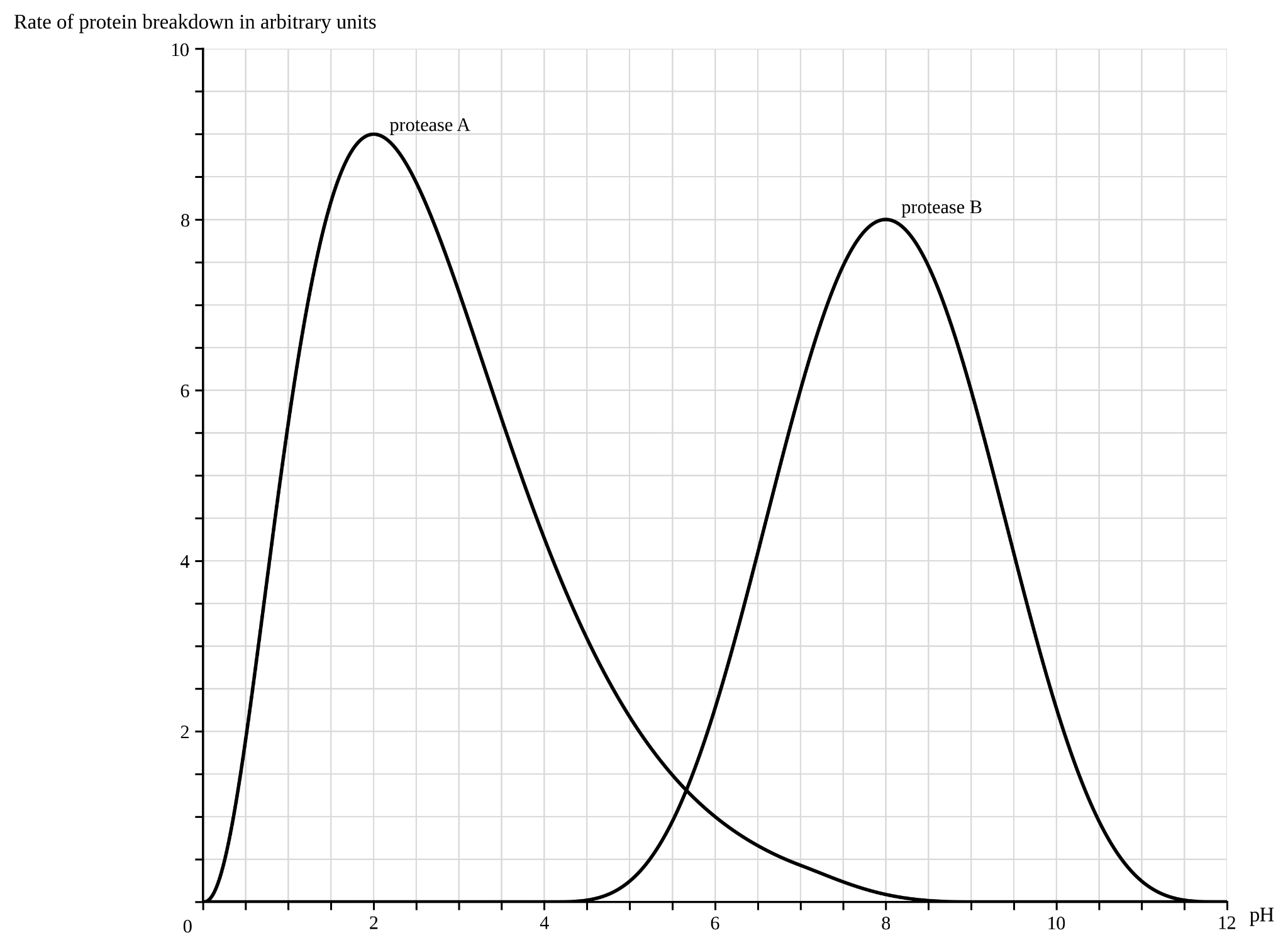
FFigure 3 shows how pH affects the rate at which two different proteases, protease A and protease B, break down protein.
Figure: The effect of pH on the rate of protein breakdown by two different proteases
a.[1]
Use Figure 3 to give the optimum pH of protease B.
b.[2]
One of these proteases was taken from the stomach.
Use Figure 3 to identify which protease came from the stomach. Explain your answer.
c.[2]
Explain why protease A breaks down almost no protein at pH 8.
d.[2]
A food company needs a protease that will work in a product stored at pH 7.
Suggest which protease the company should choose. Use Figure 3 to give a reason for your choice.
2.2 Animal tissues, organs and organ systems Questions
179 exam-style questions on AQA GCSE Biology 2.2 Animal tissues, organs and organ systems, covering 2.2.1 The human digestive system, 2.2.2 The heart and blood vessels, 2.2.3 Blood, 2.2.4 Coronary heart disease: a non-communicable disease, 2.2.5 Health issues, 2.2.6 The effect of lifestyle on some non-communicable diseases, and 2.2.7 Cancer. Each one has a worked solution and a mark scheme showing where the marks go.