Question 53
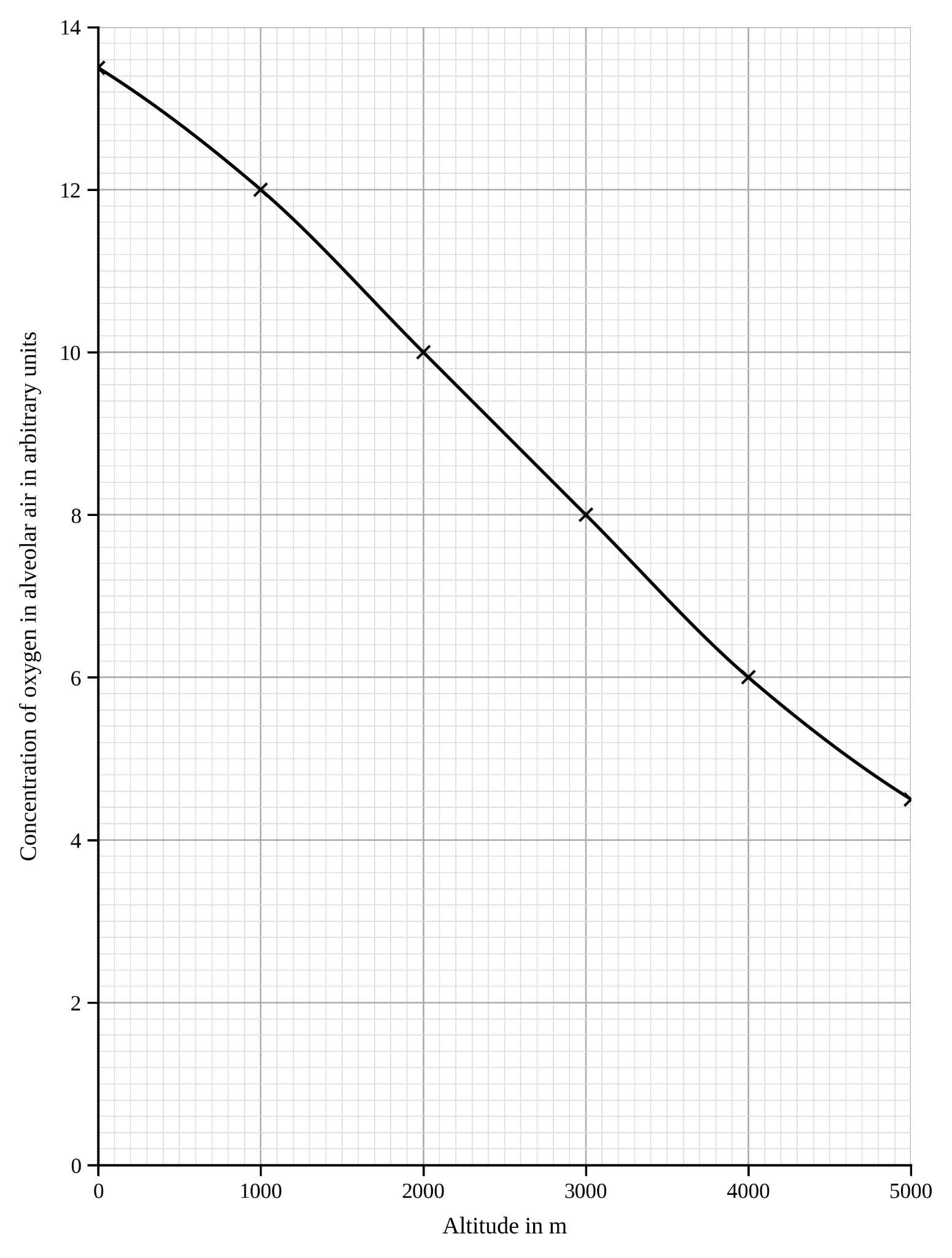
FAt high altitude the air still contains about 21 % oxygen, but the air pressure is much lower, so each breath contains fewer oxygen molecules. Figure shows how the concentration of oxygen in the air inside the alveoli changes with altitude.
Figure: The concentration of oxygen in the air inside the alveoli at different altitudes
a.[1]
Use Figure to determine the concentration of oxygen in alveolar air at an altitude of 3000 m.
b.[2]
Describe how the concentration of oxygen in alveolar air changes as altitude increases. Use data from Figure in your answer.
c.[3]
The concentration of oxygen in the blood arriving at the lungs is about the same at all altitudes. Explain why a climber becomes breathless at high altitude.
2.2 Animal tissues, organs and organ systems Questions
179 exam-style questions on AQA GCSE Biology 2.2 Animal tissues, organs and organ systems, covering 2.2.1 The human digestive system, 2.2.2 The heart and blood vessels, 2.2.3 Blood, 2.2.4 Coronary heart disease: a non-communicable disease, 2.2.5 Health issues, 2.2.6 The effect of lifestyle on some non-communicable diseases, and 2.2.7 Cancer. Each one has a worked solution and a mark scheme showing where the marks go.