Why Choose GCSE Further Maths? Students' Reasons
Why choose GCSE Further Maths? Explore the challenge, A Level preparation and deeper problem-solving that can make this extra qualification worthwhile.
A difficult maths question can produce two very different reactions. One is relief when it is over. The other is curiosity: could there be a cleaner way to solve that?
If the second reaction sounds familiar, it helps explain why choose GCSE Further Maths. Students who enjoy the course often value the deeper algebra, unfamiliar ideas and satisfaction of solving questions that initially look resistant. It can strengthen higher-tier GCSE skills and make the transition to A Level Maths feel less abrupt.
It is not the right option for everyone. It is an additional qualification, not a replacement for GCSE Maths, and its value depends on your confidence, workload and future plans. But for a student who likes mathematical challenge, it can make Year 101010 and Year 111111 maths more interesting rather than merely busier.
The short answer: why choose GCSE Further Maths?
Further Maths may be worth choosing if you:
- are working securely towards a high grade in higher-tier GCSE Maths;
- enjoy algebra, graphs, geometry and multi-step problem-solving;
- want to explore ideas such as introductory calculus or matrices;
- are considering A Level Maths or A Level Further Maths;
- would appreciate an extra mathematical qualification;
- have enough time to protect your progress across every GCSE subject.
Before deciding, confirm exactly what your school offers. “GCSE Further Maths” is often used informally for qualifications taken alongside GCSE Maths. A common route is the AQA Level 2 Certificate in Further Mathematics, while some centres offer alternatives such as Pearson Edexcel Level 222 Extended Mathematics or OCR’s Level 333 FSMQ Additional Mathematics. Their content, grading and assessment structures are not identical.
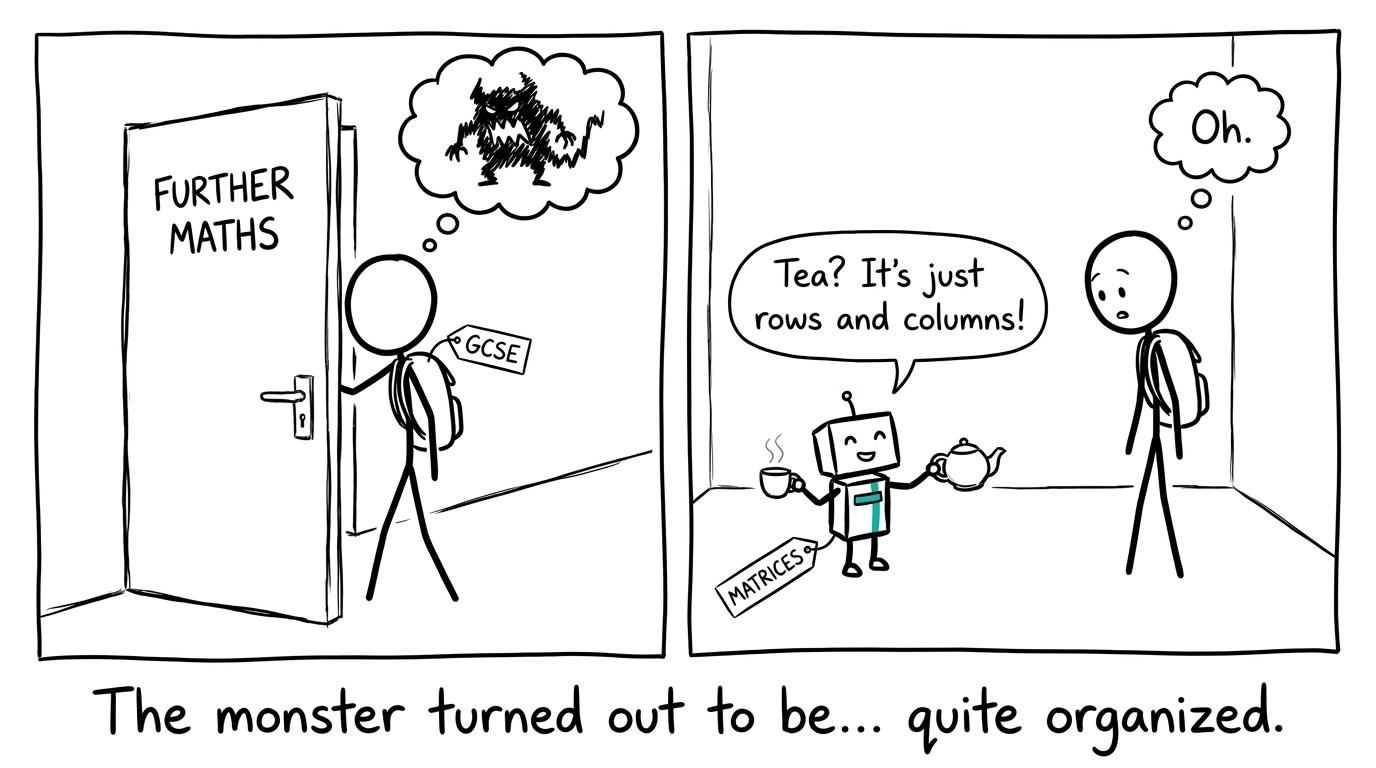 A student discovers that the Further Maths monster is a friendly matrices robot
What students tend to enjoy about Further Maths
It would be misleading to promise that every student loves the course. Enjoyment is personal, and schools select and teach qualifications differently. However, published teacher feedback collected by AQA repeatedly highlights several themes: high-attaining students enjoy the greater challenge, respond positively to new topics and often find the course useful preparation for A Level.
Maths starts to feel connected
In ordinary revision, topics can sometimes resemble separate drawers: quadratics in one, graphs in another and geometry somewhere else. Further Maths asks you to open several drawers at once.
A function may need algebraic manipulation before its graph makes sense. Coordinate geometry may combine gradients, equations and proof. A calculus question connects a curve with the way its gradient changes. The attraction is not simply “harder sums”. It is seeing that mathematical ideas form a system.
Students who enjoy that connected feeling often stop asking, “Which formula do I use?” and begin asking, “What must be true here?” That shift is valuable in demanding higher-tier GCSE questions too.
You can inspect the wider progression through the GCSE Maths topics by exam board and tier before deciding whether you want to take those ideas further.
The new content feels genuinely new
AQA’s Level 222 Further Mathematics specification extends algebra, coordinate geometry and geometry while introducing calculus and matrix transformations. Those last two areas can be especially memorable because they provide a first glimpse of mathematics beyond the standard GCSE course.
Calculus begins with the relationship between functions and gradients. For a simple power function such as
y=xn,y=x^n,y=xn,the derivative describes how its gradient changes with xxx. Matrices provide a compact way to represent and combine transformations. These are not included merely as impressive vocabulary. They show how mathematicians organise change and structure.
The pleasure often comes from being a beginner again. A student who is used to recognising most GCSE methods suddenly meets notation that requires attention. Then, gradually, it becomes readable. That small transformation from unfamiliar to manageable is one of revision’s most satisfying experiences.
Difficult questions become the interesting part
At first, harder questions can feel like evidence that you are “bad at” a topic. Further Maths can change that interpretation. Difficulty becomes the purpose rather than an unwelcome surprise.
The qualification places substantial emphasis on algebraic reasoning, rigorous argument and problem-solving. You are expected to link steps and communicate enough working for another person to follow your reasoning. Students who like puzzles often find that more rewarding than completing a long page of nearly identical exercises.
That does not mean every lesson feels effortless. Enjoyment and struggle can coexist. In fact, the most satisfying question is often the one that takes several attempts before the structure becomes visible.
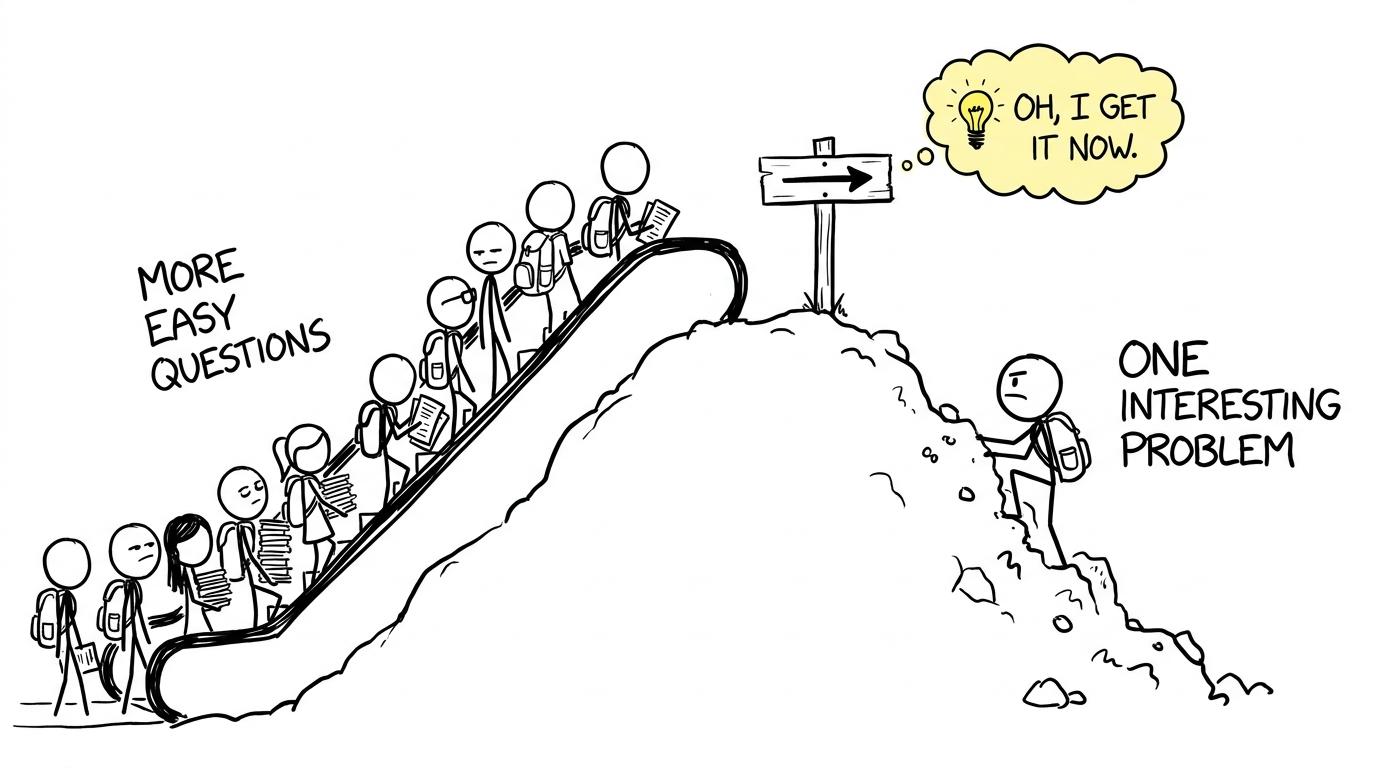 A student chooses one interesting problem over an escalator of easy questions
How Further Maths can support ordinary GCSE Maths
Further Maths should never come at the expense of your main GCSE. Done sensibly, however, the overlap can make core higher-tier skills more secure.
The AQA course assumes GCSE knowledge and develops areas such as algebra, graphs, trigonometry and geometry in greater depth. That repeated contact can improve fluency with expressions, exact values, functions, proof and quadratics. For example, the quadratic form
ax2+bx+cax^2+bx+cax2+bx+cmay appear through factorisation, roots, turning points, graphs or algebraic argument. Seeing the same structure from several directions makes it less likely that your understanding depends on one memorised procedure.
If these foundations are not yet secure, use MathsGenie’s AQA GCSE Maths revision hub or choose your own board from the main site. The quadratic equations revision guide is also useful because quadratics sit close to the centre of both higher-tier GCSE and post-GCSE algebra.
The benefit is not automatic. Merely attending extra lessons will not strengthen GCSE performance. The improvement comes from practising carefully, marking honestly and repairing weak prerequisite skills.
Is it good preparation for A Level Maths?
Yes: preparation for further study is one of the qualification’s clearest purposes. AQA states that its Level 222 certificate is designed to stretch high-achieving students and prepare them for Level 333 study. Pearson similarly describes its Extended Mathematics certificate as extending higher-tier GCSE content and supporting progression.
The advantage is less about racing ahead and more about reducing shock. A Level Maths asks for confident algebra, accurate notation and sustained reasoning. A student who has already met introductory calculus, more demanding functions or harder coordinate geometry begins with some useful familiarity.
However, GCSE Further Maths is neither required for A Level Maths nor a substitute for it. Many successful A Level students begin without an additional qualification. Sixth-form entry requirements also vary, so check the precise rules at schools or colleges you may apply to.
If you are already thinking ahead, compare the possibilities in A Level after GCSE Maths. Students aiming particularly high may also find the guidance on what comes after a grade 9 useful. You can then preview the free A Level Maths revision resources without assuming that you must learn the course early.
What the workload and exams can involve
Assessment depends on the qualification. For AQA Level 222 Further Mathematics, students take two papers in the same examination series. Each lasts 111 hour 454545 minutes and carries 808080 marks. Paper 111 is non-calculator, Paper 222 allows a calculator, and each contributes 50%50\%50% of the qualification.
That is a real addition to the summer exam timetable. The decision should therefore consider capacity, not just ability. Ask your teacher:
- Which precise qualification and specification will I follow?
- How many lessons or after-school sessions are involved?
- Is entry optional, selective or decided later?
- What standard of GCSE Maths is expected?
- When are the examinations?
- What happens if my wider workload becomes unmanageable?
A student who likes maths may still reasonably decline if several other subjects need urgent attention. Choosing fewer commitments can be disciplined rather than unambitious.
Who is most likely to be glad they chose it?
Further Maths is most likely to suit a student who enjoys the process of mathematics, not only the grade at the end. Secure higher-tier performance matters, but curiosity and persistence matter too.
A useful test is to notice your response when a familiar method does not immediately work. Do you want to investigate, draw a graph, rearrange the expression or try another representation? Or does extra maths mainly feel like another demand on limited time?
Also distinguish eligibility from suitability. A predicted grade 888 or 999 may make the course accessible, but it does not create an obligation to take it. Conversely, one disappointing test should not settle the decision if your underlying algebra is strong and your teacher believes the course is appropriate.
MathsGenie’s discussion of what a grade 8 can lead to can help separate a current result from the wider choice.
 GCSE Maths meets Further Maths, which is wearing a tiny calculus hat
Common mistakes when choosing or revising Further Maths
Choosing it only because you are expected to
A high GCSE target does not mean you must enjoy every available maths qualification. Choose it because the content and challenge interest you, not because declining would feel like wasting a grade.
Treating GCSE foundations as finished
Further Maths exposes small algebra gaps quickly. Weak manipulation of fractions, indices, surds or quadratics does not disappear when the questions become harder. Keep ordinary higher-tier revision running alongside the extra course.
Memorising notation without understanding it
New symbols can tempt students to copy procedures. Ask what each object represents: a function, gradient, transformation or relationship. Understanding makes unfamiliar questions far less threatening.
Doing papers without analysing lost marks
Completing papers is only the first half of revision. Use the mark scheme to classify each lost mark as a knowledge gap, method error, algebra slip or communication issue. The AQA Further Maths past papers include papers and official mark schemes, with worked solutions where available.
Letting the extra qualification consume every revision session
Hard questions are absorbing. That can make Further Maths an elegant form of procrastination from another subject. A realistic GCSE maths revision timetable should protect time for your full exam programme.
A sensible way to make the decision
First, look at the actual specification offered by your school rather than relying on the course’s informal name. Next, try a small sample of the material under your teacher’s guidance. Notice whether the challenge creates curiosity, exhaustion or a mixture of both.
Then review the evidence: your algebra fluency, current workload, likely sixth-form choices and willingness to practise independently. Discuss those factors with your teacher and family. The best decision is not the most impressive one. It is the one you can sustain.
Make Further Maths challenge work for you
Students who are glad they chose Further Maths often value the same things: a first look beyond GCSE, deeper connections between topics and questions that reward persistence. The course can strengthen higher-tier skills and prepare you for A Level, but its real appeal is simpler. It gives an interested student more mathematics to think about.
If that sounds worthwhile, begin with evidence rather than guesswork. Use MathsGenie’s free revision lessons and practice questions to secure your GCSE foundations, then attempt AQA Further Maths past papers and mark schemes. Add mini tests, video solutions and predicted papers as your exams approach. Learn one idea, test it, diagnose the mistake and return stronger; that is how an intimidating option becomes a satisfying one.