Grade 9 GCSE Maths Meaning: What Comes Next?
Grade 9 GCSE maths meaning explained, with realistic next steps for A Level Maths, Further Maths and keeping your skills sharp after results day.
Results day can compress two years of work into one small line on a screen. If that line says grade 9, the immediate answer is simple: you achieved the highest grade available in GCSE Maths. The grade 9 GCSE maths meaning is exceptional performance across the higher-tier course, but it is not a command to choose a particular subject or career.
You have proved that you can reason carefully, handle unfamiliar problems and perform under exam conditions. What comes next depends on what you enjoyed, not only what you achieved.
Your results-day checklist
- Take time to recognise the achievement.
- Check that your sixth-form or college place is confirmed.
- Review the entry requirements for A Level Maths and Further Maths.
- Decide whether maths belongs in your next set of subjects.
- Keep a light connection with algebra before Year 12 if you choose A Level Maths.
- Remember that a grade does not have to become your identity.
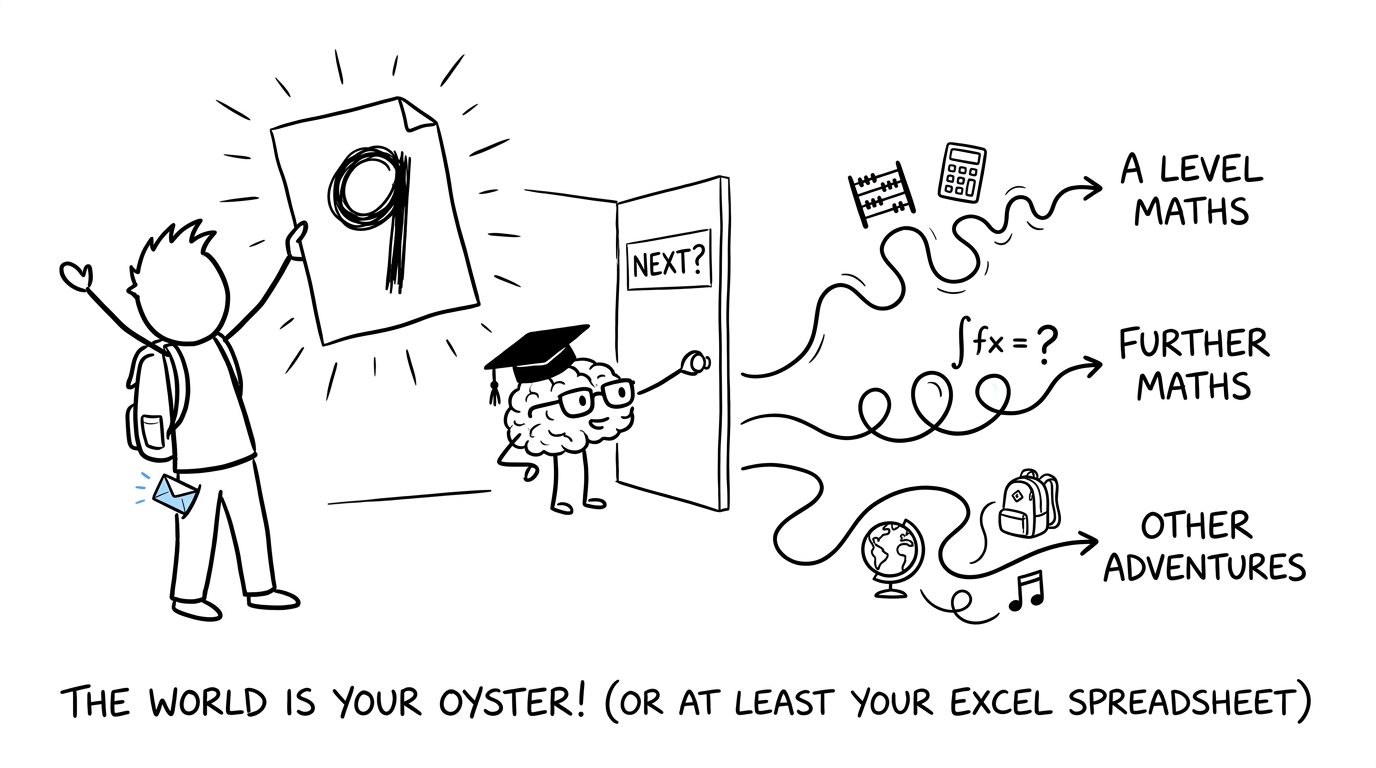 A student discovering several possible paths beyond a GCSE grade 9
What does a GCSE Maths grade 9 mean?
In England, GCSEs use the grades 9-1 scale, with grade 9 as the highest result. The numerical system is not a direct translation of the former letter system. Official guidance places grades 7, 8 and 9 across the range previously covered by grades A and A*, while grade 9 provides additional differentiation at the very top.
Your result therefore says something significant: you demonstrated an excellent command of the assessed specification for your exam board, whether that was Edexcel, AQA, OCR or Eduqas.
It does not mean that you answered every question correctly. Grade boundaries are set for each exam series and vary according to the paper and exam board. A grade is based on your total marks across the qualification, not on a fixed percentage that applies every year.
Nor does grade 9 mean you have completed maths. GCSE Maths gives you a strong platform, but A Level introduces greater depth, abstraction and connections between topics.
What next after grade 9 maths?
There is no single correct route. A high result creates options; it does not remove them.
Choose A Level Maths
A Level Maths is the most direct next step if you enjoyed algebra, graphs, trigonometry and multi-stage problem solving. You will study pure mathematics alongside statistics and mechanics, with familiar GCSE ideas developed much further.
A grade 9 normally places you comfortably above typical entry thresholds, although requirements differ between schools and colleges. Always check your chosen provider rather than assuming admission is automatic.
Before committing, look through the free A Level Maths revision hub. Sampling the topics can tell you more than the course title. You do not need to understand everything yet; you are simply asking whether the style of thinking appeals to you.
Consider A Level Further Maths
Further Maths may suit you if solving a difficult question was often the most enjoyable part of GCSE. It is normally taken alongside A Level Maths, not instead of it, and entry requirements can be higher or subject to timetable arrangements.
A grade 9 is strong evidence of readiness, but enjoyment and persistence matter too. Further Maths moves quickly. Choose it because you want more mathematics, not because your result makes you feel obliged.
Use maths inside another subject combination
You might combine Maths with physics, chemistry, economics, computer science, geography or another subject using quantitative reasoning. Equally, you may choose subjects with no formal mathematical focus.
A GCSE Maths grade 9 remains valuable either way. It shows that you can interpret information, build logical arguments and remain accurate through several connected steps. Those habits travel well beyond the maths classroom.
Keep maths as a strength without taking it further
Not choosing A Level Maths does not waste your grade. A result records what you achieved at that stage; it is not a contract governing what you must do next.
You may simply want to retain useful skills through puzzles, coding, data or occasional problem solving. The GCSE Maths revision hub remains available whenever you need to refresh a topic.
How to prepare for A Level Maths without overdoing it
After GCSE exams, rest is useful. You do not need to spend the summer trying to teach yourself the entire A Level course.
A better bridge is short and selective:
- Keep algebraic manipulation fluent.
- Revisit indices, surds, quadratics and functions.
- Practise exact values and rearranging formulae.
- Correct gaps rather than repeating topics you already know securely.
- Begin Year 12 ready to ask questions, not expecting to know everything.
Students who studied Edexcel can use the Edexcel GCSE Maths revision area, while the AQA GCSE Maths revision area provides board-matched practice. Challenging topics such as algebraic proof and vector proof questions are useful places to test whether your reasoning still feels fluent.
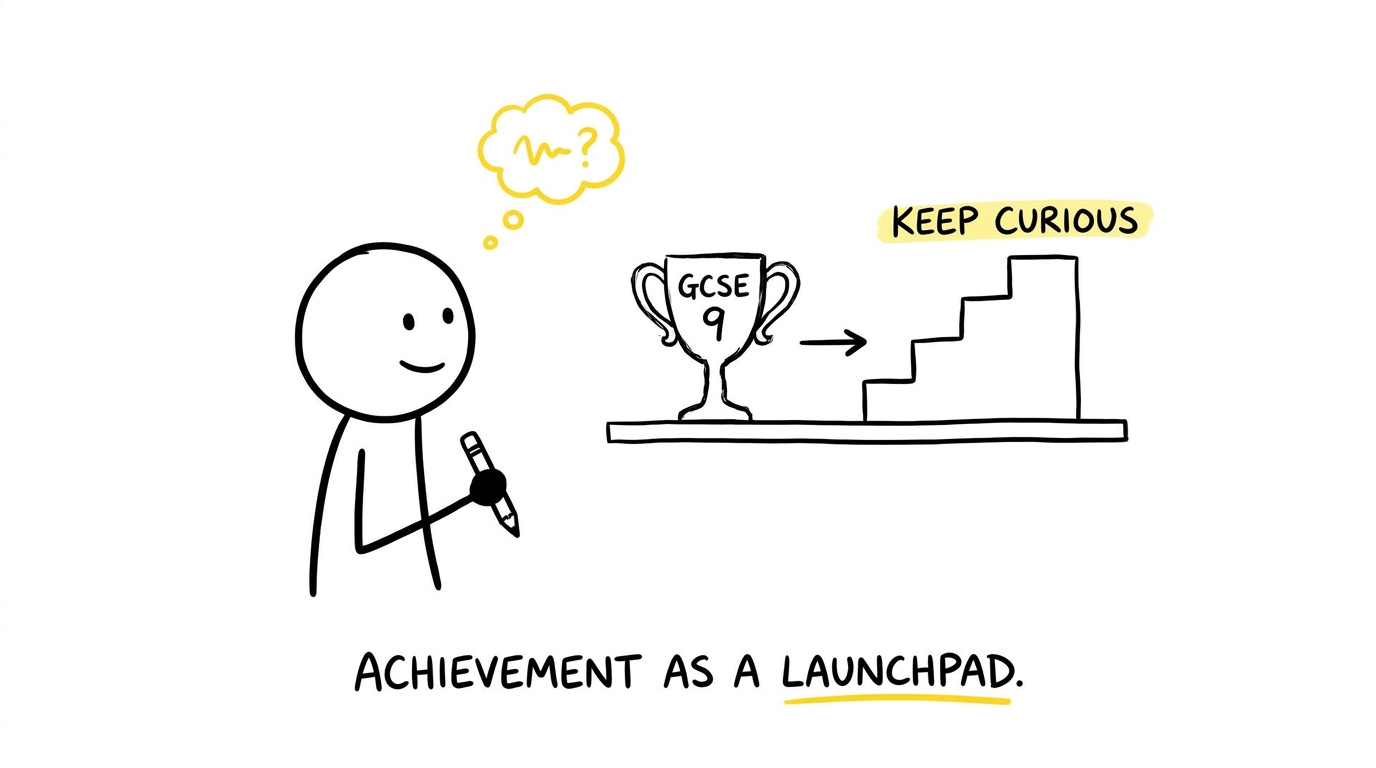 A GCSE grade 9 trophy pointing towards a staircase marked Keep curious
Common mistakes after receiving a grade 9
Assuming A Level Maths will feel easy
Your GCSE result gives you an excellent foundation, but A Level Maths still requires regular practice. New notation, faster pacing and more demanding algebra can challenge even very strong students.
Choosing Further Maths only because others expect it
Capability and preference are different things. Investigate the course, speak to teachers and consider your whole subject combination before deciding.
Comparing marks across exam boards
A raw mark from one board or year should not be compared casually with another. Papers and grade boundaries differ. The awarded grade is the meaningful outcome.
Continuing intense revision through the entire summer
Relentless practice is not automatically productive. Rest first, then use occasional focused sessions if you are progressing to A Level.
Treating grade 9 as something you must defend
A top grade can create pressure to be instantly good at every future topic. That is not how learning works. Difficulty at A Level does not invalidate your GCSE result; it means you have reached new material.
Let the grade open a door
A grade 9 is worth celebrating because it reflects sustained understanding and strong exam performance. Then it can take its proper place: behind you, as evidence of what you can do, rather than above you as a standard you must constantly protect.
If A Level Maths is next, explore MathsGenie's free revision lessons, practice questions, mark schemes, video solutions and past papers through the A Level Maths resources. If you are still preparing for GCSE or helping someone who is, use the GCSE predicted papers and the one-month GCSE revision planner to turn mistakes into a clear plan.
Celebrate the result. Consider your options calmly. Then choose the next step because it fits you.