Colour Coding Notes GCSE Arabic: Does It Help?
Colour coding notes GCSE Arabic: learn when colour aids recall, when it becomes decoration, and how to combine it with effective active GCSE revision.
A page can look organised without the knowledge inside it being secure. That is the quiet danger of colour coding notes GCSE Arabic students often encounter: highlighting feels productive, the finished page feels reassuring, yet neither feeling proves that you can recall the vocabulary in an exam.
The short answer is that colour-coding can help, but mainly when colour has a clear job. It can direct attention, group related language and reveal weak areas. It is much less useful when revision becomes an art project. To improve recall, colour should support active methods such as self-testing, spaced practice and answering questions without notes.
The same principle matters when preparing for maths. Attractive notes may organise a formula or method, but marks come from retrieving and applying that knowledge independently.
The quick colour-coding checklist
Before uncapping another highlighter, ask:
- Does every colour have one consistent meaning?
- Am I marking only information that deserves attention?
- Will this colour help me compare or retrieve something later?
- Can I test myself without seeing the coloured page?
- Am I spending more time recalling than decorating?
- Have I planned when I will revisit the material?
If most answers are yes, colour is probably serving your revision. If not, it may simply be making passive rereading more satisfying.
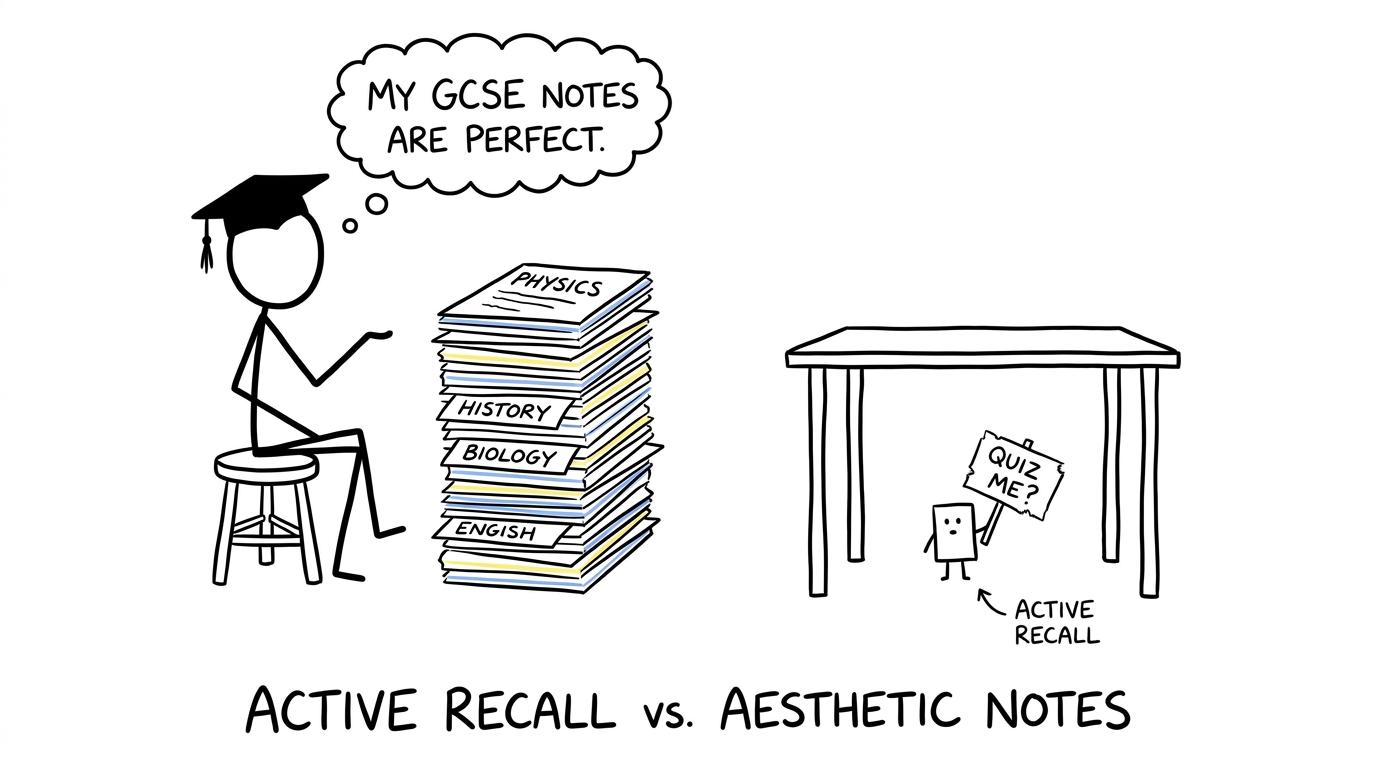 A proud student with rainbow notes overlooks the flashcard asking to be used
What the research actually suggests about colour and recall
Research into colour and learning does not support the sweeping claim that colourful notes automatically create stronger memories. The picture is more careful than that.
Colour can act as a signal. A well-chosen cue may guide attention towards important information, separate categories or make the structure of a complex page easier to see. Reviews of colour and memory research suggest that distinctive colours can improve attention and sometimes recall, particularly when their use is consistent and relevant.
But context matters. Research on visual learning has also found that colour-coding can backfire when learners become dependent on cues that are absent during testing. Other recent work indicates that background colour alone is not a reliable retrieval aid. In practical terms, remembering that a word appeared in a green box is not the same as knowing the word when a GCSE paper presents it in black ink.
There is stronger and broader support for retrieval practice: making an active attempt to bring information to mind. The Education Endowment Foundation also emphasises planning, monitoring and evaluating revision rather than simply repeating comfortable activities. Feedback matters too, because retrieving an incorrect answer without correcting it can reinforce the error.
So the sensible conclusion is:
Colour can organise the route into memory, but retrieval is what checks whether the knowledge stayed there.
Why colour-coding feels more effective than it sometimes is
Colouring notes provides immediate evidence of effort. A plain page becomes orderly. A finished section creates a small sense of closure. Retrieval practice offers a less comfortable experience: you close the book, hesitate and discover what you cannot remember.
That discomfort is useful information.
Rereading a highlighted Arabic vocabulary list can create familiarity. Each phrase looks recognisable, so it is tempting to assume that it is known. In an exam, however, recognition may not be enough. You might need to understand spoken Arabic, read unfamiliar material, respond in speech or produce accurate writing without access to a dictionary.
Maths creates the same illusion. Looking at a highlighted method for solving an equation feels easy because every step is already present. A blank exam question removes those prompts. That is why the MathsGenie GCSE maths revision hub pairs learning materials with questions, papers and testing tools rather than treating notes as the final destination.
When colour-coding GCSE Arabic notes can help
Grouping language by function
Colour is useful when it exposes relationships. You might assign separate colours to verbs, connectives, opinions and time phrases. The purpose is not to make each category attractive. It is to help you notice how sentences are constructed and which elements are missing from your own writing.
Keep the categories limited. If every grammatical feature receives a different shade, the system creates another code that must itself be remembered.
Distinguishing what you know from what needs work
A simple red, amber and green system can support honest monitoring:
- green for language you can produce correctly without help;
- amber for language you recognise but cannot always retrieve;
- red for unfamiliar or repeatedly incorrect material.
The key word is produce. Do not label an item green merely because it looks familiar. Cover it, recall it and check it first.
This principle transfers directly to maths. A self-assessment system should reflect what you can answer independently, not how comfortable a topic appears. The GCSE maths revision timetable guide explains how to turn identified weaknesses into a manageable weekly plan.
Making contrasts visible
Arabic learners often need to notice differences between related forms, patterns or meanings. A restrained colour system can make those contrasts easier to inspect. It may also help separate a common error from its correction.
Colour is most valuable here as an editing tool. It directs your eyes towards a relationship that you must still understand and retrieve.
Creating clear feedback after testing
Complete a recall task first, then use colour while marking. One colour can identify omissions and another can show corrections. This prevents the highlighting from giving away answers before your memory has been tested.
That sequence mirrors effective maths revision: attempt, mark, diagnose, repair and retest. MathsGenie's guide to revising GCSE maths efficiently develops this feedback loop for foundation and higher tier students.
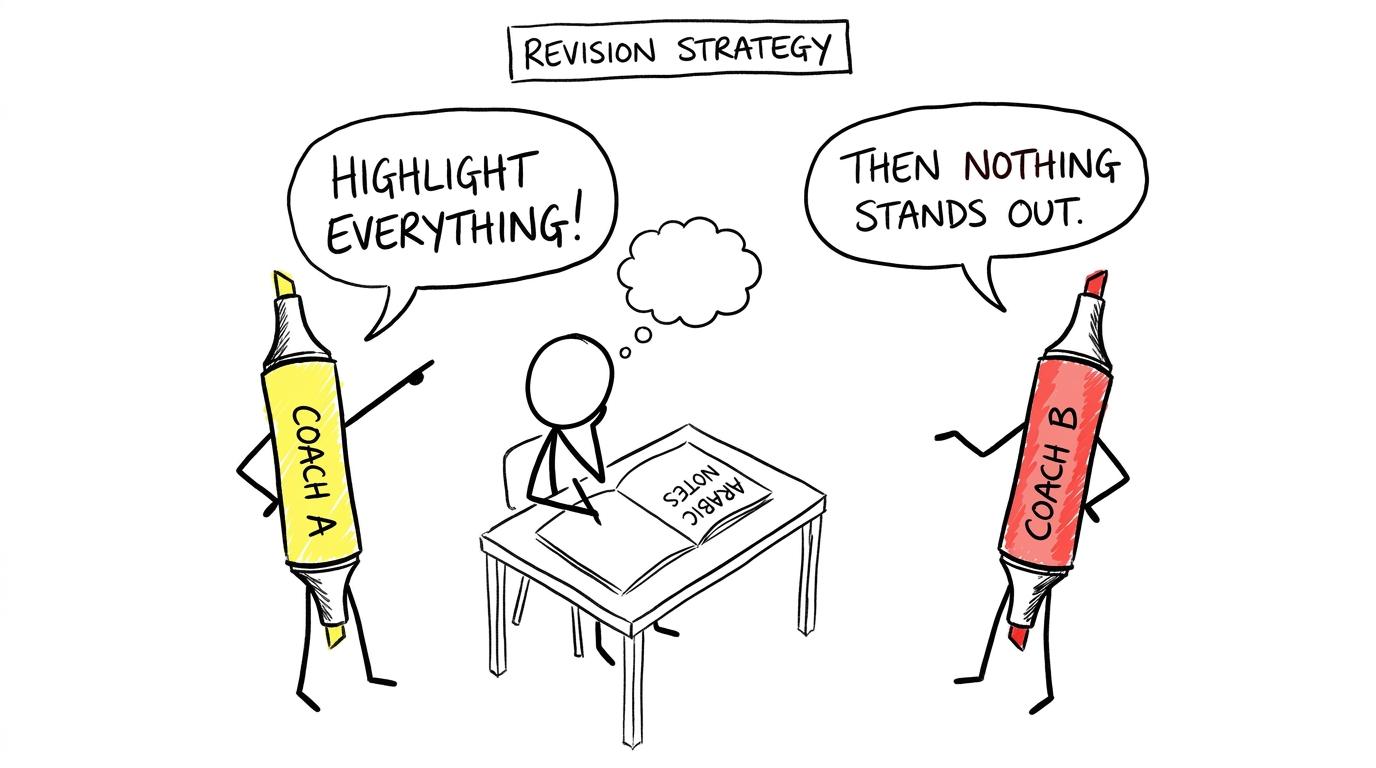 Two highlighters debate whether highlighting everything helps
What GCSE Arabic assessment demands from your memory
For Pearson Edexcel GCSE Arabic, the qualification assesses listening, speaking, reading and writing. Each skill contributes 25%25\%25% of the qualification, and students enter either foundation or higher tier across the papers. Dictionaries are not permitted, including during preparation for the speaking assessment.
That matters because the exam requires more than recognising a colourful vocabulary page. Your revision must prepare you to:
- understand language when you hear it;
- retrieve words while speaking;
- interpret Arabic in unfamiliar reading contexts;
- produce language independently in writing;
- translate meaning rather than depend on the layout of your notes.
Colour can support the organisation of vocabulary, grammar and themes, but it cannot replace listening aloud, speaking from prompts, reading unseen material or writing without notes. Your school and the current official specification should guide the exact content and assessment arrangements for your course.
A better system: colour, retrieve, check and revisit
A useful revision routine gives colour a small supporting role.
Choose a limited key
Use around three or four colours and write down what they mean. Choose meanings that lead to action, such as “secure”, “needs retrieval” and “common error”. Avoid choosing colours merely because they look good together.
Apply colour after thinking
Read a section, close the notes and recall what you can. Then reopen the page and colour-code the gaps or categories. Thinking comes first; stationery comes second.
Test in the form the exam requires
For Arabic, vary the direction of recall. Seeing an English meaning and producing Arabic is different from recognising Arabic and giving the English meaning. Speaking and listening require their own practice rather than silent visual review.
For maths, replace vocabulary prompts with exam-style questions. Begin with a short lesson when a method is unclear, then practise it independently. The best order for learning GCSE maths topics can help you identify sensible foundations before moving to harder material.
Mark immediately and record the cause
Do not merely count correct answers. Identify why an answer failed: forgotten knowledge, confusion between similar items, inaccurate working or misunderstanding of the question. Use colour to make that cause visible.
MathsGenie's free GCSE revision resources include mini tests, practice materials and predicted papers that make this cycle easier to repeat. Mark schemes and video solutions help you compare your method with what an examiner expects.
Return after a gap
A beautifully organised page reviewed once is still a page reviewed once. Revisit difficult content after increasing gaps and attempt retrieval before looking. Your colour key can determine what returns soonest: red material first, then amber, while green material still receives occasional checks.
How to transfer the method to GCSE maths revision
Students preparing for several GCSEs do not need a completely different revision philosophy for every subject. The content changes, but the central question remains: Can I use this knowledge without seeing my notes?
In maths, colour can help you:
- distinguish given information from what must be found;
- classify errors in an error log;
- identify formulae that need retrieval;
- separate method, substitution and final-answer issues;
- track weak topics after mini tests or past papers.
However, never rely on colour in place of written working. Edexcel, AQA, OCR and Eduqas papers are marked according to their relevant mark schemes, not according to how organised your revision book appears. Practising complete questions is essential because it develops method selection, accuracy and timing.
Choose resources matching your board and tier. For example, the AQA GCSE maths revision area provides board-focused lessons, questions, worksheets and past papers. When you are ready for longer exam practice, use the advice in when to start GCSE past papers to move gradually from topic questions to timed papers.
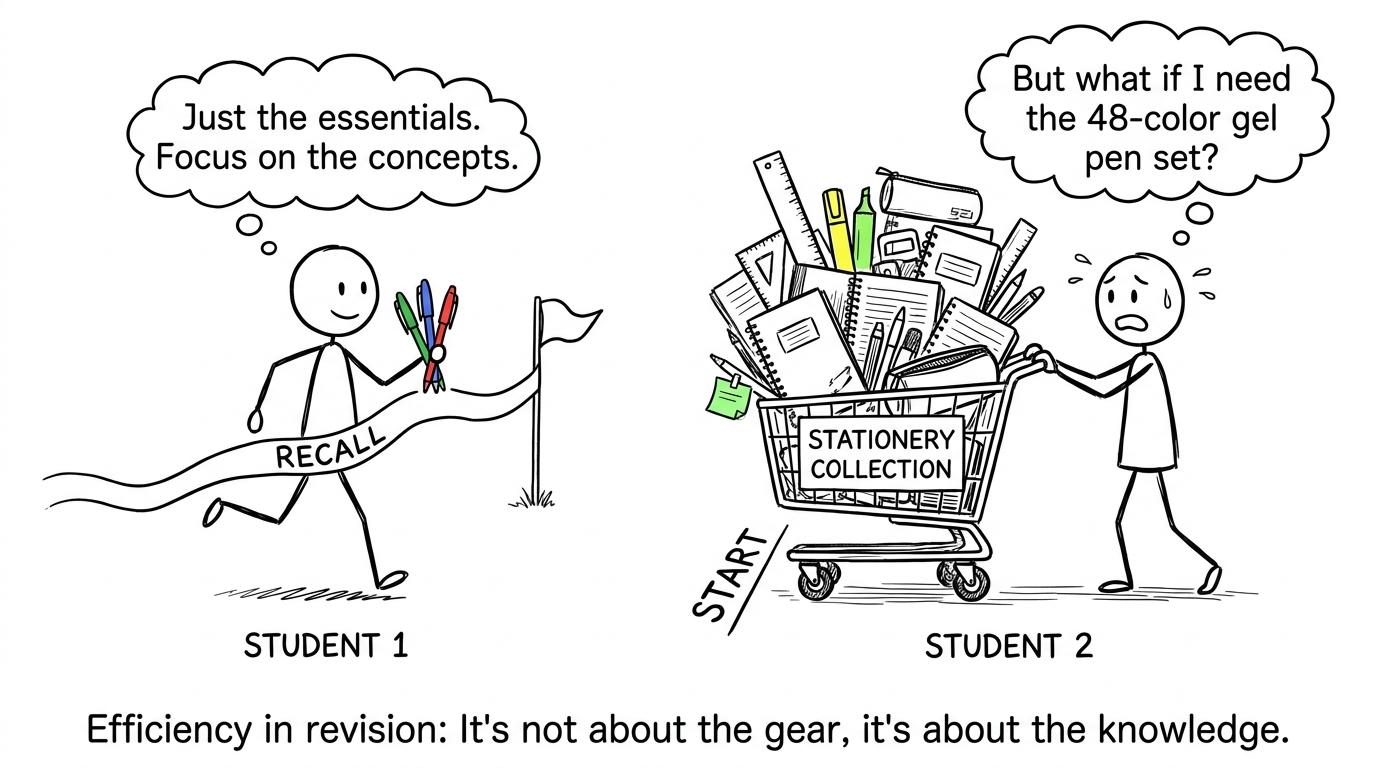 A light revision kit reaches the recall finish line while a stationery trolley gets stuck
Common colour-coding mistakes
Highlighting nearly everything
When most of a page is coloured, nothing receives priority. Highlight only information that belongs to your chosen system.
Inventing too many categories
A complicated key consumes attention. If you regularly forget what a colour means, simplify it.
Colouring before understanding
Highlighting unfamiliar material can disguise confusion. First explain the idea, word or rule in your own terms. Then classify it.
Mistaking recognition for recall
Recognising an answer after uncovering it does not prove you could have produced it. Say it, write it or apply it before checking.
Depending on visual cues that disappear in the exam
GCSE papers will not reproduce your notebook's colour scheme. Include regular black-and-white or plain-paper testing so that knowledge becomes independent of the cue.
Spending longer formatting than practising
A useful test is whether the system increases the number or quality of retrieval attempts. If an hour produces one polished page but no self-testing, the balance is wrong.
Never changing the status of material
A red item should not remain red forever without action, and a green item should not be permanently exempt from checking. Update colours according to evidence from later tests.
Colour should be a tool, not the task
Colour-coding GCSE Arabic notes is not pointless, nor is it a shortcut to recall. Used sparingly, it can guide attention, organise language and show what needs another attempt. Used passively, it can become a pleasing substitute for the harder work of remembering.
The best revision systems eventually remove their own support. You organise the page, retrieve without it, check accurately and return after a gap. Then you practise under conditions closer to the exam.
Apply that same discipline to maths with MathsGenie. Start with free revision lessons, move into focused practice questions, use mini tests to expose gaps, and build towards past papers and predicted papers. Check your work with mark schemes and video solutions, then let each mistake choose your next task. Your notes can be colourful. Your evidence of progress should be what you can do when the colours are gone.