Can AI Tools Revise GCSE Chemistry Safely?
AI tools to revise GCSE Chemistry can quiz, explain and plan. Learn where ChatGPT helps, where it fails, and how to verify every answer safely for exams.
Revision sometimes begins with a small moment of friction. You meet a confusing paragraph about electrolysis, open another tab for help, and suddenly ChatGPT is offering to explain the entire topic in seconds.
So, can AI tools revise GCSE Chemistry with you effectively? Yes, when you use them to generate questions, simplify explanations, organise revision and reveal gaps in your understanding. But they should not replace your specification, teacher, trusted revision resources, mark schemes or your own practice. AI can produce convincing scientific errors, overlook exam-board differences and make difficult work feel completed when you have only read its answer.
The useful distinction is simple: treat AI as a revision assistant, not as the source of truth.
A quick checklist for safe AI chemistry revision
Before accepting any AI-generated response, ask:
- Does it match my exam board: AQA, Edexcel, OCR or Eduqas?
- Is it appropriate for Combined Science or separate Chemistry?
- Is the topic on my current specification?
- Can I verify the explanation using a trusted lesson, textbook or mark scheme?
- Have I answered a question myself rather than merely reading an answer?
- Has the AI included correct chemical formulae, units and state symbols?
- Would my teacher recognise the terminology as GCSE-appropriate?
Begin with your board-specific resources. For example, students following AQA can use the AQA GCSE Chemistry revision hub for structured lessons, exam-style questions and papers. AI should sit around that reliable material, not above it.
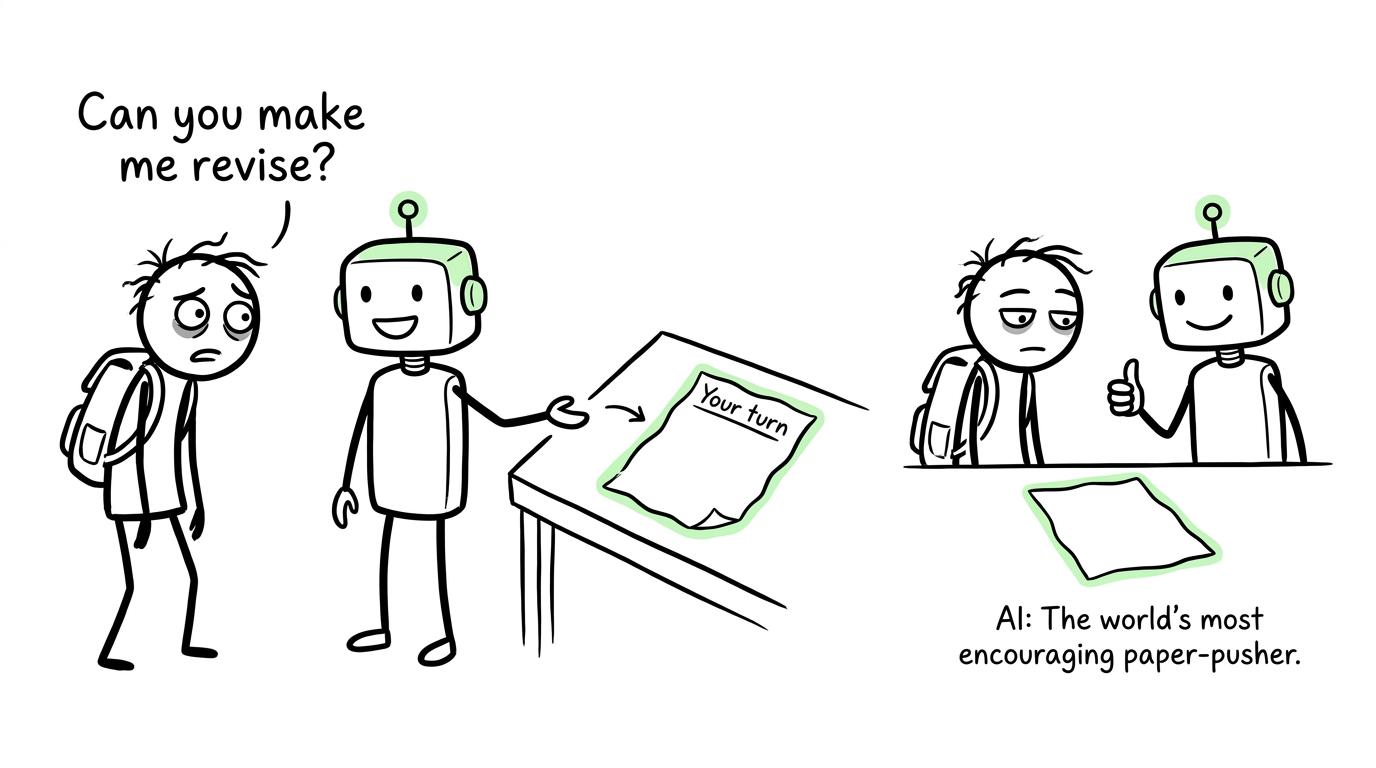 A GCSE student discovers that an AI revision coach cannot do the practice paper for them
Where AI tools can genuinely help
The best uses of ChatGPT and similar tools are interactive. Instead of asking the AI to produce finished notes, ask it to make you think.
Turning a specification point into questions
A specification can feel like a list of statements until each statement becomes something you must retrieve from memory. You can paste one short, non-copyrighted topic description into an AI tool and ask it to create a sequence of GCSE questions.
A useful prompt might be:
Ask me five short GCSE questions about rates of reaction, one at a time. Do not reveal the answer until I respond. After each response, tell me what is missing, but ask me to correct it myself.
This creates retrieval practice rather than passive reading. Ask for a mixture of recall, application and practical-method questions. Specify your board, tier and whether you take Combined Science or separate Chemistry.
The final check must still come from board-aligned material. AI-generated questions may test content outside your course or phrase a question differently from a real paper.
Explaining one difficult idea in different ways
AI can be helpful when the first explanation does not land. You might ask for:
- a concise GCSE-level explanation;
- a cause-and-effect chain;
- a comparison between two easily confused ideas;
- a list of vocabulary you must use accurately;
- questions that diagnose the exact point of confusion.
For instance, rather than requesting “all of electrolysis”, identify the obstacle: why ions move, why products differ in aqueous solutions, or how half-equations represent electron transfer. Narrow prompts tend to produce more useful revision conversations.
However, “simpler” must not become “less accurate”. Verify definitions and rules against your course materials before learning them.
Improving answers you have already written
AI is more valuable after an attempt than before one. Write an answer without help, then ask the tool to identify unclear reasoning, missing links or imprecise scientific language.
Do not ask it to award an official mark. Generative AI does not possess your examiner's judgement and may invent marking requirements. Compare your work with the actual mark scheme and, where possible, ask your teacher about extended responses.
The revision loop in GCSE Chemistry revision without wasting time is a dependable foundation: attempt, mark, diagnose and correct. AI may support the diagnosis, but the mark scheme remains the authority.
Planning revision around weaknesses
An AI tool can turn a genuine error log into a manageable plan. Give it topic names and error categories, not personal information. Useful categories include:
- knowledge gap;
- application gap;
- practical-method gap;
- exam-language gap;
- calculation or units gap.
Ask it to organise short sessions that alternate recall with questions. Then choose the actual resources yourself. If your progress has stalled, the advice in GCSE Chemistry revision when you are stuck on a pass can help you focus on the type of mistake costing marks.
How AI can support chemistry calculations
Chemistry contains substantial mathematical thinking. Depending on your specification and tier, you may meet relationships involving moles, concentration, percentage yield, atom economy, rates, gradients and standard form. Examples of important structures include:
n=mMr n=\frac{m}{M_r} n=Mrmand
c=nV c=\frac{n}{V} c=VnAI can help by asking which quantity is required, checking whether you have converted units, or generating a checklist for interpreting a graph. It can also explain why a balanced equation supplies a reacting ratio.
What it should not do is become an answer machine. AI tools can substitute into the wrong relationship, mishandle units or continue confidently from an incorrect chemical equation. If you copy the final number, you lose the chance to notice the flaw.
Use the GCSE Maths revision hub to strengthen the underlying skills, including ratio, percentages, rearranging formulae, graphs and standard form. The guide to GCSE maths topics by exam board and tier can help you locate the relevant skill.
A safer AI prompt is:
Do not calculate the answer. Ask me which formula, conversion and units I need, then check each decision after I make it.
That preserves the thinking which earns marks.
Where ChatGPT and other AI tools lead students astray
Plausible answers can still be false
Generative AI predicts a response; it does not guarantee scientific truth. The Department for Education warns that generated content may be inaccurate, biased, out of date or taken out of context. AI systems can also “hallucinate”, producing invented information in fluent, confident language.
In Chemistry, this might appear as an incorrect ion charge, an impossible reaction, a fabricated source or an explanation with its cause and effect reversed. Asking, “Are you sure?” is not reliable verification because the same system may repeat or reshape its mistake.
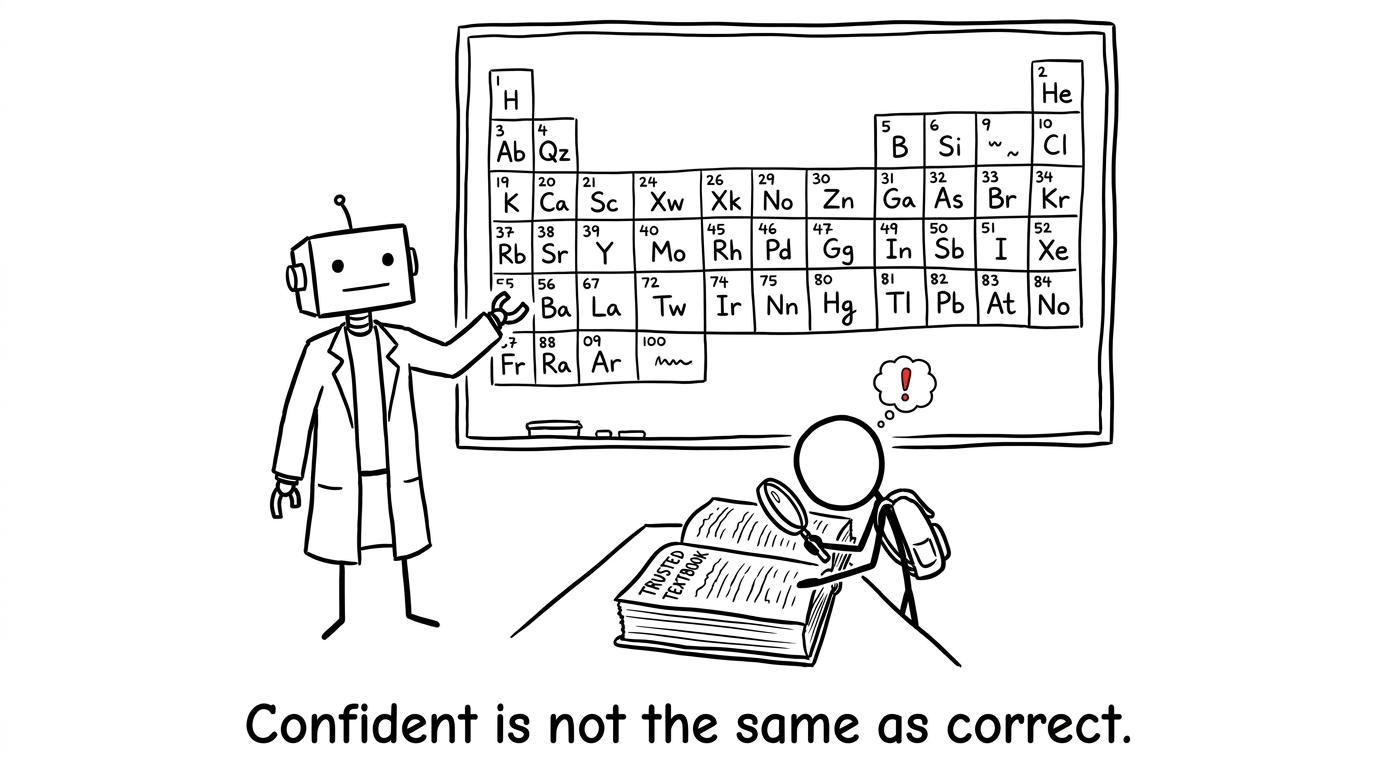 A student checks a confident robot's invented chemistry claim rather than trusting it
It may teach the wrong specification
A scientifically valid fact is not automatically useful GCSE revision. AI may mix GCSE with A Level content, draw on an international course or ignore the distinction between Combined Science and separate Chemistry.
This often creates unnecessary complexity. Students can spend time learning an advanced detail while neglecting the precise explanation their specification requires. Always tell the tool your board and course, then verify its coverage independently.
It cannot reproduce examiner judgement reliably
Mark schemes reward specific knowledge applied to the question. Some answers allow alternatives; others require linked reasoning, calculations, practical details or conclusions based on supplied data.
An AI-generated mark scheme is not an official mark scheme. Nor should an estimated grade be treated as dependable. Real papers provide the better test. Use guidance on when to start GCSE past papers to introduce timed work at an appropriate stage.
It can create an illusion of progress
A polished explanation feels productive because it removes confusion quickly. But recognition is not recall. Understanding an answer while it is visible does not prove that you can produce it under exam conditions.
Close the chat. Write what you remember. Attempt an unfamiliar question. Mark it. If the idea survives without the AI, it is becoming yours.
A safe revision routine using AI
Use this sequence whenever you include an AI tool in a session:
Start from trusted content
Choose one specification point or MathsGenie lesson. Learn only enough to begin answering questions.
Attempt without assistance
Complete a short set of questions from memory. For calculations, show formulae, substitutions, conversions and units clearly.
Mark with an authoritative source
Use the supplied mark scheme or video solution. Record the first reason each answer lost a mark.
Ask AI to diagnose, not replace
Ask for a simpler explanation, a comparison, or fresh questions on the weak idea. Do not let it rewrite the entire answer for you.
Verify and retest
Check every scientific claim against your specification or trusted revision material. Then answer again without the chat open.
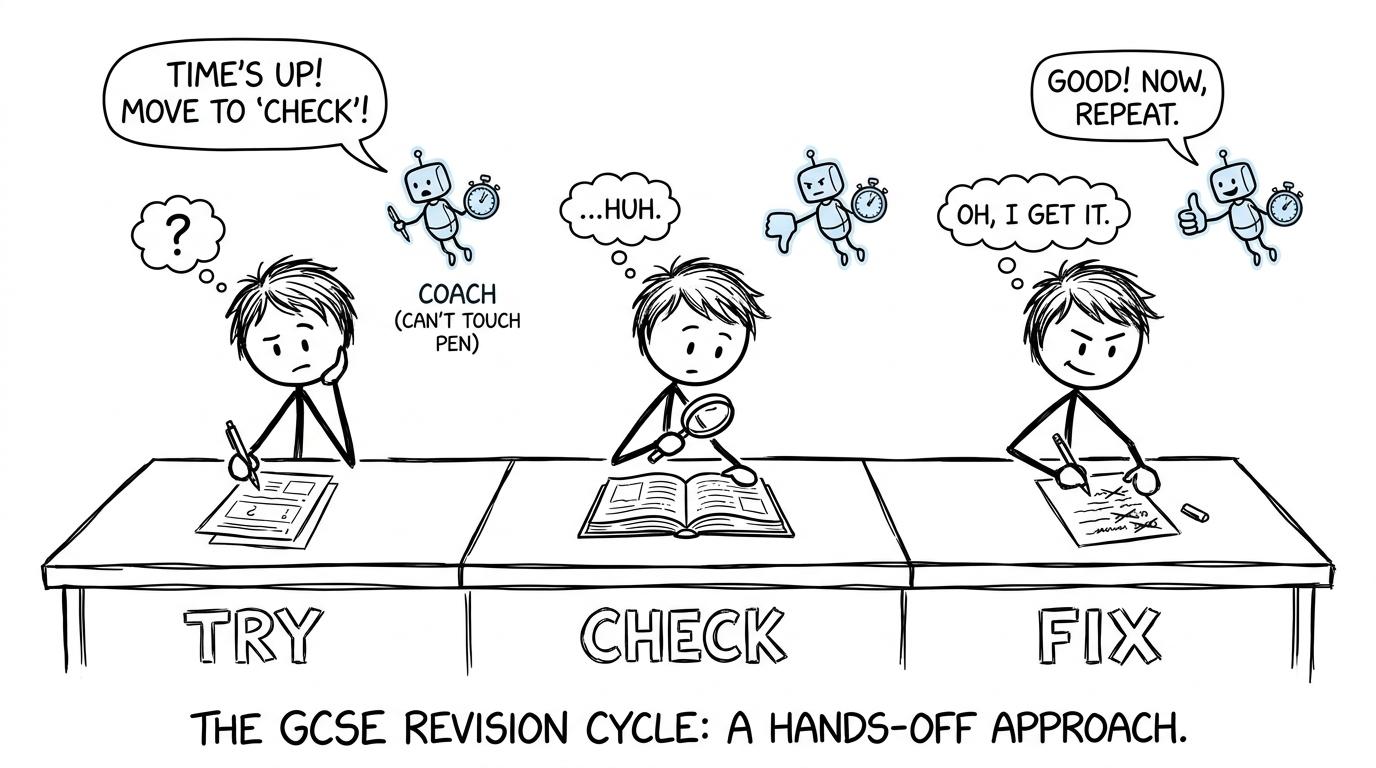 A student follows a Try, Check and Fix revision loop while an AI robot remains only a coach
This routine also works near the examination, although AI use should become less prominent as you move towards realistic timed practice. The GCSE Chemistry exam-week checklist explains how to combine paper practice, marking and focused corrections.
Rules for AI use in assessments
AI tools cannot be used during an examination. For coursework, non-exam assessment or any work submitted for formal assessment, follow your teacher's instructions and the current rules from the Joint Council for Qualifications.
JCQ guidance requires submitted assessment work to be the student's own. Using AI-generated material without proper acknowledgement can constitute malpractice, with serious sanctions possible. Where AI use is permitted, students may need to identify the tool, record when it was used, explain how it contributed and retain the generated material. Requirements depend on the assessment, so ask your teacher before using AI.
Ordinary private revision is different from submitting generated work. Even then, protect your privacy: do not enter your full name, school details, login information, marked scripts containing personal data or information about another student.
Common mistakes when revising Chemistry with AI
Requesting complete notes: Long generated summaries encourage reading rather than retrieval. Ask for questions, prompts or a short explanation of one obstacle.
Trusting scientific vocabulary because it sounds formal: Check definitions, equations, ion charges and practical claims against reliable course materials.
Letting AI complete every calculation: Ask for hints or error checks while keeping the decision-making and arithmetic for yourself.
Ignoring the exam board: State AQA, Edexcel, OCR or Eduqas, plus Combined Science or separate Chemistry. Verify that the result matches the specification.
Using AI instead of past papers: Chat is flexible, but it cannot recreate an examiner's wording consistently. Past papers reveal whether your knowledge works under pressure.
Submitting generated writing as your own: This may breach assessment rules. Follow your school's policy and ask your teacher whenever the status of a task is unclear.
Make AI the smallest useful part of your system
The best revision tool is not necessarily the one that produces the fastest answer. It is the one that leaves you better able to answer the next question alone.
Use AI to quiz, clarify, organise and diagnose. Use MathsGenie for the dependable structure: board-focused revision lessons, practice questions, mark schemes, video solutions and past papers. Alongside Chemistry, use mini tests and free GCSE maths revision resources to secure the calculations that appear across science papers. Near your maths exams, add predicted papers to test how well those skills hold together.
Start with one weak Chemistry topic today. Attempt questions first, check them properly, and invite AI into the process only when you can name the exact help you need. That is how a convenient tool becomes a useful one, without being allowed to do the learning for you.