Home Schooled GCSE Arabic: How to Sit the Exam
Home schooled GCSE Arabic explained: find a private exam centre, arrange the speaking test, meet entry deadlines and plan revision with confidence.
The difficult part is not always learning the language. Sometimes it is discovering who will let you sit the exam.
For families researching home schooled GCSE Arabic, the short answer is yes: a home-educated student can sit GCSE Arabic in the UK as a private candidate. However, the entry must be made through an approved school, college or examination centre. You cannot book the GCSE directly with the exam board.
The practical challenge is finding a centre that accepts private candidates for the exact Arabic specification and can conduct the compulsory speaking assessment. Start early, confirm everything in writing and do not begin a course until you know which qualification your centre can offer.
Your GCSE Arabic entry checklist
Use this as your starting plan:
- Identify the exact qualification and specification code.
- Find an approved centre accepting private candidates.
- Confirm that the centre can conduct the Arabic speaking assessment.
- Ask about its internal deadline, total fees and refund policy.
- Decide between foundation and higher tier with suitable guidance.
- Raise access-arrangement requirements immediately.
- Submit identification, candidate details and payment.
- Check the statement of entry when it arrives.
- Record the speaking date and written-paper dates.
- Build Arabic and maths revision into one realistic timetable.
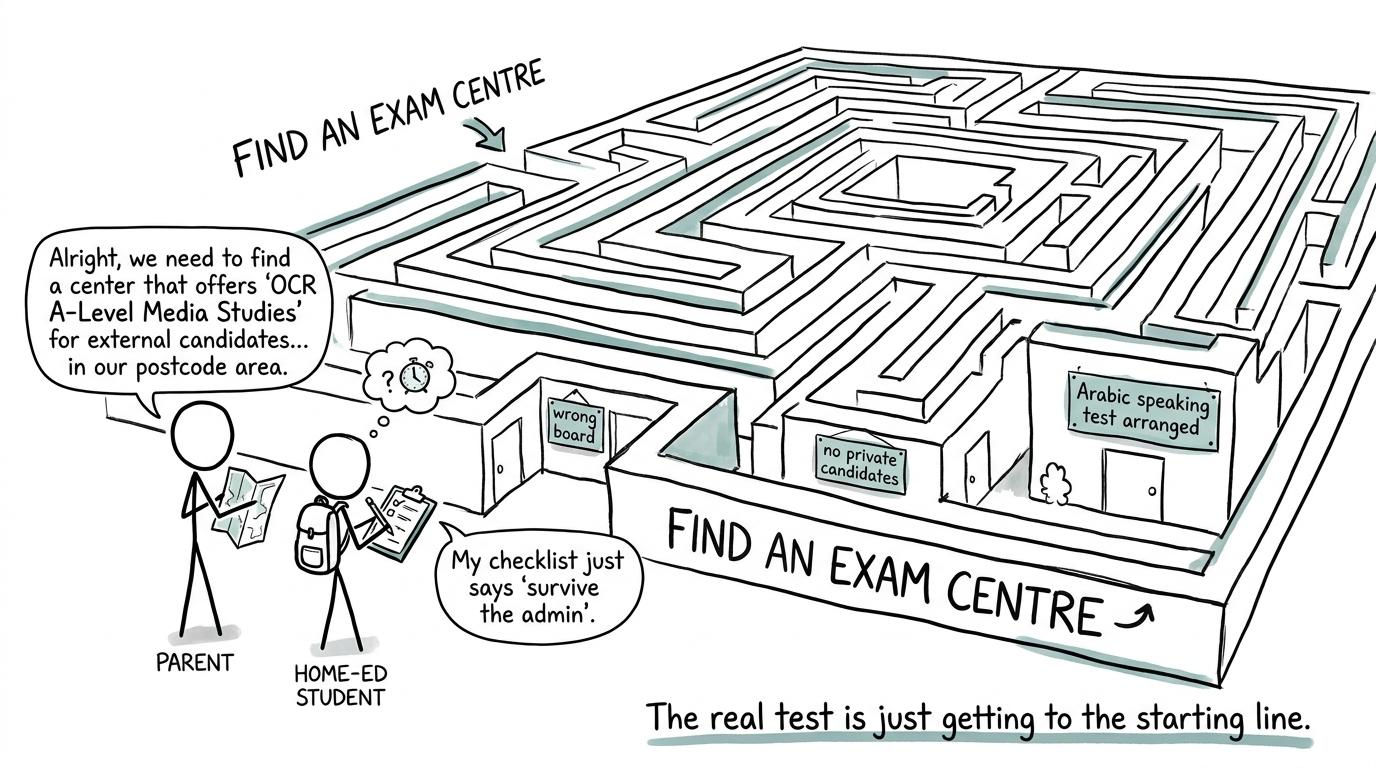 A student navigating the maze of finding an Arabic exam centre
Which GCSE Arabic qualification should you ask for?
The current Pearson Edexcel GCSE Arabic qualification is specification 1AA0. Pearson's information for the June 2027 series lists both foundation and higher entries for private candidates.
This is a GCSE graded on the grades 9-1 scale. It is not automatically the same as an International GCSE in Arabic, an Arabic first-language qualification or a course focused on classical or Quranic Arabic. Those qualifications can have different content, papers and administrative requirements.
Before buying textbooks or arranging tuition, ask a prospective centre:
Do you accept private candidates for Pearson Edexcel GCSE Arabic, specification 1AA0, in the examination series I need?
That level of precision matters. A centre may offer Pearson qualifications without offering Arabic. It may accept private candidates for written papers but lack the staff or facilities needed for a language speaking assessment.
There is also no requirement for your Arabic and maths qualifications to use the same exam board. Your maths papers might be Edexcel, AQA, OCR or Eduqas while your Arabic entry is Pearson Edexcel. What matters is following the correct specification for each subject.
What does Edexcel GCSE Arabic involve?
The qualification assesses four skills:
- listening and understanding in Arabic;
- speaking in Arabic;
- reading and understanding in Arabic;
- writing in Arabic.
Each paper contributes 25%25\%25% of the qualification. All four assessments must be completed at the same tier: foundation or higher. Mixed-tier entry is not permitted, so the centre must enter the candidate for one tier across every paper before the relevant deadline.
The speaking paper is particularly important for a private candidate. It is conducted face to face by a suitable teacher at the centre, recorded and sent to Pearson for external marking. It includes a role play, a picture-based task and a conversation. It cannot simply be completed at home with a parent or tutor.
That is why the first question to a centre should not merely be, “Can I sit Arabic there?” Ask how it will provide the speaking assessment, who will conduct it and whether the quoted fee includes it.
How to find a private GCSE Arabic exam centre
An exam board accepts entries from approved centres, not directly from families. Your task is therefore to find a centre willing to make the entry and run every required assessment.
JCQ maintains a private-candidate centre search facility. Use it as a starting point, then contact each centre directly because availability, subjects and policies can change. Local independent schools, tutorial colleges, specialist private-candidate centres and some state schools may also be worth approaching.
Contact several centres rather than waiting for one reply at a time. Speaking assessments require more organisation than ordinary written papers, and a centre that accepts private maths candidates may still decline GCSE Arabic.
What to include in your first message
Give the examinations officer enough information to answer properly:
- candidate's full name, date of birth and postcode;
- Pearson Edexcel GCSE Arabic;
- specification code 1AA0;
- intended examination series;
- likely foundation or higher tier;
- private-candidate status;
- any access-arrangement requirements;
- whether the candidate already has a Unique Candidate Identifier;
- a request for the full fee and internal deadline.
Ask whether identification must be shown when registering or on examination days. You should also confirm how results and certificates will be collected and what post-results services the centre offers.
GCSE Arabic entry deadlines for home-schooled students
For UK centres, Pearson's published standard entry deadline for the June 2027 GCSE series is 21 February 2027. Late fees begin from 22 February 2027.
But this is the exam board's deadline for centres. It is not a safe deadline for families.
Every centre can set an earlier internal cut-off so that it has time to verify identification, collect payment, arrange staff and process entries. Some centres also stop accepting candidates when capacity is full. Contacting centres during the autumn before the examination summer is far safer than waiting until February.
For the June 2027 series, Pearson has published a GCSE Arabic speaking window running from 15 April to 20 May 2027. The centre chooses the candidate's appointment within that window and manages the recording and submission.
Dates can change between examination series. Treat the current dates as planning information, then verify them with your chosen centre before making travel or tuition arrangements.
What will it cost?
There is no single national private-candidate price. The total can include:
- the awarding-body entry fee;
- centre administration and invigilation;
- organisation of the speaking assessment;
- late-entry charges where applicable;
- access-arrangement assessment or administration;
- certificate postage or other centre services.
Consequently, quotations can differ substantially. Ask for an itemised total and check whether the Arabic speaking assessment is included. A low written-paper price is not useful if the centre cannot provide the oral component.
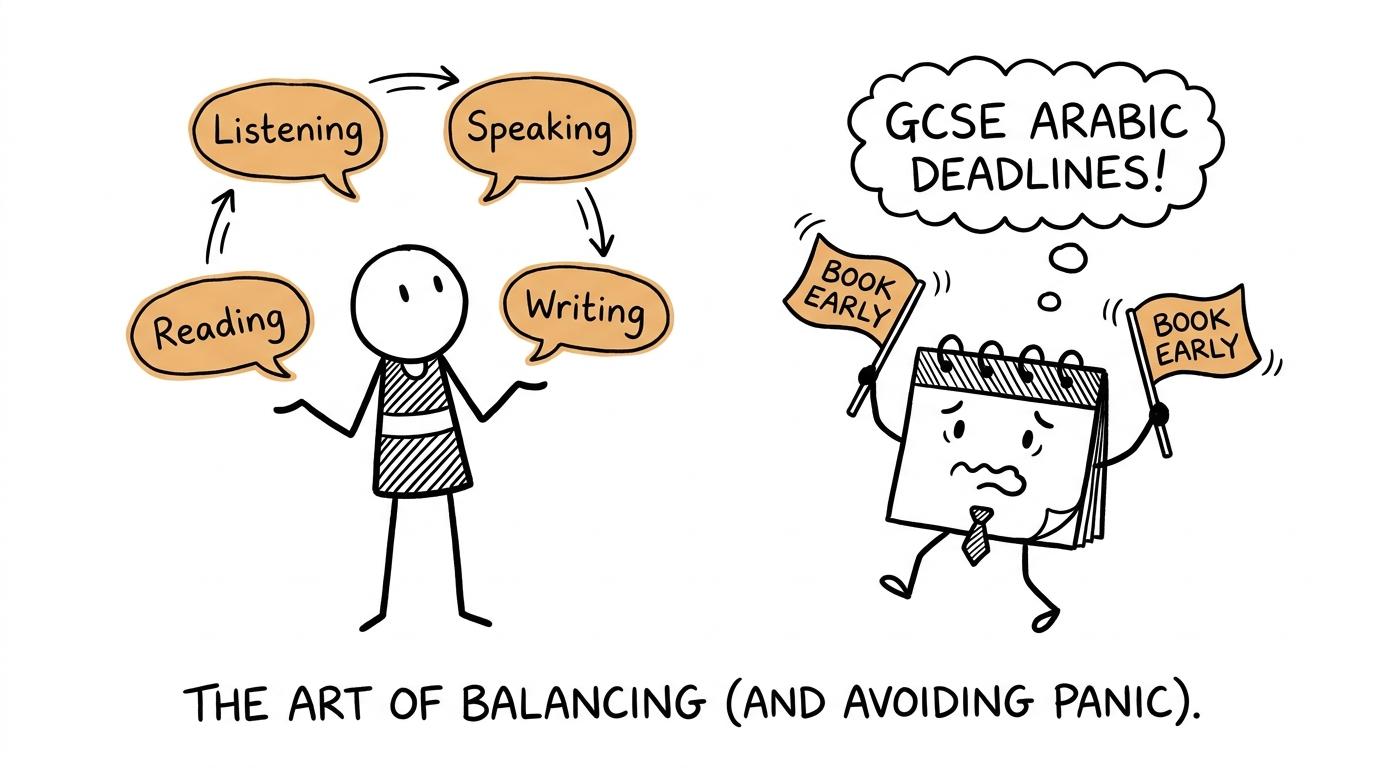 A student balancing the four GCSE Arabic skills while a calendar urges early booking
Registering after you find a centre
Once a centre agrees to accept the candidate, it will normally provide an application form and payment instructions. Complete these carefully and retain copies of emails and receipts.
The centre may request proof of identity, previous candidate information and details of access arrangements. If the student needs extra time, modified papers or another reasonable adjustment, raise this during the first conversation. The centre needs time to assess the evidence and complete the formal process before the applicable deadline.
After entry, request or wait for the statement of entry. Check:
- spelling of the candidate's legal name;
- date of birth;
- qualification and specification;
- foundation or higher tier;
- centre and candidate numbers;
- paper dates and times;
- speaking-assessment arrangements.
An incorrect tier or subject code is easier to resolve when it is noticed early.
Planning Arabic alongside GCSE maths revision
Administrative uncertainty consumes attention. Once the centre, payment and speaking appointment are settled, revision becomes much easier to organise.
Put every known examination commitment into one calendar. Then build a weekly plan that includes short Arabic listening, speaking, reading and writing sessions alongside maths. The GCSE maths revision timetable guide can help you create a schedule that leaves room for both subjects without turning every evening into a marathon.
For maths, begin with the GCSE maths revision hub, where you can choose your exam board and work through revision lessons, worksheets and practice questions. If time is limited, the 20-minute GCSE maths revision routine offers a manageable structure for busy days.
Use MathsGenie self-assessments and revision resources to identify weak topics instead of revising only familiar material. As the exams approach, move into timed work. The guide to when to start GCSE past papers explains how to progress from short tests to complete papers.
If you take Edexcel maths, the Edexcel GCSE maths past papers place papers, mark schemes and solutions together. The one-month GCSE maths revision plan is also useful when Arabic speaking preparation begins competing for time in spring.
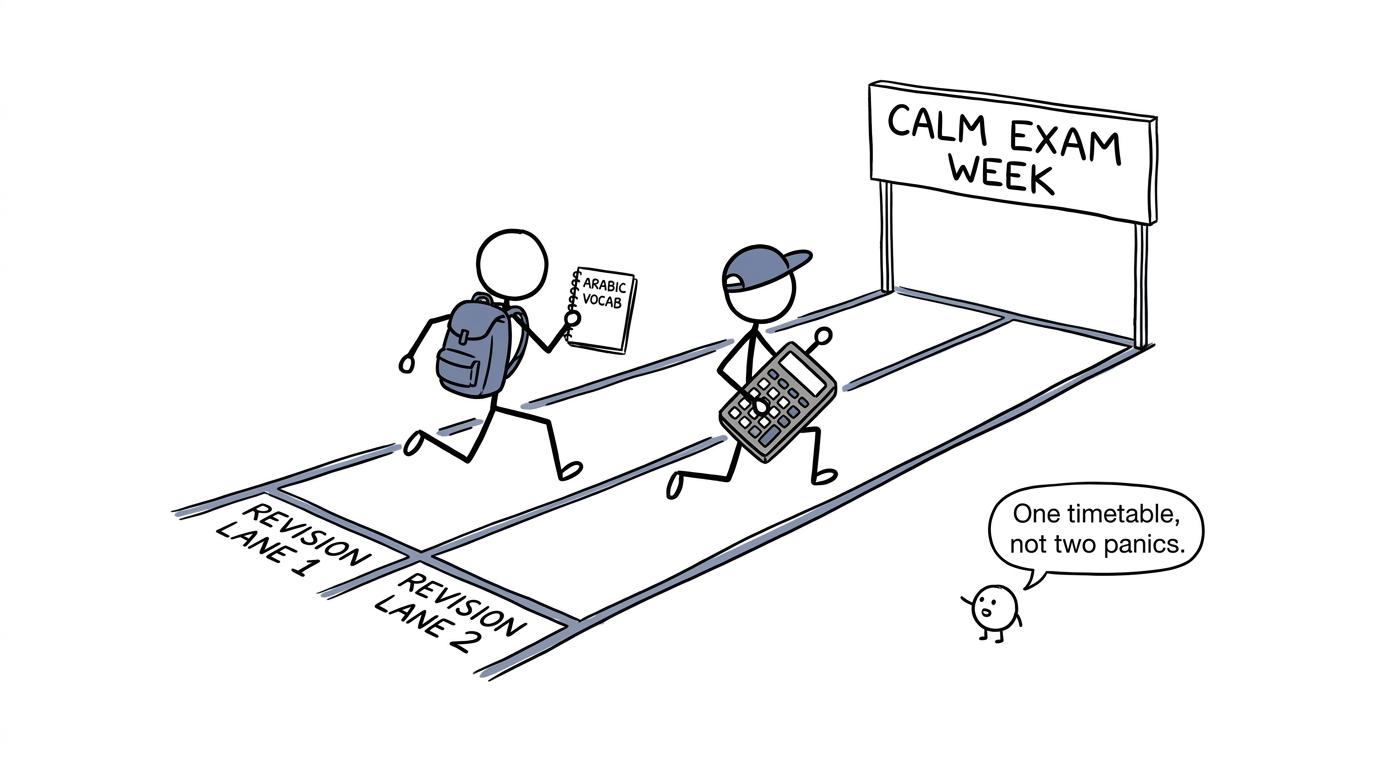 Arabic and maths revision runners following one calm timetable
Common mistakes to avoid
Assuming any Pearson centre can offer Arabic
Approval for an exam board does not mean a centre accepts every subject or private candidate. Confirm specification 1AA0 and the speaking assessment explicitly.
Confusing GCSE Arabic with International GCSE Arabic
The titles sound similar, but their content and assessment arrangements may differ. Check the full qualification title and code before starting revision.
Waiting for the awarding-body deadline
A centre's internal deadline may be weeks or months earlier. Places can also fill before either deadline.
Booking written papers without confirming speaking
Speaking is a compulsory part of GCSE Arabic. A valid plan must cover all four papers at one centre-approved tier.
Choosing a tier based only on conversational confidence
Speaking Arabic at home can be a strength, but the examination also assesses listening, reading, formal writing, grammar and specification vocabulary. Review the complete course before deciding between foundation and higher.
Mentioning access arrangements too late
Private candidates should discuss required support when first applying. Formal evidence, assessment and approval take time.
Letting one subject crowd out maths
Arabic speaking practice can become urgent in spring, just as maths paper practice should be increasing. A shared revision calendar protects both subjects.
Take the next step calmly
A home-educated student can sit GCSE Arabic, but the route runs through an approved private-candidate centre. Identify Pearson Edexcel specification 1AA0, confirm that the centre can conduct the speaking assessment, ask for its own deadline and total fee, then check the statement of entry carefully.
Once those arrangements are secure, let revision become ordinary and repeatable. Use MathsGenie's free revision lessons and practice questions to strengthen individual maths topics, mini tests to expose gaps, and past papers or predicted papers to build examination stamina. Mark schemes and video solutions then turn each lost mark into a clear next action.
The paperwork should be handled early. Your attention belongs to the learning.