A-Level After GCSE Maths: What Should You Choose?
A-level after GCSE maths: compare Maths, Further Maths and related subjects, check typical grade thresholds, and make a confident sixth-form choice.
Results Day can make one grade feel unusually powerful. You open the envelope, find your GCSE Maths result and immediately wonder what it permits, what it rules out and what you should do next.
The short answer is this: when choosing an A-level after GCSE maths, consider A-Level Maths if you enjoy algebra and problem-solving, Further Maths if you want a deeper mathematical challenge, or a related subject such as Physics, Economics or Computer Science if you want to apply quantitative thinking. Your result matters, but so do your algebraic fluency, interest and sixth form's entry requirements.
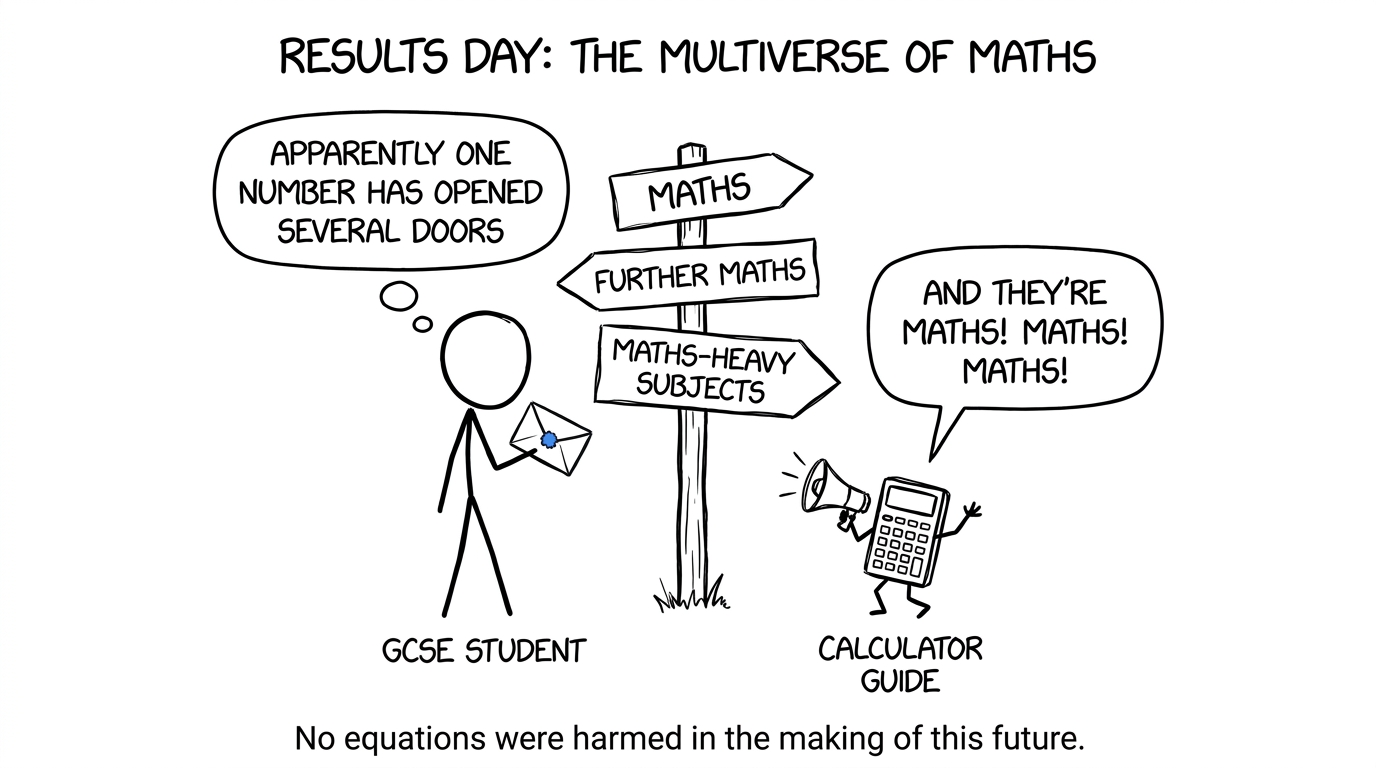 A student discovers that one GCSE result can open several sixth-form paths
Your Results Day decision checklist
Before changing or confirming your options, ask:
- Have I met my sixth form's published entry requirement?
- Did I enjoy higher-tier algebra, graphs and trigonometry?
- Am I willing to practise maths regularly rather than only before tests?
- Will Maths support a degree or career I may want later?
- Have I looked at the actual course rather than judging it from GCSE alone?
- Do my three A-Level choices form a manageable combination?
There is no universal GCSE threshold for A-Level Maths. Entry requirements are set by individual schools and colleges, so always check your provider's current prospectus and speak to its maths department.
Typical grade thresholds for maths-related A-Levels
Many sixth forms ask for a GCSE Maths grade of around 777 for A-Level Maths and around 888 for Further Maths. Some accept grade 666 for Maths, perhaps with additional guidance or an entry assessment. These are common patterns, not national rules.
| GCSE Maths result | Decision guidance |
|---|---|
| Grade 888 or 999 | You are likely to meet many providers' requirements for Maths and Further Maths, but check locally. |
| Grade 777 | A-Level Maths is commonly available. Some providers may consider Further Maths, while others require grade 888. |
| Grade 666 | Some sixth forms accept this for A-Level Maths; ask about support, summer work or an assessment. |
| Grade 555 or below | Full A-Level Maths is less commonly offered. Explore related subjects, Core Maths where available, or another route advised by your provider. |
A threshold tells you whether you may start. It does not tell you whether you will enjoy the course. A student with grade 999 who dislikes sustained algebra may be less suited than a grade 777 student who is curious, resilient and prepared to practise.
What is the GCSE maths to A-Level jump really like?
Official A-Level specifications build on the full GCSE Mathematics content. That is why the transition can feel steep: GCSE knowledge is not discarded, but assumed.
A-Level Maths contains three broad areas:
- Pure mathematics, including proof, algebra, functions, trigonometry, exponentials, logarithms and calculus
- Statistics, including probability, distributions and hypothesis testing
- Mechanics, including motion, forces and mathematical modelling
The required subject content is broadly common across English exam boards, although paper structures and teaching sequences differ. Your school may use Edexcel, AQA or OCR; Eduqas and other awarding organisations may be relevant depending on where you study.
Explore the free A-Level Maths overview to see the course before committing. You can also compare the journey in GCSE to A-Level: AS vs A-Level Curriculum.
The best readiness test is algebra
Calculus is new, but algebra is often what makes it manageable. Rearranging formulae, factorising, using indices, simplifying surds and interpreting graphs all return in more demanding forms.
Before September, use the GCSE Maths revision hub or the AQA GCSE revision guides to repair gaps. Your own exam board may differ, but the underlying skills remain useful.
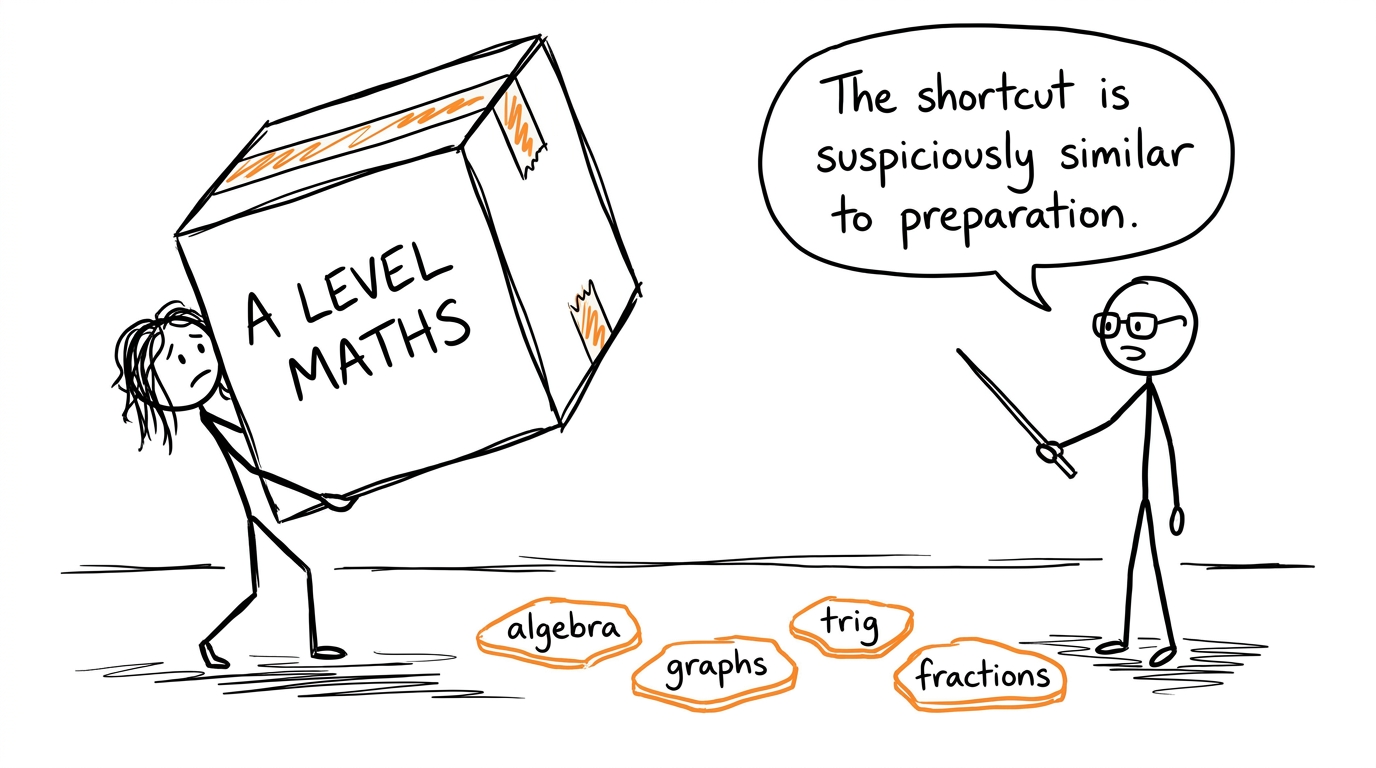 A student learns that preparation is the real shortcut into A-Level Maths
Choosing A-Level Maths, Further Maths or a related subject
Choose A-Level Maths if...
You enjoy questions that require several connected steps, want to understand why methods work and are comfortable spending significant time on algebra. It is particularly useful preparation for mathematically demanding routes such as engineering, physics, computer science, economics and mathematics, although university requirements vary.
Preview Edexcel A-Level Maths revision to see the balance of pure mathematics, statistics and mechanics.
Consider Further Maths if...
You are highly confident at GCSE, actively enjoy unfamiliar problems and want mathematics to be a major part of sixth-form life. Further Maths is normally studied alongside A-Level Maths, not instead of it. Availability and whether it is taken as a third or fourth subject depend on the provider.
Do not choose it simply because your grade permits it. Choose it because extra mathematics sounds interesting.
Consider a related A-Level if...
You like using maths more than studying it as a subject. Physics applies mathematical models to the physical world; Economics uses graphs, data and quantitative reasoning; Computer Science develops logical and algorithmic thinking. Chemistry, Biology, Psychology and Geography can also contain meaningful numerical work.
Entry requirements vary considerably. In particular, some providers require students taking Physics to study A-Level Maths alongside it, while others do not. Check the exact subject combination before enrolling.
Core Maths may also be available as a Level 333 qualification for students who want to continue practical mathematics without taking the full A-Level. It is not the same qualification as A-Level Maths.
How to make the final choice calmly
First, separate eligibility from suitability. Confirm the grade requirement, then inspect the course content and workload. Ask the department which exam board it teaches, how Further Maths is timetabled and what bridging work is expected.
Next, sample the material. A short look at OCR A-Level Maths revision guides or the Edexcel topic pages reveals more than a subject title ever can.
Finally, review your GCSE evidence. Mark a paper carefully and classify mistakes as knowledge gaps, algebra slips or time-pressure errors. The guide to using GCSE past papers properly explains how to turn each lost mark into a specific revision action.
Common mistakes when choosing A-Level Maths
- Assuming a high grade guarantees an easy course. A-Level questions demand sustained reasoning and regular practice.
- Treating grade thresholds as universal. Every sixth form or college can set its own requirements.
- Ignoring weaker GCSE topics. Fractions, indices, surds, graphs and algebraic manipulation become foundations rather than isolated chapters.
- Choosing Further Maths for status. Interest and workload matter more than how impressive the option sounds.
- Selecting subjects separately. Consider the combined workload and any university course requirements you may later face.
- Waiting until September to prepare. Light, focused revision is more useful than trying to relearn the whole GCSE course at once.
Turn your result into a starting point
Results Day closes one chapter, but it does not write the next one for you. Your grade provides evidence. Your next decision should combine that evidence with curiosity, course requirements and an honest view of how you like to work.
Start by exploring MathsGenie's A-Level Maths overview. Then use revision lessons, practice questions, mark schemes, video solutions and past papers to preview the course. If GCSE exams are still ahead, strengthen your result with GCSE predicted papers, mini tests and structured topic revision. The aim is not merely to qualify for your next course, but it is to arrive ready for it.