Active Recall for GCSE Chemistry: Does It Work?
Active recall GCSE Chemistry methods explained: learn how self-testing, feedback and spaced practice can strengthen memory and improve revision.
Revision can feel productive without producing much learning. You read a page on electrolysis, highlight three sentences and recognise every diagram. Then you close the book and the explanation disappears.
That gap between recognition and recall matters. Active recall GCSE Chemistry revision works by making you retrieve knowledge without looking at the answer first. Research on retrieval practice generally finds that this is more effective for long-term learning than simply rereading material. It is not a guaranteed route to a particular grade, but it is one of the better-supported ways to make revision stick.
The practical answer is simple: close the notes, answer a carefully chosen question, check your response, correct it and return to it later. For Chemistry, that means recalling facts, explaining processes, reconstructing practical methods and selecting equations, not only flipping through flashcards.
The active recall checklist
A useful GCSE Chemistry routine should include:
- questions based on your own exam board specification
- an attempt made without notes
- a mixture of facts, explanations, calculations and practical knowledge
- immediate checking against accurate material
- written corrections for errors and misconceptions
- another attempt after a delay
- regular exam-style questions to test application
The important word is attempt. If the answer is visible while you are thinking, you may be recognising it rather than retrieving it.
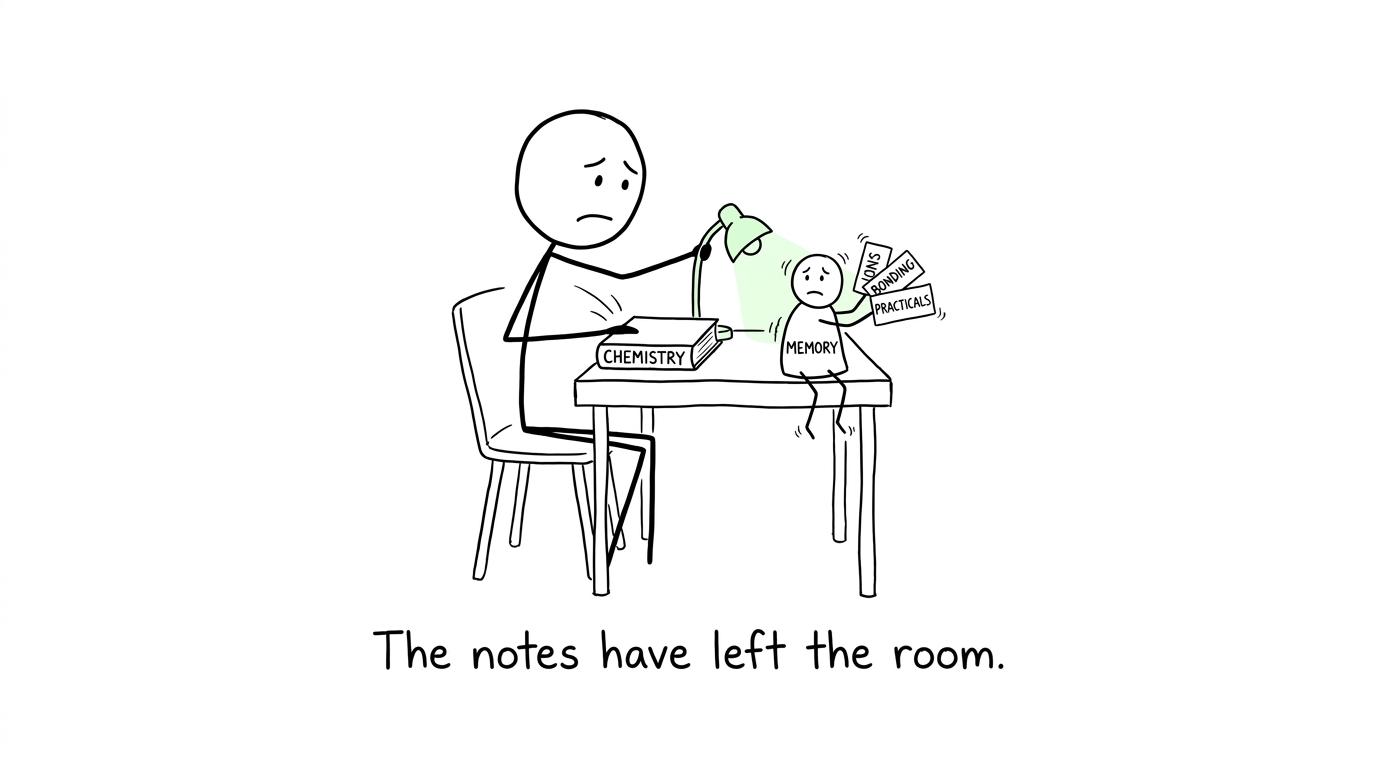 A student's memory is questioned after the chemistry notes leave the room
What active recall actually means
Active recall, often discussed in research as retrieval practice, is the deliberate effort to bring previously learnt information back from memory. A blank-page summary, a closed-book quiz and an exam question can all count. Copying a model answer does not.
A major systematic review of retrieval practice in schools and classrooms examined 505050 experiments involving 5,3745{,}3745,374 learners. Of the reported effects, 57%57\%57% showed medium or large benefits. The findings covered different ages, subjects and test formats, although research evidence never guarantees that every technique will work equally well for every student or task.
The Education Endowment Foundation also describes low-stakes quizzes as a potentially useful and inexpensive way to strengthen memory. Its guidance highlights several conditions: retrieval should involve genuine effort, the difficulty should be manageable, feedback should be provided and knowledge should be recalled again after a delay.
This distinction matters. Active recall is not simply “doing lots of quizzes”. A quiz with no correction can preserve a misconception. A quiz that is impossibly difficult may produce guessing rather than useful retrieval. The method works best as a loop:
Retrieve, check, correct, space and retrieve again.
Why active recall tends to beat rereading
Rereading is not useless. You need to encounter and understand material before you can retrieve it. The problem is that repeated exposure creates familiarity, and familiarity can be mistaken for knowledge.
A paragraph about ionic bonding looks obvious while it is open. The real test is whether you can explain, without seeing the paragraph, why ionic compounds conduct electricity when molten but not when solid.
Active recall tends to improve revision in three ways.
It reveals what you cannot yet remember
Rereading often hides gaps because the page supplies every missing word. Closed-book retrieval makes those gaps visible. That can feel uncomfortable, but it gives you better information about what to revise next.
It practises the action required in an exam
In an examination, you must recover knowledge from memory and apply it to an unfamiliar question. Retrieval practice rehearses the first part of that process. Exam questions then develop the application, analysis and evaluation required across AQA, Edexcel, OCR and Eduqas specifications.
It makes feedback meaningful
An answer is more memorable when it corrects a specific failed attempt. Instead of passively seeing that an ion has a particular charge, you compare the correct charge with the one you actually recalled. The correction now has a purpose.
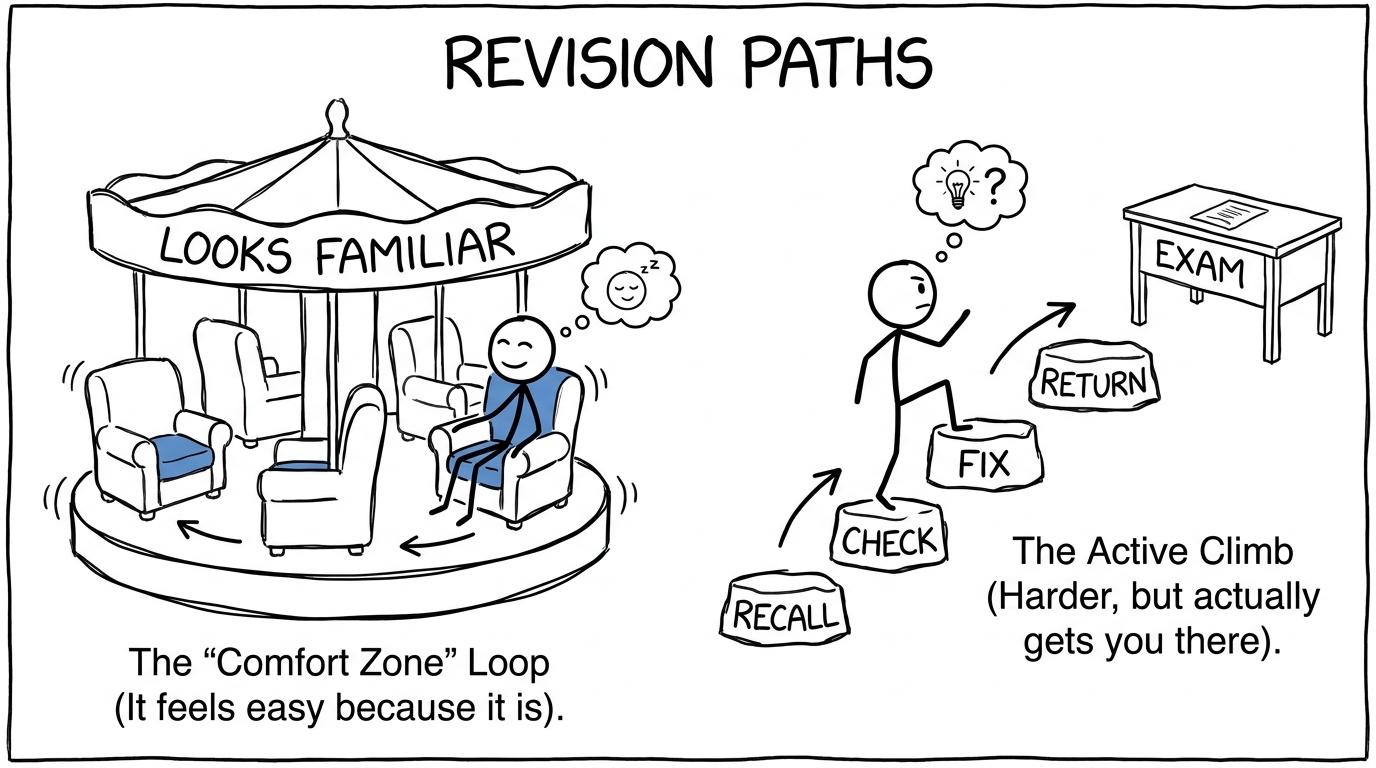 One student rereads in circles while another follows recall, check, fix and return
How to apply active recall to GCSE Chemistry
Chemistry contains several kinds of knowledge. Using only one revision method means some of them receive too little attention. Build retrieval tasks around the way the subject is assessed.
Recall precise chemical facts
Flashcards are useful for compact information such as:
- definitions of oxidation, reduction and isotopes
- ion charges and gas tests
- trends in the periodic table
- conditions used in industrial processes
- required observations and state symbols
Write prompts that require an answer rather than recognition. “What is the test for chlorine?” is stronger than a multiple-choice card where the correct option is obvious.
Keep cards small. A card asking for an entire topic encourages a vague response and makes checking difficult. Cards should also run in both directions where useful: recall a test from a gas, then identify the gas from an observation.
Reconstruct explanations from memory
Many GCSE Chemistry questions require connected reasoning rather than a single fact. Practise explaining ideas such as:
- how bonding and structure affect properties
- why increasing temperature changes reaction rate
- how equilibrium responds to altered conditions
- why particular extraction methods are used
- how greenhouse gases affect the atmosphere
After writing an explanation, compare it with your specification, teacher-approved notes or a mark scheme. Check whether you used the necessary scientific vocabulary and linked each cause to its effect.
Retrieve equations and calculation choices
Quantitative chemistry needs more than memorising formulas. You must recognise which relationship applies, substitute consistently and use suitable units.
Useful retrieval prompts might ask you to write relationships such as:
n=mMrn = \frac{m}{M_r}n=Mrmor
c=nVc = \frac{n}{V}c=Vnwhere the volume is expressed in dm3\mathrm{dm}^3dm3 when concentration is measured in mol dm−3\mathrm{mol\,dm}^{-3}moldm−3.
Chromatography may require:
Rf=distance travelled by substancedistance travelled by solventR_f = \frac{\text{distance travelled by substance}}{\text{distance travelled by solvent}}Rf=distance travelled by solventdistance travelled by substanceDo not stop after recalling the equation. Use exam questions to practise deciding what information is relevant. If rearranging equations, percentages or standard form causes difficulty, strengthen those foundations through the GCSE Maths revision hub, fractions, decimals and percentages revision and MathsGenie's structured Stage 4 topic practice.
Rebuild required practicals
Practical knowledge should not become one enormous card labelled “learn the method”. Break each investigation into retrievable parts:
- purpose and hypothesis
- independent, dependent and control variables
- apparatus and sequence
- measurements and observations
- hazards and precautions
- likely sources of error
- improvements and conclusions
Check the exact practical requirements for your qualification. AQA separate GCSE Chemistry specifies eight required practical activities, while Edexcel describes mandatory core practicals and OCR organises its own practical activity requirements. The wording and organisation are not identical, so use your board's current specification rather than a generic online list.
A useful blank-page task is to draw an apparatus arrangement from memory, label it and then compare it with an approved diagram. The drawing is not decorative. It tests whether you understand how the procedure operates.
A revision routine that remains manageable
Active recall works better as a repeatable habit than an exhausting one-off session. Try this sequence:
- Choose one small specification area.
- Learn or review it until the explanation makes sense.
- Close every source and answer several prompts.
- Mark each response immediately.
- Record the exact gap, not merely “wrong”.
- Revisit missed material on another day.
- Finish with an exam-style question when ready.
Spacing matters because recalling something after a delay is more demanding than repeating it immediately. There is no universally perfect timetable for every learner and topic. A practical starting pattern is to revisit material after a short gap, again later that week and then at widening intervals. Bring weak or frequently forgotten content back sooner.
This is also a strong approach for students balancing Chemistry with maths. MathsGenie's GCSE revision timetable guide explains how to combine short recall sessions, focused topic practice and timed papers without turning every evening into a marathon.
Move from memory to exam performance
Remembering content is necessary, but it is not the whole GCSE Chemistry exam. Assessment objectives also require students to apply knowledge, analyse information, evaluate methods and draw conclusions. A flawless deck of definition cards will not, by itself, prepare you for an unfamiliar graph or a practical evaluation.
Use three layers:
- Recall: recover facts, equations and processes without notes.
- Application: answer questions that place the knowledge in a new context.
- Review: use the mark scheme to identify missing science, unclear wording or calculation errors.
This mirrors an effective maths revision cycle. MathsGenie's guide to using GCSE past papers properly explains why the learning often happens after a paper, when mistakes are classified and repaired. The searchable past papers library and GCSE Maths self-assessment sheet can help you apply that cycle to your maths preparation.
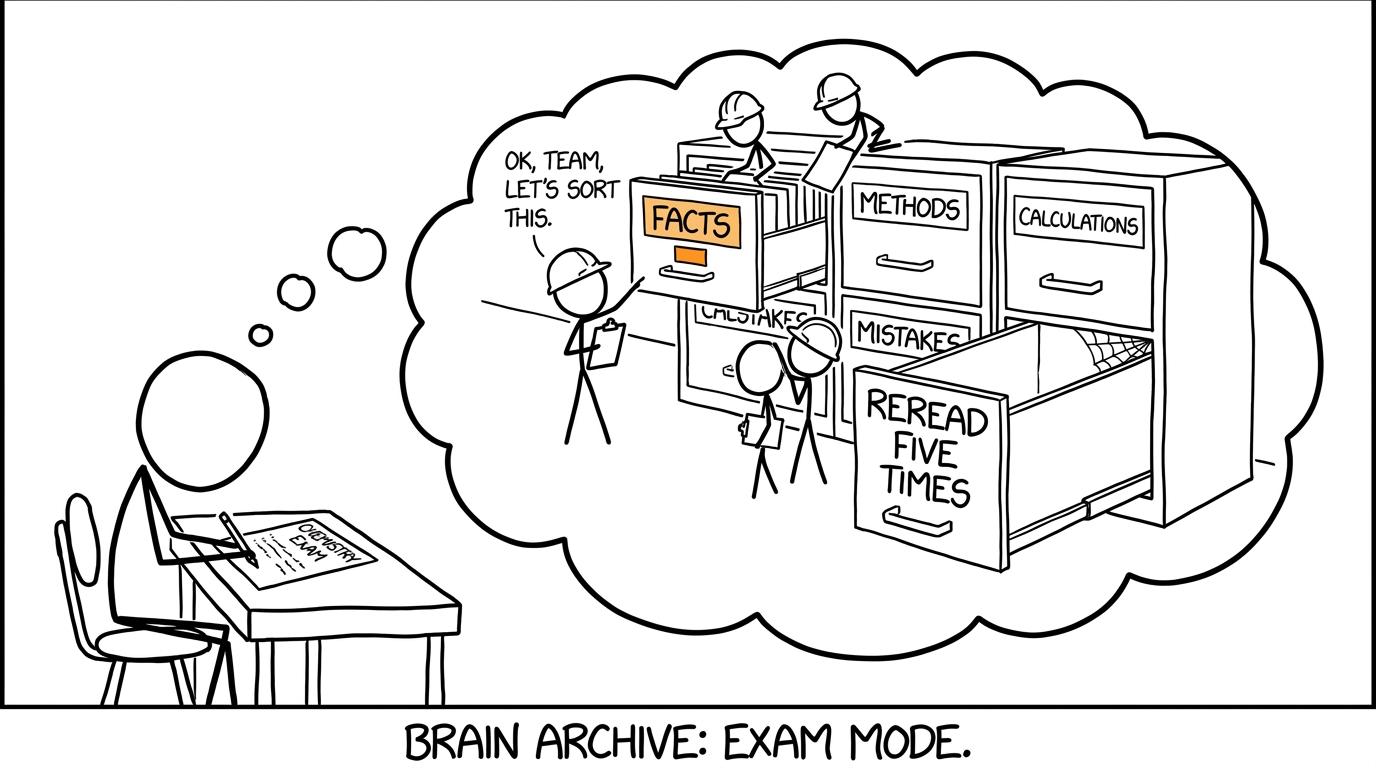 A calm team inside a student's brain sorts facts, methods, calculations and mistakes
Common active recall mistakes
Looking too quickly
Give yourself time to search your memory before turning over a card. Revealing the answer immediately removes much of the retrieval effort.
Recalling words without understanding
A memorised sentence is fragile if you cannot explain it, connect it to evidence or apply it. Follow factual cards with “why?”, “how?” and “what would change?” prompts.
Never checking the answer
Feedback is essential. Compare your response with accurate material, correct it and process why the correction is right. Do not merely put a red cross beside it.
Testing only comfortable topics
Successful recall feels good, so it is tempting to repeat cards you already know. Let errors guide your revision. Weak content should appear more often, while secure content can be spaced further apart.
Treating flashcards as the entire course
Flashcards suit discrete facts but are less effective for extended explanations, calculations and practical evaluation. Combine them with blank-page recall, diagram reconstruction and exam questions.
Cramming every card in one sitting
A long session may create short-term fluency without durable learning. Smaller sessions spread across several days are more useful and easier to sustain.
The verdict: does active recall work for GCSE Chemistry?
Yes, the wider evidence for retrieval practice is positive, and the method fits GCSE Chemistry particularly well because the course requires accurate knowledge, linked explanations, practical understanding and quantitative skills. It tends to beat passive rereading because it tests whether knowledge is actually available when the source is removed.
But active recall is not magic. It works best after understanding, with suitable difficulty, prompt feedback, spaced revisiting and exam-style application. Use rereading briefly to learn. Then close the page and find out what remains.
For your maths exams, put the same principle into action with MathsGenie's free GCSE Maths revision resources. Start with a revision lesson, retrieve the method, complete practice questions and mini tests, then check your work with mark schemes and video solutions. When the foundations are secure, move to past papers and predicted papers. Revision becomes far more useful when it asks your memory to do the work.