

Grade 8 GCSE Maths Meaning: What Comes Next?
Grade 8 GCSE maths meaning explained clearly, with A Level options, realistic next steps, results-day advice and free MathsGenie revision resources.
Results day can compress two years of work into one small number. If that number is 888, the short answer is reassuring: the grade 8 GCSE maths meaning is that you achieved an excellent result, one level below the highest available grade. A GCSE maths grade 8 demonstrates strong mathematical knowledge and leaves you well placed for A Level Maths, although your next step should depend on your interests rather than the feeling that you must prove anything more.
Here is what the result means, what your realistic options are and how to make the transition confidently.
Your results-day checklist
- Celebrate the result before analysing it.
- Confirm that you meet your sixth form or college entry requirements.
- Consider A Level Maths if you enjoy algebra, graphs and problem-solving.
- Ask about Further Maths if you want a more demanding mathematical route.
- Keep your GCSE skills active before September.
- Avoid resitting automatically just to chase a grade 999.
 A student deciding what comes after a grade eight while a calculator celebrates
What does a grade 8 in GCSE Maths mean?
GCSEs in England use grades 999-111, with 999 as the highest grade. A grade 888 therefore sits in the top part of the grading scale and represents performance above grade 777, whose lower threshold was designed to align with the lower threshold of the former grade A.
There is no exact one-to-one conversion between every numerical grade and the old letter system. Grades 777, 888 and 999 collectively cover the territory previously associated with the highest letter grades, while grade 999 was introduced to recognise the very highest performance. It is more accurate to describe grade 888 as an outstanding modern GCSE result than to force it into a single old letter.
Grade boundaries are not fixed percentages. Exam boards including Edexcel, AQA, OCR and Eduqas set boundaries for each exam series after the papers have been taken. The marks needed for grade 888 can therefore change according to the board, specification and difficulty of that series. In England, the grade 888 boundary is set in marks between the grade 777 and grade 999 boundaries.
A grade 888 can only be awarded on higher tier GCSE Maths because foundation tier is capped at grade 555.
What next after grade 8 maths?
A strong grade creates options, but it does not make the decision for you. The best route is the one that fits both your ability and the kind of work you are willing to keep doing.
Choose A Level Maths
A Level Maths is the most direct next step. A grade 888 will usually place you above the GCSE entry threshold used by many sixth forms, but requirements vary, so check the published rules for your chosen school or college.
The course develops familiar ideas much further, including algebra, trigonometry, functions, statistics and mechanics. It also introduces calculus. The jump is not simply about harder questions; methods connect more tightly, and algebraic fluency becomes increasingly important.
You can explore the course before committing through the A Level Maths revision hub. If you will follow Pearson Edexcel, the Edexcel A Level Maths resources provide lessons, questions, revision guides and papers organised around the specification.
Consider Further Maths
Further Maths may suit you if you genuinely enjoy difficult problems and your school offers the subject. A grade 888 is a strong foundation, but each provider sets its own entry requirement and some may ask for grade 999 or use an additional assessment.
Do not choose it simply because your result was high. Further Maths rewards curiosity, persistence and comfort with abstract ideas. Speak to the department about course structure, workload and whether it is offered as a full A Level or another arrangement.
Use maths within another pathway
You do not have to take A Level Maths for the result to matter. Strong GCSE maths supports subjects such as physics, chemistry, economics, computer science, geography and psychology, although the amount and style of maths differ between courses.
It also strengthens applications for technical courses and apprenticeships. Check individual course requirements rather than assuming every provider treats a grade 888 in the same way.
Keep grade 9 as perspective, not unfinished business
A grade 888 is not a near-miss disguised as success. It is an excellent qualification in its own right. Resitting solely to pursue grade 999 is rarely the most useful use of time unless a particular provider requires it or there is a specific reason to challenge the result.
If you are considering a review of marking or a resit, discuss the costs, deadlines and likely benefit with your school or college first. A better investment may be preparing for your next course.
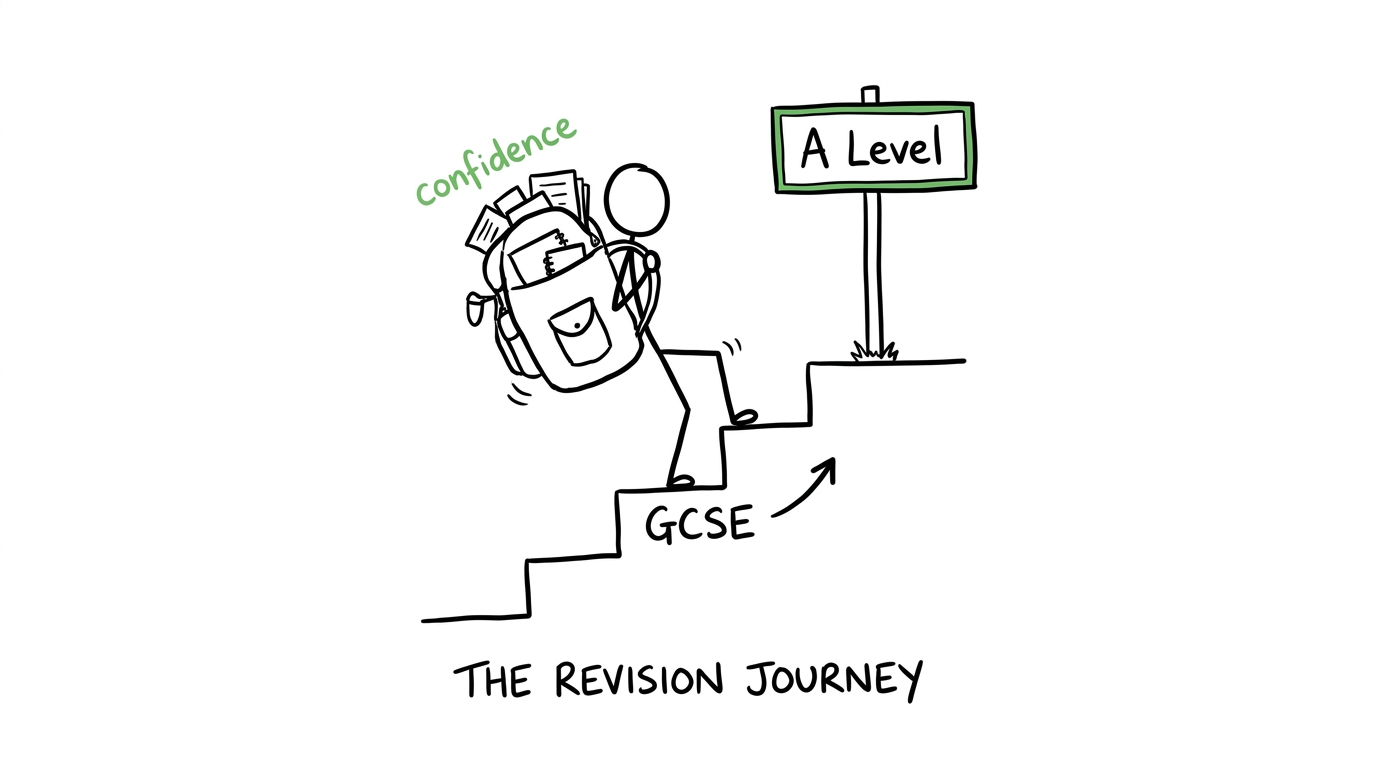 A student carrying confidence up the staircase from GCSE to A Level
How to prepare for A Level after a grade 8
Rest first. Then use a small amount of focused practice to keep the foundations secure.
Prioritise algebraic manipulation, quadratics, functions, graphs, surds, indices and trigonometry. The Edexcel GCSE Maths revision guides provide a useful higher-tier checklist, while the AQA GCSE Maths revision guides are matched to AQA content.
For demanding GCSE topics, revisit proof revision and practice and use the wider GCSE Maths revision hub to find your exam board. One short session each week is enough to preserve fluency without turning the summer into another exam term.
Common mistakes after receiving a grade 8
Assuming A Level Maths will feel automatic
A strong GCSE result is evidence of readiness, not a guarantee that every new topic will be easy. Start homework promptly and repair small gaps before they accumulate.
Choosing subjects to satisfy other people
Capability matters, but so does interest. Read each specification and ask current teachers what the weekly work actually involves.
Throwing away GCSE knowledge
A Level courses move quickly through ideas that rely on higher-tier algebra. Keep your notes or use MathsGenie revision lessons and practice questions when a foundation skill becomes rusty.
Comparing a grade 8 with somebody else's grade 9
Results are information, not identity. Your grade has already opened strong academic options. The useful question is not who scored more, but what you want the result to help you do next.
Turn a strong result into a strong next step
A grade 888 says that your GCSE understanding is highly developed. What happens next depends less on squeezing one more grade from the past and more on choosing the right challenge for the future.
Explore the free MathsGenie GCSE Maths revision resources, refresh difficult topics through revision lessons and practice questions, or preview A Level content before term begins. If you are preparing for another GCSE sitting, use GCSE predicted papers alongside past papers, mark schemes, video solutions and mini tests. Your result is worth celebrating. Now give it somewhere useful to lead.










