Too Late to Revise GCSE English Literature? A Plan
Too late to revise GCSE English Literature? Learn what can still improve, what to prioritise and how to revise without neglecting your GCSE maths.
The uncomfortable moment usually arrives when the exam timetable stops feeling theoretical. English Literature is close, several texts still feel foggy, and maths is competing for the same revision hours.
If you are wondering whether it is too late to revise GCSE English Literature, the honest answer is no. Late revision can still improve your knowledge, essay control, quotation recall and use of time. What it cannot do is compress months of teaching into one heroic evening.
The realistic goal is not to know everything. It is to become better at earning marks with what you can learn now. That means prioritising examinable knowledge, practising retrieval and planning responses rather than producing beautiful notes you will never use.
The short answer: what can still change?
Even close to the exam, you can still make a meaningful difference by improving five areas:
- your understanding of the main characters, themes and turning points
- your recall of short, flexible quotations
- your ability to connect evidence to a clear interpretation
- your analysis of language, form and structure
- your timing and response planning
Begin by confirming your exam board, set texts and paper structure. AQA, Pearson Edexcel, OCR and Eduqas do not organise every component in exactly the same way. Your teacher's guidance, specification and current exam-board materials should determine what you revise.
Do not assume that advice written for another board applies to your paper. Check which texts or extracts are provided, where comparison is required and how long you have for each section.
A quick late-revision checklist
Before creating a detailed timetable, complete this short audit:
- Write down every text and poetry collection on your course.
- Mark each area green, amber or red according to your confidence.
- Check the assessment objectives for each question.
- Identify the sections worth the most marks or causing the greatest difficulty.
- Choose a small quotation bank for each text.
- Plan at least one response for every major section.
- Protect time for maths and your other GCSE subjects.
- Schedule sleep rather than treating it as spare revision time.
This is triage, not surrender. A good emergency department does not treat every problem in alphabetical order. It deals first with what matters most.
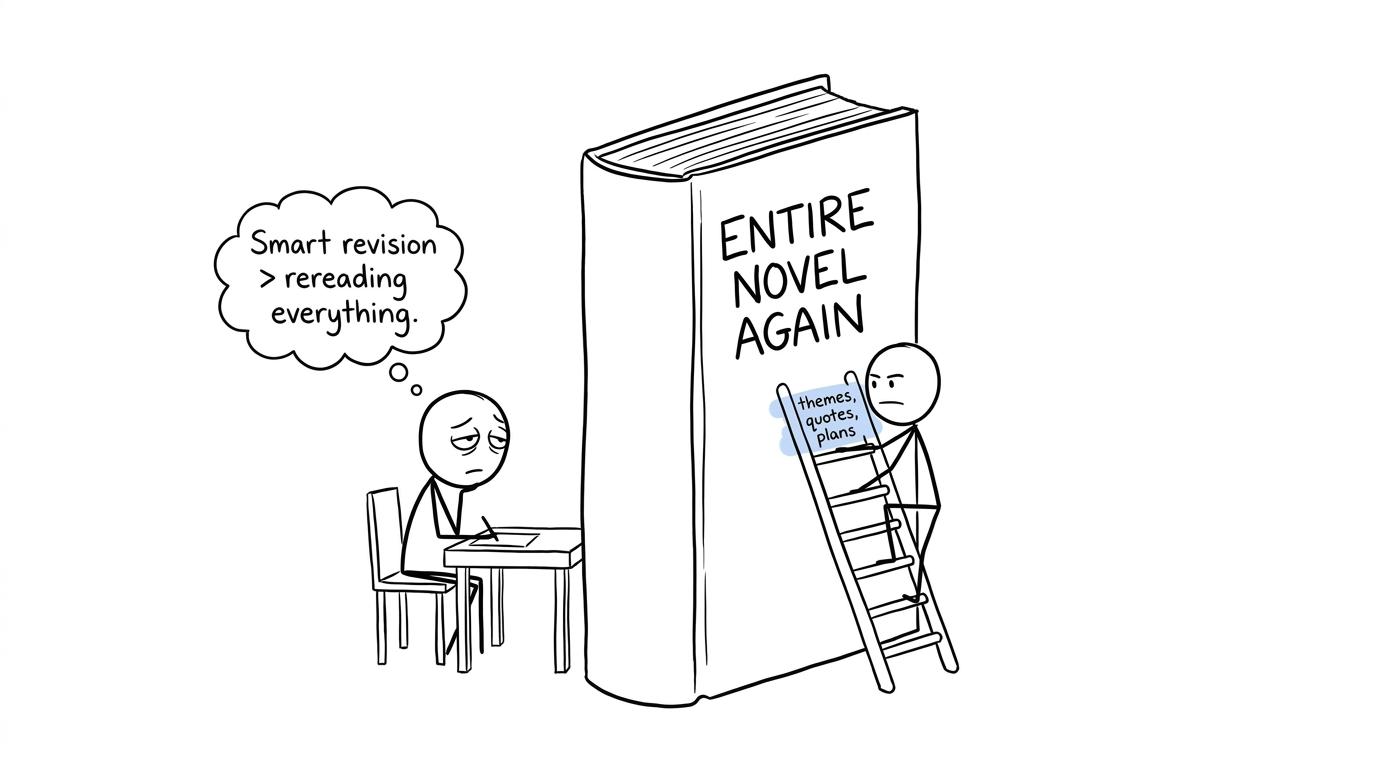 A student chooses a sensible revision ladder instead of rereading an enormous novel
What GCSE English Literature rewards
Official GCSE subject requirements focus on reading, understanding and responding to texts; analysing language, form and structure; understanding context; and writing clearly and accurately.
Across GCSE English Literature specifications, the national assessment-objective ranges are approximately:
- AO1: 35%35\%35% to 40%40\%40%
- AO2: 40%40\%40% to 45%45\%45%
- AO3: 15%15\%15% to 20%20\%20%
- AO4: 5%5\%5%
The exact distribution across questions depends on your specification. Still, the larger picture matters: knowing the plot alone is not enough. Examiners reward an argument supported by textual evidence and analysis of how the writer creates meaning.
That is encouraging for a late starter. You do not have to memorise every page before you can improve. Better paragraph decisions, more precise evidence and clearer analysis can strengthen several assessment objectives at once.
Prioritise understanding before decoration
Start with the architecture of each text:
- What changes from the beginning to the end?
- Which characters drive that change?
- Which themes appear repeatedly?
- What seems to be the writer's central concern?
- Which scenes or moments could support several possible questions?
A one-page map of a text is more useful now than a chapter-by-chapter rewrite. Your map should show relationships between character, theme, evidence and writer's purpose.
Context should support your interpretation rather than sit beside it as a detached history fact. Ask how a relevant belief, social condition or literary tradition changes the way you understand the writer's choices.
Build a compact quotation bank
Late revision rewards flexible quotations. Choose short phrases that can support more than one character or theme, and learn who says them, where they occur and why they matter.
Do not only recognise quotations when looking at a page. Cover them and retrieve them. Then practise explaining the effect of one significant word, image or structural choice.
If your specification is closed book, retrieval is especially important. However, rules about supplied extracts and poetry materials vary, so check your own paper rather than relying on a friend's exam-board advice.
Revise actively when time is short
Rereading feels safe because it creates familiarity. Unfortunately, familiarity is not the same as being able to produce an answer under pressure.
Use a repeatable late-revision cycle:
- Retrieve: write what you remember about a theme without notes.
- Check: compare your recall with reliable class materials.
- Reduce: turn the missing knowledge into a short correction.
- Apply: create a question plan or write one timed paragraph.
- Revisit: test the same material on another day.
This resembles effective maths revision. You learn a method, attempt questions, mark the work and repair the specific gap. MathsGenie's guide to finding your weakest GCSE topics explains how to diagnose weaknesses instead of revising whatever feels most comfortable.
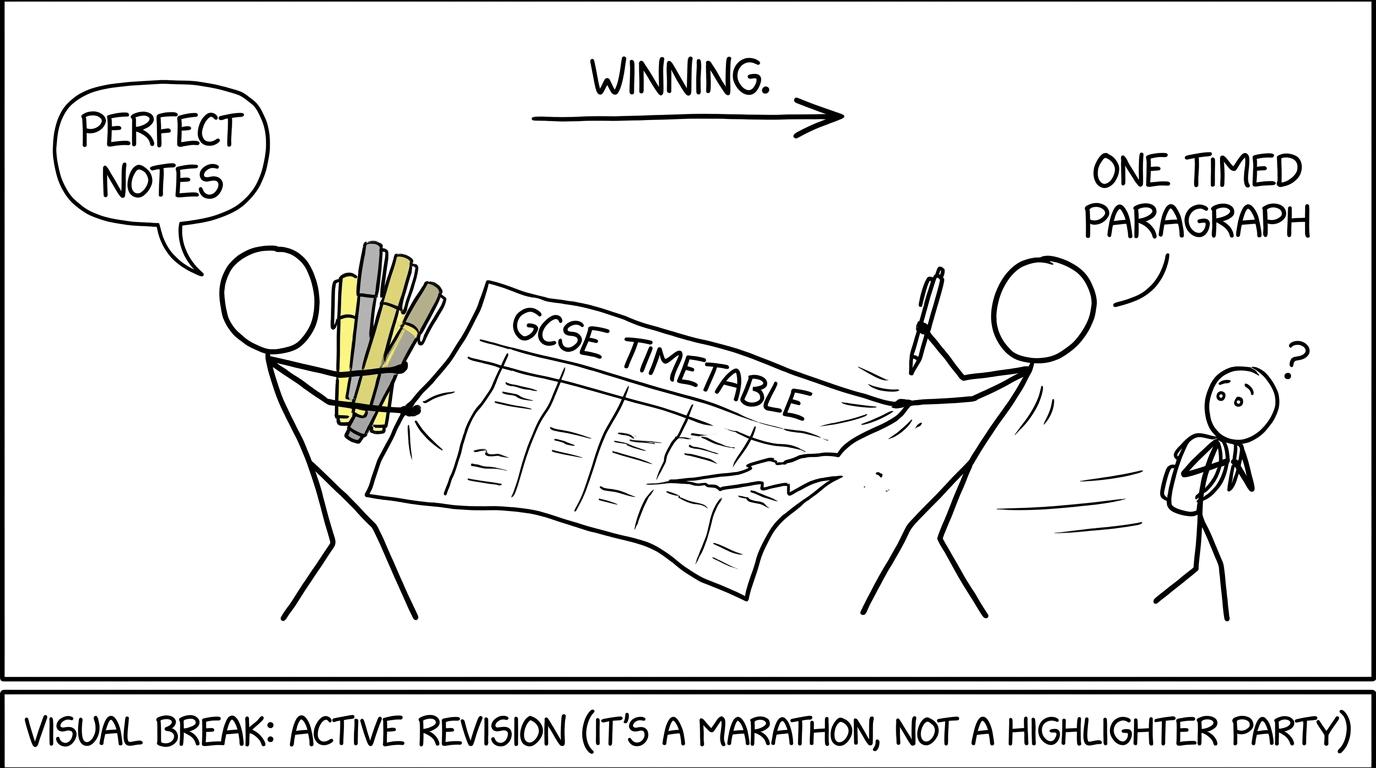 A plain pen defeats the revision gremlin carrying perfect coloured notes
Plan responses before writing full essays
A full essay is useful when you need to test timing and stamina, but it is not always the best use of every remaining hour. Short plans let you practise interpreting many questions quickly.
For each plan, include:
- a direct answer to the question
- two or three connected ideas
- relevant textual references or quotations
- language, form or structure worth analysing
- context only where it genuinely develops the interpretation
- a sense of how the argument will progress
Then choose one plan and turn part of it into timed writing. Afterwards, use your exam board's mark scheme or teacher feedback to identify the weakest feature. Avoid giving yourself a vague judgement such as “not detailed enough”. Record a precise action: analyse individual words more closely, connect context to the argument, or answer the wording of the question more directly.
What to do with a month, a week or one day
If you have several weeks
Divide the course into manageable areas and revisit each one more than once. Alternate knowledge sessions with essay planning and timed practice.
A weekly pattern might contain:
- two text or poetry retrieval sessions
- two response-planning sessions
- one timed section
- one review of mistakes and teacher feedback
If maths also needs attention, build both subjects into one realistic schedule. The GCSE maths revision timetable guide helps you balance topic work, timed practice and review, while the one-month GCSE maths plan offers a structure you can adapt around English.
If you have one week
Reduce the number of tasks, not their quality. Focus on your weakest paper sections, versatile evidence and fast planning.
Each session should have one clear outcome, such as recalling quotations for a central theme or planning two poetry comparisons. Include at least one timed response before the exam so that your first experience of the time pressure is not in the examination hall.
For maths, use the free GCSE maths revision hub to move directly to the topics, practice papers or mini tests you need. The purpose is to reduce decision-making when two major subjects are competing for your attention.
If the exam is tomorrow
Do not attempt to relearn every text. Review your text maps, key quotations, recurring themes and the structure of each paper. Plan a small number of likely question types without trying to predict the exact questions.
Finish at a sensible time. Pack what you need and protect your sleep. If you also have a maths paper nearby, the GCSE exam-week checklist provides a calm routine for short practice, immediate marking and final corrections.
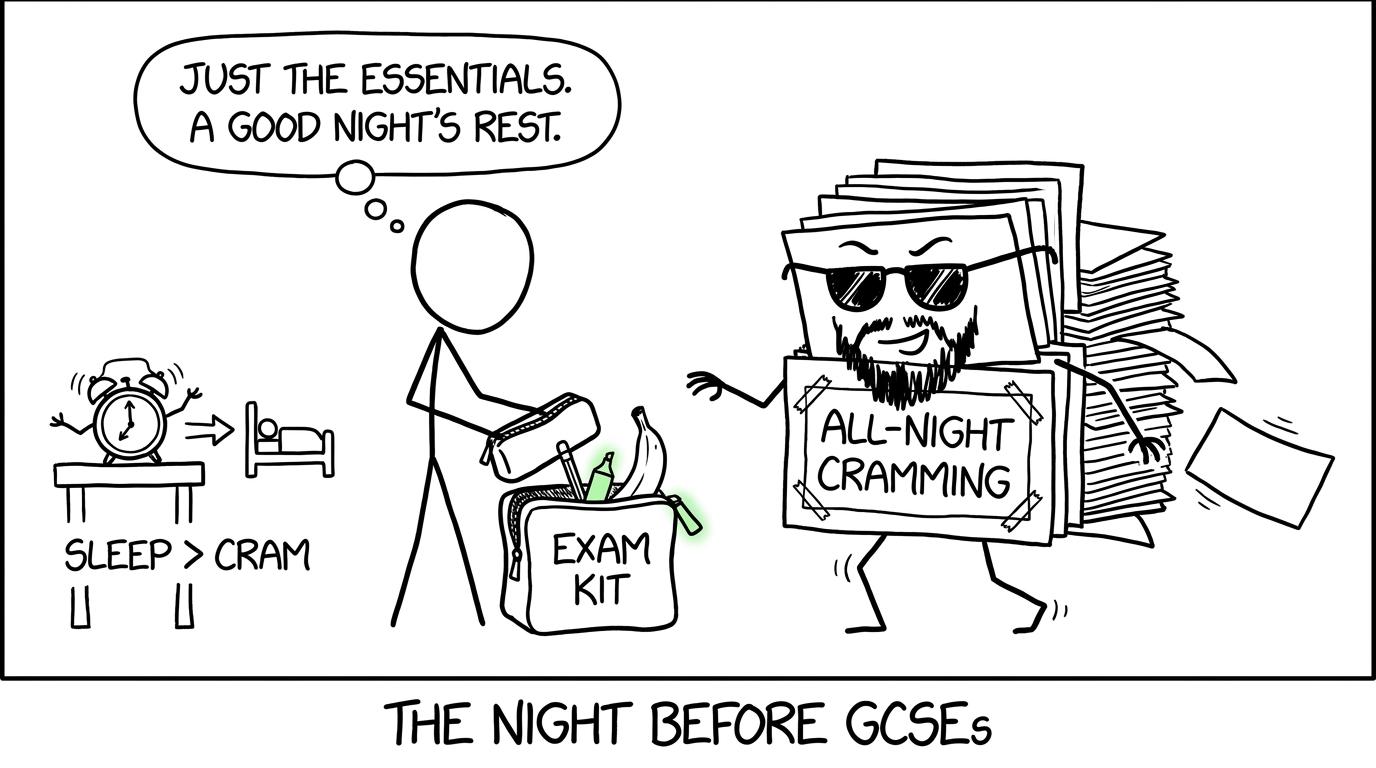 An all-night cramming stack tries to sneak into an exam bag
How to balance English Literature with GCSE maths
The danger of late revision is allowing the nearest exam to consume every available hour. Urgency feels like priority, but your timetable may tell a different story.
Give each subject a defined task rather than a vague block labelled “revision”. For example, an English session could target poetry comparison plans, while a maths session could target simultaneous equations followed by a mini test.
Short sessions can work when they contain active practice and feedback. MathsGenie's 20-minute maths revision routine is useful on English-heavy days. When you have a longer maths block, use a paper from the Edexcel GCSE maths past-paper collection, if Edexcel is your board, or select the correct board through the main GCSE hub.
The principle is the same in both subjects: attempt, check, identify the gap and return to it. The guide to using GCSE past papers properly shows how marking and retesting turn a completed paper into useful revision.
Common mistakes in late English Literature revision
Trying to cover everything equally
Not every gap has equal importance. Prioritise central themes, major characters, core poems and the sections where you currently struggle to construct an answer.
Making notes without testing recall
A neat page can hide weak memory. Close the book and reproduce the important ideas. Revision becomes useful when you have to retrieve something.
Memorising quotations without interpretations
A quotation is evidence, not an argument. Know what it suggests, which writer's choices matter and how it could answer different questions.
Forcing context into every paragraph
Context earns its place when it illuminates the text. Detached facts can interrupt an otherwise clear response and waste limited time.
Writing many essays without reviewing them
Practice only improves performance when feedback changes the next attempt. Mark, diagnose and rewrite a weak section or plan a better response.
Sacrificing every other subject
English Literature matters, but so do the maths papers and your remaining GCSEs. Make a timetable based on exam dates, current confidence and the work most likely to improve your performance.
It is late, but the next session still counts
Starting late changes the strategy. It does not remove the opportunity to improve.
Choose one text. Retrieve its central themes, secure a small bank of useful quotations and plan a response. Then repeat the process for the weakest section of your course. Calm, selective practice is more valuable than panic disguised as productivity.
For the maths side of your timetable, make MathsGenie's free GCSE revision hub your starting point. Use revision lessons to rebuild understanding, practice questions and mini tests to expose gaps, then past papers and predicted papers to develop exam readiness. Mark schemes and video solutions show you exactly what to fix next.
You cannot revise yesterday. You can decide what the next focused hour is for, and that decision can still matter.