Stop Procrastinating GCSE Food and Nutrition
Stop procrastinating GCSE Food and Nutrition with a practical revision system for theory, NEA tasks, exam questions and the maths skills behind them today.
Procrastination often begins with a task that is too vague. “Revise Food and Nutrition” could mean learning micronutrients, reviewing food science, improving an NEA evaluation or practising an exam question. Faced with all four, it is easy to choose none.
To stop procrastinating GCSE Food and Nutrition, make the next action small, visible and specific. Do not plan to “finish nutrition”. Plan to close your notes and list the functions of one nutrient, annotate one food-science process or answer one short question. Starting matters more than designing a perfect timetable.
This article explains why the subject can be unusually easy to postpone, what actually breaks that pattern and how to balance it with GCSE maths revision.
Your anti-procrastination checklist
Use this before each Food Preparation and Nutrition session:
- Choose one precise outcome, not an entire topic.
- Make the first action possible in five minutes.
- Separate theory, practical planning, NEA work and exam practice.
- Put your phone outside your immediate reach.
- Work with your specification and your teacher’s NEA instructions.
- Produce something you can check: an answer, plan, recall list or correction.
- Decide when you will return to the topic.
- Keep maths alive with a short, separate practice block.
The aim is not to feel motivated first. It is to reduce the size of the decision until beginning feels ordinary.
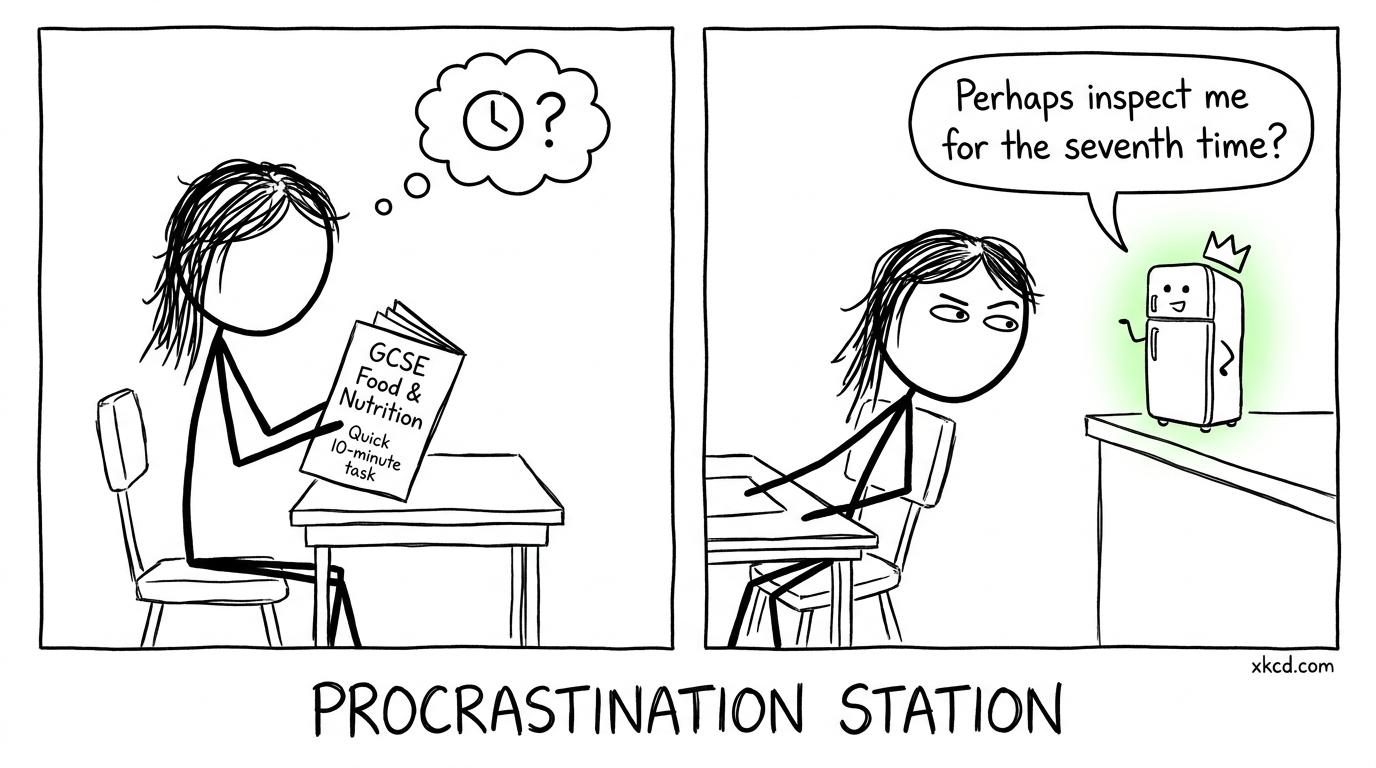 A crowned fridge attempts to distract a student from a short revision task
Why GCSE Food and Nutrition gets procrastinated on
Food Preparation and Nutrition is not simply a written subject with one final exam. Across regulated GCSE specifications, half of the qualification is assessed by examination and half through non-exam assessment. The assessment objectives cover knowledge, application, practical work, analysis and evaluation.
That variety makes the course valuable, but it can create friction. A maths question usually gives you a visible starting point. Food revision may require you to decide whether to recall facts, explain a scientific process, analyse results, plan dishes or evaluate practical work before you have even begun.
The subject contains several kinds of work
A practical session, an NEA report and a nutrition recall task require different materials and different ways of thinking. When they are stored mentally under one heading, “Food revision”, the subject feels larger than it really is.
The solution is to divide it into four lanes:
- Knowledge: nutrients, food safety, provenance, food choice and scientific processes.
- Application: adapting meals or explaining choices for a particular need.
- Practical and NEA work: investigation, planning, evidence and evaluation completed under your school’s rules.
- Exam performance: interpreting command words, using evidence and writing under time pressure.
Choose one lane before choosing a task.
Practical work can disguise the need for theory revision
Cooking feels memorable because it is physical. That can create the impression that attending practical lessons is enough. The written examination still requires accurate knowledge and the ability to apply it.
After a practical, connect one observation to theory. Ask what changed, why it changed, which process was involved and how the outcome could be evaluated. This turns an experience into examinable understanding without producing pages of passive notes.
NEA tasks can feel emotionally expensive
An NEA task has several moving parts, and teacher deadlines may be far enough away to seem unreal. There is also a natural fear of committing to an imperfect idea.
Do not respond by trying to complete the whole task privately in one burst. Follow your teacher’s timetable, supervision arrangements and authentication rules. Your first action might simply be organising permitted evidence, reading feedback or identifying the next authorised section. If you are uncertain what help is allowed, ask your teacher before proceeding.
Competing subjects appear more urgent
Maths has visible worksheets, marks and papers. Food and Nutrition can feel less urgent until an NEA checkpoint or mock approaches. The answer is not to neglect maths. It is to give each subject a defined container.
The GCSE maths revision hub lets you select your exam board, tier and topic without spending the start of a session searching. That leaves more attention for the Food task scheduled beside it.
What actually breaks the procrastination pattern
Procrastination is not always a planning failure. It can be a response to uncertainty, discomfort or a task whose reward feels distant. A detailed timetable will not help if every box still says “revise”.
Research on anti-procrastination techniques is mixed, so no single trick should be treated as a cure. However, specific starting cues, smaller tasks, reduced distractions and repeated practice provide a more useful system than waiting for motivation.
Replace subject labels with physical actions
Compare “revise food science” with these actions:
- Retrieve the definitions connected to one process without notes.
- Compare the answer with your specification or class material.
- Correct missing scientific vocabulary.
- Answer one related exam question.
The second version removes the decision that normally appears at the desk. MathsGenie uses the same principle: a student can open a topic lesson, attempt questions and check the solution rather than confronting “all of GCSE maths”. The best order for learning GCSE maths topics is useful when your maths plan feels equally vague.
Use a five-minute entry task
A five-minute task is not supposed to complete your revision. It lowers the threshold for entering it.
Good entry tasks include:
- writing everything remembered about one nutrient;
- highlighting the command word in one question;
- laying out the headings for an authorised NEA section;
- sorting feedback into “knowledge”, “application” and “evaluation”;
- choosing one calculation skill to refresh.
Once the entry task is complete, continue for a focused block if you can. If you stop, you have still created a clear restart point.
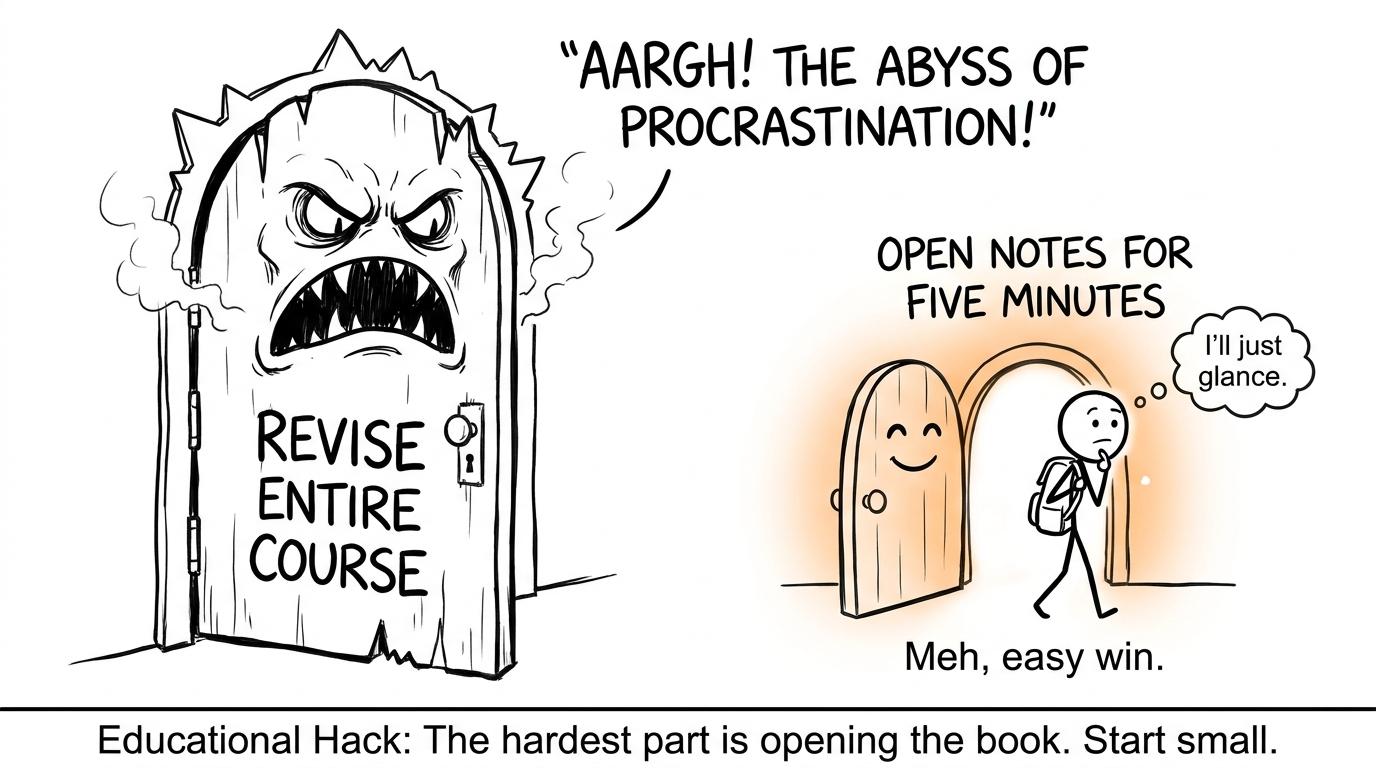 A student chooses a small revision door instead of an enormous dramatic one
Create an if-then starting cue
Tie the task to an event that already happens:
If I finish my evening meal, then I will sit at the table and answer one Food and Nutrition recall prompt before opening social media.
The plan names the cue, location and first action. “I will revise later” names none of them. Keep the cue realistic and use the same one repeatedly so that less negotiation is required.
Remove the nearest escape route
If your phone is beside your notes, resisting it becomes part of the task. Place it in another room, use a blocker or give it to somebody at home for the focus period. Open the required document before the session begins and close unrelated tabs.
This is not a test of willpower. It is sensible preparation. A clear desk cannot teach food science, but it can remove several reasons not to begin.
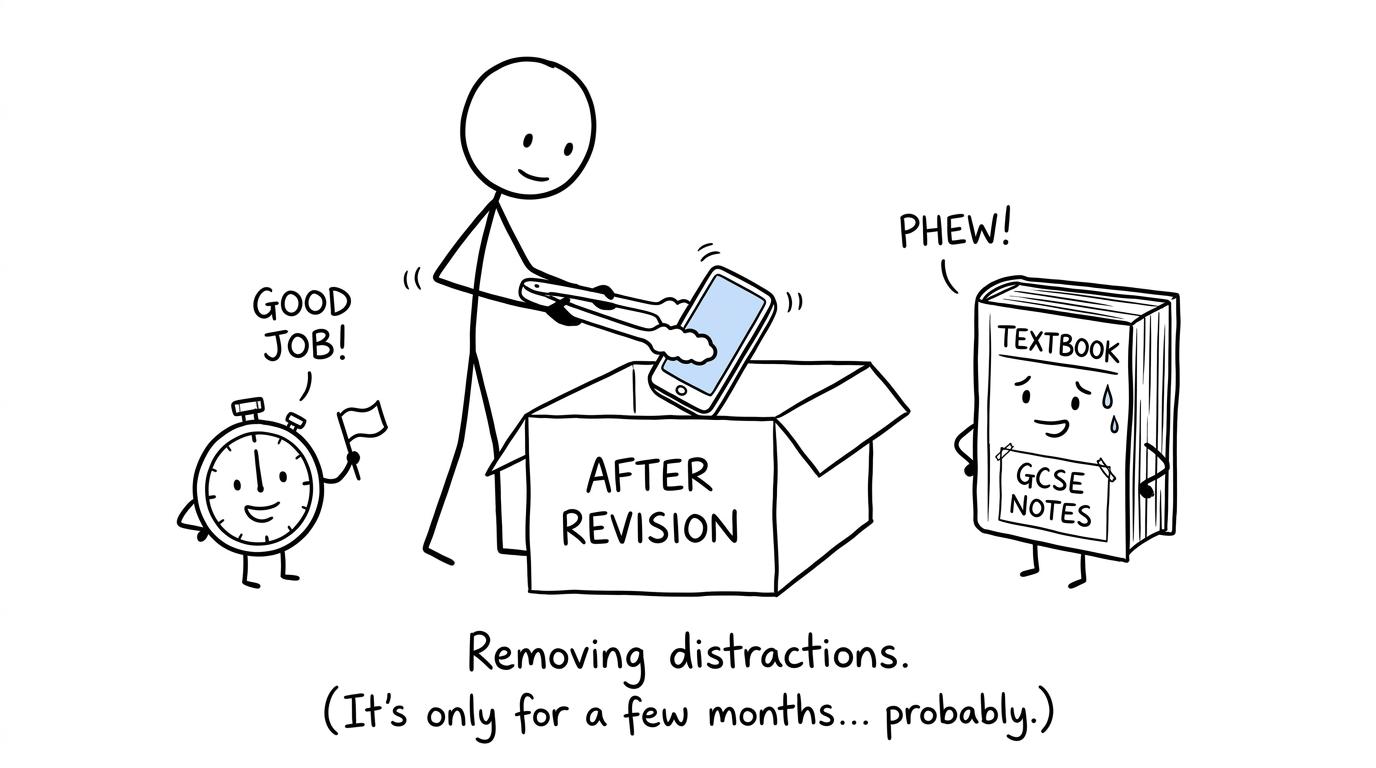 A student uses kitchen tongs to put a distracting phone away
Revise Food and Nutrition actively
Rereading can feel comfortable because it produces recognition. Examinations require retrieval, application and analysis. Your revision should therefore end with evidence that you can produce an answer without looking.
Use recall for factual knowledge
Close the book and write a short response to a prompt. Then check it, correct it and revisit it later. Keep prompts narrow enough to answer properly.
Useful prompt forms include:
- What is the function of this nutrient?
- What are its main dietary sources?
- What happens during this food-science process?
- Which food-safety control applies here, and why?
- How could this dish be adapted for a stated nutritional need?
Practise application and evaluation separately
Knowing a fact is not the same as applying it. Create separate sessions for explaining choices and evaluating outcomes. When evaluating, use evidence from the information provided rather than relying on vague statements such as “it was good” or “make it healthier”.
Check the command word and marks available. A brief identification task and an extended evaluation do not require the same depth.
Treat the specification as a boundary
AQA, OCR and Eduqas organise their Food Preparation and Nutrition content differently. Check your own specification rather than revising from a generic list. Your maths board may also be different: taking Edexcel maths does not tell you which board assesses your Food qualification.
For mathematics, the GCSE maths topics by exam board and tier guide can prevent similar confusion across Edexcel, AQA, OCR and Eduqas.
Use maths as a bridge, not another burden
Food Preparation and Nutrition includes quantitative ideas such as quantities, proportions, percentages, measurements, energy values, costing and interpretation of data. Revising the underlying maths can make those tasks less intimidating while also supporting your maths exams.
Prioritise:
- ratios and scaling;
- fractions, decimals and percentages;
- unit conversions;
- reading tables and graphs;
- averages and ranges;
- checking whether an answer is reasonable.
The general percentage relationship is:
percentage=partwhole×100\text{percentage} = \frac{\text{part}}{\text{whole}} \times 100percentage=wholepart×100For focused support, use the Edexcel ratio revision guide and the conversions and units revision guide. If you take another maths board, begin at the main GCSE hub and select the matching version.
Do not merge both subjects into one unfocused session. A better sequence is a short Food recall task, a break, then one maths topic set. Each block should have its own finish line.
Build a weekly system you can repeat
A sustainable week needs fewer promises and more return points. Choose:
- one theory retrieval session;
- one application or exam-question session;
- one practical reflection or teacher-approved NEA action;
- several short maths sessions based on your weakest topics;
- one catch-up space rather than filling every evening.
The GCSE maths revision timetable guide can help you protect regular maths practice without allowing it to consume every available revision slot. For a shorter planning horizon, adapt the structure in the one-month GCSE maths revision plan.
At the end of each session, write the next action. “Continue tomorrow” is vague. “Answer the second question without notes, then mark it” allows tomorrow’s version of you to begin immediately.
Common mistakes when trying to stop procrastinating
Planning a complete transformation
A demanding colour-coded timetable can become another avoidance task. Plan the next week and leave room for school deadlines, practical lessons and rest.
Starting with the largest task
Beginning with “finish the NEA” creates pressure before any work occurs. Break it into teacher-approved sections and identify the smallest legitimate next action.
Counting time instead of output
Sitting with notes for an hour does not prove that learning occurred. Record completed questions, recalled ideas, corrected misconceptions or feedback acted upon.
Revising only comfortable content
Familiar topics create quick confidence but may not address the areas costing marks. Use mocks, teacher feedback and marked questions to select priorities.
Borrowing an unsuitable revision plan
Your friend may have another exam board, different NEA deadlines or different weaknesses. Use your own specification and confirm deadlines with your teacher.
Letting one missed session ruin the week
A timetable is a route, not a verdict. If you miss a session, restart with the next small action. Do not double every later session until the plan becomes impossible.
Start before you feel ready
You do not need to become a different person to stop postponing Food and Nutrition. You need a smaller doorway into the work: one cue, one defined action and one piece of visible feedback.
Choose a Food and Nutrition task that can be started in five minutes. When it is complete, schedule the return. Then keep your maths moving with MathsGenie: use free revision lessons to rebuild a method, practise with topic questions and mini tests, and test your progress using GCSE past papers and the predicted papers in the MathsGenie resources collection.
Motivation is unreliable. A clear next step is available now.