Ratio
x

Revision notes for Edexcel GCSE Maths Ratio. Open the guide for explanations and worked examples. Written against the Edexcel GCSE Maths (1MA1) specification, so the content matches what's examinable rather than general Maths background.

Ratio

What you'll learn

  • What ratio notation such as 3:23:23:2 means.
  • How to share a total amount using ratio parts.
  • How to work backwards from one share or from a difference.
  • How ratio appears in lengths, money, sweets and mixtures.

1. Ratios are made from equal parts

Definition

Ratio

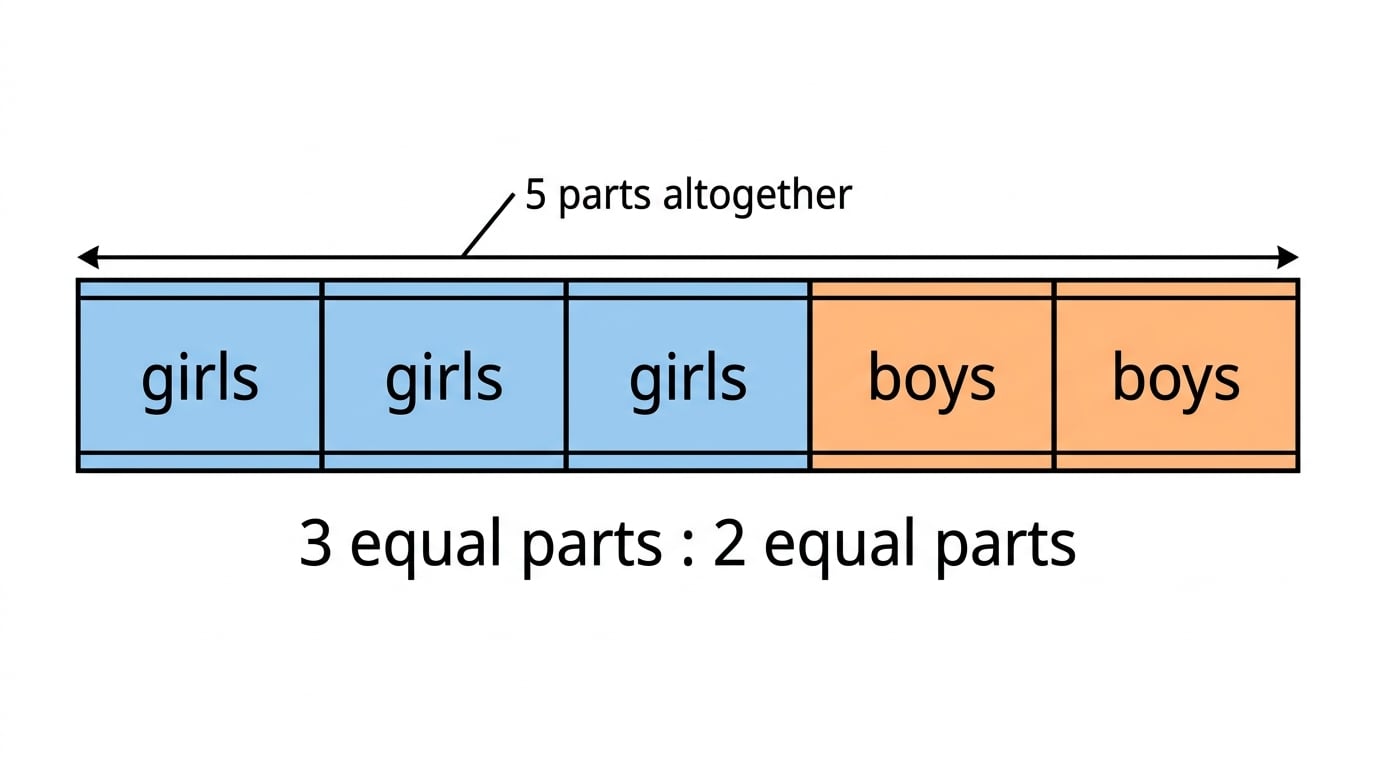
A ratio compares quantities. The ratio 3:23:23:2 means 3 equal parts of the first amount for every 2 equal parts of the second amount. One part is one equal chunk.

A bar model showing that the ratio 3:2 means three equal parts compared with two equal parts.

The order matters. If the ratio is girls : boys = 3:23:23:2, then girls get the 3 parts and boys get the 2 parts.

Key Idea

Find one part

Most ratio questions become much easier when you find the value of one part, then multiply by the ratio numbers.

Example

A length split in a ratio

A point Q lies between P and R on a straight line. The length QRQRQR is 3 times the length PQPQPQ. The full length PRPRPR is 96 m. Find QRQRQR.

The line PR is split at Q so that PQ is 1 part and QR is 3 equal parts, making 96 m altogether.

  1. Since QRQRQR is 3 times PQPQPQ, write the ratio PQ:QRPQ:QRPQ:QR as 1:31:31:3.

  2. There are 4 equal parts altogether:

    1+3=41 + 3 = 41+3=4
  3. One part is 24 m:

    96÷4=2496 \div 4 = 2496÷4=24
  4. The length QRQRQR is 72 m:

    3×24=723 \times 24 = 723×24=72

2. Sharing a total in a ratio

The total is the whole amount altogether. To share a total, add the ratio parts first.

Example

Sharing sweets between three people

Ari, Beth and Cleo share 63 sweets in the ratio 4:3:24:3:24:3:2. Work out how many sweets each person gets.

A 9-part bar model represents the total of 63 sweets shared as 4 parts, 3 parts and 2 parts.

  1. Add the ratio parts:

    4+3+2=94 + 3 + 2 = 94+3+2=9
  2. One part is 7 sweets:

    63÷9=763 \div 9 = 763÷9=7
  3. Multiply each ratio part by 7:

    Ari:4×7=28Beth:3×7=21Cleo:2×7=14\begin{aligned} \text{Ari} &: 4 \times 7 = 28\\ \text{Beth} &: 3 \times 7 = 21\\ \text{Cleo} &: 2 \times 7 = 14 \end{aligned}AriBethCleo​:4×7=28:3×7=21:2×7=14​
Common Mistake

Dividing by the number of people

For a ratio like 4:3:24:3:24:3:2, there are 9 parts, not 3. Always divide by the total number of ratio parts.

3. When one person’s share is given

Sometimes you are not given the total. Instead, you are told one person’s amount. Match that amount to the correct ratio part.

Example

Finding the other share

Ellen and Faisal share some money in the ratio 2:52:52:5. Faisal gets £85. Work out how much Ellen gets.

The known £85 belongs to Faisal’s 5 parts, while Ellen’s 2 parts are to be found.

  1. Faisal has 5 parts.

  2. One part is £17:

    85÷5=1785 \div 5 = 1785÷5=17
  3. Ellen has 2 parts, so Ellen gets £34:

    2×17=342 \times 17 = 342×17=34

4. When the difference is given

The difference is how much more one amount is than another. In ratio questions, subtract the ratio parts to find the difference in parts.

Example

Using the difference between shares

Harper and Imani have badges in the ratio 3:83:83:8. Imani has 30 more badges than Harper. Work out how many badges Imani has.

Imani’s bar has 5 more parts than Harper’s bar, and those extra parts represent 30 badges.

  1. Find the difference between the ratio parts:

    8−3=58 - 3 = 58−3=5
  2. So 5 parts represent 30 badges. One part is 6 badges:

    30÷5=630 \div 5 = 630÷5=6
  3. Imani has 8 parts, so Imani has 48 badges:

    8×6=488 \times 6 = 488×6=48
Common Mistake

Using the larger ratio part

If the question says “30 more”, do not divide 30 by 8. Divide it by the difference between the ratio parts.

5. Ratios in recipes and mixtures

Recipe questions often say something like “mix red, yellow and white in the ratio 5:4:15:4:15:4:1”. That means every full batch has 5 parts red, 4 parts yellow and 1 part white.

Example

Checking whether there is enough paint

A painter mixes red, yellow and white paint in the ratio 5:4:15:4:15:4:1. She wants to make 600 ml of paint. She has 310 ml red, 250 ml yellow and 70 ml white. Does she have enough?

A 10-part mixture bar shows the target 600 ml divided into 5 red parts, 4 yellow parts and 1 white part.

  1. Add the ratio parts:

    5+4+1=105 + 4 + 1 = 105+4+1=10
  2. One part is 60 ml:

    600÷10=60600 \div 10 = 60600÷10=60
  3. Find the amounts needed:

    red:5×60=300yellow:4×60=240white:1×60=60\begin{aligned} \text{red} &: 5 \times 60 = 300\\ \text{yellow} &: 4 \times 60 = 240\\ \text{white} &: 1 \times 60 = 60 \end{aligned}redyellowwhite​:5×60=300:4×60=240:1×60=60​
  4. Compare with what she has: 310 ml red is enough, 250 ml yellow is enough, and 70 ml white is enough.

  5. Yes, she has enough of all three paints.

Tip

Greatest amount questions

If a question asks for the greatest amount you can make, find the one-part value from each ingredient. The smaller one-part value tells you which ingredient runs out first.

6. Splitting only what is left

A percentage, such as 25%, means part of a whole out of 100. A fraction, such as 14\frac{1}{4}41​, also means part of a whole.

Sometimes a question gives some amounts first, then says the remaining amount is in a ratio. Remaining means what is left after taking away the amounts already used.

Example

Ratio after percentages and fractions

There are 160 counters. 25% are red and 14\frac{1}{4}41​ are blue. The remaining counters are yellow and green in the ratio 3:13:13:1. Work out the number of yellow counters.

The whole set of 160 counters is first reduced by the red and blue quarters, then the remaining half is split 3:1.

  1. Find the number of red counters. 25% is one quarter, so there are 40 red counters:

    160÷4=40160 \div 4 = 40160÷4=40
  2. Find the number of blue counters:

    160÷4=40160 \div 4 = 40160÷4=40
  3. Find the remaining counters:

    160−40−40=80160 - 40 - 40 = 80160−40−40=80
  4. Split 80 in the ratio 3:13:13:1. There are 4 parts, so one part is 20 counters:

    80÷4=2080 \div 4 = 2080÷4=20
  5. Yellow is 3 parts, so there are 60 yellow counters:

    3×20=603 \times 20 = 603×20=60
Exam technique

In the exam

  1. Write the ratio in the same order as the names or items in the question.

  2. Decide what you are given: a total, one share, a difference, or a leftover amount.

  3. Show the one-part calculation clearly before multiplying.

  4. Check your answer: the larger ratio part should give the larger amount, and shared amounts should add to the total.

Self review

Check yourself

  • If a total is shared in the ratio 5:35:35:3, what number do you divide the total by first?

  • In a 2:72:72:7 ratio, what ratio-part difference matches “35 more”?

  • If a question says “the remaining counters are in the ratio 3:13:13:1”, should you split the whole total or only what is left?

Recap questions

Test yourself with 5 quick questions on this guide. Answer them all correctly to complete it.

You've reached the end

Test yourself on this topic, or move on to the next guide.

Practice questionsTake a quick quiz on this topicFlashcardsSelf-test with active recall
ProportionUp next

How was this guide?

Ratio Revision Guide

  1. GCSE
  2. /Maths
  3. /Ratio