Spaced Repetition GCSE Geography: A Simple Start
Spaced repetition GCSE geography made simple: build a no-app revision cycle for case studies, processes, fieldwork and exam questions that lasts.
Revision often feels convincing while the book is open. You recognise the diagram, the case-study facts look familiar, and every highlighted sentence seems obvious. Then the book closes and the detail disappears.
That is the problem spaced repetition GCSE geography revision is designed to solve. Instead of covering a topic once and hoping it stays, you retrieve the important knowledge several times, leaving a growing gap between each attempt. You do not need an app, an elaborate card system or a colour-coded timetable. You need a short question list, a calendar and the willingness to test yourself before you feel completely ready.
For students balancing geography with GCSE maths, this approach has another advantage: it makes revision predictable. Geography facts can be revisited in brief sessions, leaving protected time for the practice questions and papers that maths requires.
The simple spaced repetition checklist
Start with this manageable system:
- Choose one small geography topic.
- Turn the specification content into short recall questions.
- Answer them without notes.
- Check and correct your answers immediately.
- Revisit the questions after two days, one week and two weeks.
- Shorten or extend the gap according to how well you remember.
- Add exam questions once the underlying knowledge is secure.
The intervals are not magic. They are simply a starting rhythm. A difficult topic may need to return tomorrow; a secure one can wait longer.
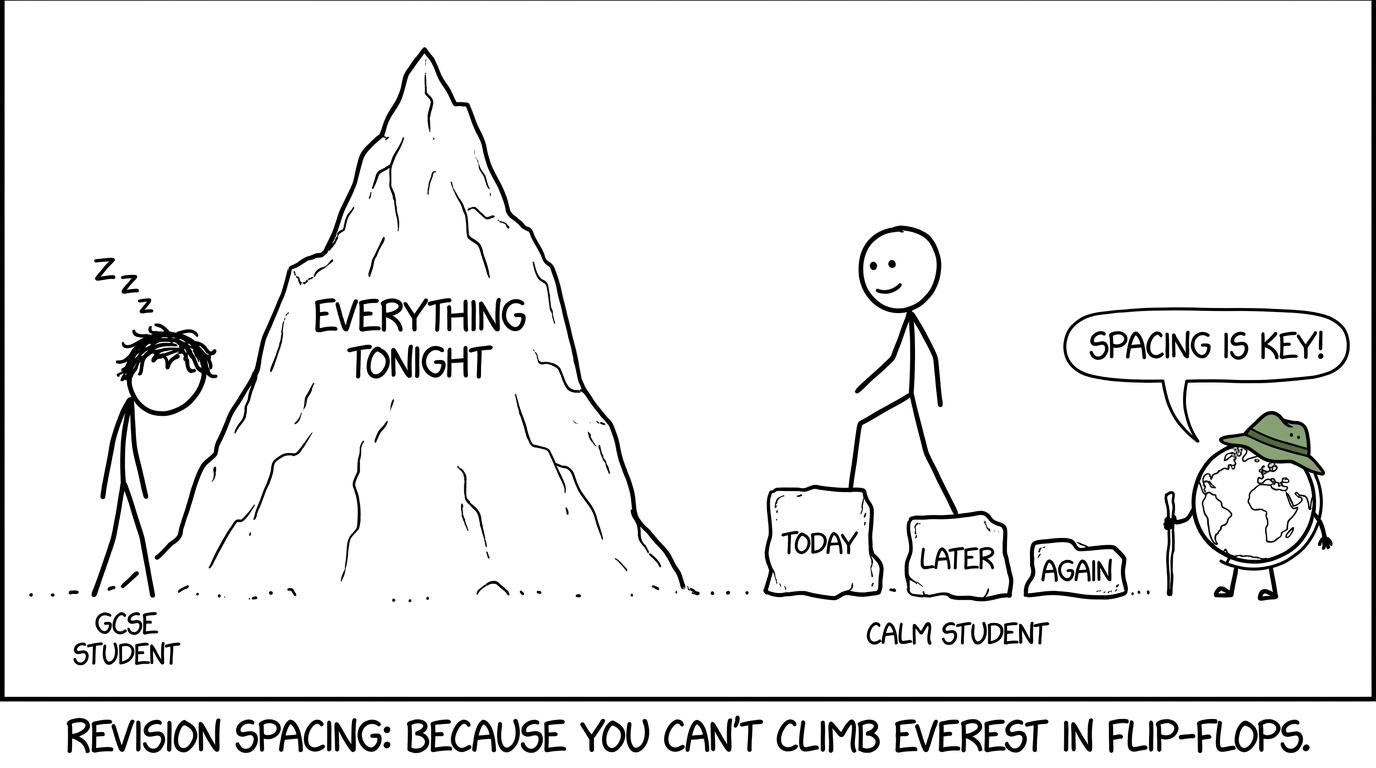 A student choosing small revision steps instead of one enormous revision mountain
What spaced repetition actually means
Spaced repetition is the practice of revisiting learning across separate sessions rather than concentrating all exposure into one sitting. It is usually combined with retrieval practice: attempting to recall information before looking at the answer.
That distinction matters. Reading coastal management notes on four different evenings is spaced, but it remains relatively passive. Closing the notes and answering questions about hard engineering, soft engineering, costs and consequences adds retrieval. The productive difficulty comes from trying to remember.
A useful cycle is:
retrieve, check, correct, schedule, return.
The check matters as much as the recall. An inaccurate answer repeated several times can become confidently wrong. Use your class materials, textbook and your exam board's current specification to confirm each correction.
This principle also fits maths revision. Recognising a method in a video is not the same as producing it independently. MathsGenie's GCSE maths revision hub provides topic lessons, exam questions and short tests that can be revisited over time rather than completed once and forgotten.
Why GCSE Geography needs more than memorising facts
Geography contains substantial factual content: terminology, processes, locations, case studies, fieldwork methods and supporting evidence. Yet the examination is not a memory contest alone.
Across regulated GCSE Geography specifications, the assessment objectives give approximately 15%15\%15% to knowledge, 25%25\%25% to understanding, 35%35\%35% to application, analysis, evaluation and judgement, and 25%25\%25% to geographical skills. Exam boards including AQA, Edexcel, OCR and Eduqas organise their papers differently, so always follow the specification taught by your school.
This means your revision cards should not all ask, “What is the definition?” They should help you move through several levels:
Knowledge prompts
These cover precise facts and terms:
- What is hydraulic action?
- Where is the named case study located?
- What data did the fieldwork enquiry collect?
Explanation prompts
These require connected thinking:
- Why does erosion vary along a coastline?
- How can urban growth create both opportunities and challenges?
- Why might a sampling method reduce reliability?
Application and judgement prompts
These prepare you to use knowledge rather than recite it:
- Which management strategy would be most appropriate in this context?
- What evidence would support this conclusion?
- What limitation has the greatest effect on the fieldwork results?
A balanced deck should therefore contain facts, explanations and decisions. If every answer is one word long, the system is probably training only the smallest part of the course.
How to start without an app
Complicated revision systems have an awkward weakness: they can become another subject to learn. A paper-based method removes that problem.
Choose a small, precise topic
Do not begin with “physical geography”. Choose something narrow, such as tropical-storm formation, river landforms, urban change in one named city or evaluation of a fieldwork method.
Check the exact content against your exam board's specification. Case-study requirements and paper structures are not identical across AQA, Edexcel, OCR and Eduqas, and your teacher may have selected particular optional topics.
The same discipline helps with maths. “Revise algebra” is too broad to schedule effectively. The GCSE maths topics by exam board and tier guide shows how broad areas can be separated into specific skills for Foundation or Higher revision.
Make a short question list
Create roughly eight to twelve questions for the chosen geography topic. Use index cards, folded paper or a page with questions on one side and answers on the other.
Keep each prompt focused. A card asking for everything about a city case study is too large to diagnose. Separate it into location, causes of growth, opportunities, challenges, management and evidence.
Answers should be brief enough to check, but detailed enough to be meaningful. For an extended process, a sequence of key stages may be more useful than a paragraph copied from a textbook.
Test before reviewing
Cover the answer and respond aloud or in writing. Do not silently think, “I know that.” Familiarity is easy to mistake for recall.
Then compare your response with the source. Mark it using three categories:
- Secure: accurate and complete enough for the question.
- Partial: the central idea is present, but detail or precision is missing.
- Not secure: incorrect, confused or unavailable without notes.
There is no need to calculate a complicated score. The category determines what happens next.
Schedule the return
Review “not secure” prompts the next day. Return to “partial” prompts after a short gap. Leave “secure” prompts for longer.
For a new set, a practical starting pattern is:
- first retrieval on the day you create it;
- second retrieval around two days later;
- third retrieval about one week later;
- fourth retrieval roughly two weeks later.
Move a card forwards only when you can answer it accurately without clues. Move it backwards when you forget. The schedule should respond to memory, not protect your pride.
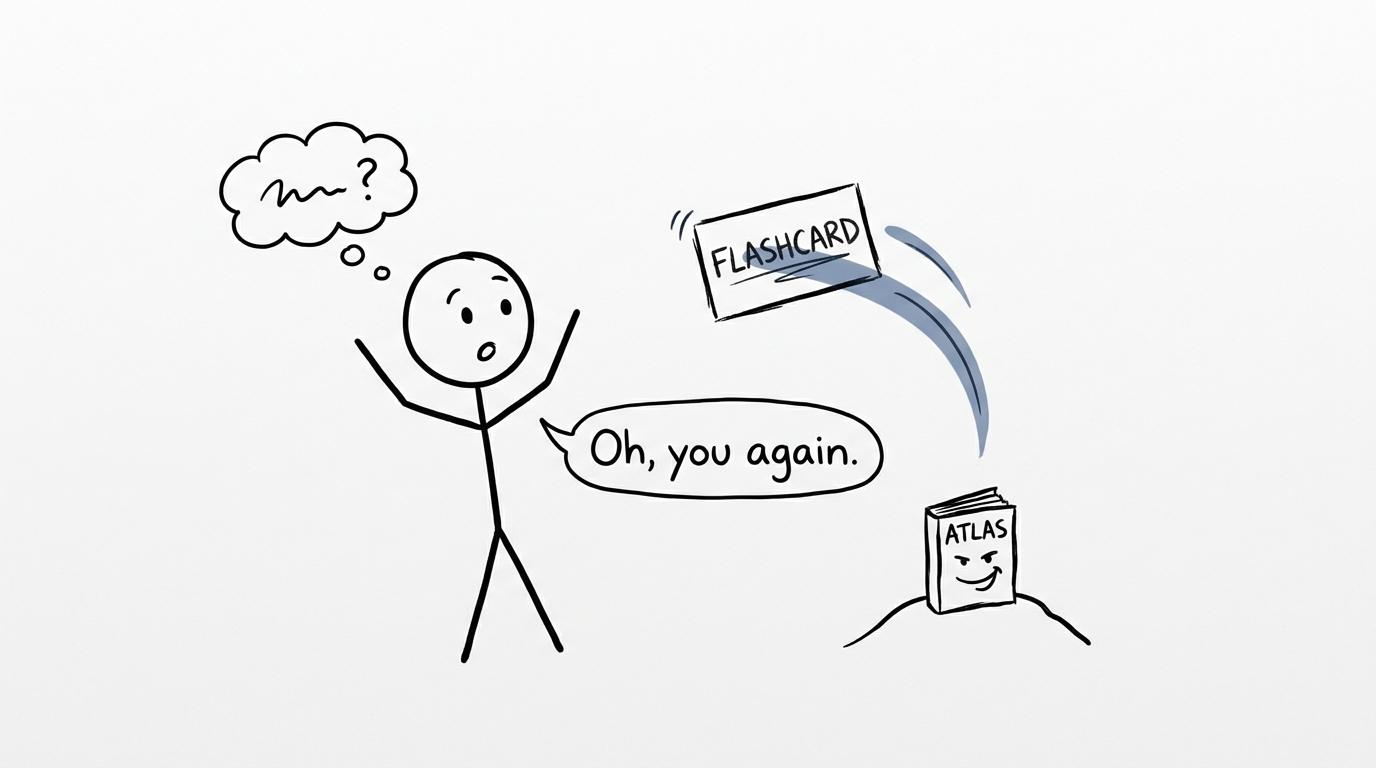 A revision flashcard returning like a boomerang to a surprised student
Build geography revision around five short sessions
A simple weekly routine might contain five sessions of ten to fifteen minutes. Each one can combine old material with a small amount of new material.
Begin by retrieving cards due that day. Correct them immediately. Add only a few new questions, then finish with one task that requires application: interpreting a resource, planning an extended response or evaluating a fieldwork decision.
This prevents the card collection from growing faster than you can review it. More cards are not automatically better. A smaller set used honestly will usually reveal more than hundreds of prompts clicked through at speed.
If several GCSE subjects are competing for time, use a visible weekly plan. MathsGenie's one-week GCSE revision plan offers a structure for balancing diagnosis, topic repair and paper practice in maths. Your geography retrieval sessions can sit beside those longer maths blocks rather than replacing them.
Add exam questions at the right point
Spaced repetition builds accessible knowledge, but examination performance also requires interpretation, structure, timing and judgement. Once a topic's core prompts are mostly secure, answer questions from your exam board's past papers and compare your response with the mark scheme.
When you lose marks, identify the cause:
- missing knowledge;
- weak explanation;
- failure to use the resource;
- unsupported judgement;
- inaccurate geographical terminology;
- poor timing or incomplete development.
Only the first problem is solved by adding a factual card. Other weaknesses need deliberate exam-question practice.
This is equally important in maths. A formula remembered perfectly is useful, but marks depend on recognising when and how to use it. The guide to starting GCSE past papers at the right time explains how topic practice can develop into timed work. Nearer the examination, GCSE predicted-topic revision guidance can support final preparation, but predicted material should supplement broad specification coverage rather than replace it.
Combine geography recall with maths revision
Geography and maths need different materials, but the learning rhythm can remain consistent.
For geography, retrieve a process, case-study detail or fieldwork decision and then apply it to an exam prompt. For maths, recall a rule or method, complete questions without help, mark them and revisit the weak skill later.
MathsGenie's guide to the best order for learning GCSE maths topics can help you choose what to revisit first. If you revise independently, the GCSE maths self-study plan provides a practical sequence using lessons, questions, mini tests and papers.
The shared idea is simple: learning is not finished when something makes sense. It is stronger when you can produce it later, without support, in a different question.
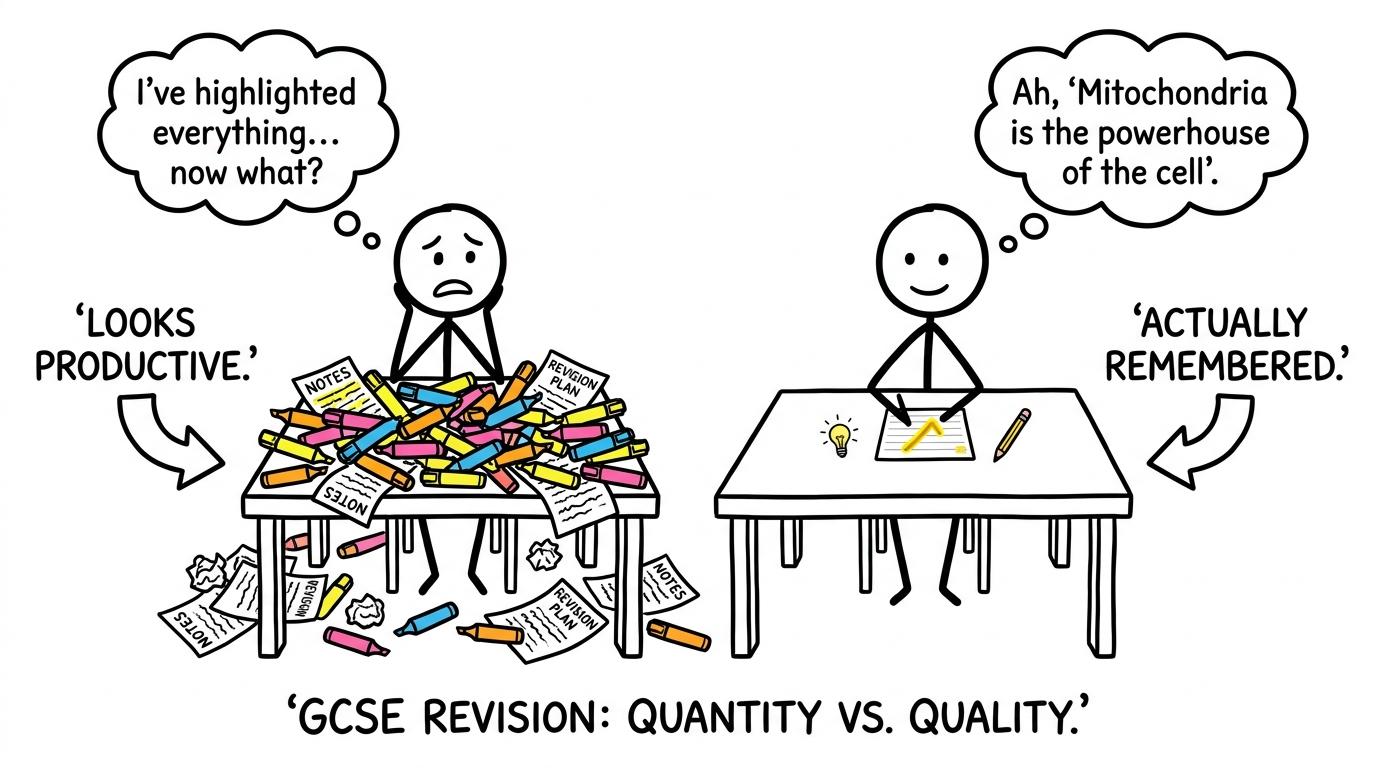 One student decorates notes while another checks what can actually be remembered
Common mistakes with spaced repetition
Making cards while copying
Copying notes can produce neat resources without requiring retrieval. Write questions from the specification, then answer from memory before checking.
Using vague prompts
“What happened in the case study?” has no clear boundary. Ask for a particular cause, effect, response, comparison or item of evidence.
Revising facts but ignoring skills
GCSE Geography assesses maps, graphs, data, fieldwork, application and judgement as well as knowledge. Schedule exam questions and unfamiliar resources alongside cards.
Keeping every interval fixed
A forgotten prompt should return sooner. A consistently secure prompt can wait longer. The system works because it adapts.
Adding too much at once
Creating fifty new cards feels efficient until all fifty become due together. Add small batches and protect time for older material.
Treating recognition as success
Seeing an answer and thinking “that is what I meant” is not the same as producing it. Say or write the complete response before turning the card over.
Make returning easier than postponing
The best revision system is rarely the cleverest. It is the one that still works on an ordinary Tuesday when several subjects need attention and motivation is unremarkable.
Begin today with one geography topic, a short set of questions and four dates in your calendar. Retrieve before reviewing. Correct errors. Let difficult knowledge return sooner and secure knowledge wait longer.
Then apply the same rhythm to maths. Open the MathsGenie GCSE revision hub, choose your exam board and work from a focused revision lesson into practice questions. Use mini tests to revisit skills, mark schemes and video solutions to correct misconceptions, and past papers and predicted papers to test whether the learning survives under exam conditions.
You do not need to remember everything today. You need a reliable plan for coming back.