Can You Self-Study GCSE Maths? A Realistic Plan
GCSE self-study is possible with the right plan. Learn how to revise effectively using Maths Genie lessons, practice questions, past papers and mark schemes.
If you’ve ever sat down to revise and felt that hollow panic of, “I don’t even know where to start”, you’re not alone. Self-studying for GCSE maths can feel like trying to build a house in the dark; you’ve got effort, but not always direction. The good news is that self-study can work. In fact, for many students it’s the thing that turns vague stress into visible improvement: more method marks, fewer silly errors, and a calmer brain on exam day.
But here’s the quiet truth: self-studying GCSE maths isn’t about being naturally “good at maths”. It’s about building a system that makes progress inevitable.
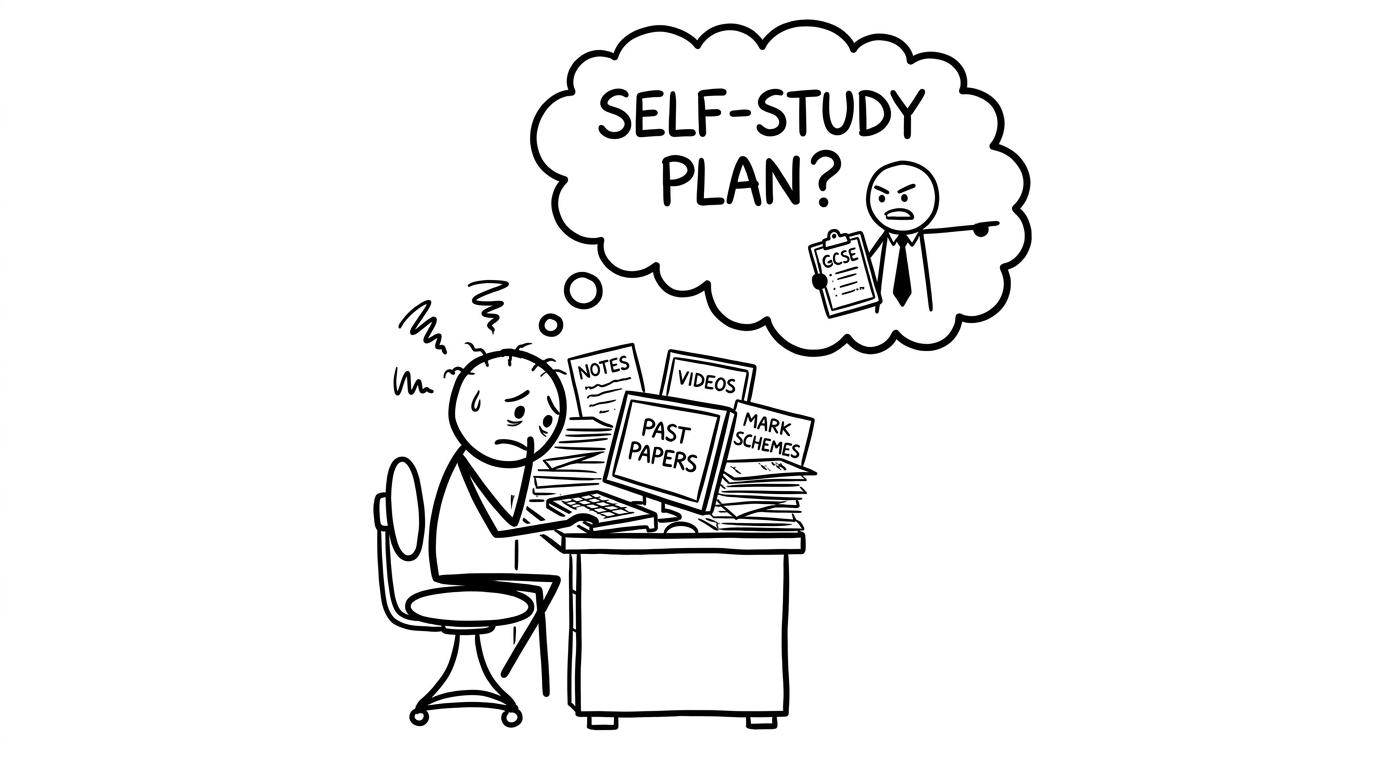 Stick-figure student planning self-study
Can you realistically self-study GCSE maths?
Yes, as long as you replace hope with structure.
Self-study works when three things are true:
- You know what your exam board expects (Edexcel, AQA, OCR, Eduqas have similar content, but papers feel different).
- You practise the right questions, at the right difficulty, and learn from mark schemes.
- You track weaknesses so revision becomes targeted, not random.
Maths Genie is built for this exact situation: free revision lessons, exam questions by topic, mark schemes, video solutions, mini tests, and predicted papers, all organised in a way that makes independent GCSE revision feel doable.
A useful starting point is the main Maths Genie Resources page where you can find predicted papers and revision materials in one place.
A self-study checklist for GCSE maths
Before you do another hour of revision, check you’ve got these in place:
- A clear target grade and tier choice (foundation or higher)
- A topic list you’re working through (not just “do some algebra”)
- A weekly routine: lessons, practise, mark, fix
- A paper routine: timed papers, then mark scheme, then error log
- A way to test recall (mini tests or short mixed practice)
If you want a quick way to identify gaps, Maths Genie has self-assessment resources, including topic checklists like the GCSE Maths Self Assessment PDF.
Build your GCSE self-study plan around marks, not moods
Most students revise based on mood: “I feel like doing fractions today.” That’s understandable. It’s also unreliable.
Instead, revise based on marks:
- What topics lose you the most marks?
- What question types keep repeating on papers?
- Where do you get method marks but miss the final answer?
The shift is subtle. You stop seeing revision as a performance of effort and start treating it like training. A Level students often recognise this quickly: the people who improve aren’t always the brightest; they’re the ones who run a repeatable process.
A strong approach is:
- Learn the method from a lesson
- Do exam-style questions
- Mark carefully
- Redo questions you got wrong two days later
For topic learning, use targeted revision lessons such as Fractions, Decimals and Percentages to rebuild foundations properly.
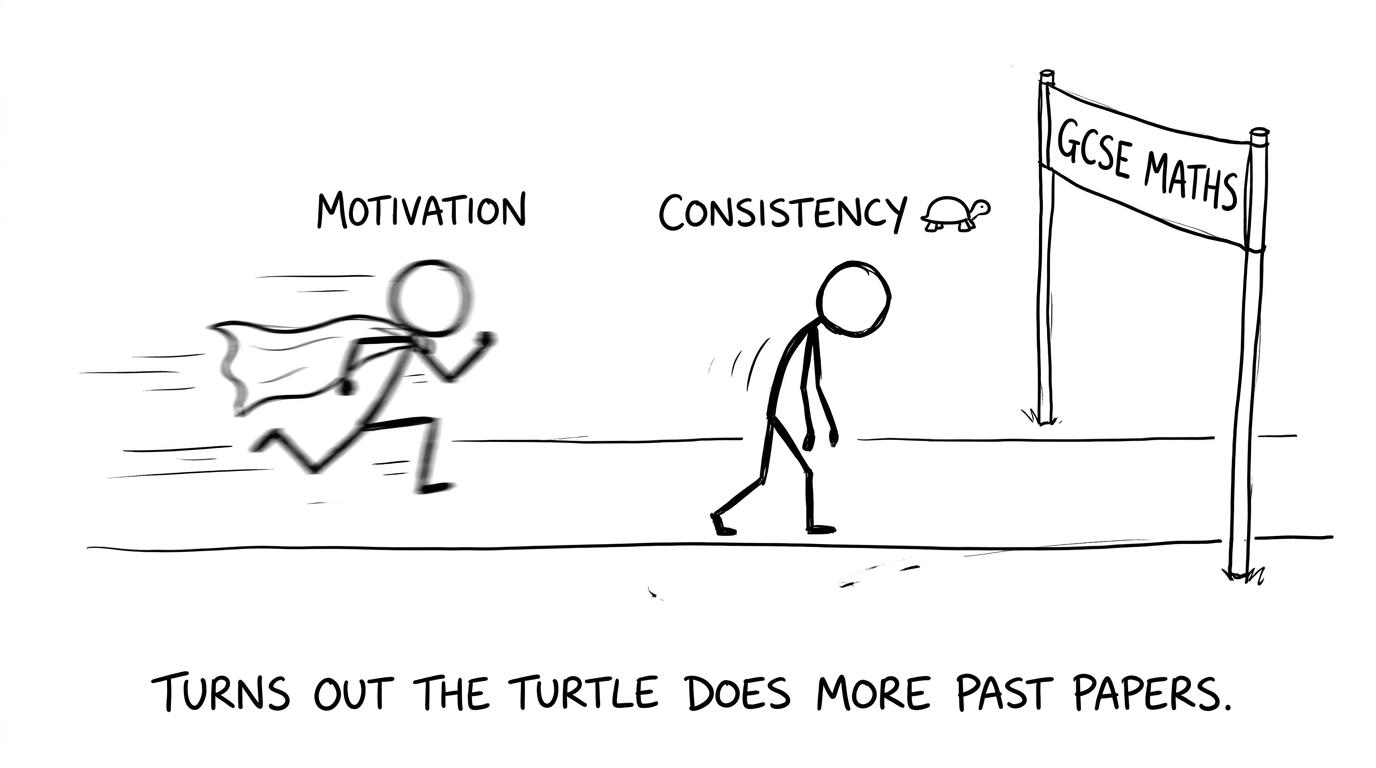 Motivation vs consistency race
What to revise first when self-studying GCSE maths
If you’re self-studying GCSE maths, start where marks are easiest to stabilise:
- Number: fractions, percentages, standard form
- Algebra: simplifying, solving equations, rearranging
- Graphs: straight lines, reading values, gradients
- Ratio and proportion: sharing, scaling, unit rates
Why this order? Because these topics feed into everything else. Weak fractions make probability harder. Weak algebra makes geometry and trigonometry feel impossible.
If you’re revising for Edexcel in particular, topic lists like Edexcel May/June 2022 Foundation GCSE Revision show how revision can be organised around what tends to appear.
Worked example: percentage change (a GCSE staple)
Percentage change appears constantly in GCSE papers because it tests fluency and interpretation.
Example: A laptop costs £480. In a sale, it is reduced by 15%15\%15%. Work out the sale price.
A reduction of 15%15\%15% means you pay 85%85\%85% of the original.
Sale price=480×0.85\text{Sale price} = 480 \times 0.85Sale price=480×0.85 480×0.85=480×85100=480×0.85=408480 \times 0.85 = 480 \times \frac{85}{100} = 480 \times 0.85 = 408480×0.85=480×10085=480×0.85=408So the sale price is £408.
A self-study habit that matters: write the sentence “I pay 85%85\%85%” before you calculate. It prevents the classic error of reducing by the wrong amount.
For targeted practice after learning the method, follow the lesson with exam questions from Maths Genie on percentages (via the topic pages and exam question sets linked from revision content).
Worked example: solving a linear equation (method marks matter)
Self-studying GCSE maths gets much easier when you train yourself to collect method marks consistently.
Example: Solve 3(2x−5)=273(2x-5)=273(2x−5)=27.
Expand first:
3(2x−5)=6x−153(2x-5)=6x-153(2x−5)=6x−15So:
6x−15=276x-15=276x−15=27Add 151515 to both sides:
6x=426x=426x=42Divide by 666:
x=7x=7x=7Notice how every line is “mark-scheme friendly”. Even if you make a slip at the end, those steps often earn method marks in a GCSE paper.
When to switch from topics to full GCSE papers
Topic revision builds tools. Papers build judgement.
A good rule:
- Start papers once you’ve covered the main grade range you’re aiming for.
- Do one paper per week early on, then increase frequency nearer the exam.
On Maths Genie you can use Predicted Papers GCSE Maths as part of that ramp-up, then mix with practice papers and past papers.
If you’re the kind of student who freezes in long papers, break the habit gently: Maths Genie also has shorter paper formats and resources, including the broader Resources page which includes different paper types.
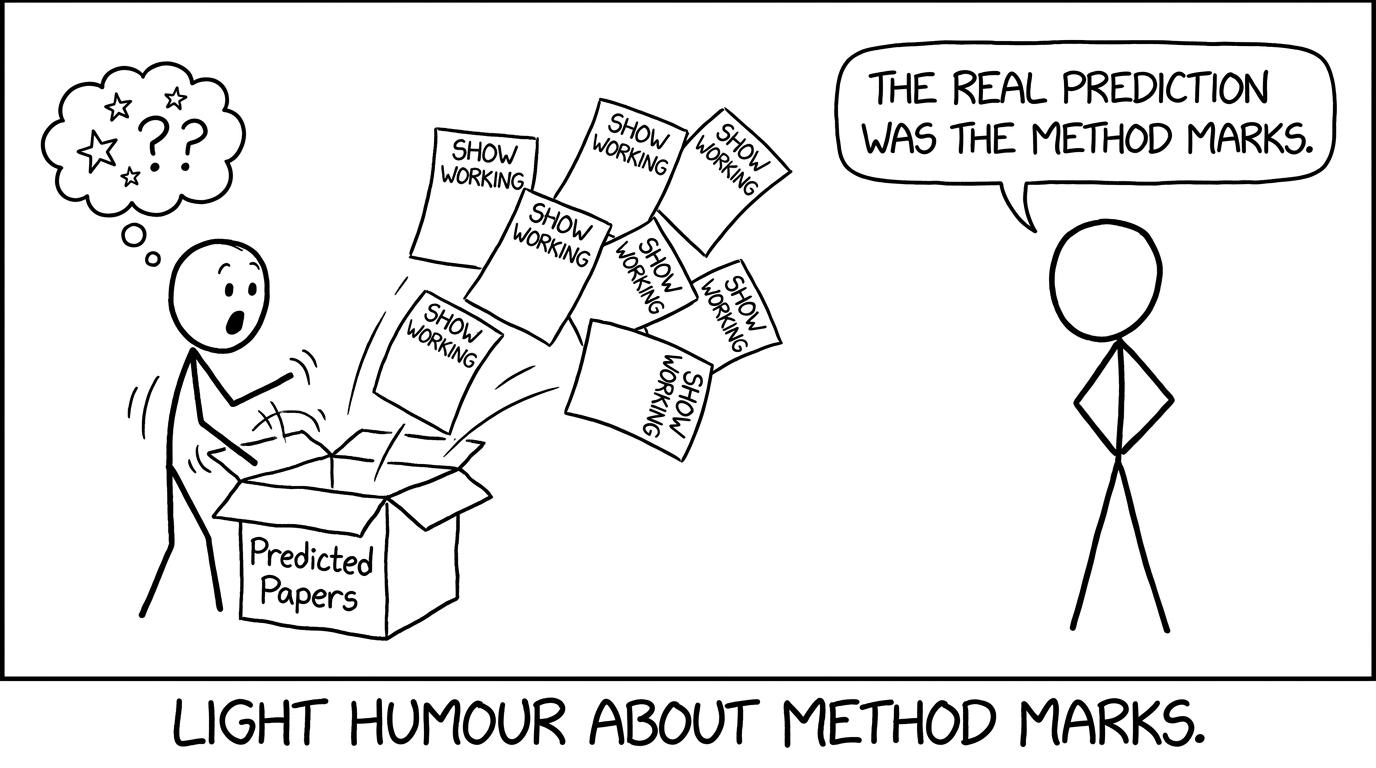 Predicted papers joke about method marks
Use mini tests to make GCSE self-study stick
Big jumps in GCSE performance often come from frequent, low-stakes testing. Not because you “need pressure”, but because your brain remembers what it has to retrieve.
Mini tests help because they:
- keep your skills warm
- reveal weak topics quickly
- reduce the fear of blank pages
Maths Genie provides mini tests, including sets like the Foundation Mini Tests (and higher mini tests too), which work well as 20-30 minute sessions.
Common mistakes when self-studying GCSE maths
Self-study doesn’t fail because students don’t try. It fails because effort leaks through predictable cracks.
Doing too many easy questions
If you only practise what feels comfortable, your GCSE grade won’t move. You need a small amount of struggle, regularly.
Marking loosely (or not at all)
A mark scheme isn’t just “the answer”. It’s a map of what gets rewarded. Marking carefully teaches you exam technique without anyone standing over you.
Not learning from errors
If you get a question wrong and move on, you’re rehearsing forgetting. Keep an error log: topic, mistake type, correct method, and a reminder.
Avoiding timed practice
Timing is part of the skill. A student can understand everything and still underperform if they never practise under exam conditions.
Relying on re-reading notes
Re-reading feels productive but often creates a false sense of security. In GCSE maths, marks come from doing, not reading.
A calm conclusion: self-study GCSE maths is a system you can build
Self-studying GCSE maths is less like cramming and more like training. You show up, you do the reps, you check the mark scheme, and you gradually stop being surprised by the exam.
Start small: one topic lesson, a set of exam questions, and honest marking. Then add mini tests for recall. Then add timed papers for confidence. That’s how self-study turns into grades.
When you’re ready to make it concrete, use Maths Genie as your home base: revision lessons, practice questions, mark schemes, video solutions, mini tests, and GCSE predicted papers and past papers. Begin with the Maths Genie Resources page, use GCSE self assessment to target weaknesses, then build towards Predicted Papers GCSE Maths as your exam confidence grows.