Spaced Repetition GCSE Citizenship Studies Guide
Spaced repetition GCSE Citizenship Studies made simple: build a paper-based revision system for key facts, arguments and exam practice without an app.
Revision can feel productive long before it becomes effective. You read a page about Parliament, highlight a definition and recognise every sentence. Two days later, the page is closed and the facts are suddenly less certain.
That gap is exactly what spaced repetition GCSE Citizenship Studies revision is designed to address. The method is simple: retrieve important knowledge from memory, check it, then revisit it after gradually longer intervals. You do not need a complicated app. A small set of cards, a calendar and honest self-testing are enough.
This matters in Citizenship Studies because remembering a definition is only the beginning. You must also apply knowledge to contexts, analyse evidence, consider different viewpoints and reach supported judgements.
Your simple starting checklist
You can build the whole system in one short session:
- Check the specification for your exam board, such as AQA, Pearson Edexcel or OCR.
- Divide the course into manageable topics rather than one enormous pile of notes.
- Create short prompts that make you retrieve, apply or evaluate knowledge.
- Use three review groups: soon, later and secure.
- Test yourself before looking at the answer.
- Move difficult prompts forward and secure prompts further back.
- Include source questions and argument plans, not only factual flashcards.
- Keep each daily review short enough that you can repeat it consistently.
The system works because it removes a surprisingly costly decision: What should I revise today? Your previous answers decide for you.
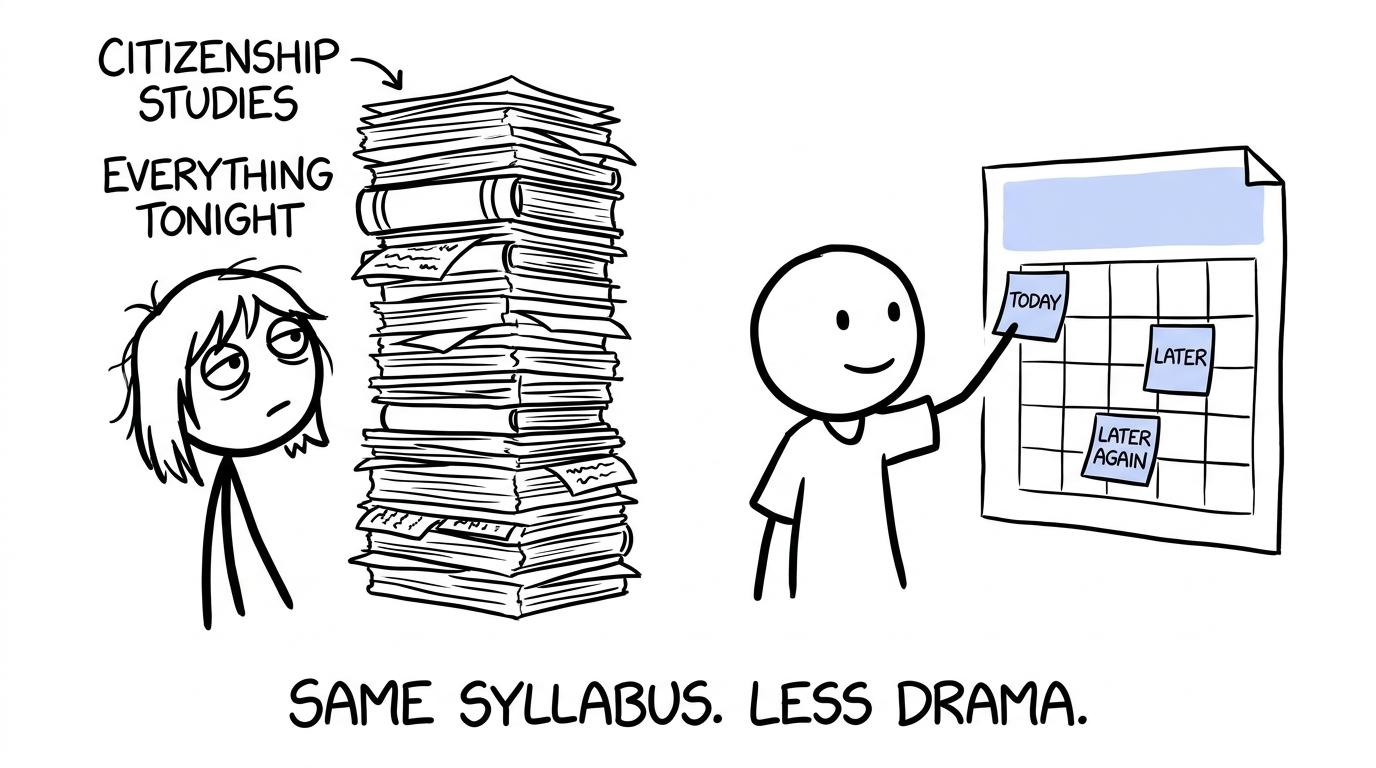 A student choosing a calm spaced revision calendar instead of a tower of notes
What spaced repetition actually means
Spaced repetition means distributing reviews over time instead of concentrating them in one long session. It is commonly combined with retrieval practice, which means trying to recall information with little or no prompting.
The distinction matters. Reading the same page every evening is spaced exposure, but it is not strong retrieval practice. Closing the book and explaining the role of the House of Commons from memory requires retrieval.
A useful sequence is:
- learn the material clearly;
- retrieve it without notes;
- check the answer immediately;
- correct any gap or misconception;
- return to it after a delay;
- increase the delay when recall becomes reliable.
Evidence reviewed by the Education Endowment Foundation suggests that spacing learning across days or lessons can have a small positive effect on pupil learning. Low-stakes quizzing and retrieval practice are also promising, generally positive approaches. However, there is no single perfect interval for every learner, year group or subject. Treat any schedule as a practical starting point rather than a scientific law.
A paper-based system that takes minutes to run
A complicated system can become another subject to revise. Start with something deliberately plain.
Take three envelopes, folders or sections of a box and label them:
- Soon: prompts you found difficult or answered incorrectly
- Later: prompts you answered correctly but not confidently
- Secure: prompts you recalled accurately and explained clearly
Begin each session with the Soon group. Answer aloud or on scrap paper before turning over the card. Correct answers move back; incomplete or incorrect answers return to the front.
A workable rhythm is:
- review difficult material the next day;
- return to improving material after several days;
- revisit secure material around a week later;
- bring everything back through mixed exam practice before the examination.
The interval should respond to performance. If you cannot explain a concept, shorten the gap. If recall is quick, precise and usable, lengthen it. That adjustment is the real engine of the method.
For students balancing Citizenship Studies with GCSE maths, place both subjects in one weekly plan. MathsGenie's guide to building a GCSE maths revision timetable can help you create a realistic structure without letting one subject consume every evening.
Build prompts around what the exam assesses
GCSE Citizenship Studies assessment objectives are consistent across specifications: AO1 concerns knowledge and understanding, AO2 concerns application, and AO3 concerns analysis and evaluation. Their overall weightings are 30%30\%30%, 30%30\%30% and 40%40\%40% respectively.
That means a deck made entirely from definition cards is incomplete. It trains one useful skill while neglecting a large part of the qualification.
Prompts for knowledge and understanding
Use these for institutions, processes, concepts and terminology. Suitable prompt types include:
- define a citizenship concept precisely;
- state the role of an institution;
- distinguish between two related terms;
- list stages in a political or legal process;
- identify rights, responsibilities or methods of participation.
Keep the expected answer short enough to check accurately. A card asking for an entire chapter encourages vague answers and makes it difficult to decide whether you were correct.
Prompts for application
Application means using knowledge in a particular context. Create prompts that ask you to:
- identify which concept applies to a short scenario;
- explain how a citizen or group could take action;
- connect an institution to a contemporary or hypothetical issue;
- choose relevant evidence for a question;
- explain how a principle operates in practice.
For current examples, use reliable material recommended by your teacher and check whether the details remain current. Political office-holders, policies and public debates can change. The underlying specification knowledge is often more stable than the examples used to illustrate it.
Prompts for analysis and evaluation
AO3 requires more than remembering a prepared opinion. Your cards should make you reconstruct reasoning.
Useful prompts might ask for:
- one argument supporting a viewpoint;
- one challenge or counterargument;
- evidence that could strengthen a claim;
- a limitation of that evidence;
- the criterion you would use to reach a judgement;
- a brief conclusion that follows from the preceding reasoning.
Do not memorise one rigid essay and hope the examination question matches it. Memorise flexible components: concepts, evidence, contrasting viewpoints and ways to judge significance or effectiveness.
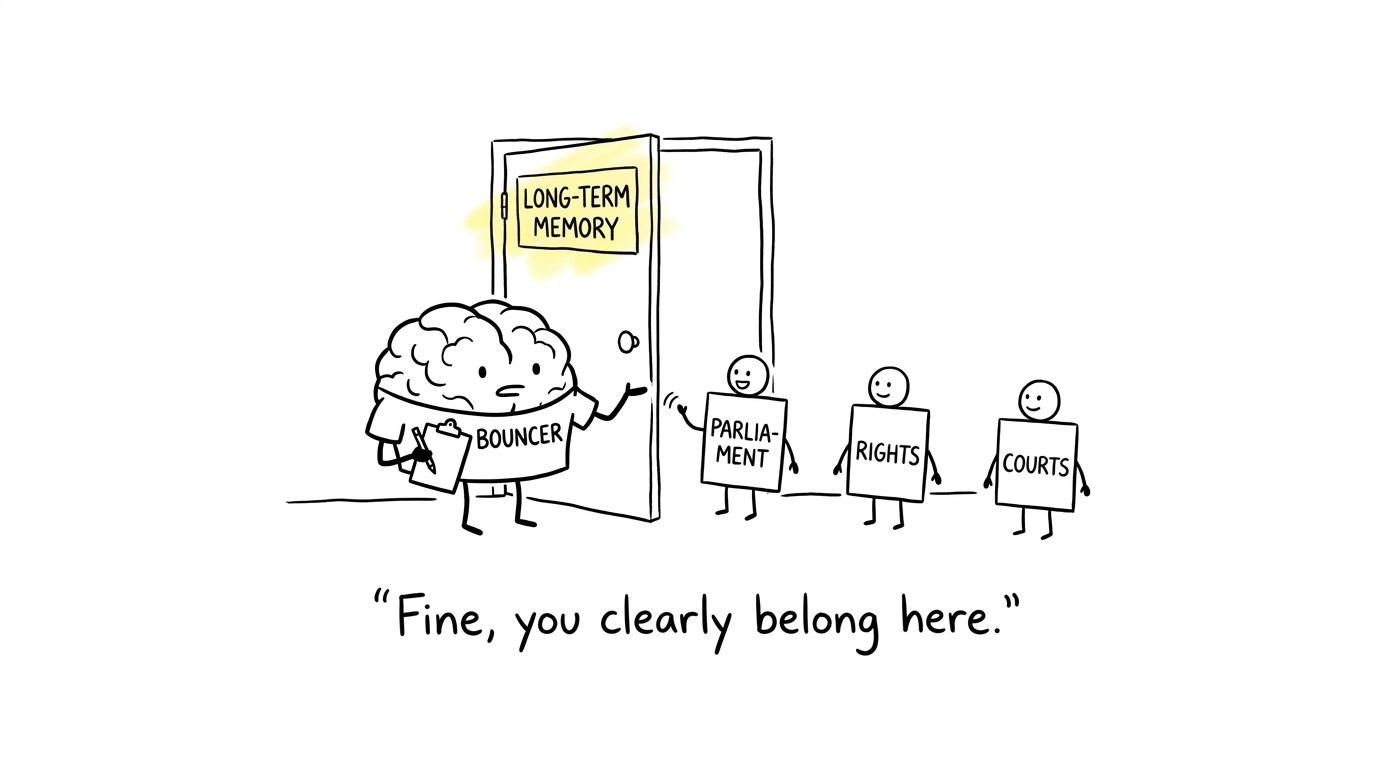 A cartoon brain finally admitting repeated Citizenship topics into long-term memory
Match your cards to your specification
AQA, Pearson Edexcel and OCR organise GCSE Citizenship Studies content and papers differently. Themes commonly include democracy and government, rights and responsibilities, law and justice, the UK's place in the wider world, participation, and citizenship action. The names and arrangement vary, so build your topic list from your own specification rather than somebody else's online deck.
Citizenship action also needs special attention. You may need to recall the purpose, research, methods, evidence, outcomes and evaluation of the action undertaken. Create prompts while the experience is still clear. Later, those cards should ask you to explain choices and evaluate effectiveness, not merely recite events.
Use a simple audit beside your card box:
- specification point covered;
- factual prompts created;
- application prompt created;
- analysis or evaluation prompt created;
- related exam question attempted;
- weakness scheduled for review.
This is similar to identifying weak areas in maths. The MathsGenie weakest-topics method shows how to turn errors into a focused revision list rather than revising randomly.
Turn each review into active recall
A flashcard is not automatically active recall. The critical moment happens before you reveal the answer.
Use this routine:
- Read the prompt once.
- Hide the reverse side and your notes.
- Say or write a complete answer.
- Compare it with the expected content.
- Add missing precision in a different colour.
- Decide the next review interval.
Be strict about partial answers. If a question requests two distinct reasons and you remember one, the card is not secure. If you state a conclusion without supporting reasoning, an evaluation prompt is not complete.
Recognition feels smoother than recall because the answer is already present. Exams do not usually provide your revision page beside the question. The mild difficulty of retrieval is therefore useful information, not proof that the session has failed.
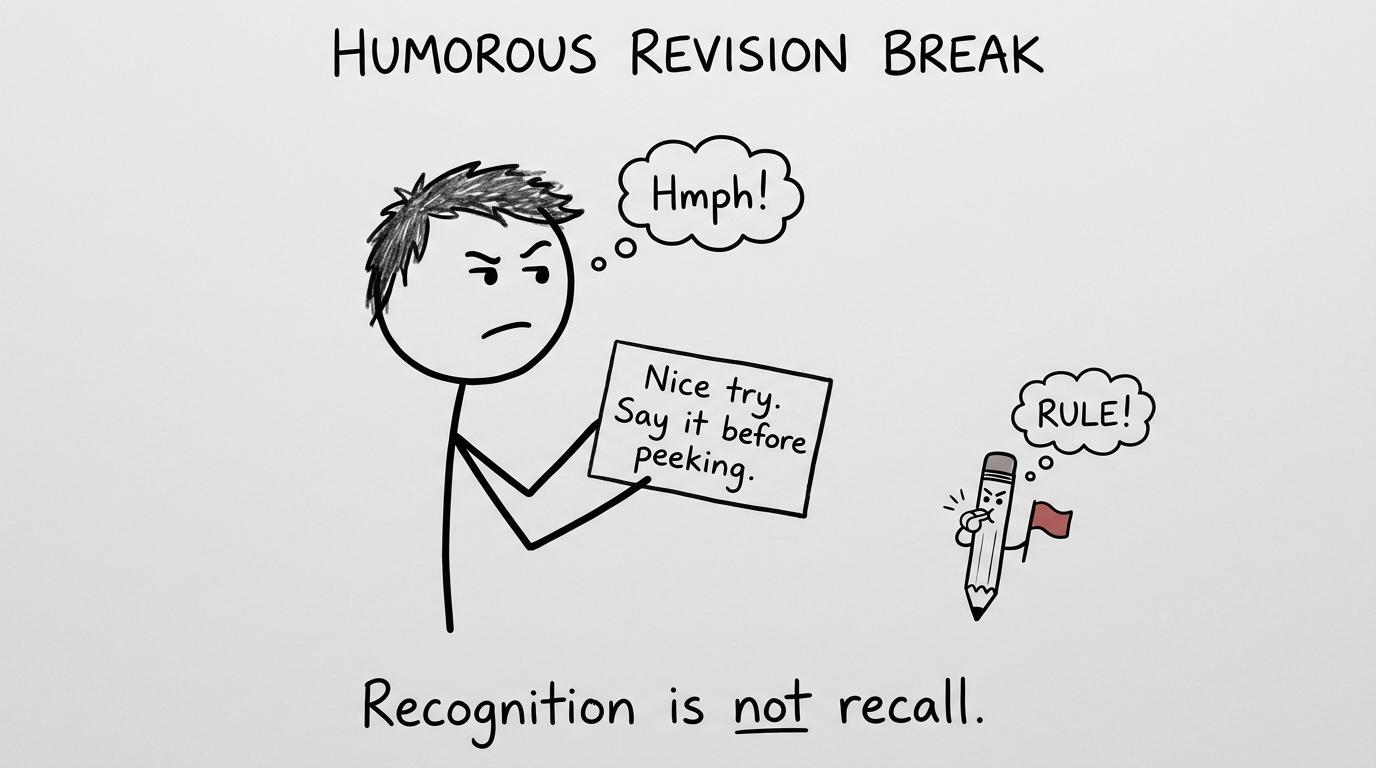 A flashcard and pencil reminding a student that recognition is not recall
Connect spaced repetition to exam questions
Flashcards strengthen access to knowledge, but they do not reproduce every demand of an examination. You must also practise interpreting sources, selecting relevant material, sustaining arguments and managing time.
Once a topic reaches the Later or Secure group, attach an exam-style task to it. Attempt the question without notes, use the mark scheme or teacher guidance, and convert any weakness into a new prompt.
This creates a useful loop:
- retrieve knowledge;
- apply it to a question;
- check against assessment expectations;
- identify the missing skill or fact;
- schedule that weakness again.
The same principle supports maths revision. MathsGenie's guide to stopping GCSE maths content from being forgotten combines active recall, spaced practice and exam questions. You can then use the free GCSE maths revision hub for lessons, practice questions, flashcards, mini tests and board-specific papers.
Fit Citizenship Studies around maths revision
Students preparing for several GCSEs do not need separate, elaborate productivity systems. Use one calendar and give each subject a clear job.
A Citizenship Studies review might contain a short card session followed by one source paragraph or argument plan. A maths session might contain retrieval of a method, targeted questions and careful marking. The subjects differ, but the revision rhythm remains familiar: retrieve, practise, check and return.
If exams are approaching, the one-month GCSE maths revision plan provides a useful model for balancing daily retrieval with weekly paper practice. The guide to when you should start GCSE past papers also explains why paper practice should build gradually rather than arriving as a last-minute shock.
Common spaced repetition mistakes
Making too many cards at once
Card creation can imitate revision without testing anything. Start with the highest-priority specification points, then add cards from lessons, marked questions and genuine errors.
Writing prompts that are too broad
“Explain democracy” is difficult to mark honestly. Break broad areas into precise prompts about principles, institutions, participation, strengths, limitations and contexts.
Turning cards over too quickly
Give retrieval a real attempt. A brief struggle is different from staring indefinitely, but instant peeking trains recognition rather than recall.
Memorising facts without arguments
Citizenship Studies rewards application, analysis and evaluation as well as knowledge. Include scenarios, evidence, counterarguments and judgement prompts.
Using fixed intervals regardless of performance
A missed card should return sooner. A confidently recalled card can wait longer. The schedule serves your learning; your learning does not serve the schedule.
Avoiding exam questions
Knowing a term does not guarantee that you can use it under pressure. Combine the card system with source work, extended responses and careful feedback.
Letting the system become unmanageable
If reviews accumulate, reduce the number of new cards and clear the difficult group first. Consistency matters more than owning a perfect collection.
Start small and let the evidence guide you
The best revision system is rarely the one with the most settings. It is the one that quietly brings yesterday's weakness back before it disappears.
Choose one Citizenship Studies topic today. Create a small set of precise prompts covering knowledge, application and evaluation. Test them without notes, sort them into Soon, Later and Secure, and put the next review in your calendar. That is enough to begin.
Then bring the same discipline to maths. Use MathsGenie's guide to self-studying GCSE maths alongside the free revision lessons, practice questions, mark schemes, video solutions, mini tests, past papers and predicted papers. Learn one skill, retrieve it, practise it, mark it and return to it later. Small loops, repeated honestly, are how revision becomes dependable.