

Stop Forgetting GCSE Maths Content (For Good)
GCSE maths revision that actually sticks. Use active recall, spaced practice, exam questions and YesGenie past papers, mini tests and lessons.
It usually happens the same way. You sit down to revise, feel fairly confident, and then a question asks for something basic, maybe rearranging a formula, or the area of a trapezium, and your mind goes oddly quiet. Not panic. Just blank.
If you’re revising for GCSE, this kind of forgetting can feel personal, like your brain is refusing to cooperate. But forgetting isn’t a character flaw. It’s the default setting. The trick is not trying to force your memory to behave, but building a revision routine that expects forgetting and plans around it.
This guide shows you how to stop forgetting GCSE maths content in a way that’s realistic for school life: short, repeatable sessions, lots of exam-style practice, and a simple system you can run on YesGenie.
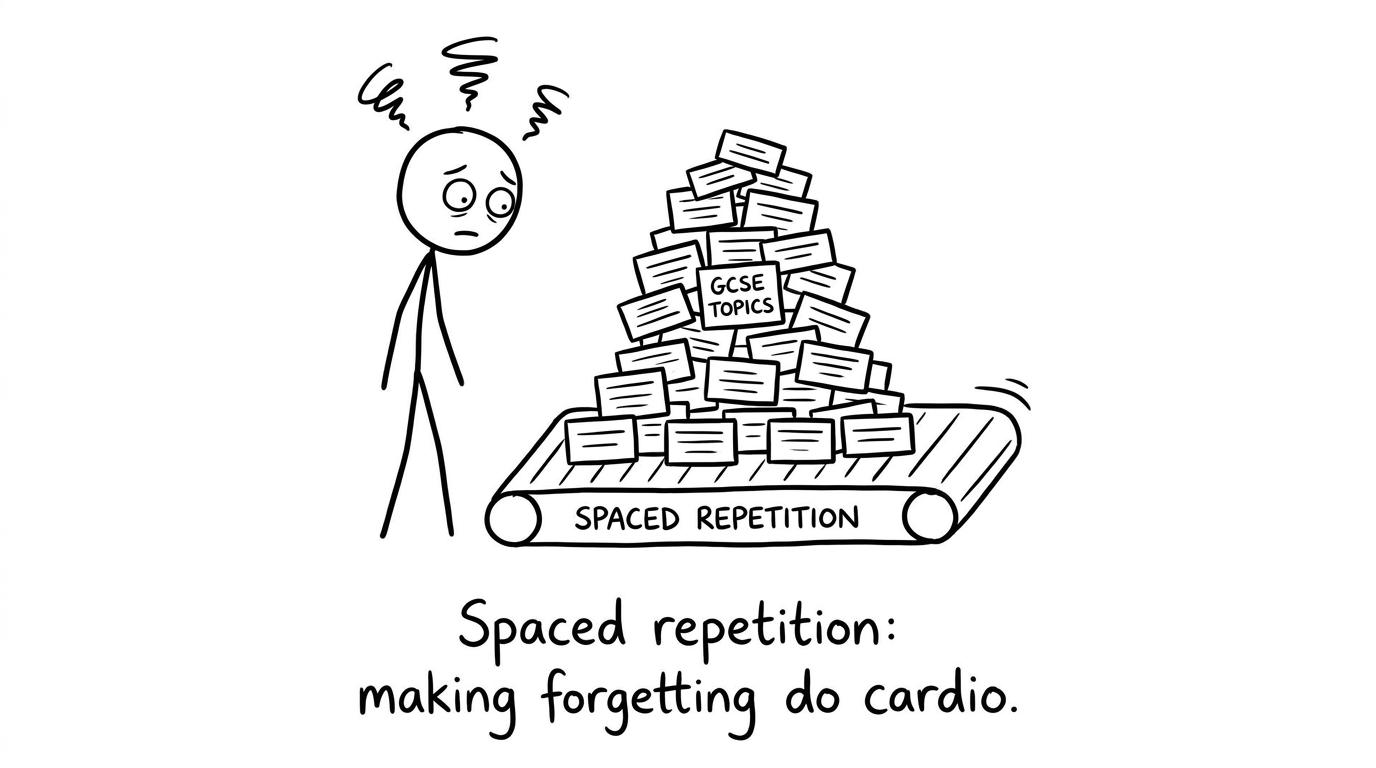 Spaced repetition making forgetting do cardio
The quick checklist (read this first)
If you want GCSE maths revision that sticks, you need three ingredients:
- Active recall: you try to remember before you look.
- Spaced practice: you come back to topics at increasing gaps.
- Exam-style questions: you practise the exact skill you’re marked on.
On YesGenie, that maps neatly to:
- Lessons + Flashcards to learn and recall a method
- Question bank + Revision guides to deepen understanding
- Mini tests + Past papers + Predicted papers to make it exam-ready
Useful starting points:
- GCSE Maths Revision (all topics)
- Edexcel GCSE Maths Revision Hub
- Edexcel GCSE Maths Lessons
- Edexcel GCSE Maths Revision Guides
- GCSE Past Papers (all boards)
- Edexcel GCSE Predicted Papers
- Edexcel GCSE Mini Tests
- Resources (mini tests, predicted papers, more)
Why you keep forgetting GCSE maths (even when you understand it)
A lot of GCSE maths feels like it should be “once learned, forever known”. But that’s not how memory works.
Understanding is often recognition: you can follow steps when the page is in front of you. Exams demand recall: you have to produce the steps with no prompts, under time pressure, with unfamiliar wording.
So the problem isn’t that you’re “bad at maths”. It’s that you’re using revision methods that create recognition, not recall. Rereading notes, watching videos passively, and highlighting can all feel soothing. They also hide forgetting until it’s too late.
To stop forgetting GCSE maths, you need to make forgetting visible early, when it’s useful.
The YesGenie method: learn, retrieve, space, exam
Think of your revision like building a small bridge that can hold weight. Each time you revisit a topic, you’re not “starting again”; you’re adding another support.
Learn it once (properly)
Pick one topic. Use a focused resource. On YesGenie, that can be a lesson or revision guide.
Examples you might choose:
Your goal here is not to memorise. It’s to understand the shape of the method.
Retrieve it fast (before you look)
Close the tab. On paper, write the method from memory.
For example, if the topic is solving a quadratic, you might write:
- “Put in the form ax2+bx+c=0ax^2+bx+c=0ax2+bx+c=0”
- “Try factorising”
- “If not, use the quadratic formula: x=−b±b2−4ac2ax=\frac{-b\pm\sqrt{b^2-4ac}}{2a}x=2a−b±b2−4ac”
Then check what you missed. This is the moment memory forms.
Space it out (so forgetting helps you)
Use a simple review schedule:
- Day 1: learn + retrieve
- Day 3: retrieve + a few exam questions
- Day 7: mini test / mixed questions
- Day 14: past-paper style questions
The spacing matters because remembering something after a gap is what makes it stick.
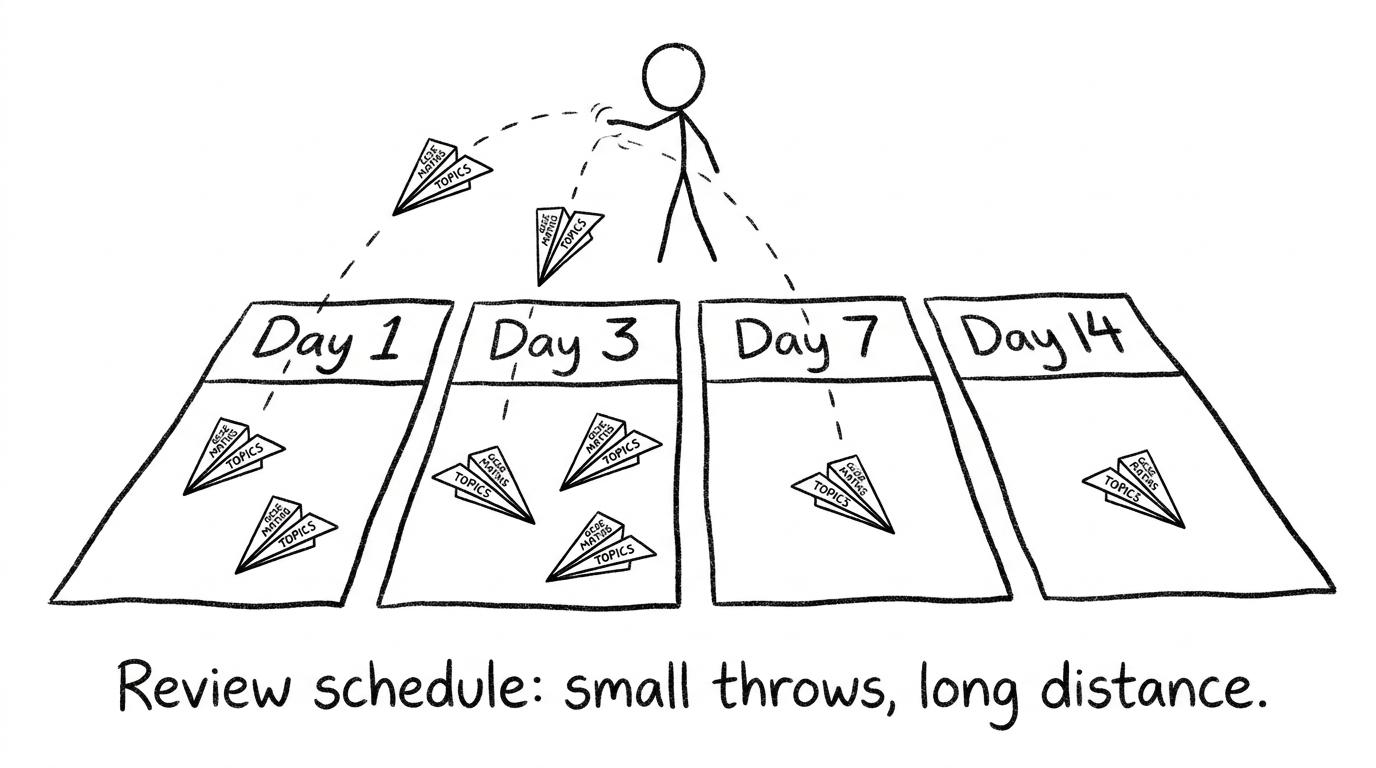 Revision schedule paper aeroplanes on calendar
Make it exam-proof (the mark scheme is the real teacher)
At GCSE, marks are awarded for methods, not vibes. This is why exam questions are the quickest route to long-term memory.
Use:
- Edexcel GCSE Mini Tests for short, topic-focused retrieval
- GCSE Past Papers when you need full exam practice
- Edexcel GCSE Predicted Papers when you want realistic, spec-matched practice
This approach works across boards (Edexcel, AQA, OCR, Eduqas) because forgetting and recall work the same way, even when question styles differ.
Worked example: rearranging a formula without “re-learning it”
Forgetting often shows up in rearranging formulae because it’s half logic, half habit.
Rearrange y=3x−52y=\frac{3x-5}{2}y=23x−5 to make xxx the subject.
Start by removing the fraction:
2y=3x−5 2y=3x-5 2y=3x−5Add 555 to both sides:
2y+5=3x 2y+5=3x 2y+5=3xDivide both sides by 333:
x=2y+53 x=\frac{2y+5}{3} x=32y+5To turn this into memory, don’t just read the steps. Do a 30-second retrieval:
- “Multiply by the denominator”
- “Undo additions/subtractions”
- “Divide by the coefficient of xxx”
Then do two more similar questions from the YesGenie topic lessons or question bank so your brain learns the pattern, not just this one question.
Worked example: percentages (the kind that vanish under pressure)
A classic GCSE forgetting moment is “reverse percentage”. Here’s a method you can reuse.
A sale price is £48 after a 20%20\%20% discount. What was the original price?
After a 20%20\%20% discount, you pay 80%80\%80% of the original price.
Let the original price be PPP.
0.8P=48 0.8P=48 0.8P=48 P=480.8=60 P=\frac{48}{0.8}=60 P=0.848=60So the original price was £60.
To strengthen recall, write the one-line template on a card:
- “After a d%d\%d% decrease, multiplier is 1−d1001-\frac{d}{100}1−100d.”
That’s more useful than a paragraph of notes, and it holds up in exam wording.
Why doing mixed questions stops forgetting GCSE content
In the real GCSE exam, questions are mixed. Your brain has to decide what topic it is before it can start.
If you only practise “today is algebra day”, you never practise the hardest skill: choosing the method.
This is where mini tests and past papers help because they force topic switching:
A good pattern is:
- Weekdays: short sessions on one topic (learn + retrieve)
- Weekend: one mixed mini test or half-paper
Even A Level students benefit here: the same forgetting cycle happens with algebra and functions, and your foundations decide how hard A Level feels.
Common mistakes that keep GCSE maths slipping away
Mistaking recognition for recall
If you can follow a worked solution, it feels like you “know it”. But GCSE papers don’t reward following, they reward producing. If you want to stop forgetting, always attempt a question before you check a method.
Spending too long “getting ready” to revise
Perfect timetables, colour-coded folders, and rewriting notes are comforting. They rarely increase marks. Five messy exam questions beat an hour of tidy copying.
Only practising your favourite topics
Forgetting clusters around the topics you avoid. You don’t have to like them, but you do need repeated contact. Use the YesGenie topic list and chip away.
Not using mark schemes properly
A mark scheme is a memory prompt for what examiners accept. If you only check the final answer, you miss the method marks that make grades move. Train yourself to compare your working line-by-line.
Revising too late and too intensely
Cramming can create short-term performance, then fast forgetting. The GCSE course is too wide for that to hold. Small, spaced sessions win.
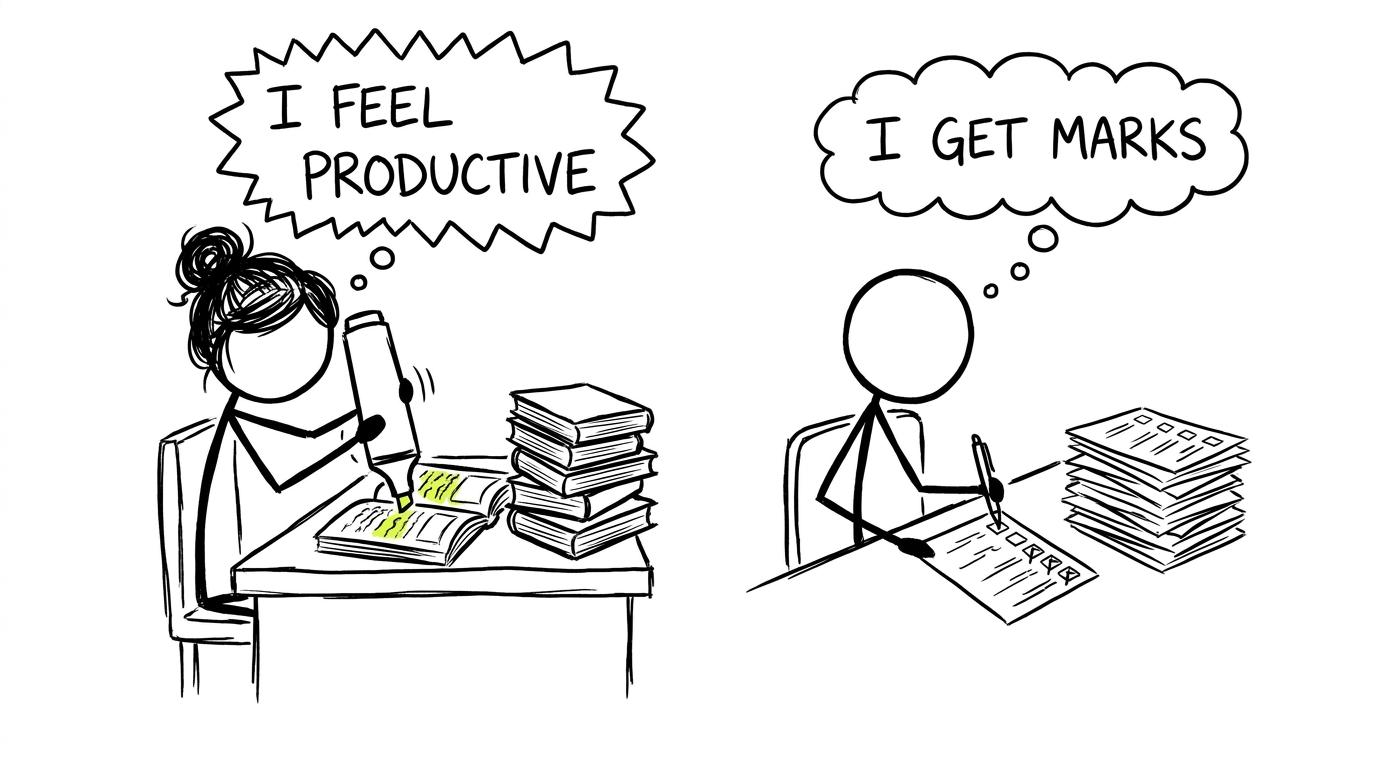 Highlighter vs practice questions: marks win
Bringing it together: a simple weekly plan
Here’s a calm, sustainable structure for GCSE maths revision:
- 3 weekdays (20-30 mins each): one topic lesson + active recall + 5 exam questions
- 1 weekday (20 mins): fix-your-mistakes session (redo the questions you missed)
- Weekend (45-60 mins): a mini test or half paper, then mark and log the gaps
Use the YesGenie hub for your board, then pull practice from the same place so your revision stays consistent:
- GCSE Maths Revision (all topics)
- Edexcel GCSE Maths Revision Hub
- Resources (predicted papers, mini tests)
Conclusion: stop forgetting GCSE maths by revising like the exam
To stop forgetting GCSE maths content, you don’t need more motivation. You need a system that treats forgetting as normal and builds recall on purpose. Learn a topic cleanly, retrieve it from memory, space your practice, and then use exam questions until the mark scheme feels familiar.
If you want one place to run that whole process, use YesGenie: revision lessons for understanding, practice questions and revision guides for depth, and GCSE past papers, mini tests, and predicted papers for exam confidence.
Pick one topic today from the GCSE Maths Revision page, do one short retrieval session, and let that be the start of your memory getting stronger, not by chance, but by design.










