

Short Breaks vs Long Break: GCSE Arabic Revision
Short breaks vs long break GCSE Arabic: learn what evidence suggests, choose practical timings, reduce fatigue and protect your GCSE maths revision.
A revision session can fail quietly. You begin with Arabic vocabulary, drift into reading notes, check your phone for what feels like a minute, and return without quite knowing where your attention went. If you are comparing short breaks vs long break GCSE Arabic revision, the practical answer is this: several planned short breaks are usually more useful during a demanding session, while a longer break is better after a group of focused study blocks or when you are genuinely fatigued.
The evidence does not reveal one perfect timetable, and research specifically on GCSE Arabic break patterns is limited. However, wider studies of learning and cognitive fatigue suggest that brief, systematic breaks can reduce tiredness and help students sustain concentration. They do not automatically improve recall or exam performance, so the work on either side of the break still matters.
For students balancing Arabic with GCSE maths, that distinction is important. A break should restore your ability to practise. It should not become the main event.
The short answer and revision checklist
Use this as your starting point:
- Work on one defined task for roughly 202020 to 303030 minutes.
- Take a planned break of around 555 minutes.
- Repeat for two or three focused blocks.
- Take a longer break of approximately 202020 to 303030 minutes afterwards.
- Keep phones, videos and games out of short breaks if they make returning difficult.
- Use active tasks such as retrieval, speaking, writing and exam questions rather than repeatedly reading notes.
- Adjust the timings when your concentration data tells you to, not simply because a productivity trend recommends a particular number.
This is a framework, not a rule. Some students can focus well for 404040 minutes; others need a reset after 202020. The useful question is not, “How long can I remain at my desk?” It is, “How long can I produce careful, testable work?”
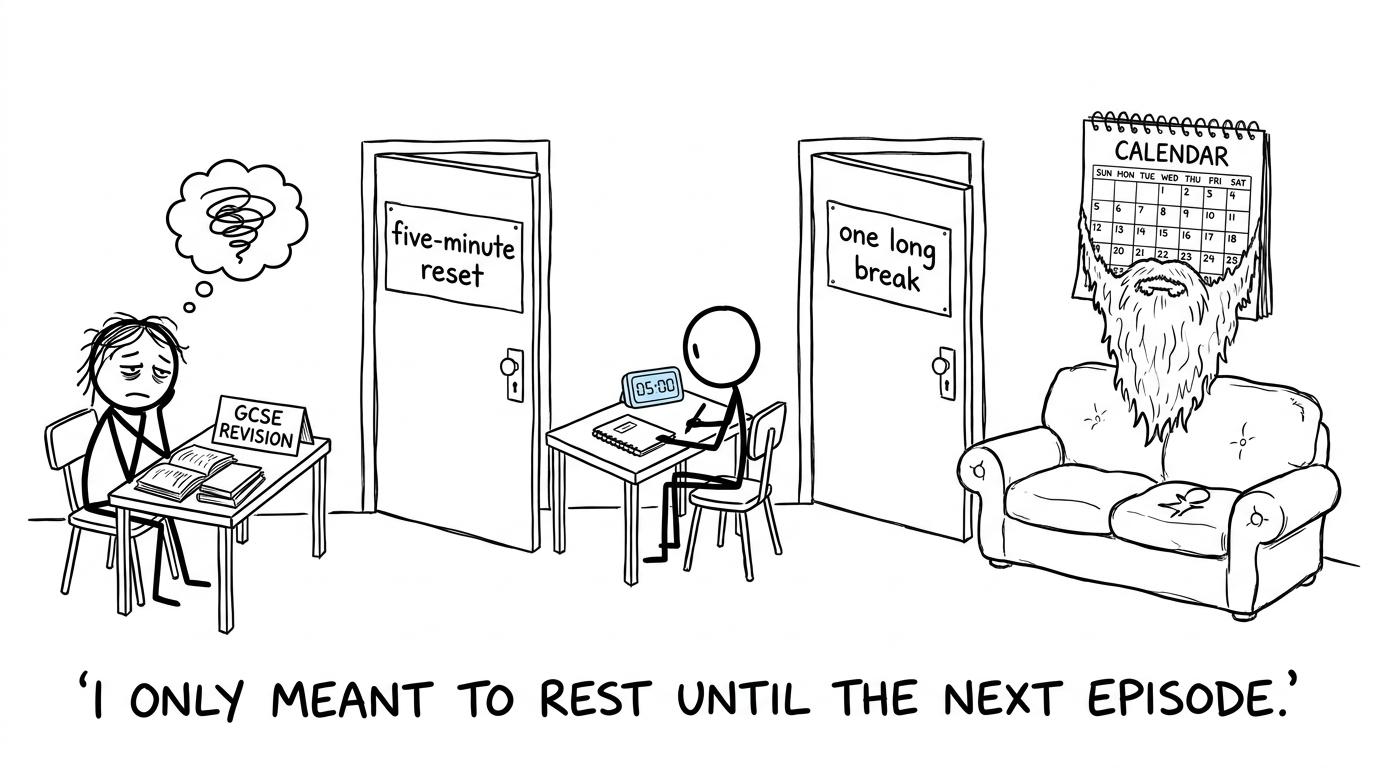 A student discovers that a long revision break has quietly become an entire television series
What the evidence actually suggests about breaks
Research on micro-breaks generally defines them as interruptions lasting no more than about 101010 minutes. A systematic review and meta-analysis found small but meaningful benefits for energy and fatigue. It did not find a statistically reliable improvement in overall task performance, and benefits were less clear for highly demanding cognitive work.
That makes the honest conclusion more useful than an exaggerated one: short breaks can help you feel less depleted, but they cannot make weak revision effective.
A separate study of real-life self-directed revision compared predetermined schedules, including 242424 minutes of work followed by a 666-minute break and 121212 minutes followed by 333. Students using systematic breaks reported better concentration, motivation and fatigue levels than those choosing breaks spontaneously. Task completion did not differ significantly between the groups.
The strongest practical message is therefore about structure. Planned breaks appear more dependable than waiting until you are already distracted. There is not enough evidence to claim that one precise ratio is best for every student, subject or task.
This also fits what is known about distributed practice. Revisiting knowledge across separate sessions generally supports longer-term learning better than compressing everything into one marathon. Spacing across days is not the same as taking a five-minute break, but both ideas challenge the assumption that uninterrupted time is always productive time.
Why GCSE Arabic can feel unusually dense
Pearson Edexcel GCSE Arabic assesses listening, speaking, reading and writing. Each skill contributes 25%25\%25% of the qualification, with Foundation and Higher tier entries available. Students must therefore move between recognition, recall, pronunciation, comprehension and written production.
Those tasks place different demands on attention. Reviewing vocabulary may feel manageable for longer than producing an extended written response. Listening practice requires concentration in real time. Speaking practice can be brief but mentally intense because you must retrieve and organise language without relying on a page.
One long session can disguise that variety. You may spend most of it on the skill that feels easiest, then describe the whole evening as Arabic revision. Shorter blocks make the imbalance visible.
A useful session might include:
- one block for vocabulary retrieval;
- one block for listening or reading comprehension;
- one block for speaking or writing;
- a longer rest before changing to maths.
The break is not what creates learning. The change from passive familiarity to active recall does that. The break simply helps protect the quality of the next attempt.
When several short breaks are likely to work better
Short breaks tend to be most useful when you are completing a sequence of demanding but manageable tasks. They create stopping points before accuracy falls away.
During vocabulary and grammar retrieval
If you are testing vocabulary, verb forms or sentence structures, repeated short blocks encourage honest retrieval. Stop at the planned time, record what you could not recall, take the break, then return without looking at the answer first.
This approach is better than staring at the same list until every word looks familiar. Familiarity can feel like knowledge even when you cannot produce the language independently.
While alternating receptive and productive skills
A brief reset between reading and writing, or listening and speaking, can prevent one task from blurring into the next. Use the pause to stand up, drink water or look away from the screen. Return with a clearly stated goal.
When Arabic shares the evening with maths
Many students are not choosing between Arabic revision plans in isolation. They are deciding how to preserve enough concentration for algebra, geometry or a timed paper afterwards.
MathsGenie's GCSE maths revision timetable guide explains how to organise topic work and exam practice without filling every available hour. You can place Arabic blocks beside maths blocks while keeping one subject from consuming all your usable attention.
For maths, a focused Edexcel GCSE maths mini test can fit neatly into a planned study block. It gives the block an endpoint and produces evidence about what needs revisiting.
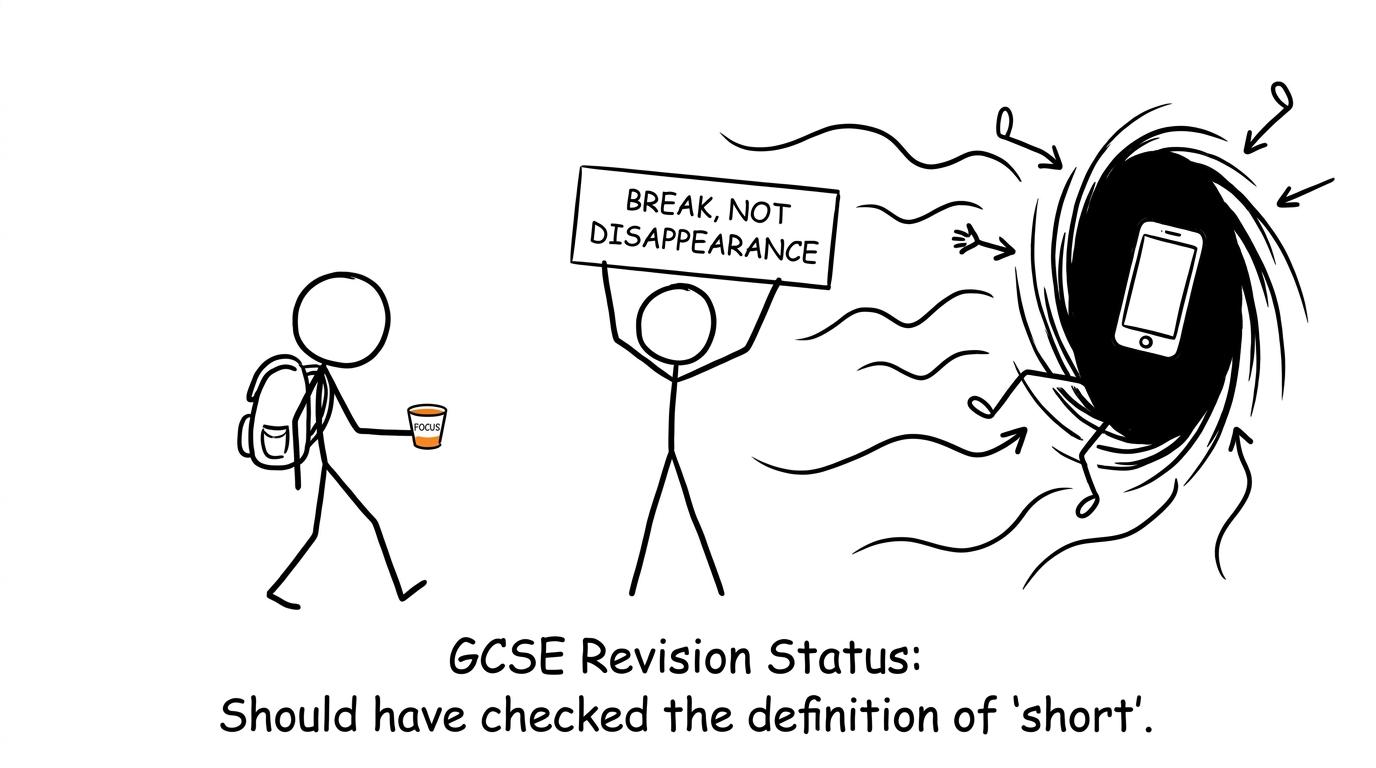 A smartphone black hole tries to turn a short break into a disappearance
When one longer break is the better choice
Several short pauses are not always enough. A longer break is sensible when you have completed multiple blocks, changed from one major subject to another, or reached the point where mistakes are multiplying despite genuine effort.
Warning signs include:
- rereading the same sentence without processing it;
- guessing answers you would normally retrieve;
- losing track of audio almost immediately;
- copying rather than producing language;
- making repeated, uncharacteristic errors in straightforward maths;
- feeling unable to restart after a brief pause.
A longer break can also separate two different kinds of revision. After Arabic, take time to eat, walk or rest before beginning maths. Light movement may support wellbeing and concentration, although evidence about immediate academic gains is mixed. Treat movement as restoration, not as a guaranteed marks booster.
The important boundary is that a longer break should still have an intended return time. If you have finished for the day, say so. Ambiguous breaks create guilt without producing either proper rest or useful revision.
Build a break pattern that you can test
Choose one schedule and use it consistently for several sessions. A reasonable starting pattern is:
- 252525 minutes of focused work;
- 555 minutes away from the task;
- repeat for three blocks;
- take a longer break of 202020 to 303030 minutes.
Do not judge the schedule by whether it felt fashionable or pleasantly organised. Track three simple outcomes:
- Did you complete the intended task?
- What could you recall without notes at the end?
- Could you restart promptly after each break?
If concentration collapses before the timer, shorten the block. If the alarm repeatedly interrupts productive work, extend it modestly. If a 555-minute break regularly becomes 252525 minutes, change what you do during the break rather than abandoning breaks altogether.
You can apply the same discipline to maths. Use the GCSE maths topics by board and tier guide to choose one precise skill, then complete a revision lesson and practice questions. Your tier and exam board matter: Edexcel, AQA, OCR and Eduqas organise papers differently, while Foundation and Higher tier demand appropriately matched practice.
MathsGenie's guide to the best order for learning GCSE maths topics can help when deciding what belongs in each block. A defined task is far easier to restart than the vague instruction to “do maths”.
Make every return active
The first minute after a break matters. Returning by reading old notes invites drift. Returning with a question creates momentum.
For Arabic, begin by retrieving vocabulary, summarising a passage, responding aloud or planning a written answer. For maths, attempt a question before opening the solution. MathsGenie's Edexcel GCSE maths past papers include mark schemes and worked solutions, making it possible to test first and diagnose afterwards.
Full papers require longer uninterrupted periods because exam stamina must also be practised. Short blocks are ideal for building individual skills, but they should eventually lead towards timed sections and complete papers. The guide to using GCSE maths past papers properly shows how to turn lost marks into targeted follow-up practice.
Nearer the examination, Edexcel GCSE maths predicted papers provide fresh exam-style practice. They should be used as tests, not predictions to memorise.
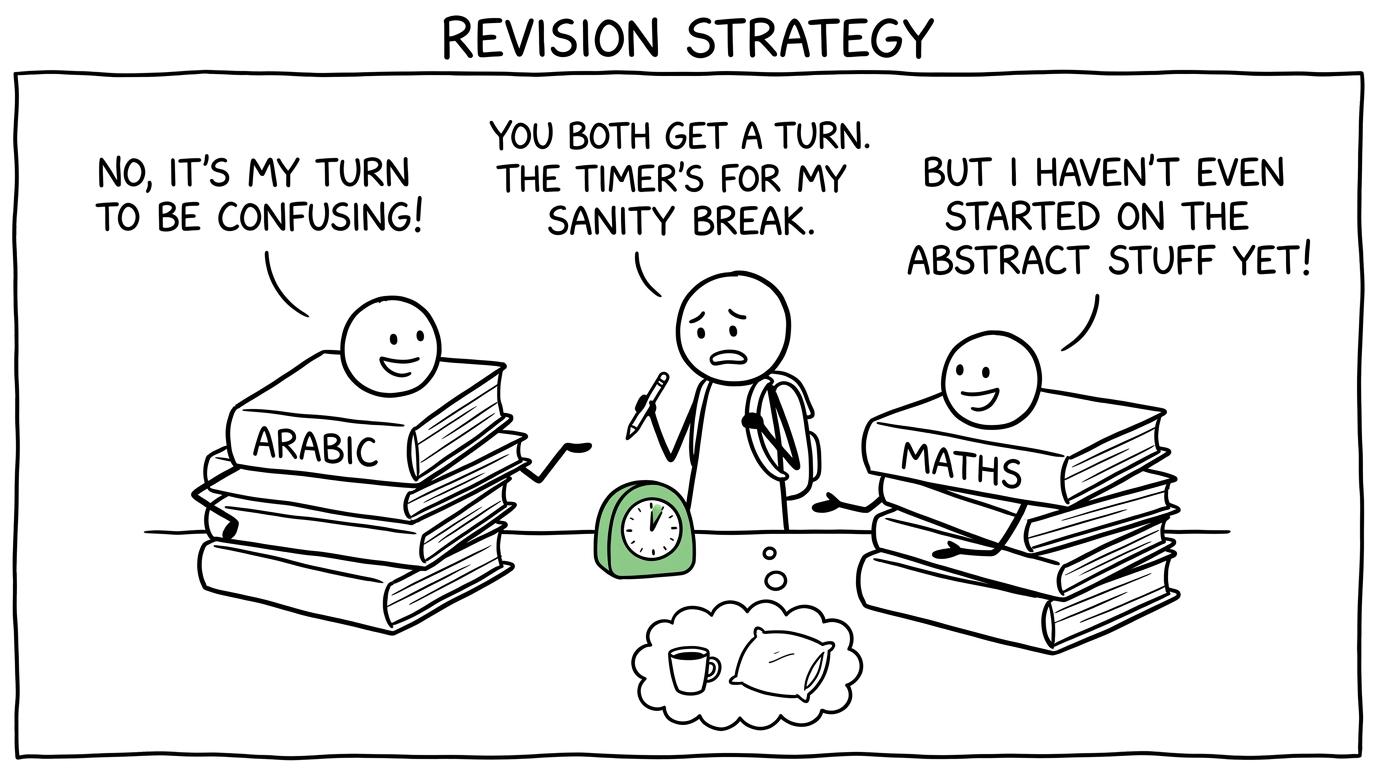 Arabic and maths books negotiate fair use of the revision timer
Common mistakes with revision breaks
Letting the phone choose the break length
A break with no boundary can expand rapidly. Set the return alarm before touching your phone, or leave the phone outside the room and choose a lower-stimulation activity.
Treating a timer as proof of learning
Completing four timed blocks proves only that time passed. End each block with something observable: recalled words, a recorded speaking response, marked questions or corrected errors.
Taking breaks only after concentration has disappeared
By then, part of the session may already have been low quality. Plan pauses in advance and adjust them from evidence gathered over several sessions.
Breaking too often during exam practice
GCSE papers do not pause every 252525 minutes. As exams approach, include uninterrupted practice that reflects the demands of the paper. MathsGenie's guide on when to start GCSE past papers explains how to progress from shorter diagnostic work to timed papers.
Using late revision to replace sleep
Neither short nor long breaks compensate for an exhausted night. Stop at a sensible time, particularly before an examination. The GCSE maths night-before plan prioritises short, targeted practice and a calm finish rather than an unsustainable marathon.
The better question is what happens after the break
Several short breaks will usually beat one long interruption when your aim is to sustain a dense GCSE Arabic session. A longer break becomes valuable after several blocks, between subjects or when genuine fatigue makes further work unreliable. Neither approach has a universally perfect length, and neither can rescue passive revision.
Plan the pause. Define the return task. Test whether you can recall more and restart reliably.
Then bring the same discipline to maths. Start at the MathsGenie GCSE and A Level maths revision hub, choose a revision lesson, complete the practice questions, and check your work with mark schemes or video solutions. Build towards mini tests, past papers and predicted papers. Good revision is rarely one heroic stretch. It is a sequence of focused returns.











