How to Use Edexcel GCSE Maths Past Papers Properly
GCSE students: learn how to use Edexcel GCSE Maths past papers properly with a simple routine to sit, mark, analyse mistakes, and improve fast.
If you have ever sat an Edexcel paper at your desk, looked at the first hard question, and felt your confidence fall through the chair, you are not alone. That moment is common in GCSE revision because past papers don’t just test maths; they test decisions: when to move on, what to write, how to show method marks, and how to stay calm. Used properly, Edexcel GCSE Maths past papers become less like a judgement and more like a map. They show you what you really know, what you only half-know, and what you keep avoiding.
This guide shows you how to use Edexcel GCSE Maths past papers properly, so every paper you do makes the next one easier.
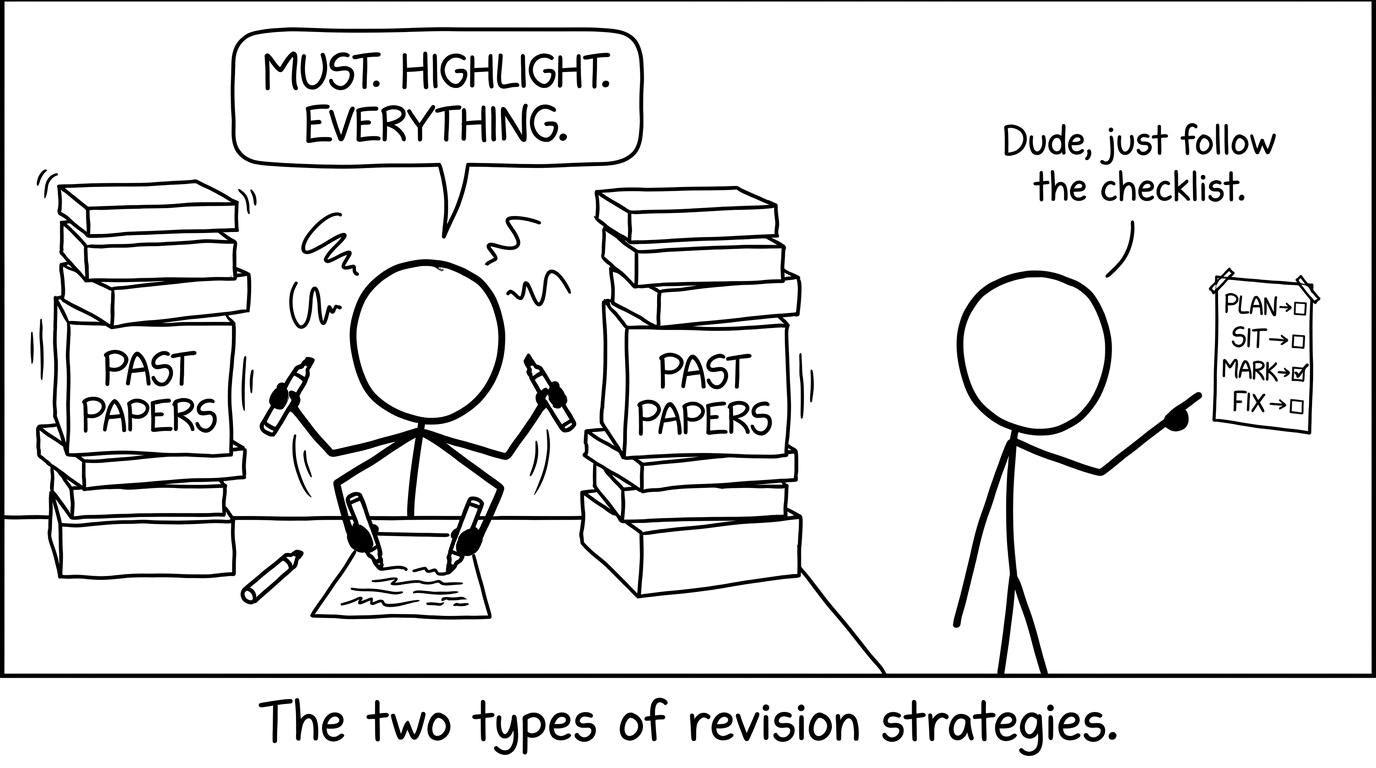 A stressed student vs a simple past paper routine
The goal: turn a past paper into a feedback machine
Most students treat a past paper like a performance. You sit it, you score it, you either feel relieved or awful, and then you move on.
But the real purpose of Edexcel GCSE Maths past papers is to create specific feedback you can act on within 24 hours.
Here’s the simple rule:
- A past paper is only “done” when your mistakes have been turned into targeted practice.
If you want the best place to start, use the board-specific hub for Edexcel on YesGenie: Edexcel GCSE Maths Revision. It pulls together the papers, mark schemes, topic revision, and practice so your paper work actually converts into marks.
A quick checklist (the method that works)
Keep this as your routine for every Edexcel paper:
- Pick the right paper (Foundation/Higher, Paper 1 non-calculator vs Papers 2/3 calculator)
- Sit it like the real thing (time, silence, no hints)
- Mark it ruthlessly (use the mark scheme, award method marks)
- Diagnose mistakes (content gap vs exam technique vs time pressure)
- Fix the top 3 topics using targeted practice and a second attempt
- Re-sit selected questions 48 hours later to confirm learning
For the actual paper set, go straight to Edexcel GCSE Maths Past Papers. If you want to browse across boards (AQA, OCR, Edexcel, Eduqas), use GCSE Past papers.
Step 1: choose the right Edexcel paper (and stop wasting the good ones)
Edexcel GCSE Maths has three papers:
- Paper 1: Non-calculator
- Paper 2: Calculator
- Paper 3: Calculator
And two tiers:
- Foundation tier (grades 111 to 555)
- Higher tier (grades 444 to 999)
A common GCSE revision trap is using the newest papers too early, before your weak topics have had any attention. It feels productive, but it often creates the same mistakes again and again.
A better approach:
- Early revision: use older papers, or split papers into sections.
- Mid revision: use full papers under timed conditions.
- Final run-up: use your newest past papers, plus predicted papers.
YesGenie also has a broader set of exam practice formats (useful if full papers feel too heavy every time): Resources.
Step 2: sit the paper like an exam (but with one smart twist)
When you practise, you’re not just learning content; you’re learning state. The exam is a performance under mild stress. So copy the conditions.
- Put your phone out of reach.
- Sit somewhere quiet.
- Use the correct time limit.
- Use only the equipment allowed.
The smart twist: two-pass pacing
On your first pass:
- Do the questions you can start immediately.
- If you are stuck for more than 60-90 seconds, circle it and move on.
On your second pass:
- Return to circled questions.
- Spend longer, but still watch the clock.
This is how GCSE marks are protected. You stop donating easy marks because one hard question stole your time.
Step 3: mark for method marks, not just answers
Edexcel mark schemes reward process. If your final answer is wrong but your method is mostly right, you can still gain marks.
So marking isn’t just “right/wrong”. It’s: what marks would an examiner give you?
On YesGenie, you can pair a paper with worked solutions and a mark scheme, then learn the exact style of working that earns marks. Start from the Edexcel hub and move through to papers and solutions: Edexcel GCSE Maths Revision.
Worked example: show working to collect method marks
Suppose a question requires simplifying:
3x4+x6 \frac{3x}{4} + \frac{x}{6} 43x+6xCorrect method:
- Find a common denominator: LCM(4,6)=12\text{LCM}(4,6)=12LCM(4,6)=12.
Add:
9x12+2x12=11x12 \frac{9x}{12} + \frac{2x}{12} = \frac{11x}{12} 129x+122x=1211xIf you instead wrote 4x10\frac{4x}{10}104x, the answer is wrong, but a mark scheme might still award a mark if you identified common denominators correctly or converted one fraction properly. That is why you must write your steps.
Step 4: build a “mistakes log” that actually improves your GCSE grade
A mistakes log sounds boring. It is. It is also one of the highest-return habits in GCSE maths.
After marking, create a table with four columns:
- Topic
- What went wrong
- The correct method (one or two lines)
- A “next action” practice link
Your goal is not to list everything. Your goal is to spot patterns.
Common patterns look like this:
- You make algebra slips when you rush.
- You lose marks for not stating units.
- You can do a method in isolation, but freeze when it’s hidden in context.
To fix patterns, switch from whole-paper practice to targeted topic practice. That is where YesGenie’s topic resources are built to help: Edexcel GCSE Maths Revision Guides.
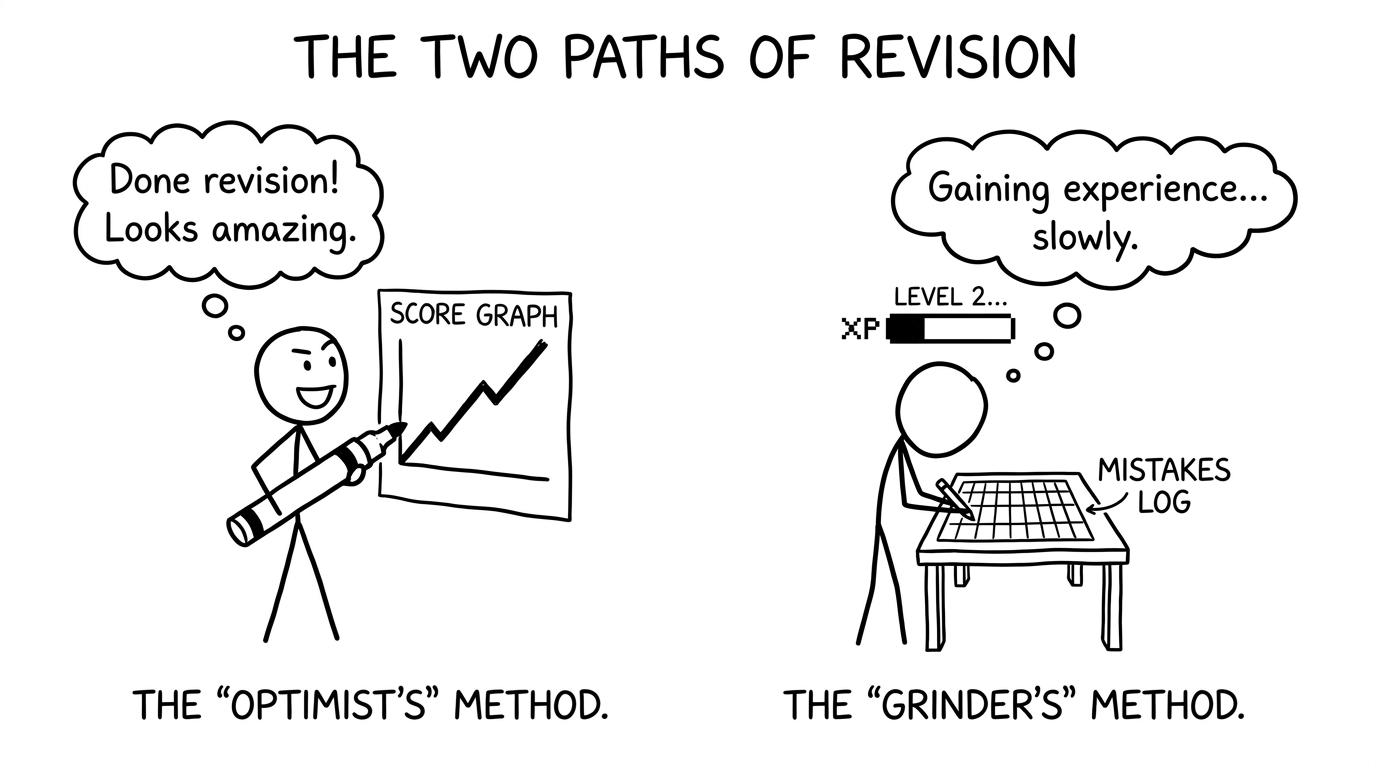 A student discovers the power of a mistakes log
Step 5: convert your paper into targeted topic practice (the 20-minute rule)
A good GCSE routine after a past paper is short, sharp, and specific.
Choose your top three mark-loss areas (not ten). Then do:
- 20 minutes per topic using revision notes plus practice questions.
For example, if you lost marks on indices and roots, you could review a focused guide like Powers and Roots (GCSE Revision Guide), then do exam-style questions on that topic.
If your weakness is proof (a classic grade 777 to 999 separator), use a dedicated topic hub like Proof (GCSE Maths) to see the structure and practise the style of written reasoning Edexcel rewards.
Worked example: a classic rearranging trap
You often see rearranging in GCSE papers because it tests algebra and accuracy.
Make xxx the subject:
3y=2x+5 3y = 2x + 5 3y=2x+5Step-by-step:
3y−5=2x 3y - 5 = 2x 3y−5=2x x=3y−52 x = \frac{3y - 5}{2} x=23y−5Two key habits that win marks:
- Keep operations balanced (whatever you do to one side, do to the other).
- Write the final subject clearly as x=…x = \dotsx=….
If you wrote x=3y2−5x = \frac{3y}{2} - 5x=23y−5, you have effectively done:
3y−52≠3y2−5 \frac{3y - 5}{2} \neq \frac{3y}{2} - 5 23y−5=23y−5because −5-5−5 should also be divided by 222.
Step 6: re-sit questions, not whole papers (spaced retrieval)
The fastest way to make past papers work is to re-sit your worst questions later.
- Re-do them the next day (with notes allowed).
- Re-do them again 48 hours later (no notes).
If you can do them cleanly the second time, you learned something. If you cannot, you did not revise; you only reviewed.
This is also where predicted papers can help, because they give you fresh exam-style questions to test whether the same topics now feel stable. Use: Edexcel GCSE Maths Predicted Papers.
Step 7: use calculator papers properly (stop letting your calculator do the thinking)
Calculator papers punish two things:
- Rounding too early
- Not showing method
Even if the final line is from a calculator, the marks are usually for the setup.
Example: calculate 3.6×1059×102\frac{3.6 \times 10^5}{9 \times 10^2}9×1023.6×105.
Use index laws:
3.69×10⁵−2=0.4×10³ \frac{3.6}{9} \times 10^{5-2} = 0.4 \times 10^3 93.6×10⁵−2=0.4×10³Then convert to standard form:
0.4×103=4×10² 0.4 \times 10^3 = 4 \times 10^2 0.4×103=4×10²A calculator will happily produce a decimal, but Edexcel often wants the structured maths.
Common mistakes students make with Edexcel GCSE Maths past papers
- Doing papers open-book and calling it revision. It is not GCSE exam practice if you are being guided.
- Only doing Paper 1 because it feels “pure”. You still need calculator fluency and setup.
- Not using the mark scheme properly. You need to see what counts as a method mark.
- Chasing a score instead of chasing a pattern. Your mistakes log is more important than your percentage.
- Never reattempting questions. Learning is confirmed by successful retrieval, not by reading solutions.
- Mixing tiers blindly. Higher students should still be secure on Foundation topics, but the paper choice should match your target grade.
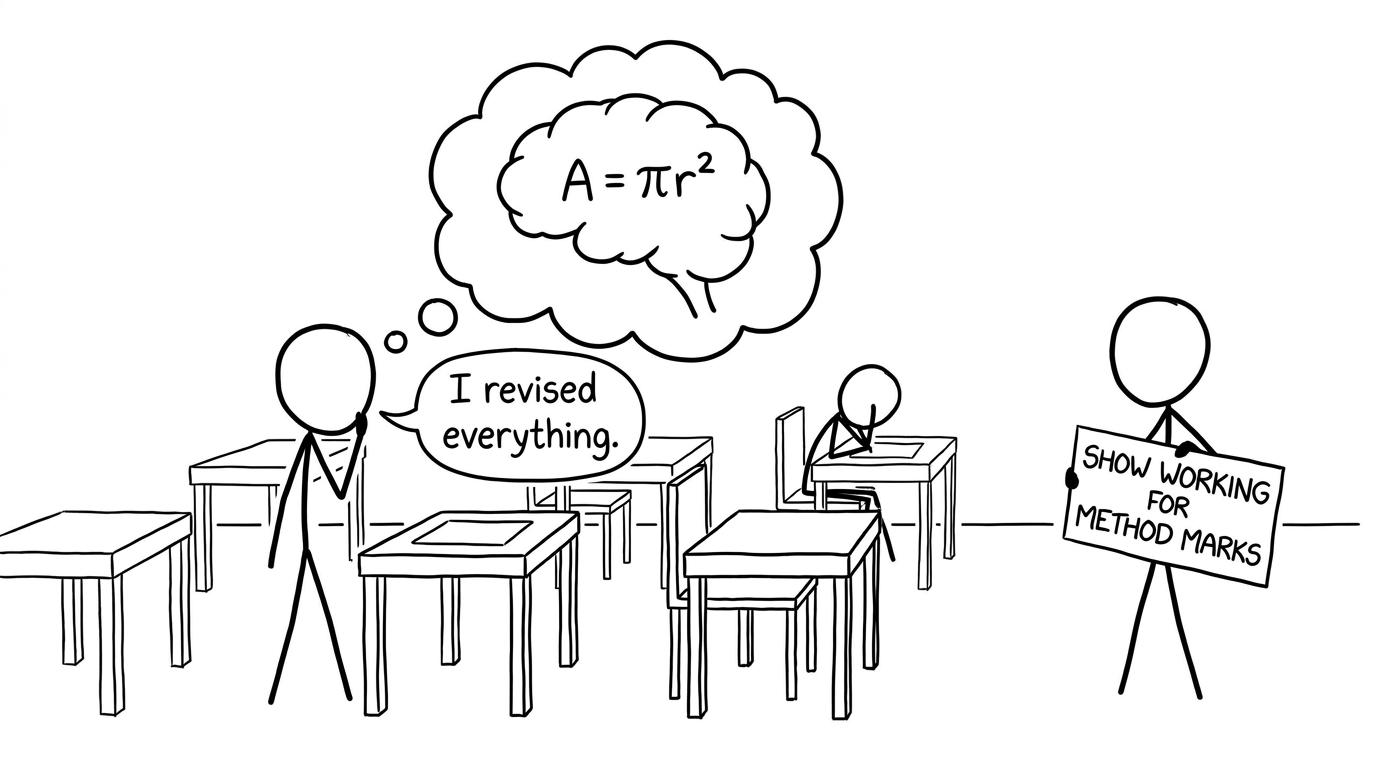 Show your working for method marks
The quiet advantage: make each GCSE paper earn its keep
The students who improve fastest aren’t always the ones who do the most Edexcel GCSE Maths past papers. They are the ones who treat every paper like a conversation: the paper tells them something honest, and they respond with targeted practice.
So keep it simple:
- Sit an Edexcel paper properly.
- Mark it using the scheme.
- Log the mistakes.
- Fix three topics.
- Reattempt the hardest questions.
If you want one place where the whole cycle is easy to repeat, use YesGenie as your revision base: Edexcel GCSE Maths Revision for lessons and revision guides, Edexcel GCSE Maths Past Papers for real papers and mark schemes, and Edexcel GCSE Maths Predicted Papers to pressure-test your progress. Then keep going until your mistakes log starts to look smaller than your confidence.