Revising GCSE Physical Education With Music
Revising GCSE Physical Education with music? Learn when it may help, why lyrics can hurt focus, and how to test your best revision setup before exams.
Revision can look productive while quietly achieving very little. The textbook is open, a playlist is running and an hour passes pleasantly. But when you close the book, how much can you actually recall?
The short answer is that revising GCSE Physical Education with music can work, but silence is usually the safer choice for demanding reading, memorisation and exam questions. Music with lyrics is the greatest risk because the words compete with the language you are trying to process. Quiet instrumental music may be acceptable for routine tasks or if it helps you begin, but research does not show that it reliably improves learning.
The useful question is not whether music feels good. It is whether you remember more and answer questions more accurately.
The quick music and revision checklist
Use this as your starting position:
- Choose silence for learning unfamiliar content, recalling definitions and writing extended answers.
- Avoid music with lyrics while reading or memorising GCSE PE theory.
- If silence feels uncomfortable, try familiar instrumental music at a low volume.
- Keep your phone out of reach so choosing songs does not become the real distraction.
- Complete past-paper questions in silence because your exam will not have a soundtrack.
- Compare your results under different conditions rather than relying on how focused you feel.
That final point matters. Enjoyment and learning are related, but they are not identical.
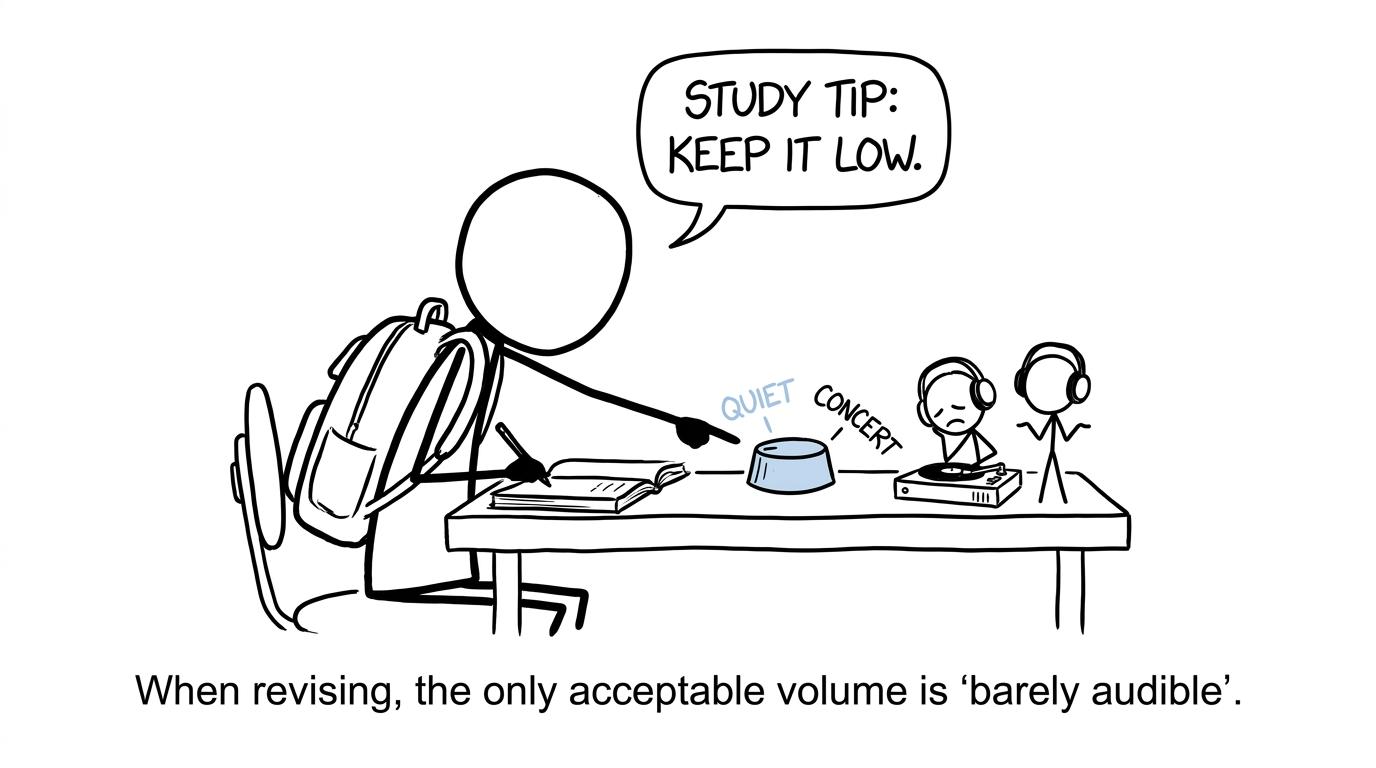 A student negotiates with tiny DJs beside a revision volume control
Does background music help GCSE PE revision?
Background music can sometimes make revision feel less tedious. It may improve your mood, reduce the sense of surrounding noise or help you settle into a session. For a student who keeps delaying the first page, that can have practical value: a session completed with quiet music is more useful than a silent session that never starts.
The evidence about actual performance, however, is mixed and task-dependent. A substantial systematic review of research into background music found that music often had no clear effect, but negative effects appeared particularly in memory and language tasks. Music containing lyrics tended to be more disruptive than instrumental music.
A controlled study published in 202320232023 compared silence, instrumental lo-fi music and music with lyrics during verbal memory, visual memory, reading comprehension and arithmetic tasks. Performance was generally strongest in silence. Lyrics hindered memory and reading, while instrumental music neither reliably improved nor damaged performance. The participants were university students rather than GCSE pupils, so the findings should not be treated as a perfect prediction for every teenager. They do, however, support a sensible rule: do not assume music is helping simply because it feels comfortable.
Why the revision task changes the answer
GCSE Physical Education combines several kinds of thinking. Depending on your specification, you may need to remember anatomical terms, explain training principles, interpret data, apply knowledge to sporting situations and construct extended responses. AQA, Edexcel, OCR and Eduqas organise their assessments differently, so check the current specification for your board.
Music is more likely to interfere when you are:
- reading a dense explanation of the cardiovascular or respiratory system;
- learning definitions and key terminology;
- recalling a sequence or classification;
- planning an extended response;
- applying theory to an unfamiliar sporting scenario;
- checking a mark scheme carefully.
A repetitive task, such as organising notes or creating headings, places fewer demands on language and memory. Quiet instrumental music may be less troublesome there. The mistake is using one playlist for every task as though all revision requires the same level of concentration.
Why lyrics are especially distracting
Your attention is limited. When a song contains words, your brain has to manage those words while also processing the words in your notes. You may not deliberately listen to every lyric, but familiar lines can still pull attention away from the material.
This competition is particularly relevant to GCSE PE theory. Remembering the functions of body systems or distinguishing closely related sporting concepts depends on accurate verbal recall. Extended questions also require you to select relevant knowledge, apply it to the context and communicate a reasoned answer. A second stream of language rarely makes that easier.
Songs in a language you understand are usually more disruptive than music without intelligible lyrics. Familiar songs introduce another problem: anticipation. You know when the chorus is coming, and part of your attention follows the track rather than the argument on the page.
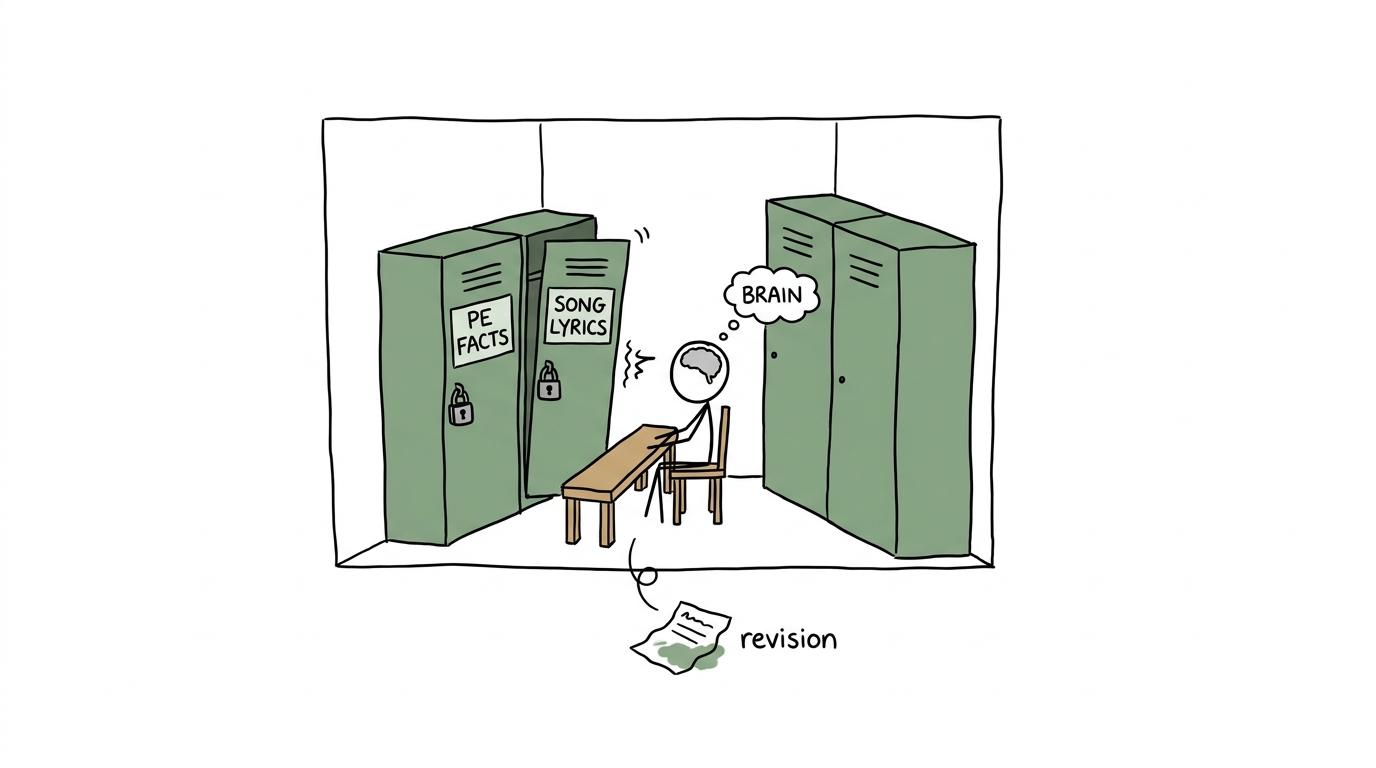 Two sets of words compete for space inside a student's imaginary changing-room brain
When instrumental music may be reasonable
Instrumental music is not automatically a concentration tool. Complex, dramatic or rapidly changing tracks can still capture attention. Volume matters too. Music that is quiet enough to fade into the background is less likely to interrupt you than music that turns revision into a private concert.
Instrumental background music may be reasonable when:
- you are completing a familiar, low-demand task;
- unpredictable household noise would otherwise distract you;
- it helps you start a session without repeatedly checking your phone;
- the track is familiar, steady and quiet;
- your test results show no loss of recall or accuracy.
If you use music, choose a playlist before starting. Do not search for the perfect track between questions. Autoplay, notifications and song changes can fragment a revision block even when the music itself is harmless.
You can use the same principle during maths revision. A video explanation, demanding higher-tier problem or timed paper deserves your full attention. The free GCSE Maths revision hub brings lessons, exam questions and papers together so that you can start working without spending half the session searching for resources.
Match the sound to each stage of revision
Good revision changes shape as you move from understanding to recall and then to exam practice. Your sound environment should change with it.
Learning unfamiliar theory
Use silence when meeting new material. Read a short section, close the book and retrieve the main ideas without looking. If you cannot explain them clearly, reread selectively rather than highlighting the whole page.
A short, defined block is easier to protect than an open-ended evening. MathsGenie's 20-minute GCSE revision routine shows how setup, recall, questions and marking can fit into one compact session. The same structure can be adapted to PE theory.
Reviewing familiar material
Quiet instrumental music is less risky once you already understand the topic, but retrieval must remain active. Cover your notes, answer a question, label a diagram from memory or explain a concept aloud. Rereading while listening to music can feel fluent because both the page and playlist are familiar. Familiarity is not proof of recall.
If you are unsure what deserves attention, use results rather than instinct. The process in finding your weakest GCSE topics, attempt, mark, diagnose and retest, works across subjects.
Completing exam questions
Turn the music off. GCSE PE written assessments include combinations of objective, short-answer and extended-response questions, although the exact structure varies by board. You need to practise retrieving knowledge under conditions that resemble the real exam.
Mark your work carefully. Record whether each lost mark came from missing knowledge, weak application, imprecise terminology, misreading the command word or poor time management. The mark scheme is feedback, not simply a final score.
That approach also sits at the heart of effective maths preparation. Read when to start GCSE past papers for a sensible progression from targeted practice to full timed papers.
Run a fair test on your own concentration
Individual responses differ, so conduct a simple personal test rather than defending your favourite playlist in theory.
Choose three similar revision sessions: one in silence, one with quiet instrumental music and one with your usual music. Keep the topic difficulty, session length and type of task as similar as possible. Put your phone away in every condition.
At the end of each session:
- answer the same number and type of retrieval questions;
- record how many answers were accurate;
- note how often you stopped, changed track or reread a sentence;
- test the material again the following day;
- compare delayed recall, not just immediate confidence.
One session may be affected by tiredness or topic difficulty, so repeat the comparison before drawing a firm conclusion. If instrumental music helps you stay seated but produces the same recall as silence, it may be a useful compromise. If lyrics reduce accuracy, the evidence has made the decision for you.
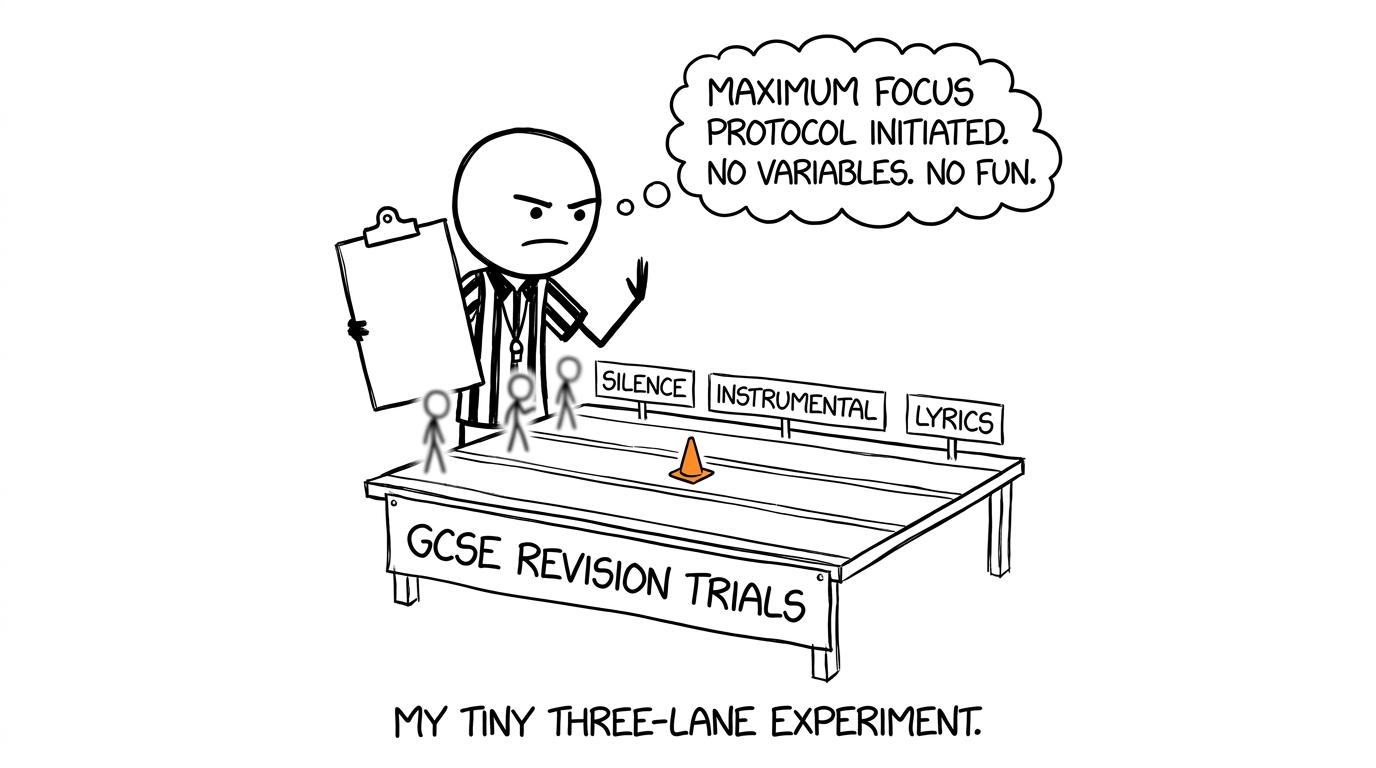 A student acts as an extremely serious official in a three-lane revision experiment
Build a revision routine that does not depend on a playlist
Music should be an optional setting, not the engine of your revision. The engine is a repeatable cycle:
- choose one specific topic;
- recall what you already know;
- check gaps using a focused lesson or textbook section;
- answer exam-style questions;
- mark them immediately;
- record one clear correction;
- return to the topic after a gap.
A planned timetable reduces the temptation to choose revision based on mood. The GCSE maths revision timetable guide explains how to combine topic work with regular exam practice, while the one-month GCSE maths revision plan provides a practical structure for the final weeks.
The subject may change, but the principle survives: progress comes from producing answers and correcting them, not from making notes look busy.
Common mistakes when revising with music
Choosing songs during the session
Skipping tracks and editing playlists repeatedly breaks concentration. Decide what you will hear before the timer starts, then leave the device alone.
Confusing a good mood with strong recall
A pleasant session may still produce weak learning. Check yourself with closed-book questions and delayed retrieval.
Using lyrics for language-heavy tasks
Reading, memorising terminology and planning extended responses already demand verbal processing. Add lyrics and you create unnecessary competition.
Never practising in silence
Even if instrumental music works well at home, complete regular timed questions without it. Exam conditions should feel familiar rather than strangely empty.
Revising passively for too long
Music can make an hour of rereading feel effortless. Replace passive time with short cycles of recall, questions and marking. Near the exam, the GCSE maths exam-week checklist can help you keep sessions focused and calm.
Make the decision from evidence
So, is revising GCSE Physical Education with music a good idea? Sometimes, but not as a default for every task. Silence is the strongest starting point for learning theory, memorising precise terms and answering exam questions. If you prefer background sound, quiet instrumental music is less likely to interfere than songs with lyrics. Test it honestly and let your recall decide.
Carry the same discipline into maths. Start with MathsGenie's free revision lessons and practice questions, diagnose gaps using mini tests, then build exam confidence with mark schemes, video solutions, past papers and Edexcel GCSE predicted papers. Use the revision planner to decide what comes next, and let your playlist remain optional.