

Revising Before Bed: GCSE Food and Nutrition
Revising before bed GCSE Food and Nutrition can aid recall if it stays short and protects sleep. Build a calm, effective bedtime revision routine.
There is a familiar moment in exam season. You are tired, the house is quiet, and one more chapter on nutrients or food science seems more responsible than turning out the light. Yet the useful answer is not simply to revise harder. Revising before bed GCSE Food and Nutrition content can support recall when the session is short, focused and followed by sufficient sleep. It is likely to hurt when revision delays bedtime, raises anxiety or becomes passive late-night reading.
Sleep helps the brain stabilise newly learned information, but it cannot rescue material that was barely understood in the first place. The best bedtime session is therefore a gentle review, not an attempt to learn an entire specification.
The bedtime revision checklist
A productive pre-sleep routine should:
- review one small, familiar topic;
- use active recall rather than repeated reading;
- finish before your planned bedtime;
- avoid a full paper or stressful new material;
- record gaps for tomorrow rather than chasing them tonight;
- protect a consistent sleep routine.
If you are also preparing for maths, use the same principle: learn and practise demanding material earlier, then reserve bedtime for light retrieval. The MathsGenie GCSE maths revision hub brings together lessons, practice questions, mini tests and papers so that revision can be planned rather than improvised at midnight.
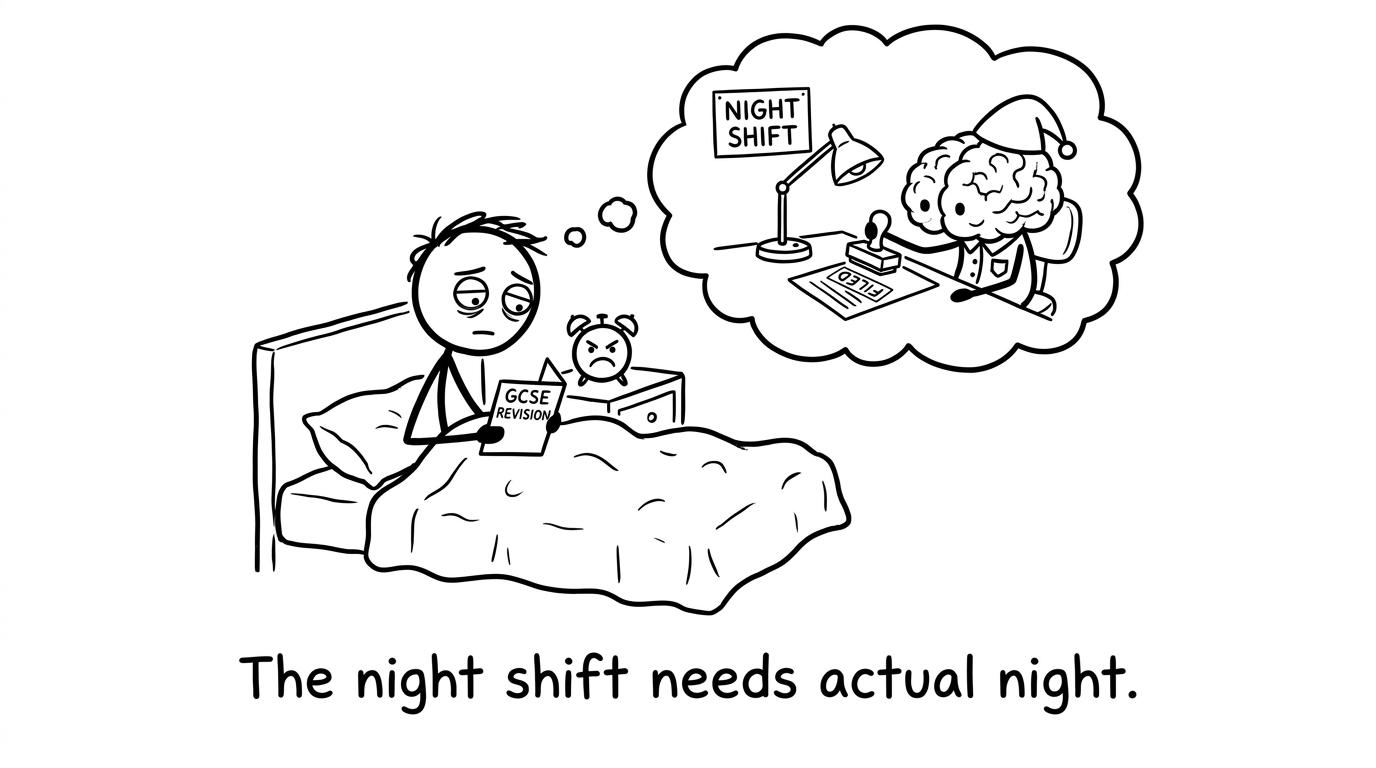 A cartoon brain working the night shift while a student sleeps
What sleep does for memory
Learning does not end when you close a book. During sleep, the brain continues processing information encountered while awake. Research reviews support a role for sleep in memory consolidation, although the size of the benefit varies with the learner, the material and the type of memory being tested.
This matters for Food Preparation and Nutrition because the written content combines several kinds of knowledge. Depending on the exam board, students may need to remember nutritional functions, sources and deficiencies; explain food science; understand food safety; and apply knowledge to unfamiliar contexts. AQA, OCR and Eduqas organise their specifications differently, so your own specification should determine what goes on your revision list.
Research involving adolescents suggests that sleep after learning can benefit memory. However, evidence does not prove that every fact is remembered better merely because it was read immediately before bed. One adolescent study found different outcomes for declarative material and procedural learning depending on the timing of practice. More recent vocabulary research has reported stronger overnight consolidation after pre-sleep learning, but vocabulary tasks are not identical to GCSE examination questions.
The sensible conclusion is modest: sleep creates useful conditions for consolidation, but staying awake longer to revise may remove the very sleep that provides the benefit. Timing helps only when the information has been properly encoded and bedtime remains protected.
When revising before bed may help
A short evening review can work well when the material is already partly familiar. Useful tasks include:
- recalling the functions and sources of nutrients without notes;
- sorting key facts into categories;
- explaining a food-science process aloud;
- checking a small set of flashcards;
- writing down three facts you want to retrieve the next morning;
- reviewing one error from an earlier question.
These activities require retrieval. That matters because recognition can be deceptive: a paragraph feels familiar when it is open, but an examination asks you to produce and apply knowledge without seeing the page.
The same distinction appears in maths. Watching a solution can feel clear, yet independent questions reveal whether the method is secure. The MathsGenie guide to efficient GCSE maths revision uses a stronger cycle: learn, practise, mark, fix and retest.
Keep the final review deliberately small
Choose one narrow area, such as food spoilage, micronutrients or the functional properties of an ingredient. Close your notes and retrieve what you know. Check the answer, correct one or two gaps, and stop.
The stopping point is part of the technique. A session that expands whenever you find a weakness teaches your brain that bedtime is unpredictable. Record the weakness for the next day instead. You are not ignoring it; you are scheduling it for a time when attention is stronger.
When late-night revision starts to hurt
The clearest danger is sleep loss. NHS guidance for teenagers commonly recommends a regular routine, reduced caffeine late in the day and a calm period away from screens before sleep. Individual sleep needs vary, but sacrificing rest to gain extra revision time is a poor trade when tiredness then weakens attention, reasoning and memory the following day.
Late revision becomes counterproductive when you:
- begin a large unfamiliar topic shortly before bed;
- continue because guilt makes stopping feel irresponsible;
- complete a timed paper that leaves you alert or frustrated;
- revise on a phone while notifications interrupt you;
- use caffeine or energy drinks to extend the session;
- reduce sleep before a morning examination.
The issue is not that the clock reaches a forbidden hour. It is the cost of the activity. A calm recall check that fits inside your routine is different from an anxious two-hour rescue mission.
Research on evening screen use is nuanced. Small experimental studies do not all find the same effect on memory or measured sleep, but screens can still encourage delay, interaction and continued stimulation. A paper flashcard or a brief written recall sheet usually makes the stopping boundary easier to respect.
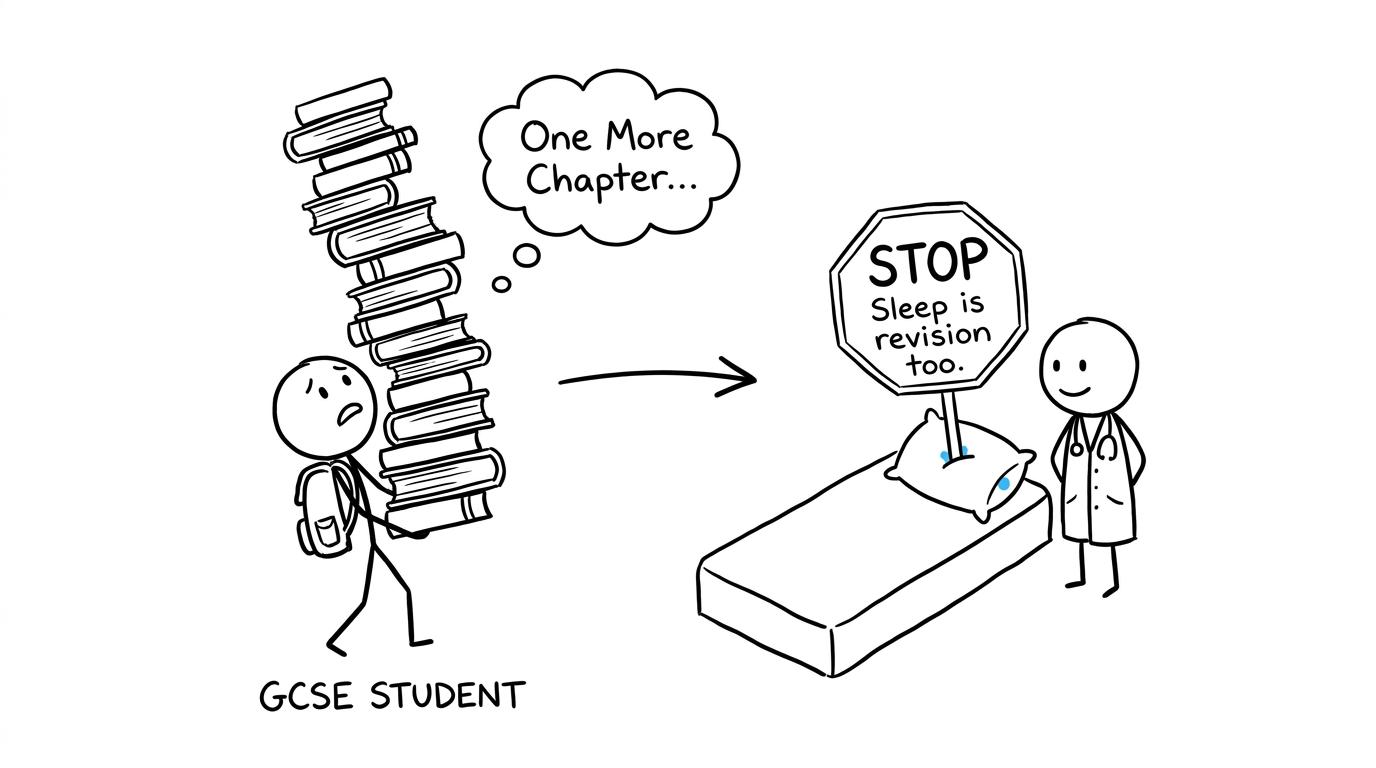 A student carrying too many revision books while a pillow holds up a stop sign
A better GCSE Food and Nutrition bedtime routine
Do demanding work earlier
Use your main revision session for new learning, extended responses and exam questions. Food Preparation and Nutrition papers assess more than isolated facts: you may need to apply knowledge, analyse information and evaluate choices. Those tasks deserve your more alert hours.
For maths, this is also the time for multi-step questions and careful marking. If you need a repeatable structure on a busy day, the MathsGenie twenty-minute GCSE revision routine shows how to combine recall, questions and immediate checking.
Select one retrieval target
Before the evening, write down the exact topic you will review. “Nutrition” is too broad. “Functions and sources of iron” is specific enough to retrieve and check without opening several chapters.
Your target should come from evidence. Use marked questions, teacher feedback and your own error log rather than revising whichever page looks most comfortable. Maths students can apply the same process through the guide to finding weak GCSE topics.
Recall, check and close
Put the resource away and say or write everything you can remember. Then check it against reliable notes or your specification. Correct only the important omissions and place anything larger on tomorrow’s list.
Do not measure the session by pages covered. A useful bedtime review may be brief because its purpose is retrieval, not volume.
Test again the next day
Morning retrieval tells you whether the knowledge survived beyond the feeling of familiarity. Try to reproduce the same ideas without looking. If recall remains weak, return to the topic during a full revision session and complete suitable examination questions.
This delayed check is equally valuable in maths. A method is not secure because it worked once with notes nearby. It becomes dependable through spaced, independent practice.
Fitting Food and Nutrition around GCSE maths revision
The search for a perfect revision hour can distract from a more important question: what kind of work should happen at each time?
Food and Nutrition includes substantial factual knowledge, while GCSE maths relies heavily on selecting and executing methods. Both subjects require application, but the balance differs. You could therefore use an earlier session for maths practice and extended Food and Nutrition questions, followed by a short factual recall review before winding down.
Avoid switching repeatedly between subjects. Each switch carries a small attention cost, and late evening is not the moment to create unnecessary friction. Decide the order in advance with a weekly plan.
As maths examinations approach, move from topic practice towards mixed work under realistic conditions. The MathsGenie advice on when to start GCSE past papers explains how to increase timed practice gradually. For the final evening, use the calmer GCSE maths night-before plan rather than attempting an exhausting last-minute paper.
Common mistakes with bedtime revision
Confusing reading with recall
Highlighting or rereading can make information look familiar without proving that you can reproduce it. Close the material before testing yourself.
Learning a whole topic at midnight
New material needs attention, explanation and practice. Move it to an earlier session. Bedtime is better suited to strengthening a small amount of existing knowledge.
Revising until the anxiety disappears
Anxiety rarely provides a natural stopping signal. Set the endpoint before starting and write unfinished tasks on tomorrow’s list.
Checking answers without analysing errors
A wrong response should produce a precise correction. “Revise vitamins” is vague; identifying the particular function, source or deficiency you confused gives you something useful to revisit.
In maths, mark schemes and video solutions help distinguish a knowledge gap from a careless error. The MathsGenie one-week revision plan shows how to turn marked work into a focused fix list.
Treating sleep as wasted revision time
Sleep is not a replacement for practice, but neither is it an optional luxury after practice. It supports the attention needed to learn tomorrow and the consolidation of what you learned today.
The verdict: protect sleep first
Revising GCSE Food and Nutrition before bed can help when it is a short active-recall session followed by sufficient sleep. It hurts when it becomes a reason to delay bedtime, absorb unfamiliar content or continue until exhaustion.
Make the demanding decisions earlier. Retrieve one small topic later. Then stop.
For your maths preparation, start at the free MathsGenie GCSE revision hub. Use revision lessons and practice questions to build methods, mini tests to expose gaps, and past papers or predicted papers to rehearse examination conditions. Mark your work with the available mark schemes and use video solutions when a method needs clarification, then give sleep its proper place in the revision plan.











