

Revise GCSE Arabic Alone or With Others?
Revise GCSE Arabic alone or with others? Compare both approaches, match each exam skill to the right method and create a focused weekly revision routine.
Revision can become strangely social. One student needs silence; another only discovers what they do not know when somebody asks a question. If you are deciding whether to revise GCSE Arabic alone or with others, the short answer is: use both, but for different jobs.
Solo revision is usually best for vocabulary recall, grammar, reading, writing and timed exam practice. Revising with another person is particularly valuable for speaking, pronunciation, spontaneous responses and discussing mistakes. The right question is not which method is universally better. It is which setting gives the skill you are practising the right kind of pressure.
This matters when Arabic must share your timetable with GCSE maths and other subjects. A good method protects your time rather than merely filling it.
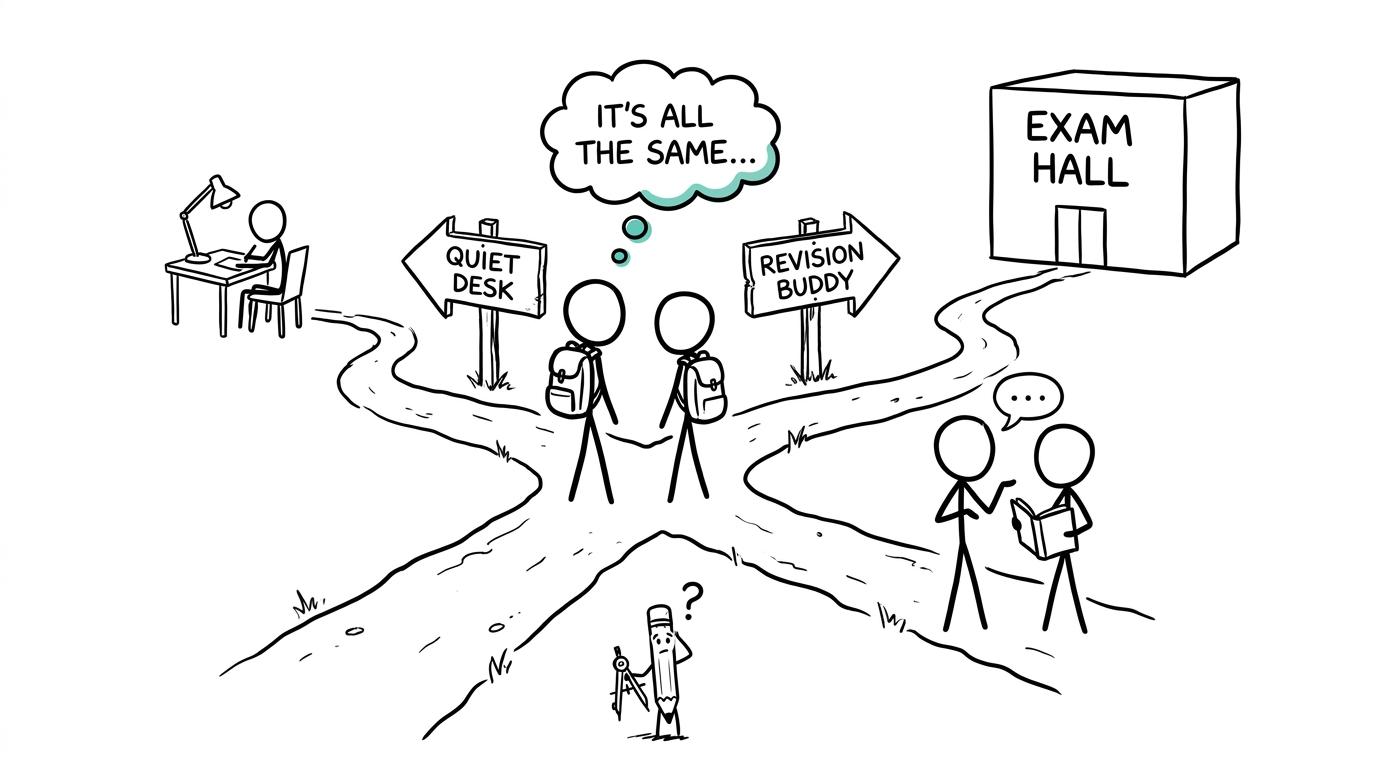 Two revision paths leading towards the same exam hall
A quick decision checklist
Choose solo revision when you need to:
- retrieve vocabulary without prompts;
- learn or review grammatical structures;
- read carefully at your own pace;
- draft and improve written responses;
- complete timed listening, reading or writing tasks;
- identify your personal gaps honestly.
Choose revision with others when you need to:
- practise speaking and responding spontaneously;
- hear different pronunciations and sentence choices;
- rehearse role plays, picture tasks or conversations;
- explain a language rule aloud;
- compare interpretations after attempting a task independently;
- stay accountable to a clear revision plan.
A sensible default is to spend about rac{2}{3} of your Arabic revision working independently and rac{1}{3} interacting with a partner, teacher or small group. That is a planning suggestion, not an exam-board requirement. Adjust it according to your weakest skill.
What the GCSE Arabic assessment demands
Your specification should decide how you revise. Pearson Edexcel GCSE Arabic currently assesses listening, speaking, reading and writing through four compulsory papers. Each skill contributes 25%25\%25% of the qualification, and students enter either foundation or higher tier across all four papers. Dictionaries are not permitted in the assessments, including the preparation time for speaking.
That structure has an important consequence: revision cannot consist only of memorising vocabulary or completing written exercises. You need independent recall, but you also need to understand unfamiliar language, communicate clearly and respond under time pressure.
Check the current specification and instructions provided by your school before planning. GCSE Arabic is not offered in exactly the same way by every UK exam board, so do not assume that arrangements for AQA, OCR or Eduqas languages automatically apply to your course.
When revising GCSE Arabic alone works best
Vocabulary and accurate recall
Vocabulary revision needs moments when nobody can rescue you. Covering an answer, recalling it and then checking it gives you evidence. Reading the same list repeatedly can feel fluent because every word is visible, but recognition is easier than retrieval.
Revise words in both directions, place them in short sentences and return to difficult items on later days. Keep a small error list organised by theme or type of mistake. The principle is similar to the active-recall approach described in MathsGenie’s guide to stopping GCSE maths content from being forgotten: attempt first, check second, then revisit the gap.
Reading and grammar
Independent work is valuable when a text needs slow attention. You can identify tense, agreement, linking language and unfamiliar vocabulary without being pulled towards another student’s answer.
Try the task before consulting notes. Afterwards, separate mistakes into useful categories: vocabulary, grammar, misunderstanding the question or rushing. A vague note saying “reading was bad” gives tomorrow’s revision session nothing to act on.
Writing
Writing benefits from uninterrupted concentration. You need time to plan, retrieve suitable vocabulary and check whether your response actually addresses every part of the task.
Solo practice also exposes dependence on notes. Because dictionaries are not permitted in the Edexcel assessments, some writing sessions should eventually be completed without one. Use support while learning, then remove it when testing.
Timed examination practice
Silence is essential when you want realistic evidence about concentration, pacing and recall. Complete an appropriate section under the conditions set out for your paper, mark it carefully and record why marks were lost.
This is the same discipline that makes GCSE past papers useful in maths. The paper is not the end of the session. The review is where the next revision decision comes from.
When revising GCSE Arabic with others is better
Speaking and spontaneous interaction
Speaking is the clearest case for working with somebody else. Pearson Edexcel’s speaking assessment includes interactive tasks, so silently memorising model answers cannot recreate the need to listen, understand and respond.
A partner can vary questions, ask for clarification and notice when an answer sounds memorised rather than responsive. Keep the session constructive: one person asks, one responds, and both record only a few specific improvements.
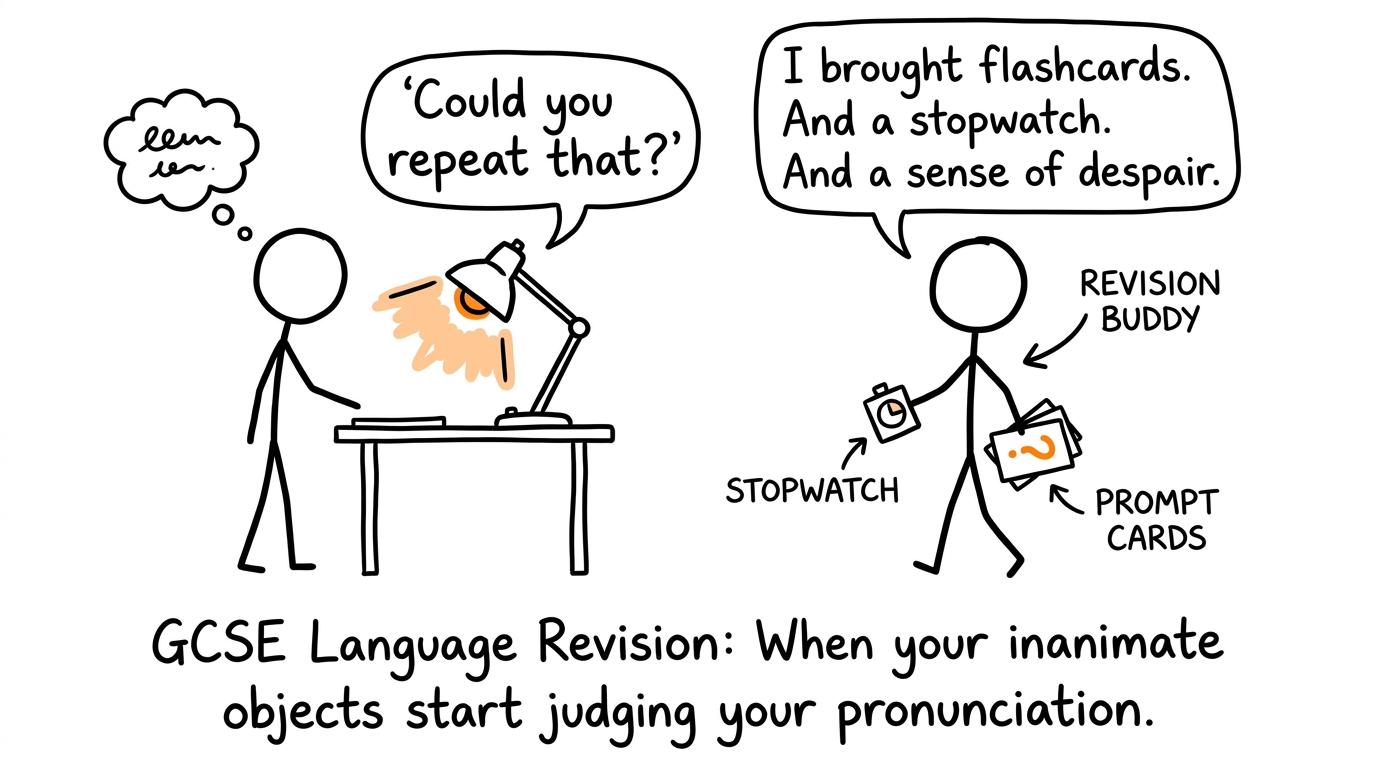 A desk lamp makes an unhelpful speaking partner
Pronunciation and listening
A partner can reveal unclear pronunciation that you may not notice yourself. They can also read prompts in a different voice or order, preventing you from relying on a familiar sequence.
However, a classmate is not automatically a reliable authority. If you disagree about pronunciation or grammar, flag the point and check it with your teacher or an approved course resource. Group confidence is not the same as accuracy.
Explaining difficult ideas
Explaining why a verb form or sentence structure works forces you to organise your understanding. Your partner should ask precise questions rather than simply agreeing.
This is useful in maths too. If you cannot explain why a method works, you may only be copying its surface. MathsGenie’s GCSE maths revision hub provides lessons, practice questions and exam-style material that can be attempted independently before methods are discussed with somebody else.
Motivation and accountability
A planned meeting can help when revision keeps being postponed. The useful part is not simply being in the same room. It is agreeing what will be completed and checking whether it happened.
A group session therefore needs an agenda, a finish time and individual thinking time. Otherwise, the most confident speaker may do all the work while everyone else experiences the comforting illusion of progress.
Which method suits each Arabic topic?
| Skill or topic | Best starting method | Useful follow-up |
|---|---|---|
| Vocabulary recall | Alone | Quick partner quiz |
| Grammar and sentence construction | Alone | Explain the rule to a partner |
| Reading comprehension | Alone | Compare reasoning after answering |
| Translation | Alone | Discuss alternative wording |
| Writing | Alone | Peer-check against clear criteria |
| Listening | Alone with approved recordings | Discuss difficult sections afterwards |
| Pronunciation | With a teacher or partner | Record and review independently |
| Role play and conversation | With others | Note personal weaknesses alone |
| Timed paper practice | Alone | Review selected errors together |
The pattern is simple: attempt independently when the exam requires independent performance, then collaborate where feedback or interaction adds something that silence cannot.
A hybrid revision routine that fits around maths
Start each week by identifying one Arabic weakness and one maths weakness. Evidence should choose them: a marked task, mini test or past-paper section is more useful than mood.
For a 606060-minute Arabic block, you might use:
- 202020 minutes for independent vocabulary and grammar recall;
- 202020 minutes for a timed reading, listening or writing task;
- 151515 minutes for speaking with a partner;
- 555 minutes to record errors and choose the next action.
If no partner is available, record responses to unfamiliar prompts and review them, then seek feedback from your teacher when possible. This does not fully reproduce interaction, but it is more useful than avoiding speaking altogether.
On busy school days, shorter blocks may be easier to repeat. MathsGenie’s 20-minute GCSE maths revision routine shows how one clear task, immediate checking and a next step can make limited time productive.
Use the same architecture across subjects: attempt, mark, diagnose, repair and retest. For maths, find weak topics from evidence, repair them through topic practice, and check progress with Edexcel GCSE maths mini tests. For Arabic, apply that loop to one language skill at a time using resources approved for your specification.
How to make group revision productive
Keep the group small enough for everyone to speak. Two students are often sufficient for conversational practice; a larger group needs firmer structure.
Before beginning, agree:
- the exact skill being practised;
- who will ask questions or keep time;
- how long silent preparation will last;
- what feedback is allowed;
- what each person will complete afterwards alone.
Feedback should be specific. “That was good” offers little direction. Comment instead on whether the answer addressed the prompt, whether communication was clear and which recurring error should be checked.
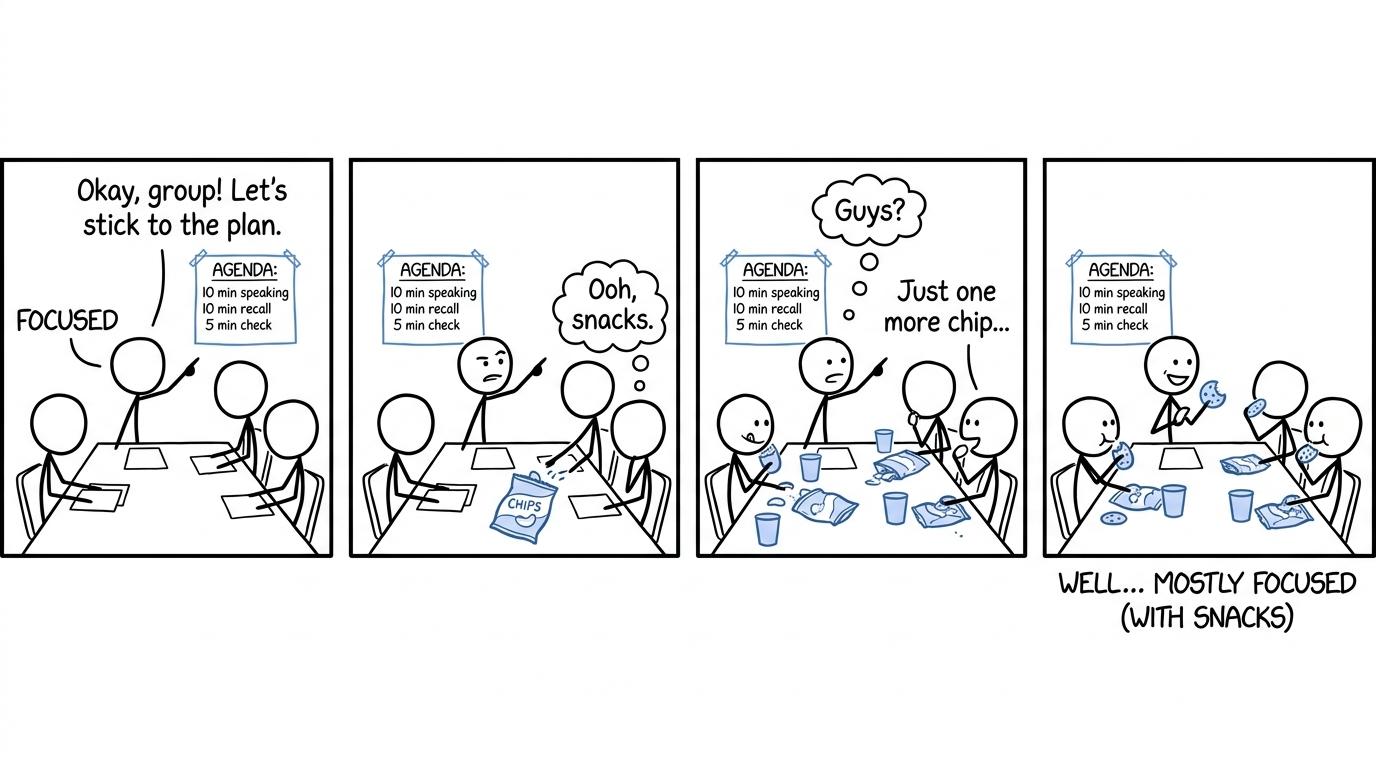 A revision group discovers why an agenda matters
Common mistakes when choosing how to revise
Treating friendship as a revision method
A friend can be an excellent partner, but only if both of you are willing to attempt difficult tasks and correct errors. Choose reliability and focus over group size.
Doing every task collaboratively
If every answer is produced together, you cannot tell what you can retrieve alone. Complete part of the work independently before comparing responses.
Avoiding speaking because it feels uncomfortable
Students often revise the skill that feels safest. Speaking may feel awkward precisely because it needs practice. Use short, frequent sessions rather than waiting for one long rehearsal.
Copying a partner’s mistakes
Peers provide interaction, not guaranteed accuracy. Resolve disagreements through a teacher, specification-aligned material or an official mark scheme.
Using practice without review
Completing tasks creates evidence; reviewing them creates direction. The same applies when deciding when to begin GCSE past papers: start while there is still time to repair what the paper reveals.
Letting Arabic revision displace maths completely
A speaking assessment may need extra attention at particular times, but your wider timetable still matters. Keep maths active through short lessons, practice questions and mini tests. Nearer the exams, use GCSE predicted topics and papers carefully as practice tools, never as permission to ignore the rest of the specification.
Choose the setting that serves the skill
You do not need to identify permanently as a solo reviser or a group reviser. That label is less useful than the task in front of you.
Work alone when you need honest recall, detailed concentration or realistic exam conditions. Work with others when Arabic must become a living exchange rather than words on a page. Then bring both approaches together through a weekly cycle of practice, feedback and retesting.
For the maths side of your GCSE timetable, make MathsGenie your free revision base. Begin with the GCSE maths revision area, use revision lessons and practice questions to repair individual topics, and build exam confidence through past papers, predicted papers, mini tests, mark schemes and video solutions. Good revision is not defined by how crowded the room is. It is defined by whether today’s work makes tomorrow’s performance more independent.











