

Reset After a Bad Week of GCSE Psychology Revision
Reset after bad week GCSE psychology revision with a practical plan to rebuild routines, test recall and balance psychology with GCSE maths revision.
A bad revision week can become two bad weeks surprisingly quickly. Not because you have forgotten how to work, but because guilt makes the next step feel larger than it is.
The search reset after bad week GCSE psychology usually comes from that uncomfortable moment when unfinished notes, missed flashcards and approaching maths exams all seem to demand attention at once. The practical answer is not to recover every lost hour. It is to choose one psychology topic, complete one short active session today and build a realistic plan for the next seven days.
Your week fell apart. Your GCSE preparation has not.
Your quick GCSE Psychology reset checklist
Use this before creating another elaborate timetable:
- Accept that the missed week has finished.
- Check what your exam board actually assesses.
- Choose one priority psychology topic.
- Complete a short retrieval task without notes.
- Check your answers and identify one gap.
- Schedule three or four manageable sessions.
- Leave protected time for maths and other GCSE subjects.
- Review the plan after seven days rather than rewriting it tomorrow.
The aim is movement, not punishment.
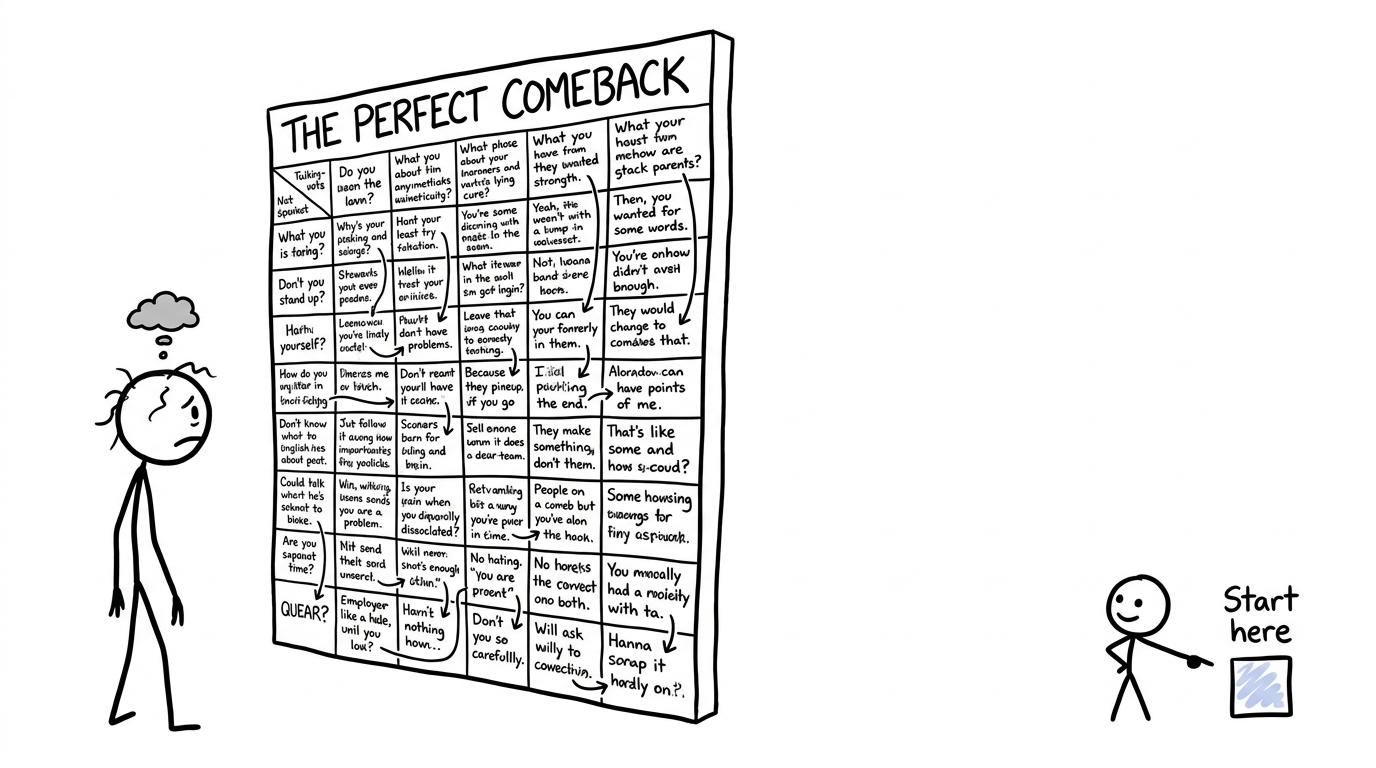 A student choosing one small revision task instead of designing an impossible comeback
Begin with evidence, not guilt
After a disrupted week, students often respond by planning from emotion. They add every missed task to the next week, double their daily targets and promise themselves that Saturday will contain an heroic revision marathon.
That creates a plan for an imaginary student with unlimited time and energy.
Instead, conduct a brief audit. Write down:
- what you intended to revise;
- what you actually completed;
- which topics are becoming urgent;
- why the plan broke down;
- how much time is genuinely available this week.
Keep the explanation specific. “I am lazy” tells you nothing useful. “I planned psychology immediately after two late school days” suggests a practical change. So does “I spent too long rewriting notes” or “I did not know which research methods questions to practise”.
The same diagnosis-first principle helps with maths. MathsGenie’s guide to finding your weakest GCSE topics explains how evidence from questions can replace vague feelings about being “bad” at a subject.
Check the Psychology specification before catching up
Psychology revision becomes overwhelming when “revise memory” or “learn research methods” is treated as one enormous task. Your specification turns those broad labels into a finite list.
AQA GCSE Psychology is assessed through two written papers. Its content includes memory, perception, development, research methods, social influence, language, thought and communication, brain and neuropsychology, and psychological problems. The papers assess knowledge and understanding, application, analysis and evaluation.
Pearson Edexcel GCSE Psychology also uses two externally examined papers, but its organisation and optional content differ. Research methods are assessed alongside psychological topics, and mathematical skills form part of the qualification.
Do not borrow a friend’s topic list without checking that you follow the same exam board. Ask your teacher if you are unsure about your specification, optional topics or examination entry.
Turn topics into answerable questions
Replace “revise memory” with narrower prompts such as:
- Can I define the key terms accurately?
- Can I describe the relevant theory or study?
- Can I apply the idea to an unfamiliar scenario?
- Can I explain a strength or limitation?
- Can I interpret the research evidence?
This matters because Psychology is not assessed through recall alone. You need to know content, use it in context and evaluate it. A colourful page of notes may cover the first requirement while leaving the others untouched.
Make the first session deliberately small
Your first session back should be easy to begin but active enough to reveal something useful. Aim for approximately 202020 to 303030 minutes.
A practical structure is:
- Set up: choose one narrow topic and remove distractions.
- Retrieve: write or say what you remember without opening your notes.
- Check: compare your recall with reliable class materials or the specification.
- Practise: answer one or two relevant exam questions.
- Record: write one precise next action.
Retrieval is the important part. Educational research supports making an active attempt to recall information, followed by feedback, rather than relying entirely on rereading. Feedback matters because repeatedly recalling an incorrect idea can strengthen the misconception.
You can use the same short structure for simultaneous maths preparation. The MathsGenie 20-minute maths revision routine provides a repeatable pattern for busy school days.
Do not judge the first session by how many pages you cover. Judge it by whether you discovered what to do next.
Build a seven-day recovery plan
A reset plan should be smaller than the plan that failed. It must fit around school, sleep, meals, exercise, family commitments and your other GCSE subjects.
Try planning three types of Psychology session:
Knowledge session
Retrieve definitions, theories, processes and study details. Check accuracy afterwards. Flashcards can help, but only if you attempt an answer before turning the card over.
Application and evaluation session
Use short scenarios and exam questions. Practise connecting the details in the question to the relevant psychological idea. For evaluation, focus on clear, developed reasoning rather than memorising disconnected lists of strengths and weaknesses.
Research methods session
Revise variables, hypotheses, sampling, experimental designs, ethics, reliability, validity, data presentation and any mathematical skills required by your specification. This is an area where psychology and maths revision can reinforce each other: percentages, averages, tables, graphs and interpretation all reward careful quantitative thinking.
A balanced recovery week might include three short Psychology sessions, one longer question-practice session and protected blocks for maths and your other subjects. Use the structure, not the exact quantity, as your guide.
For broader planning, the GCSE maths revision timetable guide shows how to prioritise weak areas while leaving room for rest and catch-up time. MathsGenie also offers a structured one-month GCSE revision plan when several subjects are competing for attention.
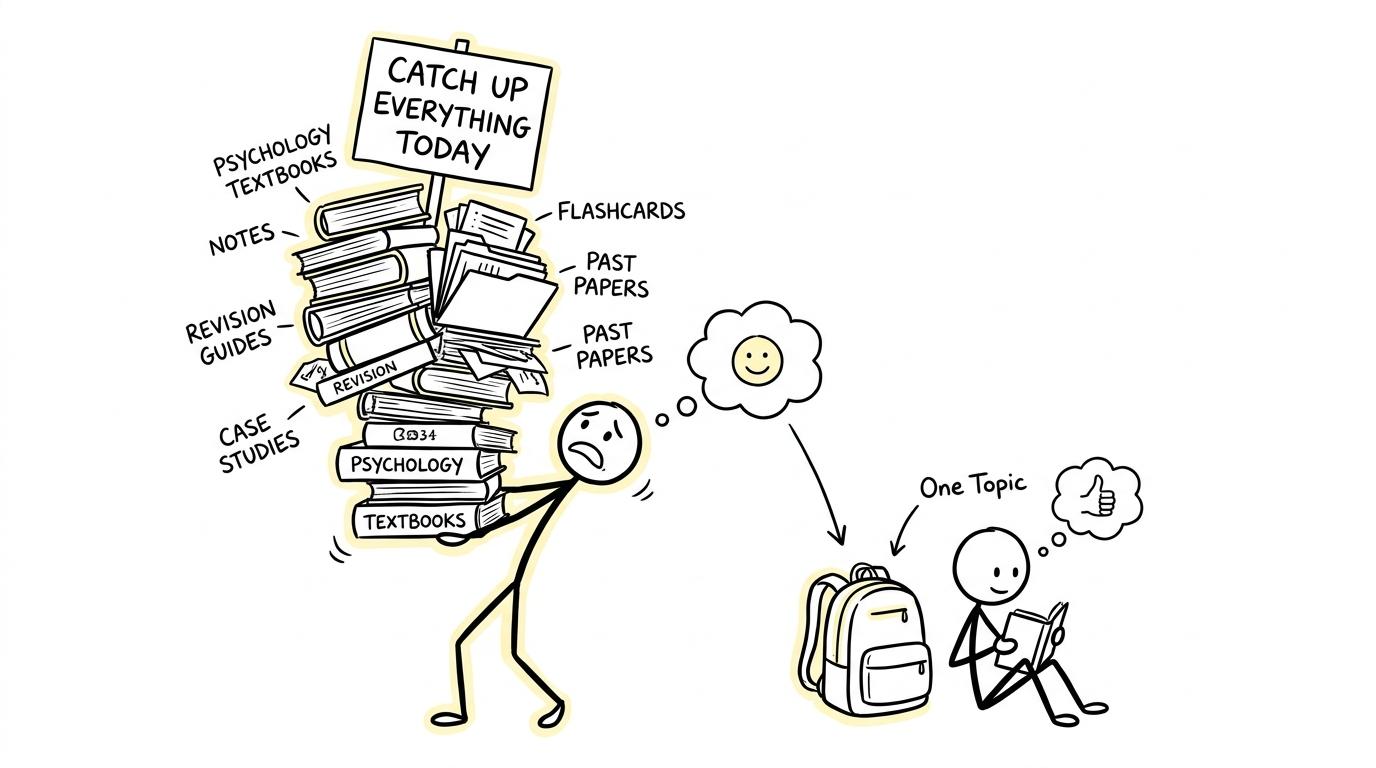 A student abandoning a tower labelled catch up everything today and choosing one manageable topic
Use active revision instead of rebuilding every note
When a week has been lost, rewriting an entire folder feels productive because it is orderly. Unfortunately, neatness is not evidence that you can retrieve and apply the material in an examination.
Choose tasks that produce visible feedback:
- closed-book brain dumps;
- self-testing with flashcards;
- brief topic quizzes;
- exam questions;
- essay or extended-response plans;
- timed research methods questions;
- marking and correcting previous answers.
Use notes after the attempt, not automatically during it. If recall is too difficult, reduce the task: retrieve one subtopic, use a short cue or answer a recognition question before trying free recall again.
Then revisit the material on another day. The purpose is not to cram all missed Psychology into one evening. It is to create several opportunities to remember, correct and apply it.
Protect maths while Psychology catches up
A Psychology reset should not create a new crisis in maths. GCSE students often lose momentum by allowing the subject that feels most urgent to consume every available session.
Give each subject a minimum commitment. On a difficult weekday, that might mean one short Psychology retrieval task and one short set of maths questions. On a weekend, you may have time for a Psychology extended response and a timed maths section.
For maths, begin at the GCSE Maths revision hub, where you can choose resources for your exam board and work through revision lessons, practice questions, mini tests and papers. Edexcel students can also use the Edexcel GCSE Maths past papers with mark schemes and available solutions.
Keep the roles of different resources clear. Topic questions repair a specific weakness. Mini tests check whether it has improved. Past papers build exam familiarity and stamina. Predicted papers offer additional exam-style rehearsal, but they should never replace coverage of the full specification.
MathsGenie’s guide to when you should start GCSE past papers can help you choose the right level of paper practice for your current stage.
What to do when motivation still does not return
You do not have to feel motivated before beginning. Make the starting conditions easier instead:
- decide the topic before the session;
- leave the correct materials ready;
- put your phone in another room;
- set a short timer;
- begin with a task you can clearly finish;
- stop at the planned time if continuing would damage sleep.
NHS examination guidance recommends realistic schedules, manageable chunks, regular short breaks, physical activity and asking for help when stress becomes difficult to manage. These are not rewards for completing revision. They are part of a sustainable preparation system.
If anxiety, low mood or stress is affecting sleep, school, eating or everyday life, tell a parent, carer, teacher, pastoral lead, school counsellor or healthcare professional. A revision timetable cannot solve every difficulty, and seeking support is a sensible response rather than a failure of discipline.
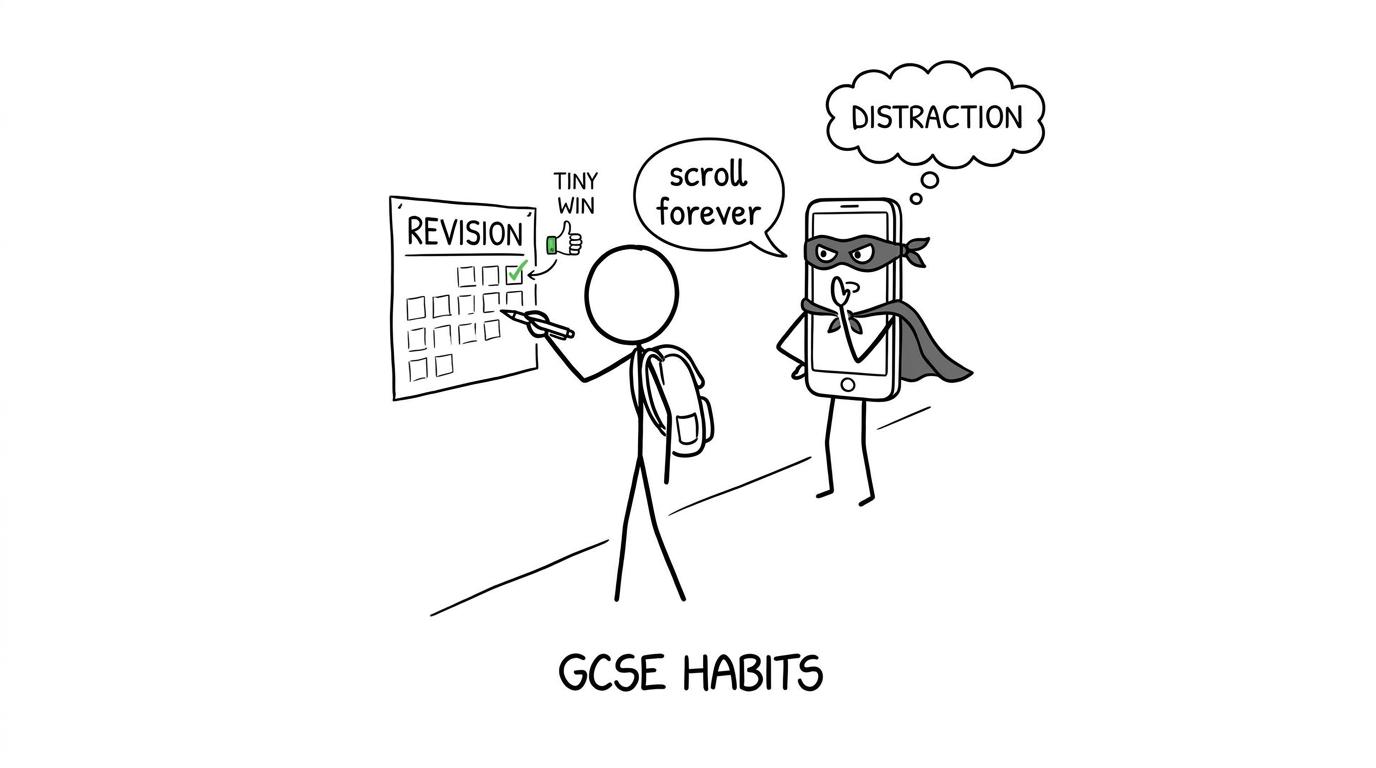 A completed revision tick wins a quiet battle against a phone trying to cause endless scrolling
Common mistakes when restarting revision
Trying to repay every missed hour
Lost revision time is not a debt. Carrying every unfinished task forward usually overloads the new plan. Prioritise what matters now.
Making the timetable more demanding
If the previous plan was unrealistic, doubling it is not resilience. Reduce the number of sessions and make each one more specific.
Rereading without testing yourself
Recognition can feel like knowledge. Close the book and retrieve before deciding that a topic is secure.
Ignoring application and evaluation
Knowing a definition is valuable, but Psychology examinations also require students to apply ideas and analyse or evaluate information. Include those skills every week.
Spending the whole session marking
Marking is only useful when it changes the next attempt. Record the correction, then return to a similar task later.
Sacrificing sleep to catch up
A late-night marathon can damage the following day and begin another disrupted week. MathsGenie’s night-before GCSE plan reflects the same principle: focused preparation is more useful than panicked overwork.
Your next move matters more than last week
A successful reset is rarely dramatic. It is one small session completed, one gap identified and one realistic appointment made with tomorrow.
Choose a GCSE Psychology topic now. Spend a short period recalling what you know, check it carefully and answer one relevant question. Then protect a separate maths block rather than allowing catch-up work to consume the whole week.
When it is time for maths, let MathsGenie’s free GCSE revision resources remove the need to search endlessly. Use revision lessons to rebuild understanding, practice questions and mini tests to check it, then past papers and predicted papers to develop exam readiness. Mark with the available mark schemes and use video solutions to understand where your method changed.
You do not need a perfect comeback. You need a next step you can repeat.











