

Reset After a Bad Week of GCSE Latin Revision
Reset after bad week GCSE Latin with a calm plan for vocabulary, grammar and set texts, while keeping your GCSE maths revision moving forward too.
A bad revision week rarely announces itself. One missed evening becomes three, vocabulary cards stay unopened, and by Sunday the plan looks less like a timetable and more like evidence against you.
If you need to reset after bad week GCSE Latin revision, the answer is not to recover every missed hour immediately. Make your next session small, specific and active: test a short set of vocabulary, correct the gaps, then schedule one grammar or set-text task for tomorrow. You are restarting a system, not repaying a debt.
That matters particularly if you are also preparing for GCSE maths. Latin and maths both reward repeated recall, careful correction and regular contact. A punishing Latin catch-up session can easily consume the energy needed for your other subjects. A controlled reset protects both.
Your GCSE Latin reset checklist
Use this as your immediate route back:
- Accept that the lost week has finished. Do not build a timetable designed to punish it.
- Check your exam board, specification and current prescribed material.
- Divide Latin into vocabulary, grammar, translation and literature or civilisation.
- Choose one task that can be completed in twenty minutes.
- Retrieve from memory before looking at notes.
- Mark the task and record only the important gaps.
- Revisit those gaps on another day.
- Keep protected time for GCSE maths and your other subjects.
The first successful session should feel almost too manageable. That is useful. A plan survives because you can repeat it, not because its first day looks impressive.
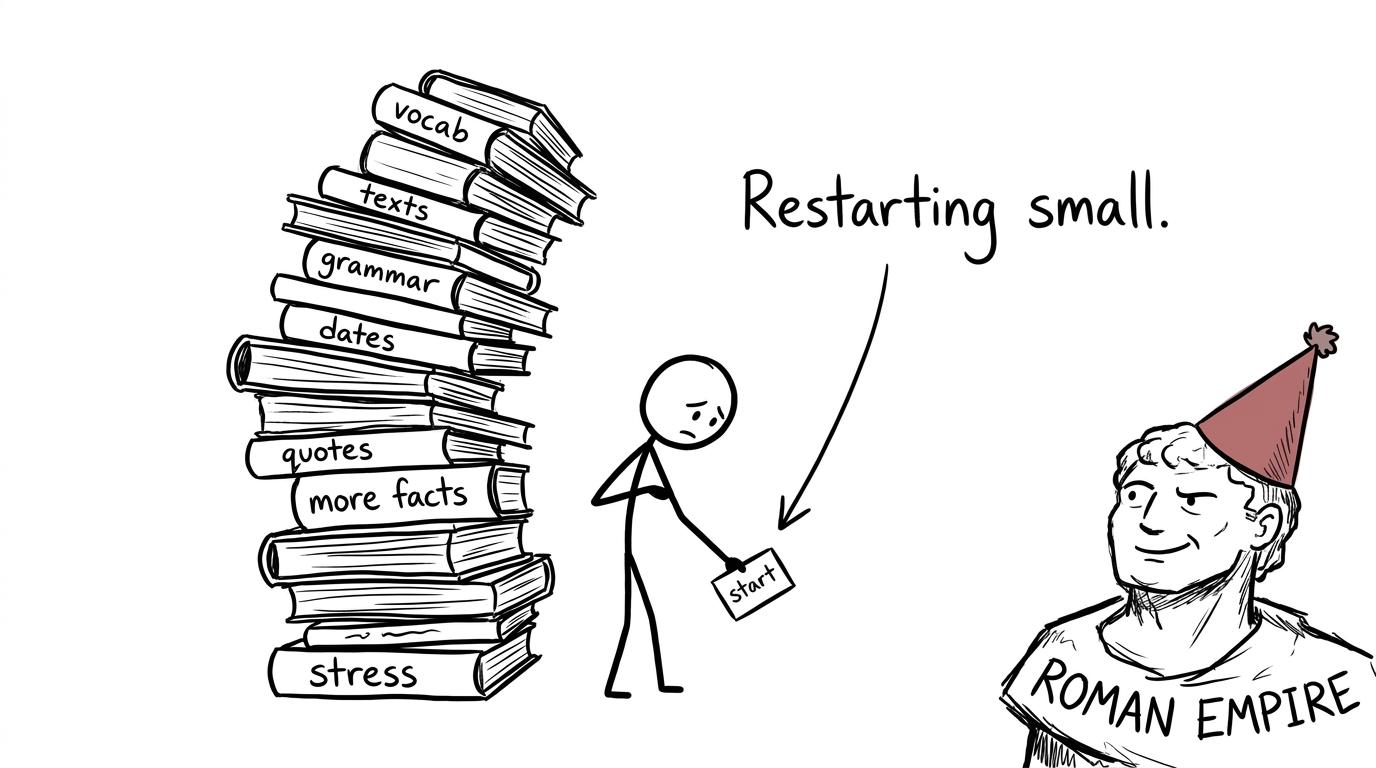 A student calmly restarts GCSE Latin revision with one flashcard beside a towering pile of books
Start with a diagnosis, not a catch-up marathon
After a disrupted week, students often open the largest textbook or begin rewriting everything. This creates activity without answering the important question: what have you actually forgotten?
Run a brief, low-stakes check instead. Without notes, try to:
- recall a small group of defined vocabulary;
- identify endings from one noun or verb pattern;
- translate a few lines previously studied;
- list key ideas, characters or stylistic features from your prescribed text;
- outline one civilisation topic from memory.
Then compare your answers with trusted class materials. Sort the results into three groups:
- Secure: you recalled it accurately without help;
- Uncertain: you partly remembered it or needed a prompt;
- Missing: you could not retrieve it reliably.
This prevents a bad week from becoming a vague judgement such as “I have forgotten all my Latin”. Usually, the problem is narrower. Perhaps vocabulary is fading while your set-text knowledge remains sound. Perhaps you know translations but cannot explain the effect of the language.
The same diagnostic principle works in maths. MathsGenie’s guide to finding your weakest GCSE topics explains why evidence from questions is more useful than revising whatever feels familiar.
Rebuild GCSE Latin in four separate lanes
Latin revision becomes overwhelming when it is treated as one enormous subject. A better reset separates the work into distinct lanes.
Vocabulary
Use the defined vocabulary list for your qualification rather than an unofficial list assembled for a different course. Cover the answers and retrieve the Latin or English meaning before checking. Words you miss should return sooner; secure words can wait longer.
Do not merely read a list several times. Active retrieval is more demanding, but established learning research supports recalling information from memory and spacing that recall across different days rather than relying only on rereading.
Grammar and syntax
Choose one limited area: case endings, tense recognition, participles, pronouns or a particular construction from your specification. Your purpose is to recognise how the form functions inside a sentence, not to produce another beautiful page of notes.
Write a short cue explaining each repeated error. For example: “I recognised the ending but did not check the noun it agreed with.” That is more actionable than writing “grammar bad”.
Translation
Translation practice should be short enough for you to review carefully. After attempting a passage, compare it with the supplied answer or your teacher’s guidance. Identify whether each problem came from vocabulary, grammar, sentence structure or English expression.
A translation is not complete when you reach the final full stop. The correction is where the passage becomes useful revision.
Literature or civilisation
Use the exact prescribed content for your examination series. OCR and Eduqas organise GCSE Latin differently, and prescribed texts or materials may change. Check the current official specification, your teacher’s course information and the relevant exam board materials before deciding what to revise.
Instead of rereading an entire booklet, retrieve a small section: its meaning, context, key themes and significant literary choices. For civilisation, practise connecting a source to a clear claim rather than memorising disconnected details.
Use a three-day restart rather than rebuilding the whole week
A failed timetable often tempts you to create an even stricter timetable. That usually adds more decisions and more guilt. Use a short restart sequence instead.
The first day: restore contact
Complete one easy-to-start task, such as a brief vocabulary test. Mark it immediately and select a few uncertain items for tomorrow. Stop at the planned time, even if you feel you could continue.
The aim is to finish with evidence that revision has restarted.
The second day: repair one weakness
Choose one grammar or translation issue exposed by the diagnosis. Review the minimum explanation needed, then attempt questions or a short passage without support. Correct it while your thinking is still fresh.
The third day: mix and review
Return to the vocabulary from the first day, then add a short literature or civilisation retrieval task. This creates spacing and prevents the reset from becoming a single burst followed by another gap.
After these three days, build a realistic weekly pattern. It might contain several brief Latin contacts rather than one huge session. MathsGenie’s article on stopping GCSE content from being forgotten describes the same useful cycle for maths: revisit, retrieve, mark and return later.
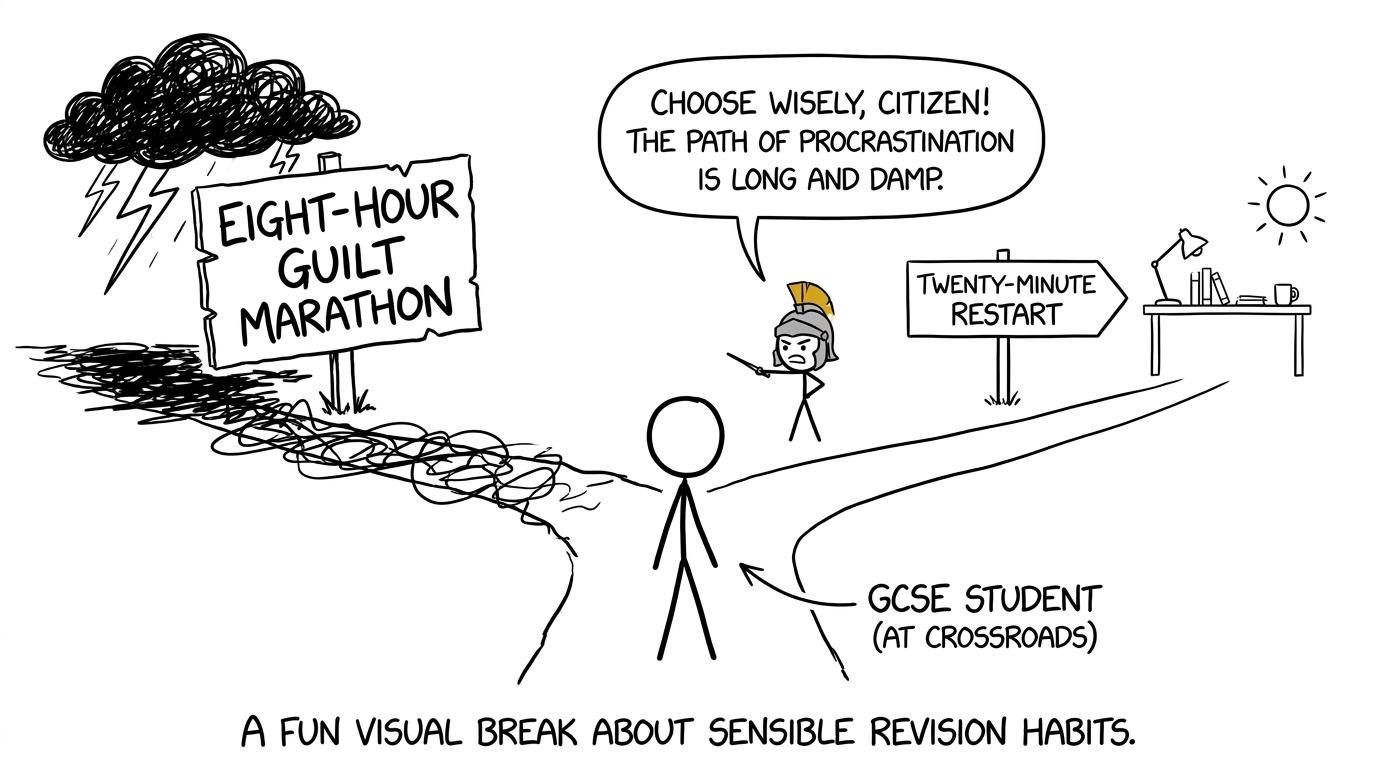 A student chooses a short revision restart instead of a guilt marathon
Protect your GCSE maths revision during the reset
The unusual difficulty here is that you are revising Latin while preparing for maths examinations. A Latin reset should not quietly erase the maths sessions already in your week.
Give each subject a clear job. A Latin session might focus on vocabulary retrieval or translation. A maths session should involve mathematical questions, marking and correction. Avoid vague timetable labels such as “revise” because they require you to make another decision when the session begins.
If maths has also slipped, start from the GCSE Maths revision hub. Choose the correct exam board and tier, then use a revision lesson followed by practice questions. The GCSE maths topics by board and tier guide can help you distinguish Foundation and Higher content before planning.
A sensible shared routine is:
- retrieve knowledge without notes;
- attempt a focused task;
- check against an answer or mark scheme;
- record the precise error;
- revisit it on a later day.
For maths, this could mean a mini test followed by video solutions. For Latin, it could mean a vocabulary quiz followed by a corrected translation. The subjects differ, but the learning loop is remarkably similar.
If your entire revision schedule feels disordered, begin with prerequisites rather than the hardest chapter. MathsGenie’s guide to the best order for learning GCSE maths topics shows how a structured sequence reduces wasted effort. Apply the same logic to Latin: secure core vocabulary and forms before expecting fluent unseen translation.
Know when to use exam papers
A full Latin paper can provide valuable information, but it may be the wrong first task after a bad week. If you are tired, behind on prescribed content or unable to recall basic forms, a complete timed paper can create a large pile of errors without helping you repair them.
Begin with sections. Attempt a comprehension task, a translation extract or selected literature questions. Mark them using the official materials available for your specification. Ask what each lost mark reveals.
Move towards full papers once your routine is stable and you have covered enough of the course for the result to be meaningful. This mirrors the advice in MathsGenie’s guide to when GCSE students should start past papers: topic practice and short tests can diagnose gaps before regular full-paper practice builds timing and stamina.
For maths, MathsGenie provides past papers, predicted papers, practice questions, mark schemes and video solutions. Predicted papers are best treated as practice rather than promises about exact questions. Use the result to decide which lesson or topic set comes next.
Common mistakes when restarting revision
Trying to repay every missed hour
Missed revision is not a financial debt. Adding all abandoned sessions to the next week usually produces an impossible schedule. Re-plan from today using the time genuinely available.
Making a new timetable instead of revising
Planning can feel safe because it contains no risk of being wrong. Give yourself a short planning limit, choose the next task and begin. The timetable only matters if it leads to retrieval and practice.
Rereading before testing yourself
Immediate rereading hides what you can recall independently. Try first, check second. Being unable to remember something is useful diagnostic information, not proof that the session failed.
Using the wrong Latin material
Do not assume that every online vocabulary list, set text or civilisation booklet matches your qualification and examination year. Confirm your board and current prescription with your teacher and official exam board documentation.
Letting Latin consume every other subject
An anxious catch-up marathon can displace maths, English and science. Protect important sessions in your revision planner. Your goal is balanced preparation across your actual examination timetable.
Moving on without correcting mistakes
Completing questions feels productive, but unreviewed errors tend to return. In maths, use the mark scheme and video solution. In Latin, identify whether the problem was vocabulary, morphology, syntax, interpretation or expression.
If an exam is very close, use a calm triage plan rather than studying indefinitely. MathsGenie’s GCSE maths night-before checklist offers a useful model: select focused work, prepare your equipment and preserve time for sleep.
Your next session is the reset
A bad week feels significant because it is recent. It is not a forecast. The way back is deliberately ordinary: one defined task, one honest check and one scheduled return.
Open your current GCSE Latin vocabulary or prescribed material and complete a short retrieval task today. Then protect your next maths session. On MathsGenie, you can follow a revision lesson with practice questions, use mini tests to expose gaps, and progress to efficient Edexcel GCSE maths revision, past papers and predicted papers when you are ready.
Do not wait for the perfect Monday. Restart with the next twenty minutes, record what needs attention, and let consistency make the lost week smaller.











