GCSE: Stop Forgetting Maths Content (Edexcel Plan)
GCSE revision for Edexcel students who keep forgetting maths. Use spaced practice, retrieval, past papers and mark schemes with a simple weekly plan.
You can revise for GCSE Maths for hours, feel confident… then open an Edexcel paper and realise the topic you “knew” has vanished.
That moment is strangely universal: a blank line, a familiar-looking question, and the uncomfortable thought that maybe you’re just “bad at maths”. You’re not. Forgetting is normal. What matters is whether your GCSE revision system expects forgetting and plans around it.
Edexcel students often feel this most because the papers mix skills across number, algebra, geometry, statistics and probability. If your revision only revisits a topic once, your brain treats it like a one-off event. In real exams, it needs to be a habit.
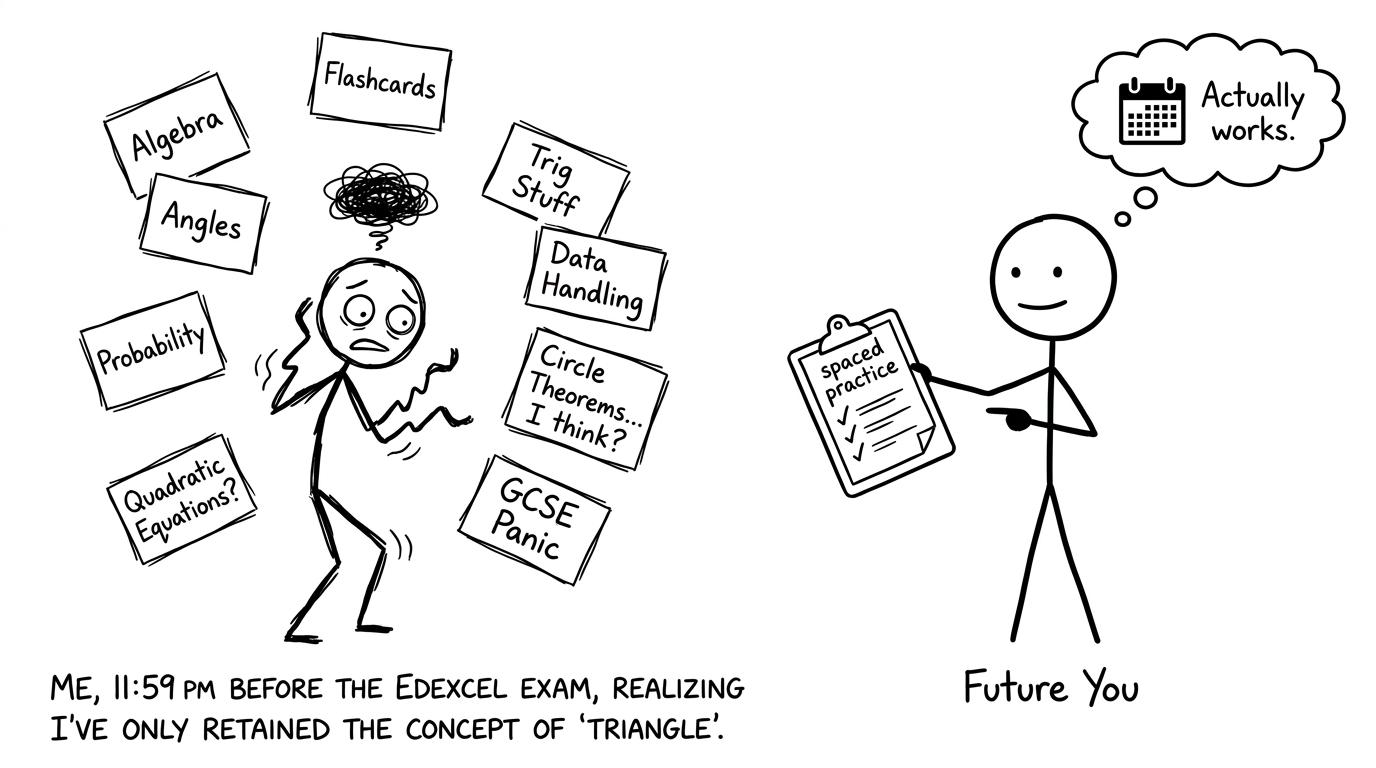 A student meets “Future You” holding a spaced practice plan
A quick checklist to stop forgetting GCSE maths
Use this as your simple “am I doing effective GCSE revision?” check:
- Revisit topics using spaced practice: same content, different days.
- Use retrieval practice: try questions first, notes second.
- Interleave topics: don’t do one big block of “angles day” then never again.
- Mark with the mark scheme and write a one-line fix.
- Practise with real Edexcel papers and predicted papers.
- Use short timed sets (mini tests/45-minute chunks) to build exam memory.
For an Edexcel-friendly hub of lessons, practice and exam resources, start here: Edexcel GCSE Maths Revision.
Why you forget GCSE content (and why it’s not your fault)
Forgetting is a feature of memory. If a piece of knowledge isn’t used, your brain saves energy by letting it fade. In GCSE Maths, this is brutal because skills stack: if you forget simplifying expressions, rearranging formulae, or fraction rules, the harder questions become a maze.
The fix isn’t “revise harder”. It’s “revise differently”. You want desirable difficulty: enough challenge that you have to think, but not so much that you guess randomly. That is why the best GCSE revision is built around attempts, feedback, and re-attempts.
On YesGenie, you can do this using lessons, question bank practice, past papers, predicted papers and mark schemes in one place. The structure matters as much as the content.
The Edexcel GCSE memory system: spacing + retrieval + interleaving
If you only change three things in your GCSE revision, change these.
Spacing: revisit before you feel ready
Instead of one long session on a topic, do three shorter sessions across a week.
A practical spacing pattern for Edexcel GCSE:
- Day 1: learn + short practice
- Day 3: retrieval practice (no notes first)
- Day 7: exam-style questions (timed)
Spacing works because each return forces your brain to reconstruct the method. That reconstruction is what creates long-term memory.
Retrieval: questions first, notes second
Retrieval practice means you try to pull the method out of your head before looking.
A simple rule for GCSE revision:
- If you can’t start a question within 20 seconds, then check the method.
- After checking, cover it and do a similar question immediately.
YesGenie’s topic pages make this easy because you can learn a method, then practise it straight away: GCSE Maths Revision.
Interleaving: mix topics like the real paper
Edexcel GCSE papers rarely give you five identical questions in a row. Interleaving trains selection: deciding which technique to use.
A good interleaved set might include:
- one algebra simplification
- one percentage change
- one angles fact
- one probability question
- one graph/gradient question
This is also why mini tests and past papers help you stop forgetting: your brain learns the “which method?” step, not just the “how”.
For short exam-like practice, use: Edexcel GCSE Maths Mini Tests.
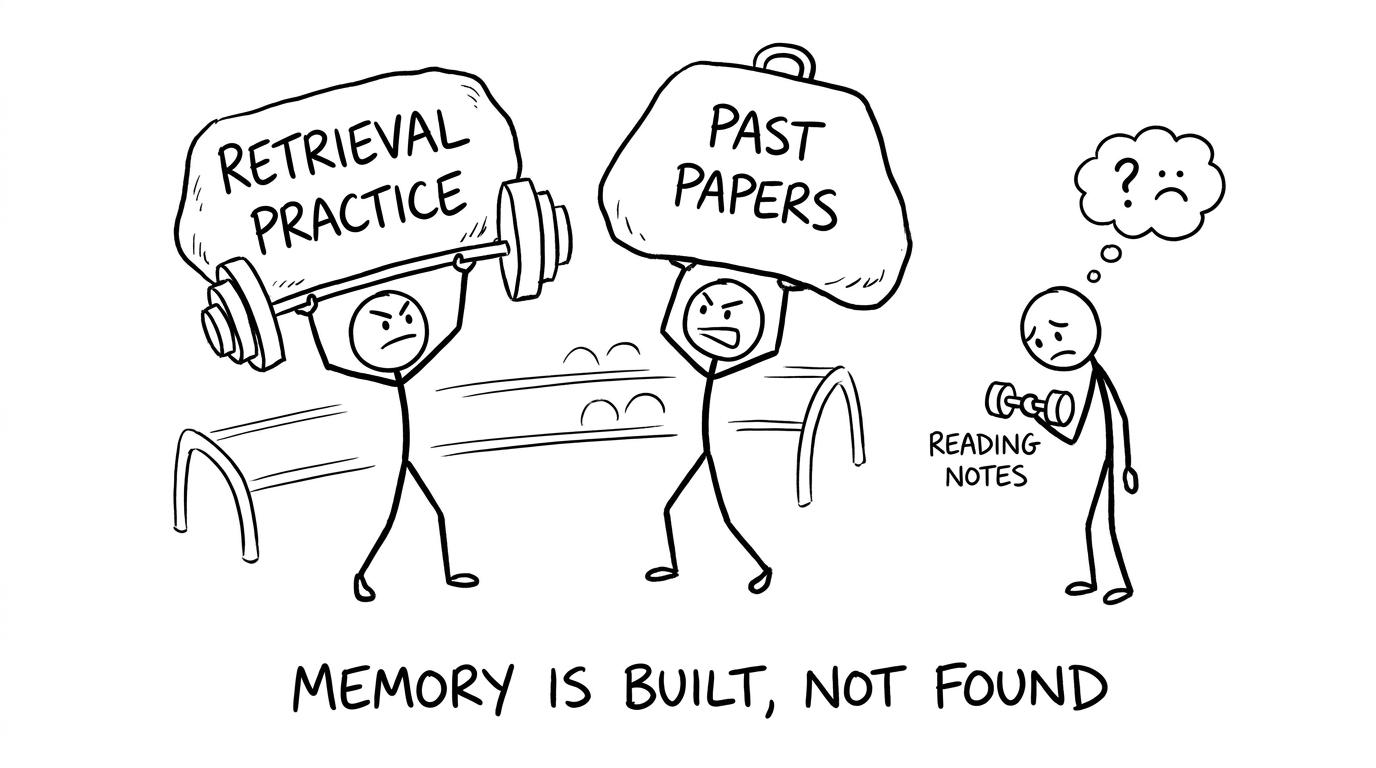 Memory is built like strength training
Worked examples that build GCSE memory (not just confidence)
Below are three GCSE-style examples designed for retrieval and retention. The key is not the topic: it’s the process: attempt, check, then re-attempt later in the week.
Worked example: algebra simplification
Simplify 3(2x−5)−2(x+4)3(2x-5)-2(x+4)3(2x−5)−2(x+4).
Start by expanding:
3(2x−5)=6x−15 3(2x-5)=6x-15 3(2x−5)=6x−15 −2(x+4)=−2x−8 -2(x+4)=-2x-8 −2(x+4)=−2x−8Combine like terms:
6x−15−2x−8=4x−23 6x-15-2x-8 = 4x-23 6x−15−2x−8=4x−23So the simplified expression is 4x−234x-234x−23.
If algebra slips from memory, build the habit with topic practice and solutions: Simplifying Algebra (Edexcel topic).
Worked example: percentage change (typical Edexcel skill)
A jacket costs £48. In a sale, the price is reduced by 15%15\%15%. What is the sale price?
Calculate the multiplier:
100%−15%=85%=0.85 100\%-15\% = 85\% = 0.85 100%−15%=85%=0.85Apply it:
48×0.85=40.8 48 \times 0.85 = 40.8 48×0.85=40.8So the sale price is £40.8040.8040.80.
To make this stick for GCSE, revisit it later with a different context (reverse percentages, multipliers, repeated change). Interleaving prevents “topic amnesia”.
Worked example: equation of a line from gradient and a point
Find the equation of the line with gradient m=3m=3m=3 passing through (2,−1)(2,-1)(2,−1).
Use y=mx+cy=mx+cy=mx+c:
y=3x+c y=3x+c y=3x+cSubstitute the point (2,−1)(2,-1)(2,−1):
−1=3(2)+c -1 = 3(2) + c −1=3(2)+c −1=6+c -1 = 6 + c −1=6+c c=−7 c = -7 c=−7So the equation is:
y=3x−7 y=3x-7 y=3x−7This is a classic Edexcel GCSE skill because it connects graphs, substitution and rearranging in one place. The best way to stop forgetting it is to see it appear again in mixed past-paper questions.
Use mark schemes like a coach, not a judge
Many students mark a paper, see a low score, and panic-revise the whole topic list again. A better approach is smaller and calmer:
- Mark with the mark scheme.
- For every dropped mark, write one line:
- “I expanded brackets incorrectly.”
- “I didn’t show the substitution step.”
- “I used ab\frac{a}{b}ba instead of ba\frac{b}{a}ab.”
- Do two more questions of the same type.
- Schedule that topic for a spaced revisit.
On YesGenie you can practise this with real Edexcel papers: Edexcel GCSE Maths Past Papers.
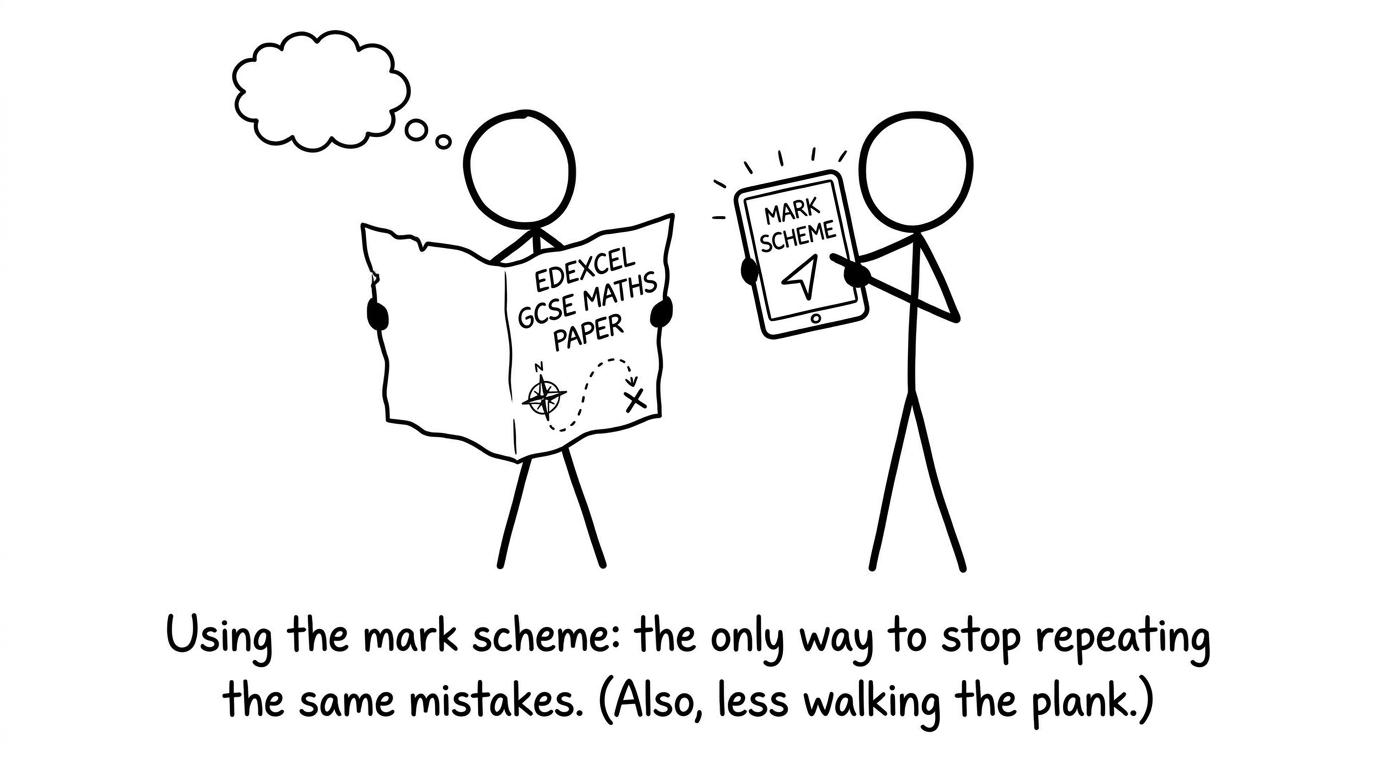 A mark scheme as a GPS, not a verdict
A simple weekly plan for Edexcel GCSE students who forget
Here’s a realistic GCSE revision rhythm that fits around school and avoids cramming.
Two weekday sessions (30-45 minutes)
- 10 mins: retrieval flashcards or quick recall (formulae, facts, steps)
- 20 mins: mixed topic questions
- 10 mins: mark + write fix lines
One longer weekend session (60-90 minutes)
- 45 mins: a mini test or half paper (timed)
- 15 mins: mark scheme + error log
- 15 mins: redo your worst 3 questions (immediately)
If you want more exam-style structure without jumping straight into full papers, use the resources hub: Resources: Mini Tests, Predicted Papers, 45 Minute Papers.
Use predicted papers near exam season
Predicted papers are most effective when they’re used like this:
- Sit it timed.
- Mark it the same day.
- Turn every mistake into a topic revisit session.
For Edexcel, you can find them here: Edexcel GCSE Maths Predicted Papers.
Common mistakes that make GCSE content slip away
These are the patterns that cause “I revised it but forgot it” in GCSE Maths:
- Only rereading notes: it feels productive, but it doesn’t train recall.
- Doing questions with the method visible: you’re practising recognition, not retrieval.
- Massed practice (one topic for two hours): you improve fast, then forget fast.
- Not using mark schemes properly: you see the answer, but you don’t isolate the reason you lost marks.
- Ignoring easy marks: number skills (fractions, percentages, standard form) are the glue for higher grades.
- No timed practice: memory behaves differently under exam conditions.
If you need a way to spot weak areas quickly, use self-assessment resources to guide what you space and revisit: Other Resources (Self Assessment Sheets).
Bring it together: the GCSE student who stops cramming
The students who stop forgetting aren’t the ones with perfect memory. They’re the ones who build a system that assumes forgetting will happen, then calmly pulls the content back into reach.
Make your GCSE revision boring in the best way: spaced practice, retrieval practice, mixed questions, mark scheme feedback, and regular timed work. Then let the exam feel familiar because you’ve trained familiarity on purpose.
If you’re revising Edexcel, you can do the whole loop on YesGenie: start with Edexcel GCSE Maths Revision, practise with Edexcel GCSE Maths Mini Tests, build exam confidence using Edexcel GCSE Maths Past Papers, and sharpen your final weeks with Edexcel GCSE Maths Predicted Papers.
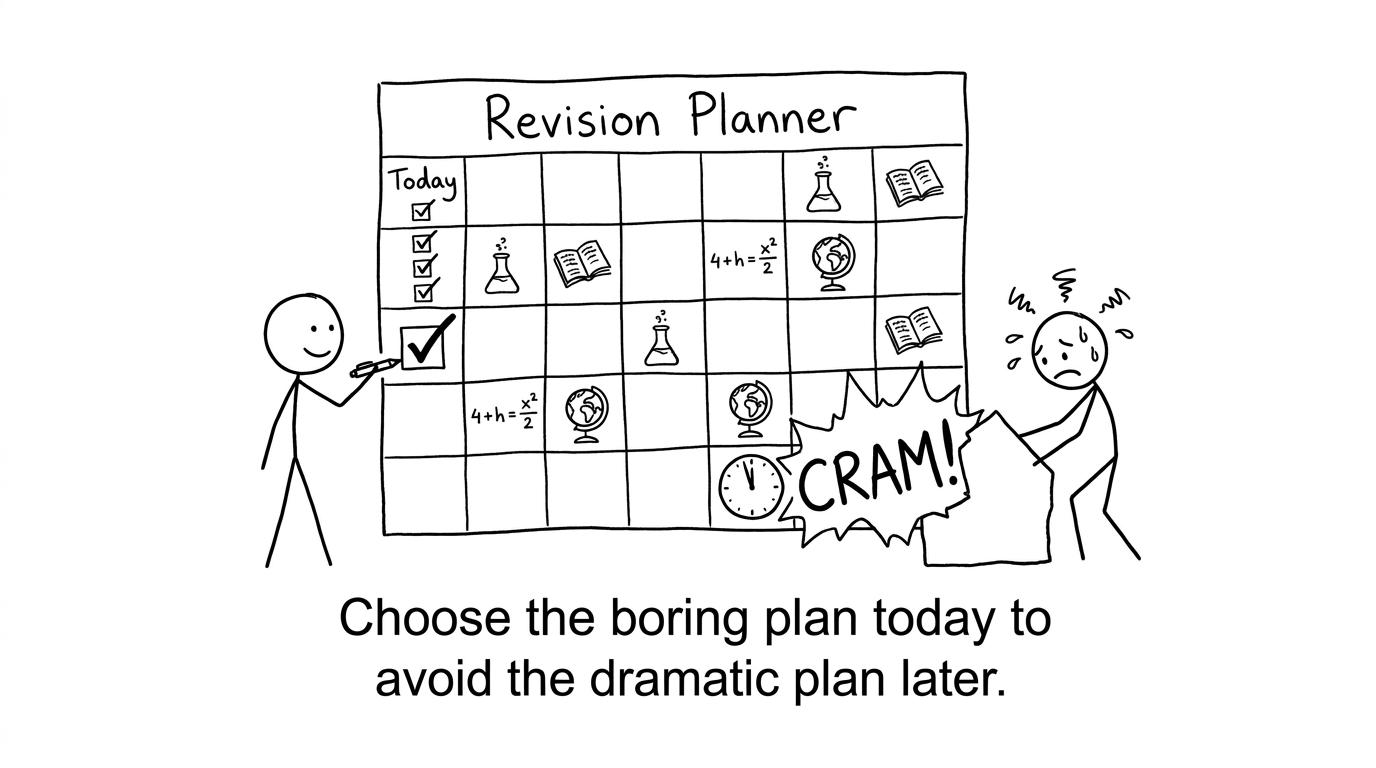 A revision planner beats last-minute drama
Your next step: pick one topic you “keep forgetting”, do a YesGenie lesson, answer a small set of exam-style questions, mark it properly, and schedule two spaced re-attempts. That is how GCSE maths starts staying in your head and how grades 9-1 become something you can actually control.