Regret Picking GCSE Citizenship Studies?
Regret picking GCSE Citizenship Studies? Learn why the course surprises some students and what to check before choosing your GCSE options wisely.
Choosing GCSE options can feel strangely permanent. A subject may sound interesting in a ten-minute presentation, then look very different when lessons, assessments and revision begin. If you already regret picking GCSE Citizenship Studies, the problem may not be the subject itself. More often, there is a mismatch between what a student expected and what the specification actually requires.
Citizenship Studies is not simply a weekly discussion about current affairs. It includes substantial knowledge of politics, government, law, rights, identity, finance and participation. It also rewards evidence-based arguments, source analysis and evaluation. That can be fascinating for the right student, but surprisingly demanding for someone expecting an easy option.
This guide explains the main reasons regret can develop, what to investigate before committing and how to protect your maths revision time if Citizenship Studies is already part of your timetable.
The quick checklist before choosing Citizenship Studies
Before submitting your options, find clear answers to these questions:
- Which exam board does your school use?
- What topics appear in that board's current specification?
- How many written papers will you sit?
- How much extended writing and source evaluation will be required?
- How will your citizenship action be taught and assessed?
- Do you enjoy politics, law, debate and comparing viewpoints?
- Will the subject fit alongside your other writing-heavy options?
- Can your teacher show you a past paper and mark scheme?
- What are your school's rules and deadlines for changing options?
That last point matters. Option-change arrangements are determined by individual schools, so do not assume that a change will remain possible indefinitely. Ask your head of year, options lead or examinations officer for the exact procedure.
 A student discovers that reading the specification matters at the GCSE options crossroads
Why some students regret picking GCSE Citizenship Studies
There is no reliable national survey establishing one universal reason for option regret. However, the structure of the course reveals several predictable sources of disappointment. Most involve expectations rather than ability.
They expected lessons to be mostly informal discussion
Citizenship involves debate, but informed debate depends on knowledge. The Department for Education's subject content includes parliamentary democracy, elections, government, citizen participation, rights, law, the legal system, identities, diversity, the economy and public finance.
You therefore need accurate terminology and specific knowledge. Having a strong personal opinion is not enough. In an examination, a claim normally needs to be relevant, developed and supported before it can contribute to a reasoned judgement.
This is often the first surprise: the course asks you to understand how institutions work, not merely how you feel about them.
They underestimated the extended writing
The official assessment objectives across GCSE Citizenship Studies allocate approximately 30%30\%30% to knowledge and understanding, 30%30\%30% to application and 40%40\%40% to analysing and evaluating evidence, viewpoints and actions.
That final weighting helps explain why vague answers struggle. Students must connect ideas, consider alternatives and reach substantiated conclusions. If you dislike structured writing under time pressure, inspect a real paper before choosing the subject.
This does not mean you need naturally elegant prose. Clear paragraphs, relevant evidence and logical judgements matter more than decorative language. But you must be willing to practise them.
They assumed the citizenship action was optional or ordinary coursework
Taking citizenship action is built into the national subject requirements. For a full-course GCSE, questions drawing on what students learnt from taking action account for 15%15\%15% of the marks. The work may involve identifying an issue, researching it, planning action and evaluating its effectiveness.
The exact organisation depends on the specification and school. On AQA, for example, students complete an active-citizenship investigation, but the qualification is assessed through written examinations rather than a separately graded coursework component.
Students can regret the option when they expected either no practical element or a large piece of coursework that would directly secure part of the final grade. Neither assumption should be made without checking the current specification.
They did not check their exam board
The core national content is shared, but paper structures differ. AQA's specification has two written papers, each worth 50%50\%50%, while OCR's specification uses three externally assessed components. Question formats and the distribution of topics also vary.
Do not prepare from a random online summary just because it says “GCSE Citizenship”. Confirm whether your school uses AQA, Pearson Edexcel or OCR, then compare the current specification with the papers your class will actually sit.
The same principle matters in maths. Revision should match your board and tier, which is why the MathsGenie GCSE Maths revision hub lets students begin with the correct route rather than treating every examination as identical.
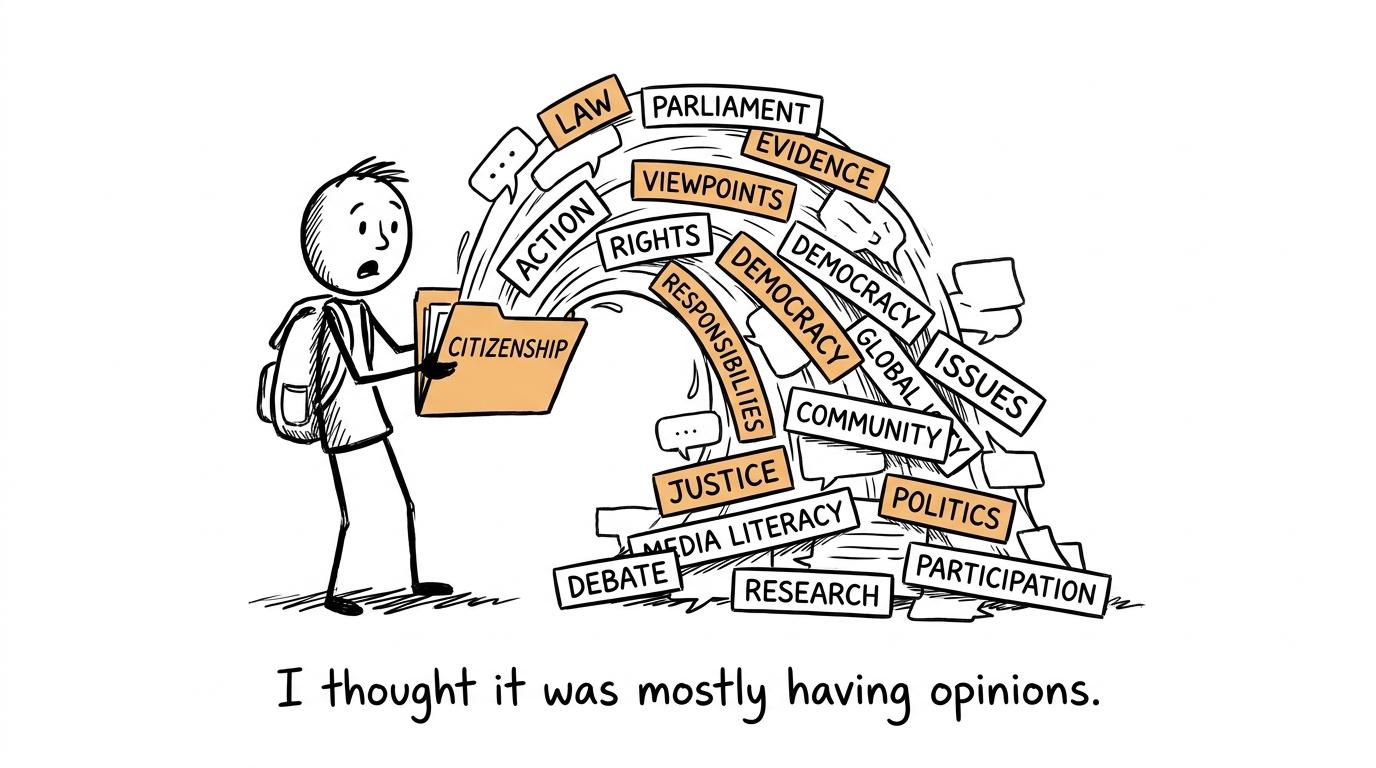 A Citizenship folder releases more law, evidence and politics than expected
They chose it because it sounded easy
No GCSE is automatically easy for every student. A subject feels manageable when its demands match your interests and habits.
Citizenship may suit you if you enjoy asking how decisions are made, analysing evidence, learning about institutions and constructing balanced arguments. It may feel draining if you strongly prefer short factual answers, dislike reading sources or avoid writing conclusions.
The useful question is not, “Is Citizenship easy?” It is, “Am I willing to become good at the skills it examines?”
They created an unbalanced combination of subjects
A single essay-based option may be comfortable. Several subjects requiring extensive reading, recall and writing can produce a crowded revision timetable. Meanwhile, compulsory maths, English and science still need regular attention.
Look at your complete option combination. Consider the type of effort each subject requires, not just whether its title sounds appealing. A balanced timetable gives you different kinds of work and reduces the temptation to neglect maths until the final weeks.
What to inspect before you commit
Read the specification, not only the prospectus
A school prospectus gives a useful introduction, but the specification defines the course. Check the content headings, assessment objectives, paper lengths and question styles. Ask which elements students commonly find unfamiliar.
Then open a past paper. You do not need to answer it. Simply notice how often it asks you to explain, analyse, evaluate, compare or justify. Those command words reveal the course more honestly than an options leaflet can.
Ask how the subject is taught at your school
The qualification may be national, but the classroom experience is local. Useful questions include:
- How is the citizenship action organised?
- Are lessons mainly knowledge, discussion, source work or writing practice?
- Which resources will be provided?
- How frequently will students complete timed answers?
- What support is available when a topic feels difficult?
These are practical questions, not signs of doubt. Good choices are usually made with more information, not more confidence.
Compare the reality with your reasons
Write down why you are considering the option. “I enjoy understanding politics and law” is a reason connected to the course. “My friend is choosing it” is not. Neither is “someone said it has little revision”.
Friends, teachers and future plans can influence your decision, but you will complete the lessons and sit the papers. Your reason needs to survive an ordinary Tuesday afternoon, not just options evening.
What to do if you already regret the choice
First, separate temporary discomfort from a genuine mismatch. A difficult topic, an unexpectedly low mark or one demanding homework task does not prove that the entire option was wrong.
Try a short diagnostic period:
- Identify whether the difficulty is knowledge, terminology, writing or time management.
- Ask your teacher to explain how your last answer lost marks.
- Practise one improvement at a time, such as using evidence or reaching a supported judgement.
- Review the mark scheme rather than relying only on the final score.
- Speak to the appropriate member of staff if regret remains persistent.
This mirrors an effective maths process: diagnose, practise, mark and retest. MathsGenie's guide to finding your weakest GCSE topics explains why naming the specific gap is more useful than deciding you are simply “bad” at a subject.
If changing the option is still permitted, discuss the academic and timetable consequences with your school and a parent or carer. Do not stop attending lessons or assume that another subject will be available until the change has been formally approved.
Protecting maths revision alongside Citizenship Studies
Writing-heavy subjects can expand to fill every available evening. Maths improves through repeated problem-solving, so it is particularly vulnerable when practice becomes irregular.
Use a simple weekly structure:
- Reserve two or three short maths sessions before allocating longer reading tasks.
- Use revision lessons and practice questions to repair individual topics.
- Complete mini tests to check whether a method has stayed in memory.
- Add timed papers gradually rather than saving them all for examination season.
- Mark every attempt and record why marks were lost.
If you need a starting point, the one-week GCSE maths revision plan provides a manageable structure. The guide to when to start GCSE past papers also helps you move from topic practice to timed work without beginning full papers too early.
For Edexcel students, GCSE Maths past papers with mark schemes provide realistic examination practice. Students who repeatedly forget methods can use the spaced maths revision plan to revisit topics across several days.
 A calm weekly planner defeats an ambitious pile of revision books
Common mistakes when deciding or responding to regret
Calling the subject easy without seeing an examination paper
Course names do not reveal assessment demands. Look at the current specification, sample materials, past papers and mark schemes before deciding.
Confusing strong opinions with high-mark answers
Citizenship rewards informed reasoning. A confident conclusion still needs knowledge, application and evaluation.
Revising only recent news stories
Current affairs can provide context, but the examination assesses specification content and citizenship skills. News consumption cannot replace learning the required political, legal and economic concepts.
Using resources for the wrong board
A general explanation may help, but examination practice must reflect your specification. Check the board, component and current paper structure every time.
Letting one option consume the whole timetable
Revision time should reflect need and evidence. Use short diagnostics in every subject, then allocate time to the gaps that are genuinely costing marks. MathsGenie's advice on using past papers properly shows how marking and targeted follow-up prevent aimless practice.
Waiting until the night before to ask for help
Problems become harder to solve when deadlines have passed. Speak to school staff early. For maths examinations, a calm GCSE night-before revision plan is useful precisely because the deeper learning has already happened.
Make the decision from evidence
Regretting an option does not mean you made a foolish decision. It usually means you made a decision with incomplete information. The remedy is not panic. It is a clearer picture of the course, an honest assessment of your preferences and an early conversation with your school.
Before choosing Citizenship Studies, inspect the specification, paper structure, writing demands and citizenship action. If you have already started, identify the exact source of difficulty before deciding the subject is beyond you.
Whatever happens with your options, keep compulsory maths moving. Use MathsGenie's free GCSE revision resources to build a revision plan from lessons, practice questions, mini tests, past papers, predicted papers, mark schemes and video solutions. Choose one weak topic today, practise it, mark it carefully and turn uncertainty into a specific next step.