

Redo GCSE Sociology Mock Timed: Is It Worth It?
Redo GCSE Sociology mock timed: decide when a full resit helps, when review is better, and how to turn lost marks into focused GCSE revision that lasts.

There is a particular kind of frustration that follows a disappointing mock. You close the paper knowing that some answers were rushed, other questions were misread, and several things you revised simply refused to appear in your memory. The instinct is often to start again and prove that you can do better.
But should you redo GCSE Sociology mock timed, from the first page to the last? Usually, not immediately. Reviewing and repairing your first attempt is generally the better use of revision time. A complete timed resit becomes worthwhile later if pacing, stamina or decision-making under pressure was a genuine problem.
That distinction matters for maths students too. Whether the paper contains sociological arguments or algebra, repeating an assessment without understanding the lost marks can reproduce the same weaknesses more efficiently rather than remove them.
The short answer: review first, then decide
Use this checklist before committing to another complete sitting:
- Review first if most lost marks came from missing knowledge, weak evaluation or misunderstood questions.
- Use targeted practice if one topic or question type caused a large share of the damage.
- Redo selected questions if your ideas were sound but your answers lacked development, evidence or conclusions.
- Sit a fresh timed paper if time pressure, concentration or exam stamina affected several sections.
- Redo the original paper in full only after a delay, and only when it tests a specific improvement you have made.
The sequence is important:
attempt, mark, diagnose, repair, and retest
A mock tells you where the problem is. The learning happens when you act on that information.
Why immediately repeating the entire mock is often inefficient
A second attempt can feel reassuring because the questions are familiar. You remember the item you missed, the argument you wished you had included and perhaps even parts of the mark scheme. Your mark may rise significantly.
That improvement is not meaningless, but it can be misleading. You are partly measuring memory of the paper rather than your ability to respond to an unseen question. In the real examination, familiarity with the exact wording will not be available.
Immediate repetition also consumes a substantial block of time. Under the current AQA GCSE Sociology specification, each paper lasts 111 hour 454545 minutes, carries 100100100 marks and contributes 50%50\%50% of the qualification. A full resit therefore requires nearly two hours before marking and reviewing have even begun. Check your own specification and mock format if your school follows another exam board.
That same opportunity-cost problem appears in maths. A complete paper can diagnose weaknesses, but a shorter set focused on equations, probability or geometry may repair them faster. MathsGenie's guide to finding your weakest GCSE topics explains how to turn lost marks into specific revision priorities rather than another vague instruction to “revise everything”.
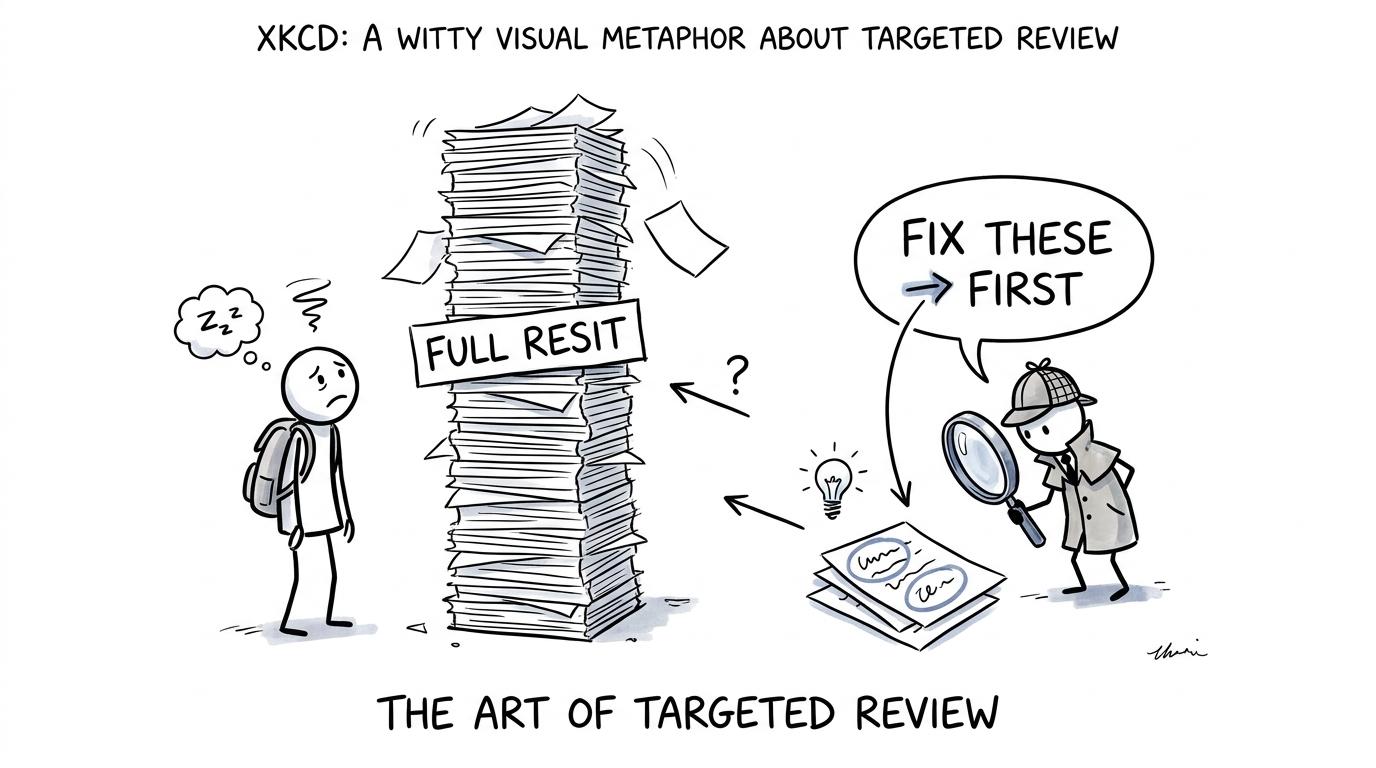 A student choosing between an enormous full resit and three targeted corrections
What reviewing the first attempt should actually involve
Review is not reading the teacher's comments, nodding and putting the paper away. It is an active process in which every important lost mark receives an explanation and a next action.
Classify why each mark was lost
Use four categories:
- Knowledge: You could not recall a theory, concept, study or research-method issue.
- Application: You knew relevant material but did not connect it closely enough to the question or item.
- Analysis and evaluation: You described an argument without examining its strengths, limitations or implications.
- Exam execution: You misread a command word, spent too long on one response or left part of the paper unfinished.
This reflects the broad assessment demands of GCSE Sociology. For AQA, the assessment objectives cover knowledge and understanding, application, and analysis and evaluation. A total mark alone cannot tell you which of those needs attention.
Maths papers benefit from a parallel classification: knowledge gap, method error, accuracy slip or exam-technique problem. The MathsGenie guide to using GCSE past papers properly develops this diagnostic approach for maths revision.
Turn comments into precise actions
“Needs more detail” is not yet a revision plan. Replace it with something observable:
- retrieve the missing concept without notes;
- create a comparison between two perspectives;
- practise planning an extended response;
- identify where evidence should support an argument;
- rewrite a conclusion so that it answers the exact question;
- complete one section within a realistic time allowance.
Educational evidence on retrieval practice also emphasises the importance of feedback. Attempting to recall material can reveal gaps, but misconceptions need to be corrected rather than repeatedly retrieved. That is why marking and repair are inseparable from testing.
Reattempt selected questions without copying
Close the mark scheme. Put away the model answer. Then reattempt the questions that best represent your weaknesses.
For a knowledge gap, a short retrieval task may be enough. For weak evaluation, rewrite or re-plan the extended response. For a timing problem, attempt a comparable section with a timer. The retest should match the problem you are trying to solve.
When a full timed resit is worth doing
A complete paper has a different purpose from targeted revision. It is rehearsal rather than repair.
Your main problem was pacing
If you knew enough sociology but failed to finish, a full timed paper can show whether your pacing strategy now works. It tests transitions between short and extended responses, decisions about when to move on, and your ability to preserve time for later sections.
Do not merely start a timer and hope. Set planned checkpoints based on the structure and marks of your own paper. If you miss a checkpoint, make a deliberate decision rather than silently borrowing time from the final question.
Your concentration declined noticeably
Knowing the content in a short revision session is not identical to retrieving and applying it throughout a long examination. A full mock can reveal whether answer quality falls late in the paper or whether rushed reading creates avoidable mistakes.
This is one reason maths students eventually need complete papers too. The Edexcel GCSE Maths past papers collection provides full papers with mark schemes and worked solutions where available. Students following AQA, OCR or Eduqas can choose their board through the wider GCSE maths revision hub.
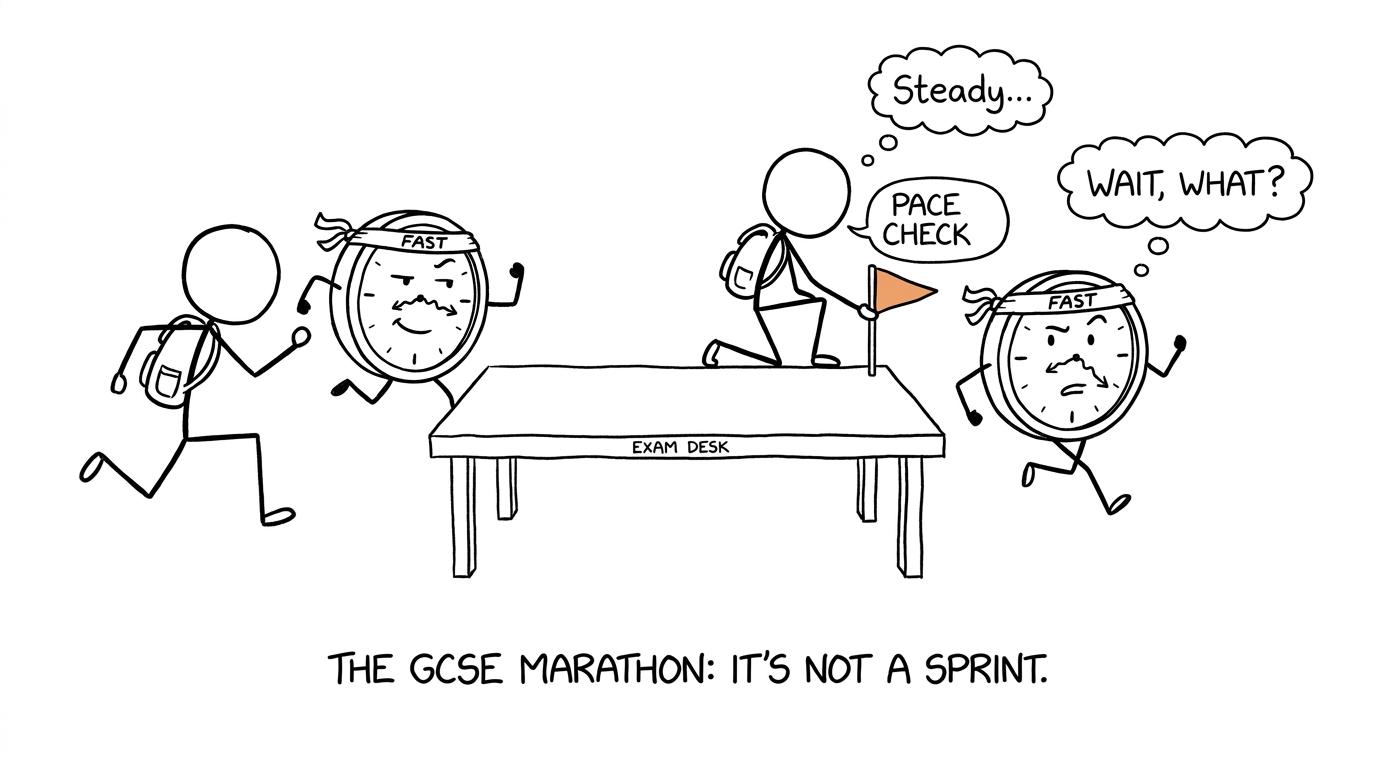 A calm student using a pace checkpoint while racing an overconfident exam clock
You have repaired the weaknesses first
A resit is useful when it answers a question such as: “Can I now maintain stronger evaluation while finishing the paper?” It is less useful when the only question is: “Can I get a higher mark on something I have already seen?”
Repair first. Allow some time to pass. Then test the improvement without notes. If possible, use a fresh paper that matches your specification. Unseen questions provide cleaner evidence because remembered wording and answers cannot support you.
The examination is approaching
Earlier in revision, topic work usually offers a better return because there is time to rebuild weak knowledge. Closer to the examination, full papers become more valuable for bringing knowledge, writing and timing together.
The same progression works in maths: learn through revision lessons, practise individual question types, use mini tests for shorter checks, and finish with full past or predicted papers. The one-month GCSE maths revision plan shows how to move gradually from diagnosis to realistic exam conditions.
A better plan than simply repeating the paper
Use the next several revision sessions as a connected cycle.
First session: forensic review
Mark the original paper carefully using your teacher's feedback and the relevant mark scheme. Record the topic, marks lost, reason and next action for every significant mistake. Choose the three weaknesses responsible for the greatest loss rather than creating an overwhelming list.
Middle sessions: repair and retrieve
Relearn missing content, then recall it without notes. Plan or write selected responses that require application, analysis and evaluation. Use different questions where possible so that you have to select the knowledge rather than reproduce a remembered answer.
Final session: retest under suitable pressure
Choose the smallest test capable of proving that the weakness has improved. This might be one timed extended response, a complete section or a fresh full mock. Full-paper conditions are necessary only when you need full-paper evidence.
For maths revision, shorter assessment can serve the same purpose without exhausting an evening. MathsGenie's twenty-minute revision routine combines recall, exam questions and immediate marking, while its GCSE exam-week checklist explains when a mini test or paper section is preferable to another full sitting.
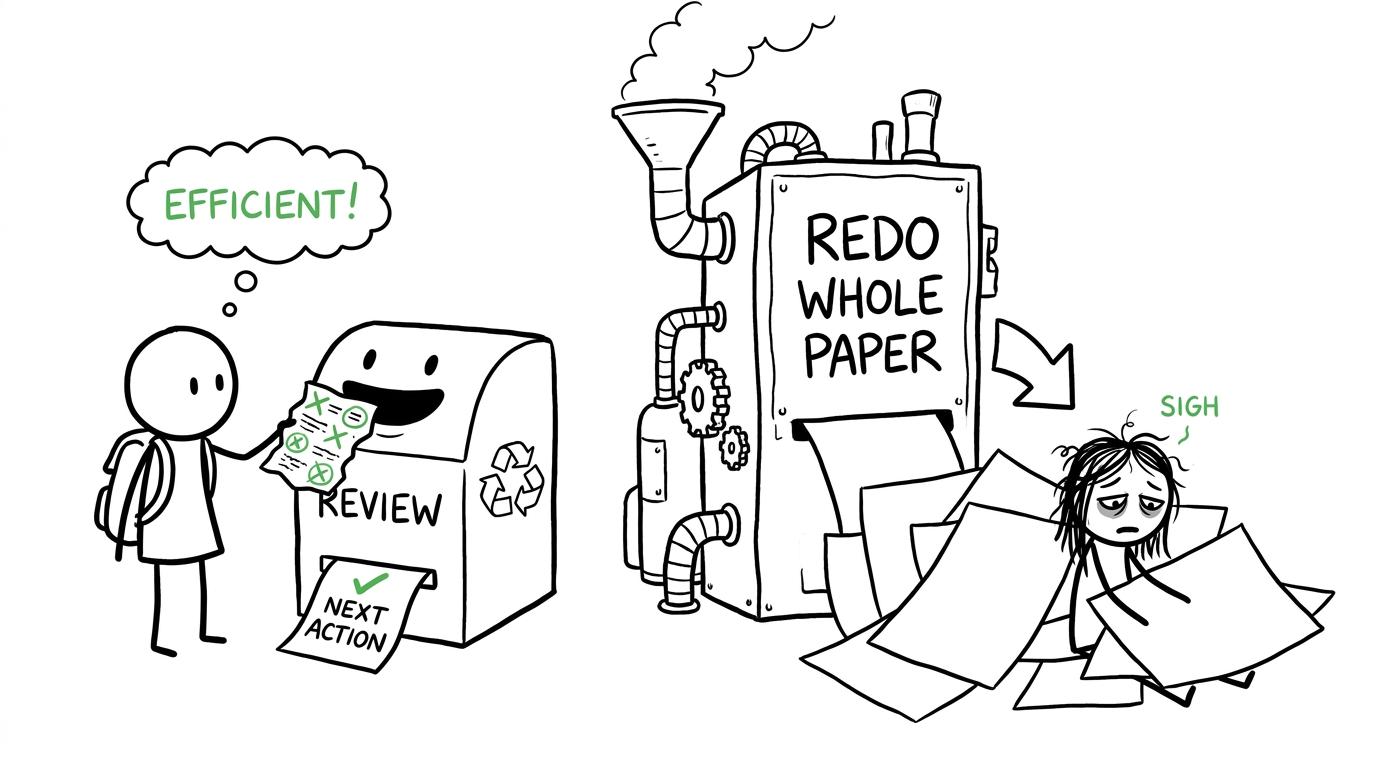 A revision machine turning marked errors into clear next actions
How to judge whether the resit helped
Do not judge the second attempt only by its total mark. Compare evidence across several dimensions:
- Did you finish every required response?
- Were extended answers balanced and focused?
- Did you apply material to the wording or item?
- Did your evaluation lead towards a reasoned judgement?
- Were fewer marks lost to the same recurring weakness?
- Did you perform without relying on remembered feedback?
A higher mark accompanied by the same timing problem is only a partial success. A modest mark increase with stronger pacing and fewer repeated errors may represent more durable progress.
The principle transfers neatly to foundation and higher tier maths. Scores matter, but so do the reasons behind them. If algebra improved while geometry remained weak, your next session should follow the evidence. MathsGenie's article on using Edexcel GCSE papers effectively recommends marking strictly, diagnosing errors and repairing a small number of priority topics before another full test.
Common mistakes when redoing a GCSE mock
Resitting before reviewing
This turns the second paper into another diagnosis when you already have one. Analyse the first attempt before spending time generating similar evidence.
Memorising the mark scheme
Model answers can clarify what a strong response contains, but copying their language creates recognition rather than independent recall. Study the principle, close the answer and apply it to a different question.
Treating every lost mark equally
A one-off slip and a repeated misunderstanding do not deserve the same revision time. Prioritise patterns, high-mark questions and weaknesses that affect several topics.
Using timing to hide knowledge gaps
A timer cannot supply a missing sociological concept or mathematical method. If you cannot begin a question when working without pressure, repair the knowledge before trying to complete it faster.
Never returning to full papers
Targeted practice is efficient, but examinations require integration. Once the underlying weaknesses are improving, complete at least some fresh papers in realistic conditions so that timing and stamina are not left untested.
Make the next attempt prove something
Redoing an entire GCSE Sociology mock under timed conditions can be worthwhile, but it is rarely the best first response. Review the original attempt, identify why marks disappeared, repair the most important weaknesses and then choose a retest that matches the problem. Use a full paper when you genuinely need to test pacing, stamina and whole-exam decision-making.
The lesson is equally valuable for GCSE maths. A paper is evidence, not a punishment and not the whole revision process. Start with the free MathsGenie GCSE maths revision hub, use revision lessons and practice questions to repair weak topics, check progress through mini tests, and build towards past papers and predicted papers under timed conditions. Mark carefully, use the video solutions where available, and let every mistake choose your next action.











