Learning Styles GCSE Maths: Do They Matter?
Learning styles GCSE maths evidence explained. Discover what improves revision: retrieval, spaced practice, feedback and exam questions for better marks.
A learning-style quiz can feel reassuring. It gives revision a neat label: visual, auditory or kinaesthetic. The difficulty is that GCSE maths exams do not arrive in three personalised versions.
So, do learning styles GCSE maths strategies actually improve results? The short answer is no: current evidence does not support matching revision to a supposed fixed learning style. You may prefer diagrams, spoken explanations or writing things down, but preference is not proof that you learn best through that format.
A stronger approach is to choose the method that fits the mathematical task, then use retrieval practice, spaced revision, exam questions and feedback to make the learning last.
The practical answer at a glance
- Do not restrict yourself to one learning style.
- Use diagrams when the mathematics is spatial or graphical.
- Use clear verbal explanations to understand reasoning and vocabulary.
- Write full solutions because that is what the examination requires.
- Retrieve methods from memory before checking notes.
- Space practice across several days.
- Mix topics once the individual methods are secure.
- Mark your work and revisit the precise cause of each lost mark.
You can begin by checking the GCSE maths topics for your exam board and tier, rather than allowing a learning-style label to decide what you revise.
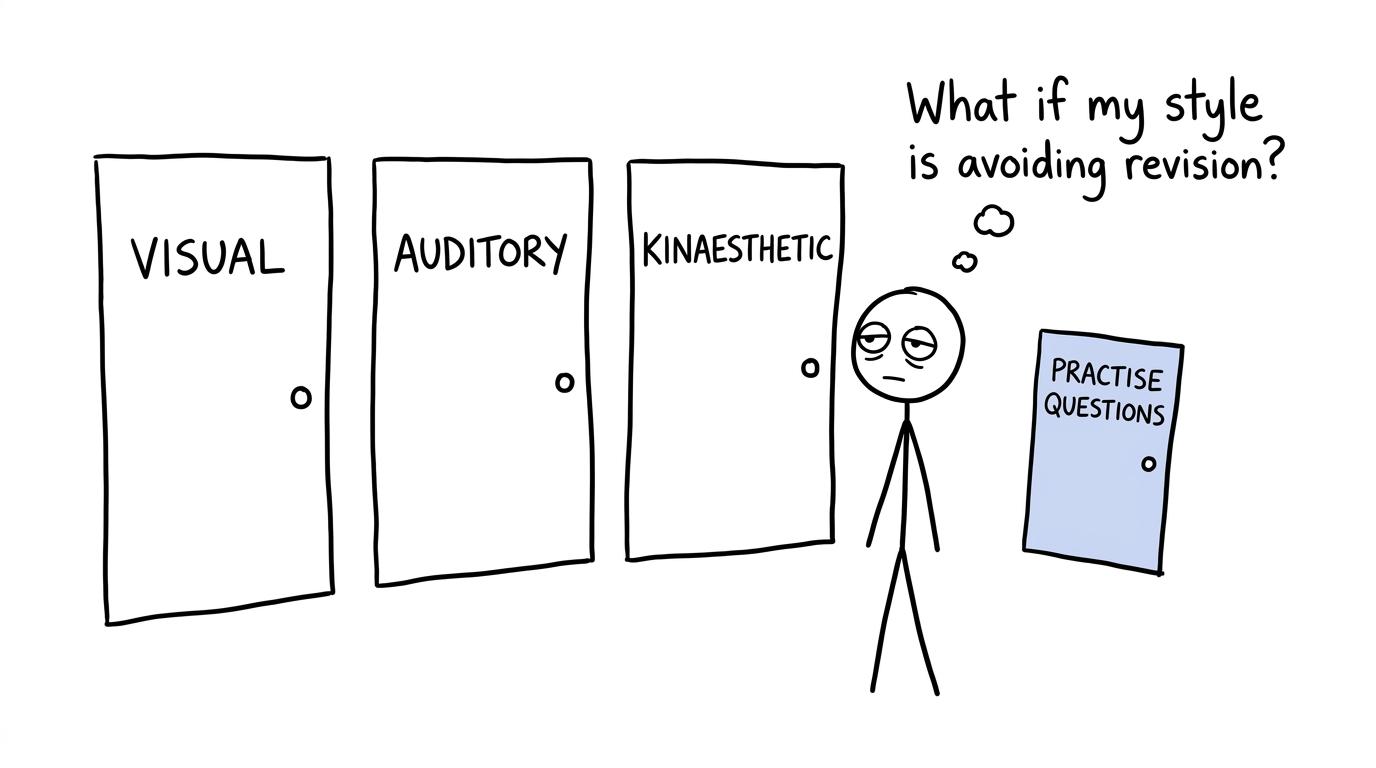 A student choosing between learning-style doors and practice questions
What does matching a learning style mean?
The familiar visual-auditory-kinaesthetic model suggests that people can be classified by the way they learn best. A visual learner might be directed towards diagrams and colour coding. An auditory learner might listen to explanations. A kinaesthetic learner might use movement or physical activities.
There are two different ideas hidden here:
- students can have preferences about how revision feels;
- students learn more when teaching is matched to those preferences.
The first is unsurprising. You may genuinely enjoy videos more than textbooks. The second is a testable claim, sometimes called the meshing hypothesis. To support it convincingly, visual learners would need to perform better with visual instruction while auditory learners performed better with auditory instruction, when both groups were assessed fairly on the same learning.
Research has not produced reliable evidence for that pattern. Enjoying a format can improve your willingness to begin, but it does not guarantee durable knowledge or better exam performance.
What the evidence actually shows
The Education Endowment Foundation describes the evidence for identifying and matching fixed learning styles as extremely limited. It also warns that restricting pupils to activities based on a reported preference may hinder progress and encourage unhelpful labels.
A major review published in 202320232023 found no reliable empirical basis for matching teaching methods to preferred styles. A 202420242024 meta-analysis offered a more nuanced result: it found a small overall benefit across the included studies, but the particular crossover pattern needed to support learning-style matching appeared in only about 26%26\%26% of the relevant measures. The researchers judged the effects too inconsistent, infrequent and dependent on low-quality evidence to justify widespread adoption.
That nuance matters. The responsible conclusion is not that pictures, speech or physical models are useless. It is that you should not build GCSE revision around the belief that you are permanently one type of learner.
There is also a risk in the label itself. Saying, “I am not a visual learner,” can become a reason to avoid graphs. Saying, “I only learn by listening,” can become a reason not to write complete solutions. In maths, both choices would remove important forms of practice.
Why GCSE maths needs more than one format
The best representation is usually determined by the topic, not the student category.
Graphs, transformations, vectors and constructions contain relationships that are naturally visual. Ratio, algebraic proof and probability also benefit from words that explain why a method works. Written calculation matters because Edexcel, AQA, OCR and Eduqas papers require students to select methods, show reasoning and communicate solutions.
Consider the different demands involved in understanding an equation such as:
y=mx+cy = mx + cy=mx+cA graph can reveal gradient and intercept. A spoken explanation can clarify what each symbol represents. Written questions then test whether you can apply the relationship independently. These formats support different parts of the same learning; they are not treatments for different types of brain.
This is why the free GCSE and A Level maths revision resources on MathsGenie combine explanations, videos, questions and solutions. Variety is useful when it serves the mathematics and leads to independent practice.
What works better than revising by learning style?
Retrieval practice
Retrieval means trying to recall knowledge before looking at the answer. In GCSE maths, that might involve writing a formula from memory, describing the steps of a method or attempting an exam question without notes.
The effort is important. Watching a solution can make a method look familiar, but familiarity is not the same as being able to produce it under exam conditions. Start with the question. Use the explanation afterwards to repair what was missing.
Short tests make this manageable. The Edexcel GCSE Maths mini tests offer focused practice with mark schemes and worked solutions where available.
Spaced practice
One long evening on algebra may create rapid short-term improvement. It can also create the illusion that the topic is secure because every question looks similar and the method remains fresh in memory.
Spacing means returning to the topic on different days. A practical cycle is:
- learn and practise the method;
- retrieve it in a later session;
- answer an exam-style question after another gap;
- revisit it again if the mark scheme exposes a weakness.
A realistic GCSE maths revision timetable can help you distribute topics rather than cramming them into isolated blocks. MathsGenie's revision planner can then keep those return visits visible.
Mixed and interleaved questions
Blocked practice tells you which method to use because every question is from the same topic. Mixed practice removes that clue. You must decide whether a problem needs percentages, Pythagoras, simultaneous equations or another technique.
That decision is part of examination performance. Begin with focused practice while learning a new method, then mix it with older material. Past papers are valuable because the topic is not announced above each question. The guide to when to start GCSE maths past papers explains how to introduce them without abandoning topic revision too early.
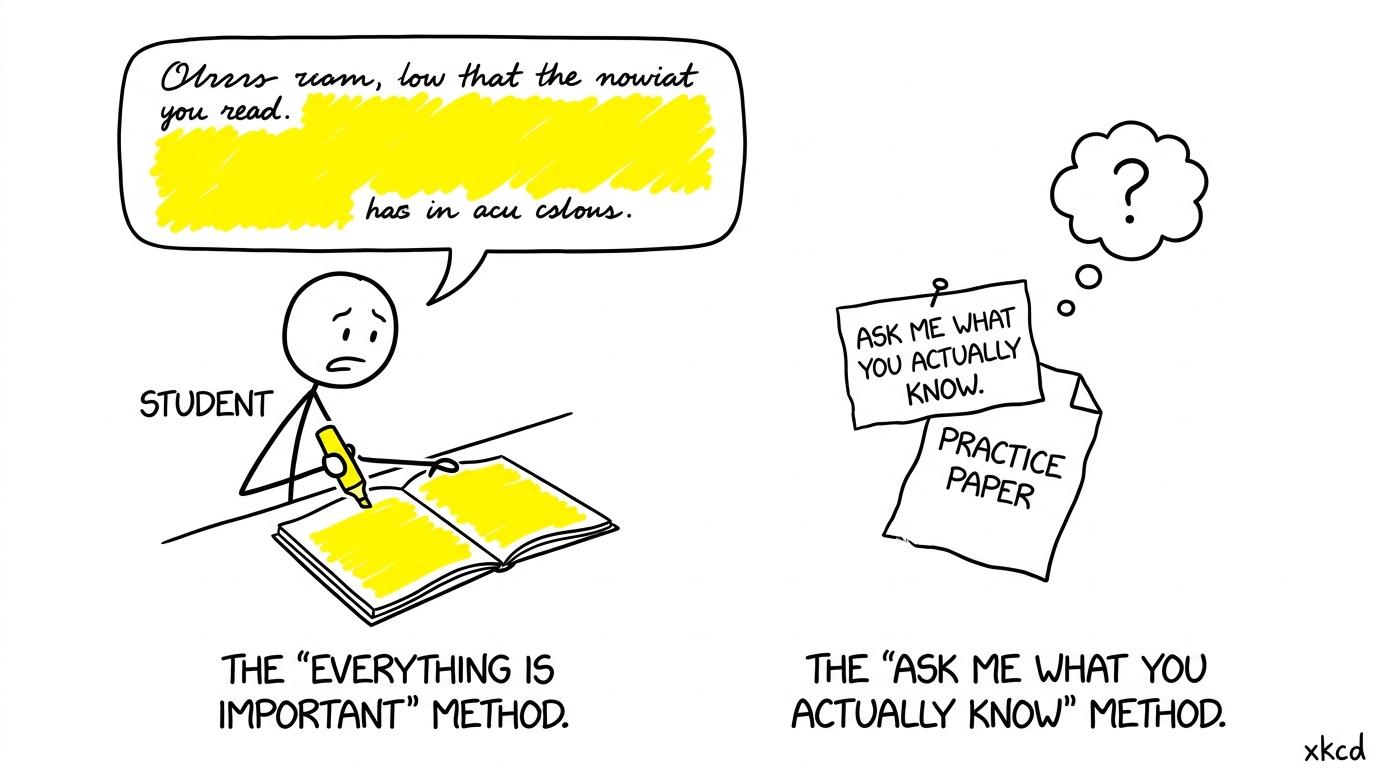 A highlighted page asking for attention while a practice paper waits
Feedback and correction
Completing questions is only half of revision. The other half is discovering why marks disappeared.
Use the mark scheme and classify each error:
- missing knowledge;
- incorrect method;
- arithmetic or algebra slip;
- misread instruction;
- incomplete working;
- poor timing.
Then choose the response that fits the cause. Rewatching a whole lesson will not fix a habit of omitting units. Equally, telling yourself to “be more careful” will not repair a missing method.
The process in finding your weakest GCSE maths topics helps turn lost marks into specific next actions. If you sit Edexcel, the guide to using GCSE maths past papers properly also explains how to mark, diagnose and reattempt questions.
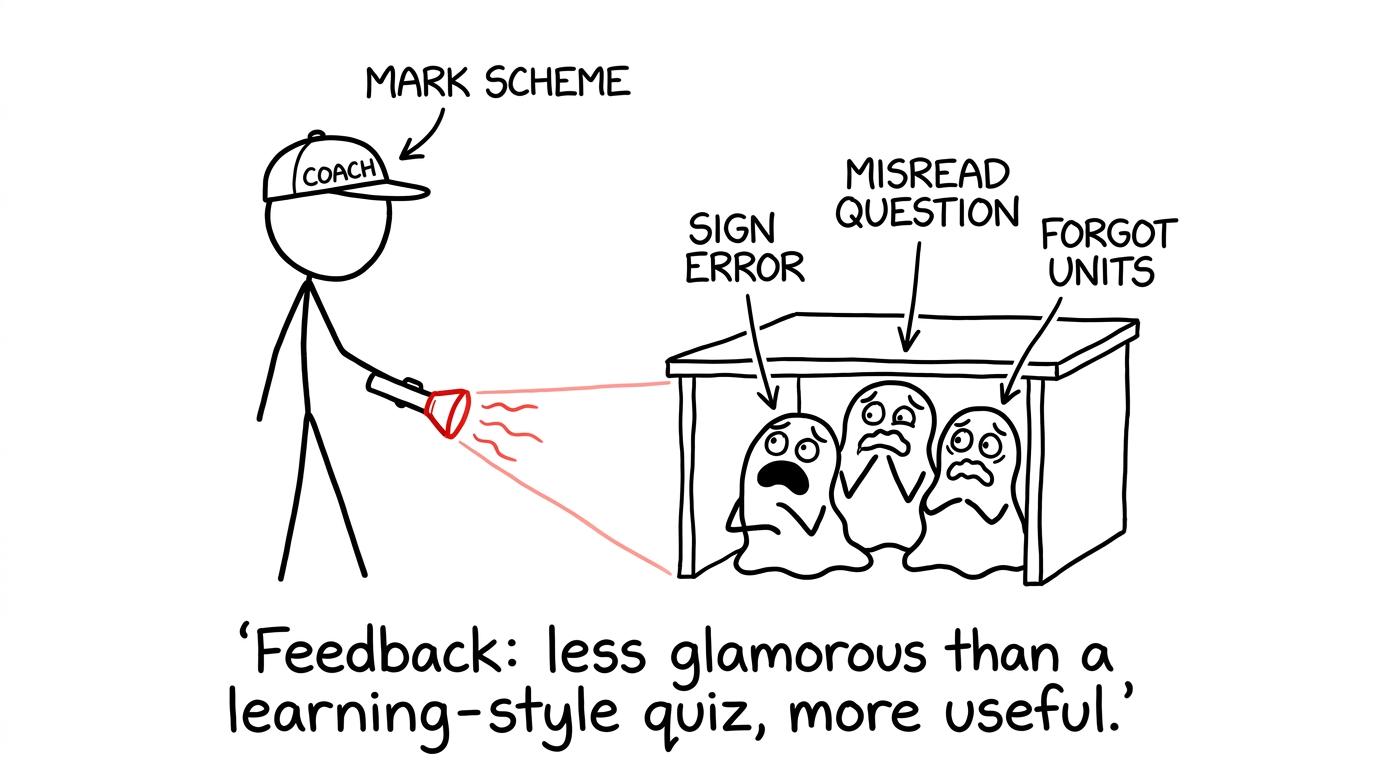 A mark scheme revealing revision mistakes hiding under a desk
A learning-styles-free revision routine
You do not need to ban your preferred resources. Instead, turn them into a complete learning cycle.
Learn
Choose one precise topic at the correct foundation or higher tier. Use a MathsGenie revision lesson or video solution to understand the method. Include a diagram, explanation or model when it genuinely clarifies the mathematics.
Retrieve
Close the notes. State the key facts or method from memory, then attempt practice questions. If you cannot begin, check only the necessary prompt and try again without it.
Mark
Use the answers or mark scheme. Record the exact reason for every lost mark. A specific note such as “used diameter instead of radius” is useful; “silly mistake” is not.
Revisit
Schedule the topic again after a gap and use different questions. A short routine can be enough on busy days; MathsGenie's 20-minute GCSE maths revision routine combines recall, questions and marking.
Test under exam conditions
Move towards timed past papers and, nearer the examination, Edexcel GCSE Maths predicted papers. Predicted papers are practice tools rather than promises about exact questions. Their value comes from attempting them independently, using the mark scheme and fixing the gaps they uncover.
Common mistakes when thinking about learning styles
Confusing preference with effectiveness
A revision activity can feel pleasant without creating reliable recall. Judge a method by what you can answer later without support, not by how comfortable it felt at the time.
Avoiding necessary representations
Graphs are essential for some topics. Written working is essential for communicating mathematical reasoning. Do not avoid either because a quiz assigned you a different style.
Watching without practising
Videos can explain methods clearly, but examination marks come from doing mathematics. Pause, attempt the question and compare your reasoning with the solution.
Making beautiful notes the final product
Colour and layout can organise information, but decorating notes should not replace retrieval and exam questions. The page is a tool, not evidence that the method is secure.
Treating one successful session as mastery
Immediate success may reflect short-term familiarity. Return after a delay, remove the notes and test the skill in a mixed set.
Choose evidence over labels
You are allowed to have preferences. You may begin more readily with a video, remember a diagram clearly or find that speaking through a method exposes gaps. Use those preferences as doorways into revision, not boundaries around what you can learn.
The more useful question is not “What type of learner am I?” It is “Can I retrieve this method, choose it in an unfamiliar question and earn the marks without help?”
Start on MathsGenie with a revision lesson, move directly to practice questions, check the mark scheme and revisit mistakes. Then build towards mini tests, past papers and predicted papers with video solutions when you need them. That cycle is less fashionable than a label. It is also much closer to what GCSE maths success requires.