Catch Up GCSE Citizenship Studies After Absence
Catch up GCSE Citizenship Studies after absence with a realistic recovery plan that protects your health, rebuilds key knowledge and keeps maths on track.
Missing several weeks of school can make GCSE Citizenship Studies feel as though it carried on without you. New legal terms appeared. Parliament acquired another layer. Your class may even have begun its citizenship action while you were away.
If you need to catch up GCSE Citizenship Studies after absence, start by getting your exam-board specification, identifying exactly what was taught and dividing the gap into small knowledge and exam-skill tasks. Do not begin by copying every missed page. Your goal is to recover what the examination requires while protecting your health and keeping maths revision moving.
This plan is designed for students returning after illness or extended time away. It gives you a realistic route back without pretending that one exhausting weekend can replace several weeks of learning.
Your catch-up checklist
Before doing any detailed revision:
- tell your Citizenship Studies teacher that you need a prioritised list of missed topics;
- confirm your exam board and specification;
- collect lesson materials, homework and information about your citizenship action;
- label each missed area as secure, partly secure or not yet learned;
- schedule short catch-up sessions around your current lessons;
- practise knowledge recall, source analysis and extended writing;
- keep separate time for GCSE maths;
- ask your school for support if illness is continuing or may affect examinations.
The order matters. A clear map reduces the anxiety created by an apparently endless pile of notes.
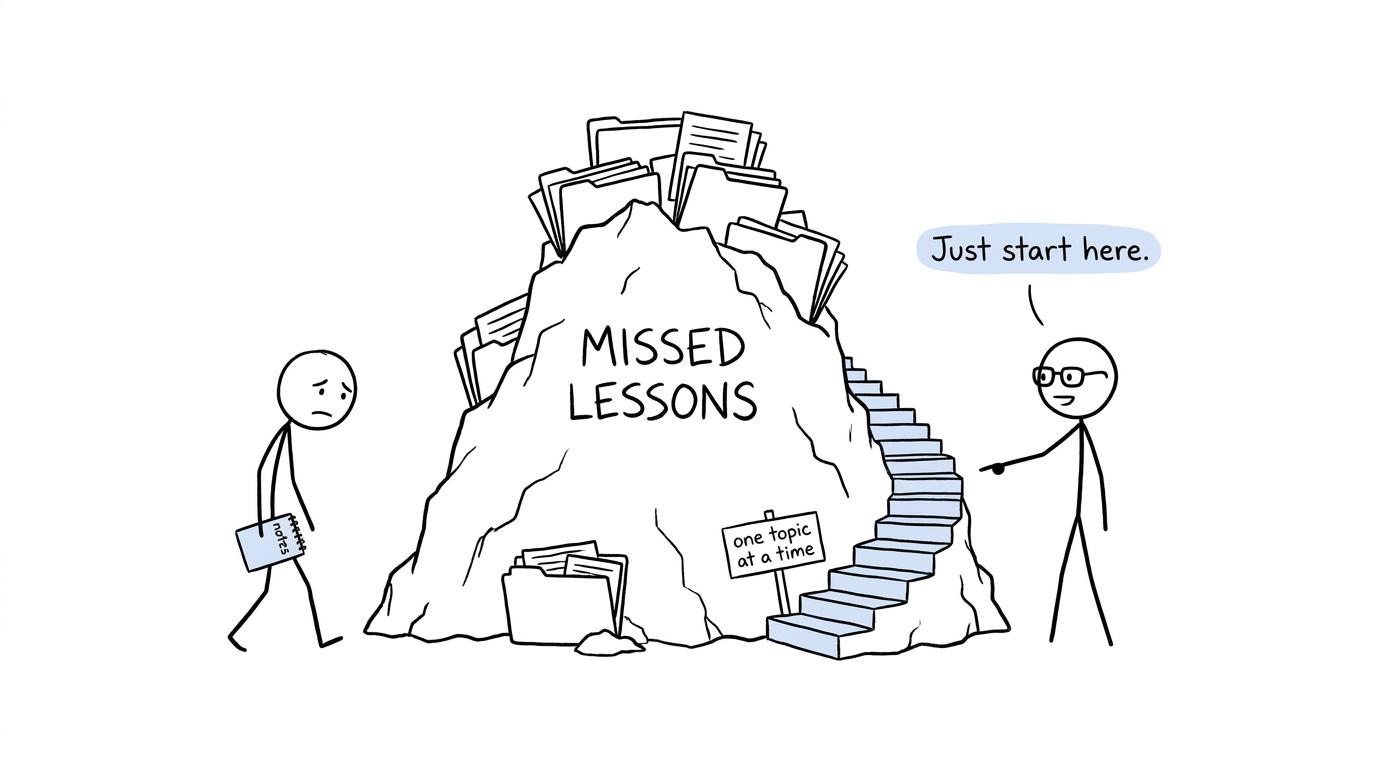 A student facing a mountain of missed lessons while a teacher points towards a one-topic-at-a-time staircase
Find the real size of the gap
Absence feels like one large problem, but it is usually several smaller problems mixed together. You may have missed factual content, classroom debates, source practice, homework feedback or part of the required active-citizenship process.
Ask your teacher for four things:
- the dates and titles of missed lessons;
- the relevant specification sections;
- essential resources rather than every worksheet handed out;
- the next assessment date and its content.
Then compare this information with your exercise book and the specification. Do not assume your Citizenship Studies board is the same as your maths board. A school might use Edexcel for maths and AQA for Citizenship Studies, for example.
Current GCSE Citizenship Studies content in England includes democracy and government, participation in democracy and society, rights and the law, identities and diversity, the economy, citizenship skills and taking citizenship action. The precise organisation and paper structure depend on the board.
AQA divides its course into life in modern Britain, rights and responsibilities, politics and participation, and active citizenship. Pearson Edexcel organises its content into five themes. Both current specifications use two written papers, but their sections and question structures are not interchangeable. Use your own specification and mark schemes.
Build a realistic recovery plan
Catching up works best when it runs beside current learning rather than replacing it. If you spend every evening reconstructing old lessons, this week's lessons become next week's backlog.
Choose a sustainable weekly rhythm
For the first two weeks back, consider this pattern:
- two short Citizenship Studies catch-up sessions during the week;
- one longer session at the weekend;
- one brief check-in with your teacher;
- protected maths revision sessions on separate days where possible.
A weekday session might last 252525 to 353535 minutes. A weekend session might last 454545 to 606060 minutes, provided your recovery allows it. These are practical starting points, not medical rules. Reduce the load if fatigue or symptoms return, and follow advice from your family, school and healthcare professionals.
Divide each session into three jobs:
- retrieve what you already know without notes;
- learn one clearly defined missing section;
- answer a small number of relevant questions or plan one extended response.
This is more effective than spending the whole session highlighting. Recognition can feel like knowledge, but examinations require you to recall, apply, analyse and evaluate.
Prioritise by consequence, not chronology
The first missed lesson is not automatically the first lesson you should recover. Prioritise:
- content needed for current classroom work;
- material included in an approaching assessment;
- active-citizenship tasks with school deadlines;
- high-value concepts that connect several topics;
- isolated details last.
For example, understanding Parliament, government and the rule of law may unlock several later discussions. Recovering a minor case detail may be less urgent. Your teacher can help distinguish essential specification knowledge from enrichment.
Recover knowledge and exam skills together
GCSE Citizenship Studies is not only a memory test. Across the regulated qualification, assessment objectives give 30%30\%30% to knowledge and understanding, 30%30\%30% to application, and 40%40\%40% to analysing and evaluating evidence, developing arguments and making substantiated judgements.
That balance changes how you should catch up. Beautiful notes covering every fact will not, by themselves, rebuild source analysis or extended-writing skills.
Create compact topic records
For each missed topic, produce one concise record containing:
- key terms and accurate definitions;
- institutions, people or processes involved;
- relevant rights and responsibilities;
- contrasting viewpoints;
- one or two suitable contemporary or specification-based examples;
- links to other course themes.
Check examples with your teacher or an authoritative source. Citizenship can involve changing office-holders, policies and legislation, so an old worksheet may no longer be enough. Keep enduring concepts separate from current examples.
Practise the command words
Short sessions should include active tasks such as:
- defining a term from memory;
- explaining a process in a logical sequence;
- applying knowledge to a source or situation;
- identifying evidence supporting different viewpoints;
- planning a balanced argument;
- writing a justified conclusion.
Read the exact question before deciding how much to write. An instruction to identify is different from one asking you to explain, analyse or evaluate. Use your board's past papers and mark schemes to see how its command words operate.
Reconnect with your citizenship action
Active citizenship must not disappear beneath content revision. AQA assesses students' understanding of their citizenship action through the written examination. Pearson Edexcel also requires candidates to complete an in-depth investigation leading to citizenship action, with centres confirming completion.
If work continued during your absence, ask your teacher:
- what decisions the group made;
- what evidence was collected;
- which actions were taken;
- what your individual responsibilities now are;
- how the impact will be evaluated;
- what records you need for later reflection.
Do not invent participation that did not happen. Instead, agree on a genuine way to rejoin, such as reviewing evidence, helping evaluate outcomes or contributing to a remaining action. Accurate reflection on strengths, limitations and impact is more useful than an inflated account.
Keep GCSE maths from becoming a second backlog
The temptation is to pause every other subject until Citizenship Studies is repaired. That often creates another problem. Maths depends on repeated practice, so a complete break can make familiar methods feel less secure.
Use a simple division of labour: Citizenship sessions repair the missed curriculum, while maths sessions preserve fluency and exam readiness. The GCSE maths revision hub gives you free revision lessons, topic questions and exam resources for the major UK boards, including Edexcel, AQA, OCR, Eduqas and CCEA.
If you are unsure how to divide your week, adapt the structure in the GCSE maths revision timetable guide. Keep the plan modest while you recover. Two focused sessions completed calmly are worth more than five ambitious sessions abandoned through exhaustion.
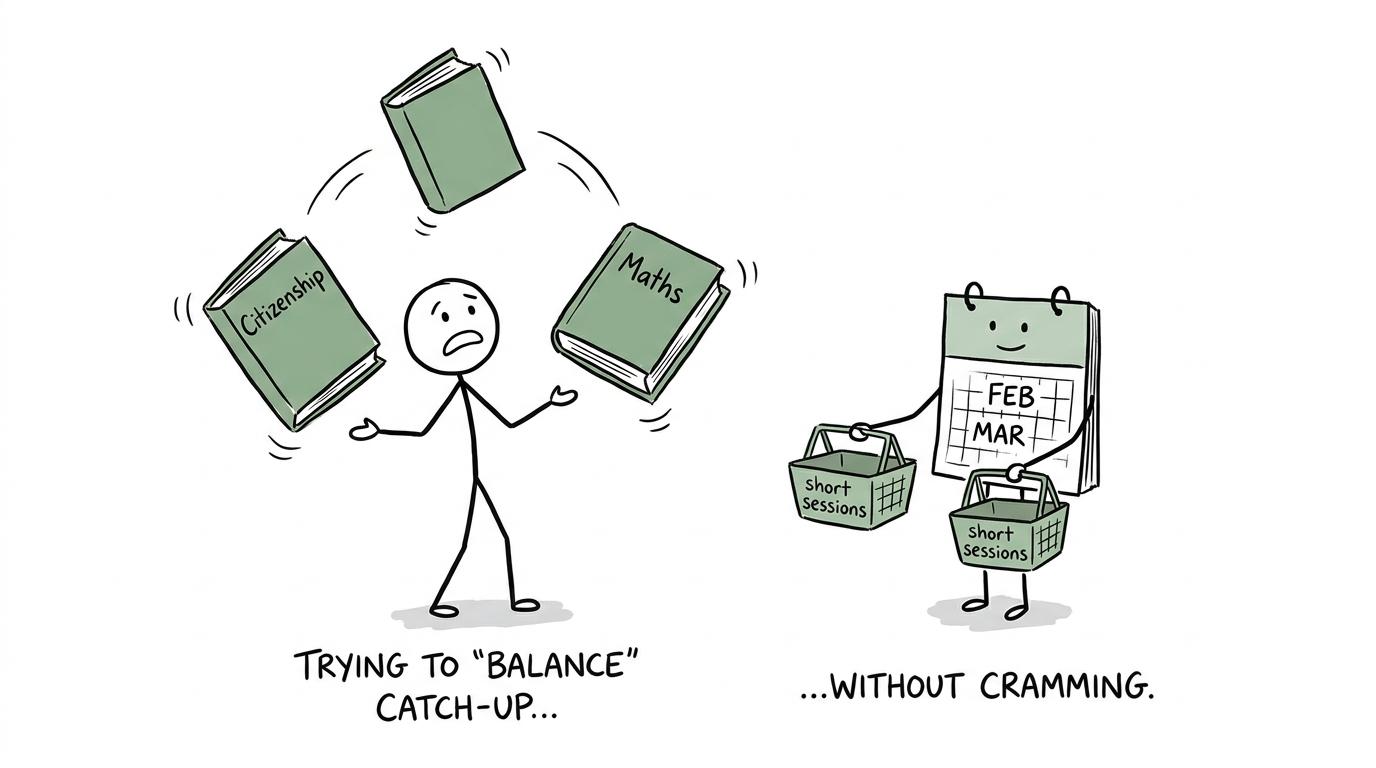 A student balancing Citizenship and Maths books while a calendar offers two short-session baskets
When maths confidence has slipped, begin with topic practice rather than immediately attempting a full paper. The one-month GCSE maths revision plan explains how to combine retrieval, focused skills and exam questions. If you take Edexcel, the guide to revising Edexcel GCSE Maths efficiently provides a clear learn-practise-mark-retest loop.
Know when to move from catch-up to exam practice
You are ready to reduce note-making when you can:
- explain the missed topic without relying heavily on prompts;
- use key terminology accurately;
- connect the topic to a source or unfamiliar context;
- present more than one viewpoint;
- reach a supported conclusion;
- explain your citizenship action and evaluate its impact.
At that stage, use your Citizenship Studies board's official assessment materials through your school or exam board. Marking matters. Record whether lost marks came from missing knowledge, weak application, limited evidence, an unbalanced argument or poor timing.
The same principle applies to maths. The guide on when to start GCSE past papers shows why papers should diagnose gaps rather than merely produce a score. As examinations approach, GCSE predicted papers can supplement past-paper practice, but they should not replace learning weak topics or using official papers.
Common mistakes when catching up after absence
Copying everything before learning anything
Copying missed notes feels orderly, but it can consume hours without testing understanding. Ask for the essential material, then retrieve and apply it.
Trying to complete the backlog in one weekend
Cramming may worsen fatigue and produces fragile recall. Spread the work across manageable sessions and review topics again after a gap.
Ignoring current lessons
A catch-up plan fails if it continually creates new missed work. Keep up with the present week while repairing older gaps in parallel.
Treating Citizenship Studies as facts alone
Knowledge matters, but so do application, evidence analysis, evaluation and justified conclusions. Include question practice early.
Forgetting the citizenship action
Your investigation and action are part of the qualification's required learning. Speak to your teacher promptly if absence interrupted your role.
Letting Citizenship consume all maths time
Maths fluency benefits from continuity. Use short topic sessions, mini tests and video solutions instead of waiting for a completely clear week. If an examination is very close, the GCSE maths night-before plan can help you make calm, limited choices rather than panic-cramming.
Waiting too long to ask about continuing illness
Access arrangements are not automatic rewards for having missed lessons. They are based on evidenced need and a student's normal way of working. Special consideration is a different process concerning adverse circumstances at the time of an assessment. Speak to your SENCo, examinations officer or pastoral team as early as possible rather than trying to interpret the rules alone.
Turn absence into a sequence of next steps
You do not need to recreate every classroom hour exactly as it happened. You need an accurate map, a sensible priority order and repeated contact with the knowledge and skills your examination will assess.
Start today with one conversation and one list. Confirm your Citizenship Studies specification, identify the most urgent missing topic and book your first short catch-up session. Then protect a separate block for maths.
MathsGenie can carry the maths side of that plan. Use the free GCSE maths revision resources for lessons and practice questions, then add mini tests, past papers, mark schemes, video solutions and predicted papers as your confidence returns. Absence may have interrupted the timetable, but it does not have to decide what happens next.