GCSE Chemistry Exam Conditions Practice at Home
GCSE chemistry exam conditions practice: build a realistic timed session at home, choose the right paper, control distractions and learn from lost marks.
The strange thing about revising at home is that it can make you feel more prepared than you really are. Your notes are nearby. The clock can be paused. A difficult question can be abandoned for a quick search.
A real exam removes those comforts. That is why GCSE chemistry exam conditions practice matters: choose a paper matching your exam board and tier, use the official time limit, remove notes and distractions, complete it in one sitting, then mark it honestly. You are not only testing chemistry knowledge. You are rehearsing concentration, timing, numerical accuracy and decision-making under pressure.
This guide explains how to create that experience without a classroom, teacher or invigilator around you.
Your realistic practice checklist
Before starting, make sure you have:
- the correct Chemistry or Combined Science paper for your board;
- the right paper number, content and tier;
- the official time allowance;
- only the permitted equipment and inserts;
- a quiet desk with notes removed;
- a clock or timer that you will not pause;
- an uninterrupted period long enough to finish;
- the mark scheme kept out of sight;
- time afterwards for careful review.
The goal is not to make your bedroom look exactly like an exam hall. It is to reproduce the decisions the exam demands: recalling without help, managing limited time and continuing when a question feels unfamiliar.
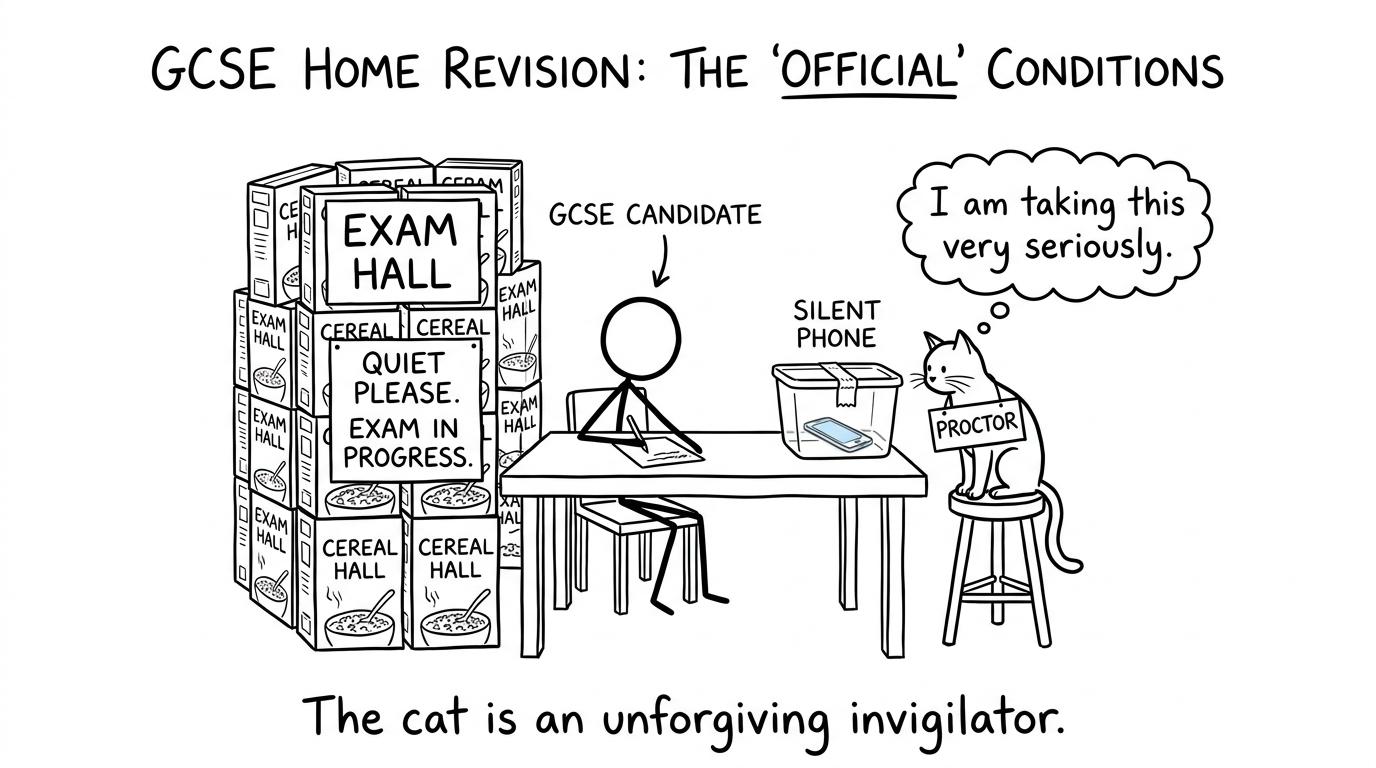 A cat invigilates a homemade exam hall built from cereal boxes
Choose the exact paper you are preparing to sit
Realism begins with the right paper. Check whether you take separate GCSE Chemistry or the chemistry components of Combined Science. Then confirm your exam board, Edexcel, AQA, OCR or Eduqas, along with your foundation or higher tier where applicable.
Paper structures are not interchangeable. For example, the current AQA standalone GCSE Chemistry specification has two written papers. Each lasts 111 hour 454545 minutes, carries 100100100 marks and contributes 50%50\%50% of the qualification. Combined Science chemistry papers have different durations and totals. Other boards organise and label their assessments differently.
Use your current specification, school entry information and the front of the question paper to confirm:
- the qualification and exam board;
- the paper or component;
- foundation or higher tier;
- the topics assessed;
- the duration and total marks;
- whether a data sheet or other insert belongs with that paper.
Do not add a revision formula sheet simply because it is useful when learning. Use only the materials supplied with that specific assessment. Arrangements can vary by board and exam series, so your school and the official paper instructions are the final authority.
Older papers remain valuable, but specification changes can affect content or presentation. If a question is no longer relevant, identify that before the session rather than discovering it halfway through.
Set up the room before the clock starts
A realistic desk should be almost boring. Keep the question paper, answer booklet if required, permitted equipment and plain water within reach. Move textbooks, flashcards, wall notes and revision guides out of view.
Put your phone in another room. Silent mode is weaker than distance: seeing a phone can preserve the feeling that help remains available. If you need it as a timer, use flight mode, disable notifications and place it where only the time is visible. A basic clock is better.
Ask people at home not to interrupt until a stated finishing time. Turn off music, videos and message alerts. You do not need perfect silence, exam halls contain occasional coughs and moving chairs, but entertainment should not become part of the task.
Prepare the equipment listed for your paper. This may include black pens, pencils, a ruler and an approved calculator. Clear stored notes or prohibited material from the calculator and practise with the model you expect to use in the exam.
If you have approved access arrangements, such as extra time, supervised rest breaks or a word processor, practise with those arrangements rather than forcing yourself into standard conditions. Ask your school how they will operate in the real exam. An accurate rehearsal is more useful than an unnecessarily harsh one.
Recreate the official timing honestly
Write down the start and finish times before opening the paper. Begin only when everything is ready, then let the clock run continuously. Do not stop it for snacks, messages or difficult questions.
Your paper's total marks and duration can give a rough pacing guide:
average minutes per mark=available minutestotal marks.\text{average minutes per mark}=\frac{\text{available minutes}}{\text{total marks}}.average minutes per mark=total marksavailable minutes.This is a guide, not a command to spend identical time on every mark. Multiple-choice questions may be quick. Extended explanations, practical-method questions and calculations may need longer. What matters is noticing when one stubborn question is consuming time that could secure marks elsewhere.
At the start, read the instructions on the paper. During the session:
- attempt questions in a deliberate order;
- show stages in calculations;
- include units where required;
- underline command words if that helps;
- leave space and return later if you become stuck;
- reserve a final check where possible.
Do not look up a fact midway through. Place a small mark beside the question and continue. That uncomfortable moment is useful evidence: it reveals what your memory does when the safety net disappears.
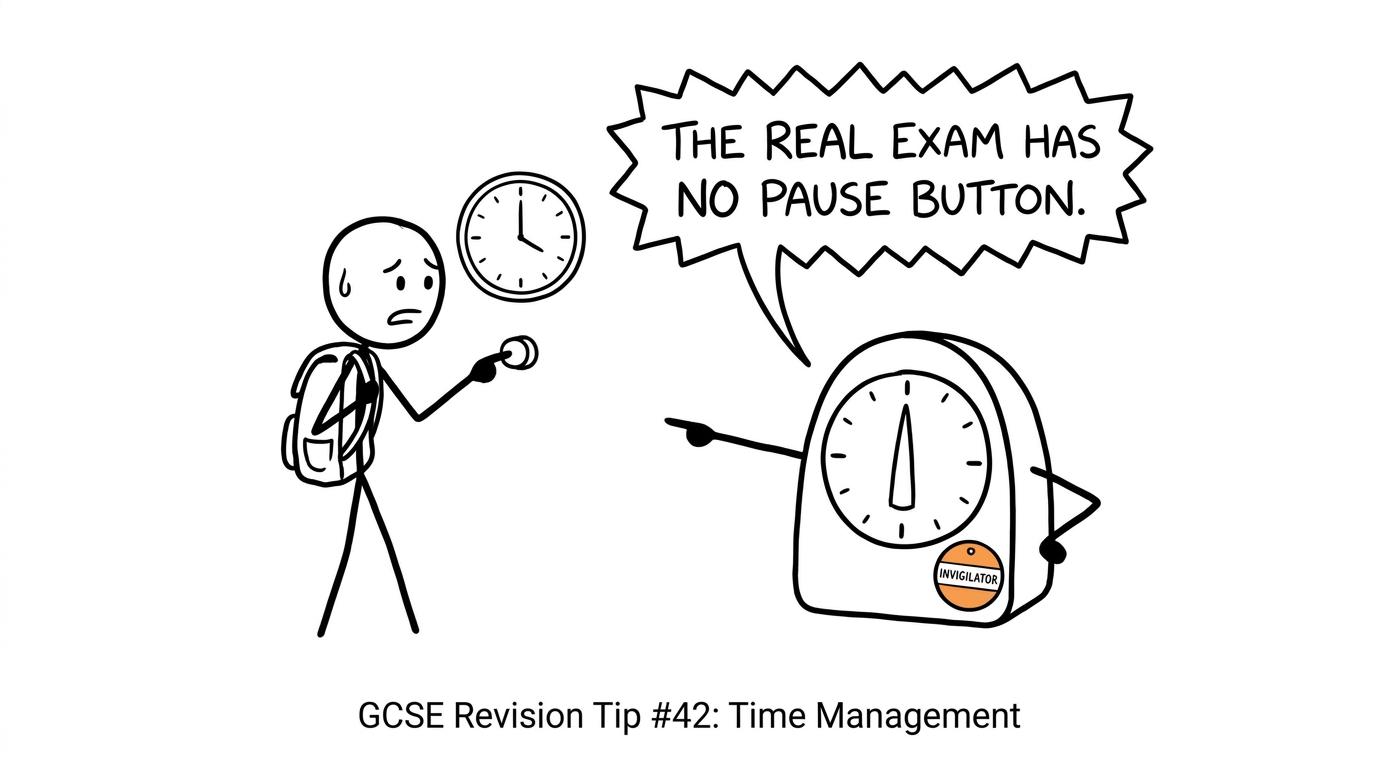 A kitchen timer reminds a student that the real exam has no pause button
Build up to a full Chemistry paper
A complete paper is demanding. If your concentration currently fades after 303030 minutes, repeatedly failing to finish a long assessment may teach frustration rather than control.
Build realism in stages:
Start with timed sections
Complete one intact section without notes or interruptions. Keep the paper's approximate pace and mark it afterwards. This develops the habit of working independently while the session is still manageable.
Progress to a substantial block
Use approximately half a paper, preserving the original question order. This tests whether accuracy survives beyond the opening questions.
Complete the full assessment
Once shorter sessions feel stable, sit the whole paper with its official duration and materials. The MathsGenie guide to starting GCSE past papers explains a similar progression from diagnosis to timed full-paper practice.
One genuine simulation is more informative than several papers completed with pauses and notes. Quality comes from preserving the conditions and reviewing the evidence afterwards.
Treat Chemistry calculations like exam maths
Chemistry can expose mathematical habits that ordinary recall revision misses. Quantitative questions may involve ratios, percentages, graphs, standard form, rearranging equations and converting units. Knowing the chemical idea is not always enough if the calculation is entered incorrectly or the answer is rounded too early.
During the paper, write substitutions and intermediate stages clearly. Check whether the final value is sensible and whether the requested unit matches your answer. Keep sufficient calculator precision until the final line unless the question directs otherwise.
If numerical chemistry is repeatedly costing marks, use the free GCSE maths revision hub to strengthen the underlying skill. MathsGenie's lessons, practice questions and video solutions can help you isolate weaknesses such as percentages, ratio, graphs or rearranging formulae before returning to chemistry questions.
This separation matters. Sometimes the chemistry is secure but the maths is fragile. At other times the arithmetic is correct but the scientific relationship was chosen incorrectly. Your review should distinguish between them.
Mark the paper without protecting your score
Take a short break after finishing, then use the official mark scheme for that exact paper. Mark in a different colour and apply the stated criteria. Do not award a mark because your answer was “basically what I meant”. Examiners can only credit what appears on the page.
Record more than the total. For every lost mark, classify the reason:
- missing chemistry knowledge;
- misunderstood command word;
- weak practical understanding;
- mathematical or calculator error;
- missing unit or inappropriate rounding;
- vague scientific language;
- poor time management;
- incomplete checking.
The MathsGenie weakest-topics method shows how to turn lost marks into focused revision rather than a vague judgement about being “bad at the paper”.
Be cautious when interpreting grades. Grade boundaries differ between exam series and qualifications. Use boundaries belonging to the exact paper set where available, and treat the result as diagnostic evidence rather than a prediction of your final grade.
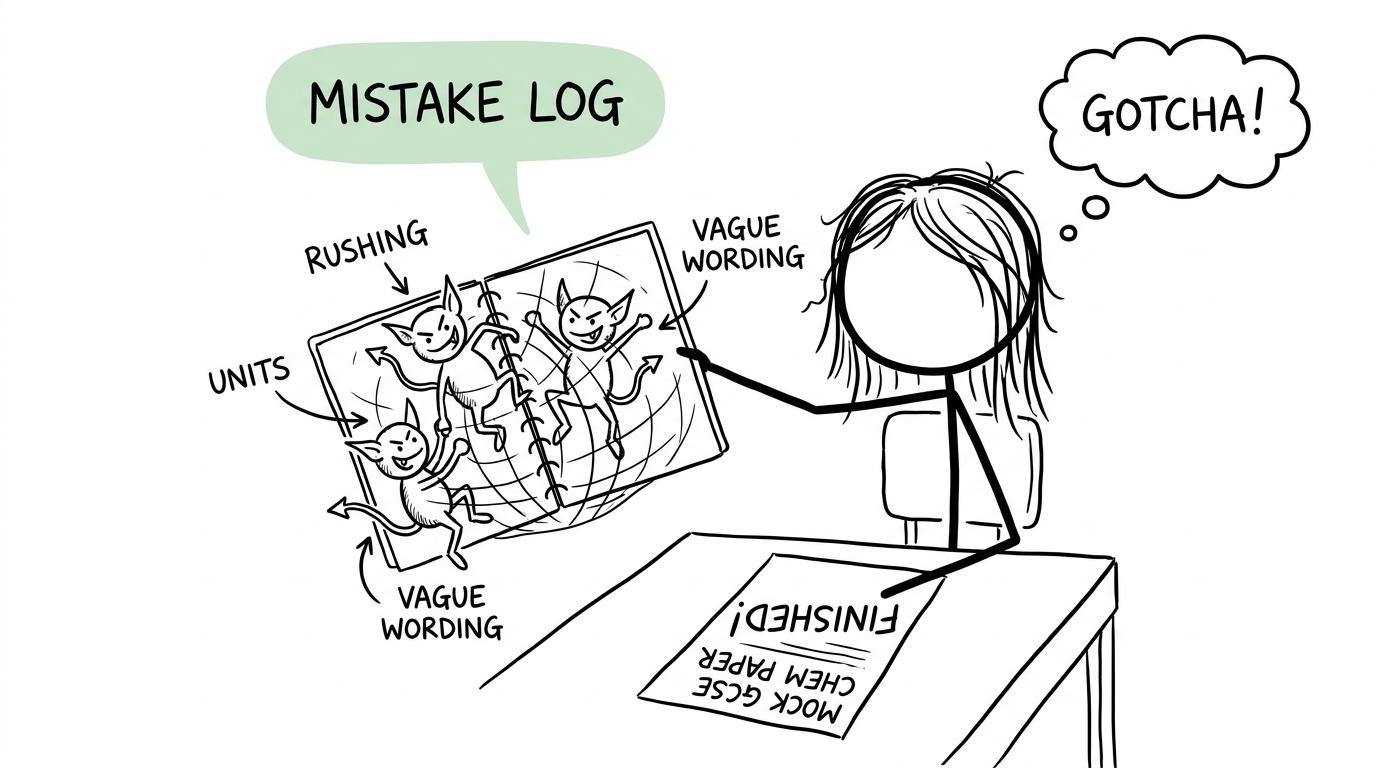 A student catches rushing, units and vague wording in a mistake log
Turn the result into your next revision plan
A timed paper is valuable only if it changes what you do next. Select a small number of repeated weaknesses, revisit the relevant specification content and complete targeted questions without the pressure of a full paper.
Then retest those areas using fresh questions. The useful cycle is:
- diagnose under realistic conditions;
- learn or refresh the missing idea;
- practise the precise skill;
- check with a mark scheme or solution;
- retest without notes.
For mathematical weaknesses, MathsGenie's approach to remembering GCSE maths content combines retrieval, spacing and mixed practice. The same principle applies here: correcting an answer once is not proof that you can retrieve it next week.
Past papers should remain your main source of authentic assessment practice. Fresh practice or predicted papers can provide unfamiliar combinations, but they should supplement rather than replace official material. The guide to using predicted topics sensibly explains why broad preparation is safer than gambling on a narrow list.
Common mistakes when practising exam conditions
Pausing whenever the paper becomes uncomfortable
The pause removes the exact pressure you need to rehearse. Mark the question, move on and investigate it after time expires.
Keeping notes within reach
Even if you promise not to use them, visible notes change the psychology of recall. Remove them completely.
Using the wrong paper or allowance
A separate Chemistry paper and a Combined Science chemistry component may have different durations, marks and content. Confirm the front page before starting.
Marking immediately and generously
A brief break creates useful distance. Follow the official mark scheme and record uncertainty rather than quietly awarding borderline marks.
Focusing only on the final score
A total cannot tell you whether marks disappeared through knowledge, timing, calculations or wording. A mistake log can.
Attempting a full paper too late at night
Fatigue may measure your bedtime rather than your preparation. Choose a time when you can work uninterrupted and alert. The MathsGenie night-before plan also emphasises focused practice, equipment and sleep rather than a final exhausting marathon.
Make the next rehearsal count
A realistic home mock does not require rows of desks or an invigilator pacing the room. It requires honest boundaries: the correct paper, the correct time, permitted equipment, no outside help and a serious review afterwards.
Start with one session in your calendar. Prepare the desk beforehand, complete the paper without pausing and turn every lost mark into a named action. If calculations are part of the problem, use MathsGenie's GCSE revision resources for free revision lessons, practice questions, mini tests, past papers, predicted papers, mark schemes and video solutions.
The purpose is not to prove that you are ready today. It is to make the real exam feel less unfamiliar tomorrow.