Fluent Before Starting GCSE Chinese? What You Need
Fluent before starting GCSE Chinese? You do not need to be. Discover the beginner skills required and build a realistic plan alongside GCSE maths revision today.
The word fluent can make a beginner feel late before they have even started. Other students may already recognise characters, understand family conversations or pronounce Mandarin tones confidently. That does not mean you need to be fluent before starting GCSE Chinese.
The direct answer is no. Pearson Edexcel states that its GCSE Chinese qualification has no prior learning requirements, while AQA describes its GCSE Chinese course as a two-year qualification. In practice, however, schools decide how they deliver the course and may set their own entry expectations. If you are beginning from scratch, the important question is therefore not whether you are fluent. It is whether your school offers a genuinely beginner-friendly course with enough teaching time.
GCSE Chinese is designed to develop listening, speaking, reading and writing. You are not expected to arrive having mastered all four.
The short beginner checklist
Before joining the course, try to confirm the following:
- which exam board and specification your school uses
- whether the course teaches complete beginners
- whether you will take Mandarin or Cantonese
- whether simplified or traditional characters will be taught
- how frequently lessons take place
- what independent practice your teacher expects
- whether you can access recordings and character-writing support
- how Chinese will fit alongside your GCSE maths and other subjects
Knowing a few greetings, numbers or basic sentence patterns can make the opening weeks easier, but these are helpful head starts rather than formal fluency requirements.
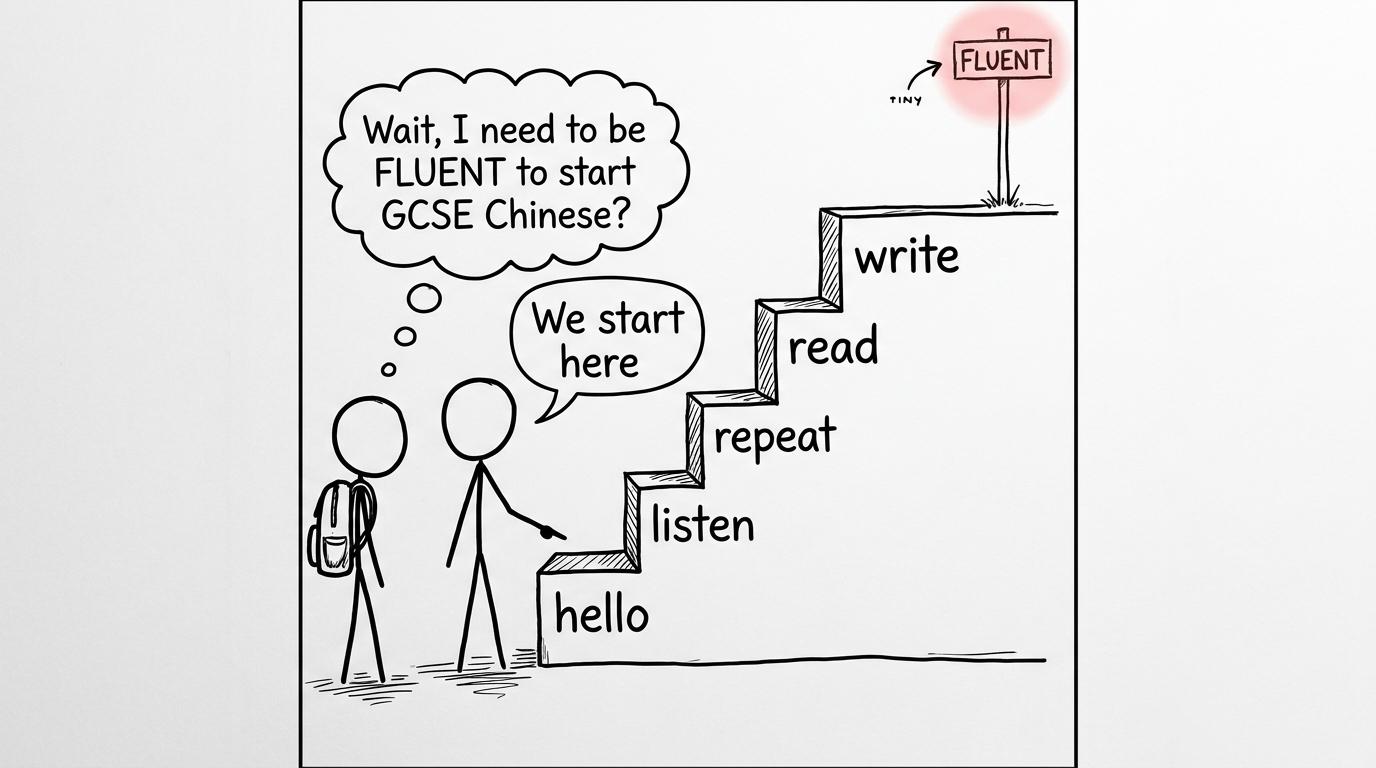 A student discovers that the first step towards GCSE Chinese is simply beginning
What does fluent actually mean?
Fluency is not a switch that changes from off to on. Someone might speak comfortably with relatives but struggle to read unfamiliar characters. Another learner might write accurately yet find spontaneous conversation difficult.
GCSE assessment is more specific. It asks whether you can understand and communicate within defined themes, vocabulary and grammatical structures. That is different from being able to discuss any subject naturally with a native speaker.
For example, current AQA GCSE Chinese assesses four areas: listening, speaking, reading and writing. Each contributes 25%25\%25% of the qualification. Pearson Edexcel GCSE Chinese is also organised around these four language skills. Both offer foundation and higher tiers, with students entered at the same tier across the papers.
The course develops examination-level communication. It does not require complete mastery of Chinese before lessons begin, and passing the GCSE does not mean that every learner will become universally fluent.
How much Chinese do you need before starting from scratch?
A true beginner can start with no formal Chinese knowledge if the course has been planned for beginners. You should not need to arrive knowing hundreds of characters, holding long conversations or translating extended passages.
There are, however, several foundations that you will need to build early.
Awareness of pronunciation and tones
Mandarin uses tones to distinguish meaning. At the beginning, you need willingness rather than perfection: willingness to listen carefully, imitate recordings and accept correction.
Pinyin, the system commonly used to represent Mandarin pronunciation with the Roman alphabet, can support this stage. It is a bridge into pronunciation, not a replacement for learning characters.
If your course is Edexcel Chinese, check whether the school teaches Mandarin or Cantonese. AQA's GCSE Chinese qualification is specifically Spoken Mandarin. This choice affects pronunciation, listening practice and speaking preparation, so it is worth confirming before you enrol.
Readiness to learn characters consistently
Chinese characters can appear intimidating because they do not offer the same alphabetic clues as English. The solution is not to memorise an enormous list before the course. It is to establish a repeatable routine.
You will gradually need to recognise characters, connect them with pronunciation and meaning, and reproduce required vocabulary accurately. Learning components and common patterns can help, but regular retrieval matters more than copying the same page without testing yourself.
Basic sentence-building habits
You do not need an advanced understanding of grammar. You do need to become comfortable noticing word order, time expressions, questions, negatives and ways of linking ideas.
A beginner course should teach these structures. Your role is to practise them often enough that they become usable in listening, speaking, reading and writing rather than remaining isolated notes in a folder.
Patience with incomplete understanding
New language learners often believe that they must understand every word in a recording. GCSE listening and reading require a more useful skill: finding the main message, relevant details, opinions and time references even when something is unfamiliar.
This resembles a strong maths habit. You may not immediately see the whole route through a problem, but you can identify what is known, what is being asked and which information matters.
What the GCSE Chinese course will expect you to learn
Although precise tasks vary by board, current specifications assess communication across familiar personal, social, educational and wider-world contexts.
You can expect to develop:
- listening comprehension from recorded Chinese
- accurate pronunciation, including tones where relevant
- responses for role-play and conversation tasks
- recognition and recall of characters
- reading for gist and detail
- translation between Chinese and English
- short and extended writing
- vocabulary connected with everyday GCSE themes
- grammatical control across different time frames
AQA Chinese has three broad themes covering identity and culture; local, national, international and global interests; and study and employment. Pearson Edexcel organises related content into themes such as identity, school, aspirations, travel and global issues.
The exact task lengths, timings and mark allocations differ. Always follow the specification your school names rather than combining advice from different boards. The same principle applies in maths: an AQA Chinese student could still take Edexcel maths, so never infer one exam board from the other.
Can a complete beginner realistically catch up?
Yes, but the course structure matters. A complete beginner needs regular teacher contact, listening exposure, character practice and opportunities to speak. A compressed lunchtime course will feel very different from a timetabled two-year programme.
Ask the teacher direct questions:
- Is the first term designed for students with no Chinese?
- How quickly does the class move into characters?
- Are there students with home-language experience in the same class?
- What support is available if the speaking or writing pace feels fast?
- When is foundation or higher tier decided?
Students who already use Chinese at home may begin with advantages, but their strengths can vary. Familiar spoken language does not automatically produce accurate formal writing or examination technique. Equally, a new learner can build dependable GCSE skills through systematic practice.
The comparison worth making is not between your first week and someone else's fifth year. Compare what you can retrieve now with what you could retrieve last month.
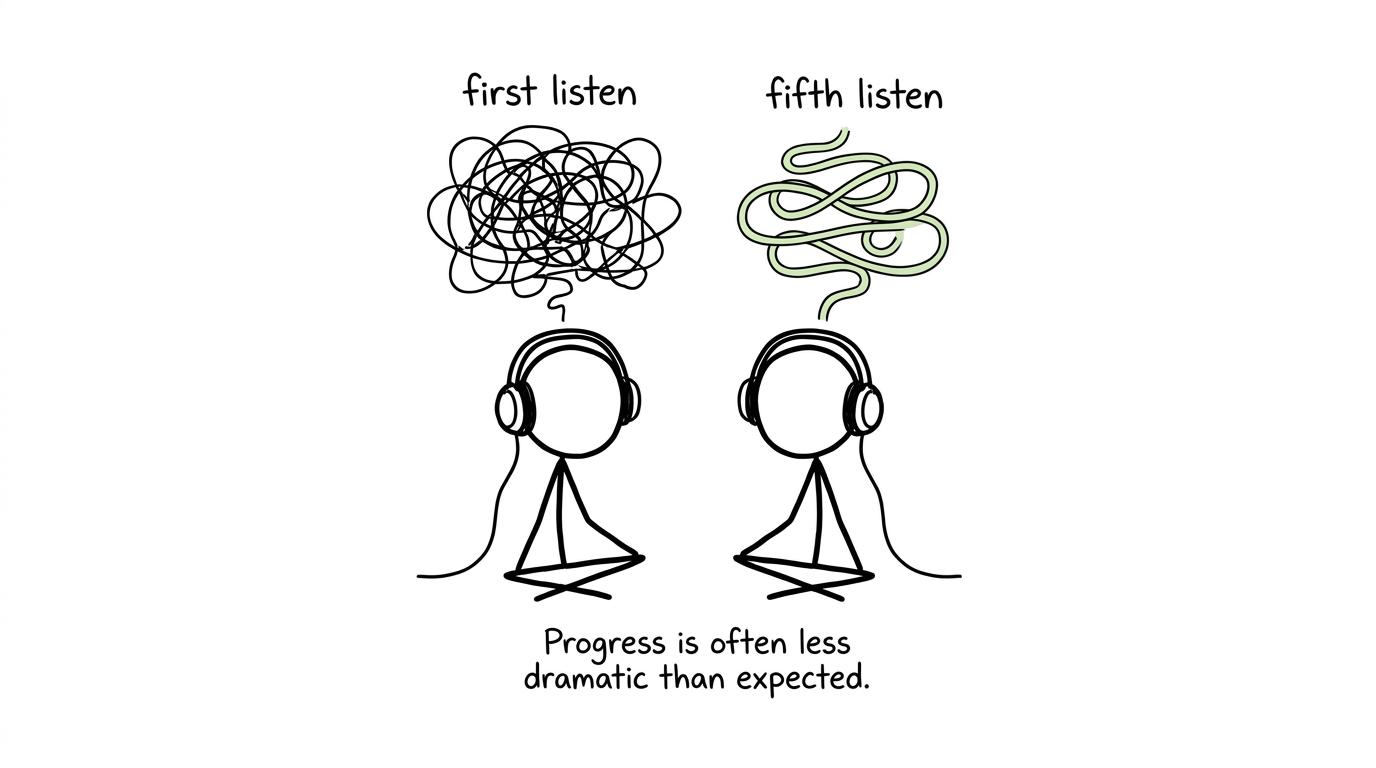 Repeated listening slowly turns confusion into something more manageable
A sensible preparation plan before the course
If you have a few weeks before lessons begin, keep preparation narrow. Trying to race through an entire GCSE vocabulary list can create fragile knowledge and poor pronunciation.
Learn the sound system first
Listen to reliable teacher-approved recordings and practise distinguishing initial sounds, final sounds and tones. Repeat short items aloud. Recording yourself can reveal differences that are difficult to notice while speaking.
Build a small core vocabulary
Start with language connected to introductions, family, school, dates, everyday activities and preferences. Learn each item as sound, meaning and written form rather than treating these as unrelated facts.
Become familiar with character learning
Learn how characters are structured and how your teacher expects written work to be presented. Aim for accurate recognition and recall. Pages of untested copying may feel productive while producing little usable memory.
Practise little and often
A short daily session is usually more manageable than a large weekend catch-up. Divide practice between listening, speaking, reading and writing so that one comfortable skill does not consume all your time.
This is also a useful way to protect your maths revision. Keep Chinese preparation small enough that it does not displace core GCSE work. The MathsGenie GCSE maths revision hub lets you choose your board and move between lessons, topic questions and papers without rebuilding a plan each evening.
Balancing GCSE Chinese with maths revision
Starting a language from scratch requires frequent recall. Maths also improves through repeated problem-solving, marking and correction. The danger is not usually having two demanding subjects. It is allowing one of them to expand until it occupies every available evening.
Use separate, visible goals. A Chinese session might focus on vocabulary retrieval or listening. A maths session should name a precise topic or paper section. The best order for learning GCSE maths topics can help if you are unsure what mathematical foundations to tackle first.
For maths, match resources to your actual board. Edexcel students can use the Edexcel GCSE maths revision hub, while students preparing for other specifications can go directly to AQA GCSE maths past papers or OCR GCSE maths past papers.
Do not begin every evening by deciding from nothing. Choose tomorrow's short Chinese task and maths task before finishing today. This reduces the friction that often turns revision time into planning time.
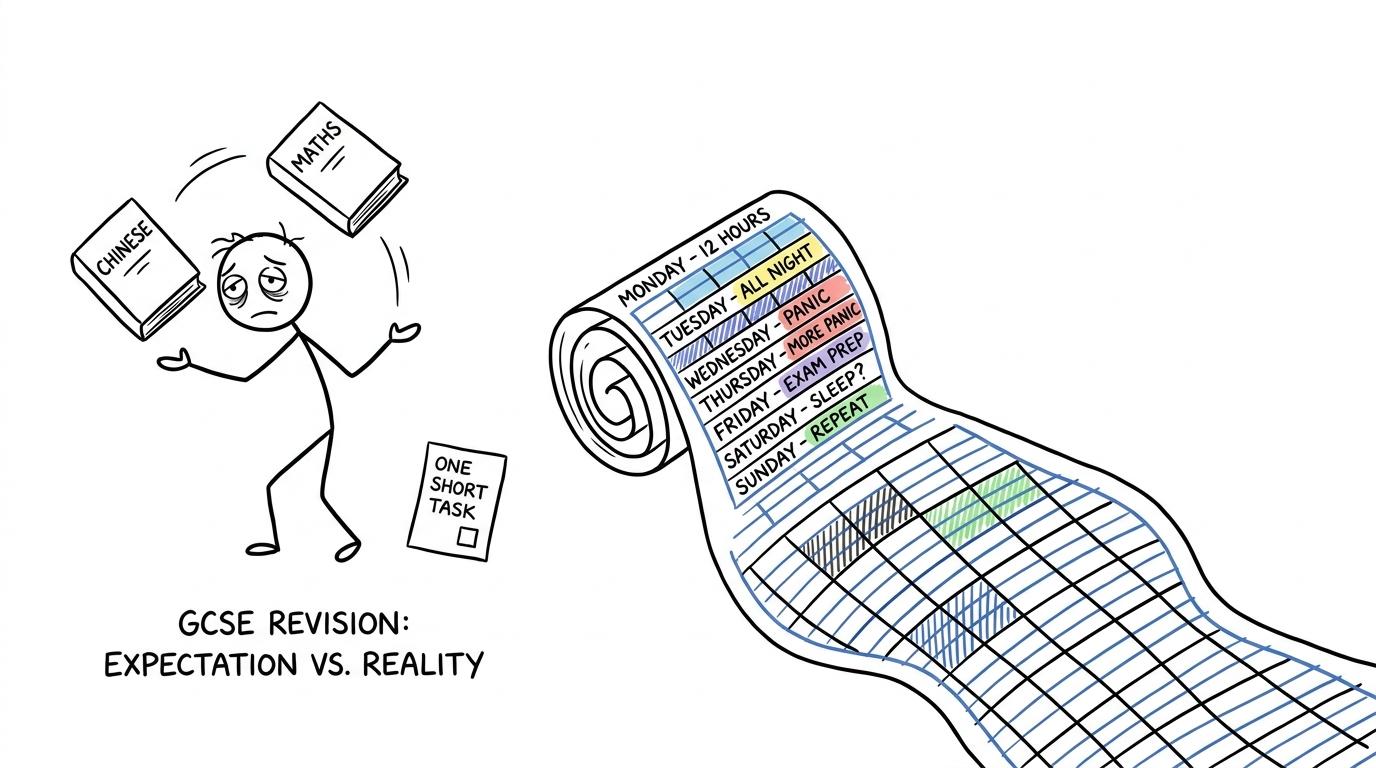 A GCSE student learns that a small checklist is easier to manage than an enormous timetable
Common mistakes when beginning GCSE Chinese
Waiting until you feel ready
Readiness often arrives after starting, not before it. If the course accepts beginners, use the first lessons to establish pronunciation and study routines rather than postponing until you somehow become fluent independently.
Ignoring the precise qualification
AQA offers GCSE Chinese in Spoken Mandarin, whereas Pearson Edexcel provides Mandarin and Cantonese routes. Schools may also offer an International GCSE instead of a GCSE. Confirm the qualification title, board, language and character system.
Using pinyin as a permanent substitute for characters
Pinyin is valuable for Mandarin pronunciation, but GCSE reading and writing require character knowledge. Use it as support while progressively retrieving characters without it.
Revising only the skill you enjoy
Reading vocabulary silently can feel safer than speaking. Conversation can feel easier than character writing for another student. The examination rewards a balanced set of skills, so your weekly practice should reveal rather than hide weaknesses.
Letting Chinese preparation consume maths time
Enthusiasm for a new subject can produce an elaborate timetable that is impossible to sustain. Keep maths moving through short topic sessions and gradual paper practice. The guide to when you should start GCSE maths past papers explains how to progress from targeted questions to timed papers.
Treating mistakes as evidence that you lack talent
A forgotten character or misunderstood recording is information about what to revisit. The useful cycle is attempt, check, correct and retrieve again. MathsGenie's GCSE one-week revision plan uses the same principle for turning lost marks into specific next actions.
Start from where you are, not where fluency ends
You do not need to be fluent before beginning GCSE Chinese. You need the right course, clear expectations and enough time to develop the four assessed skills. A little prior knowledge may soften the first few weeks, but it is not the same as a formal requirement.
Speak to the Chinese teacher before enrolling. Confirm that beginners are supported, identify the exam board and ask what preparation would genuinely help. Then start small: listen carefully, learn a manageable core of language and practise retrieving it.
Meanwhile, keep your maths revision structured through MathsGenie. Use free revision lessons and practice questions to strengthen individual topics, mini tests to check recall, and past papers with mark schemes and video solutions to develop exam technique. Nearer the exams, predicted papers can add fresh practice. Open the GCSE maths revision hub, choose your board and tier, and give both subjects a clear next step.