Is GCSE French Hard? What Students Really Say
Is GCSE French hard? Get a balanced answer from student experiences, the current exam structure and practical revision advice for improving your grade.
The difficult thing about GCSE French is not always the French. It is the moment an audio recording begins, the first sentence seems to disappear, and panic convinces you that everyone else understood it.
So, is GCSE French hard? The straight answer is: it can feel difficult, particularly in listening and speaking, but it is manageable for most students who practise regularly. Students who have taken the subject repeatedly describe the same divide. Those who revise vocabulary and grammar little and often tend to find it reasonable. Those who leave it until the final weeks often find it unusually hard to rescue.
That makes French rather like maths. Both subjects build on earlier knowledge, and both expose gaps when you try to use that knowledge under exam pressure.
The short answer: how hard is GCSE French?
GCSE French is not easy, but it is not impossibly hard either. Its difficulty comes from having to develop four different skills:
- understanding spoken French
- speaking clearly without relying entirely on a script
- reading for precise meaning
- writing accurately using suitable vocabulary and grammar
For current GCSE French qualifications, first assessed under the reformed specifications in summer 2026, listening, speaking, reading and writing each contribute 25%25\%25% of the qualification. Foundation tier normally covers grades 111 to 555, while higher tier covers grades 444 to 999, subject to the precise awarding rules of your exam board.
A useful verdict is this:
- Harder than expected if you rely on last-minute memorisation.
- Manageable if you build vocabulary, listening and sentence formation steadily.
- Potentially enjoyable once you stop translating every word and begin recognising patterns.
Public student discussions are anecdotal rather than representative research, so they cannot tell you how every candidate feels. They do, however, reveal recurring experiences: listening feels fast, speaking creates nerves, vocabulary accumulates quickly, and regular exposure makes a noticeable difference.
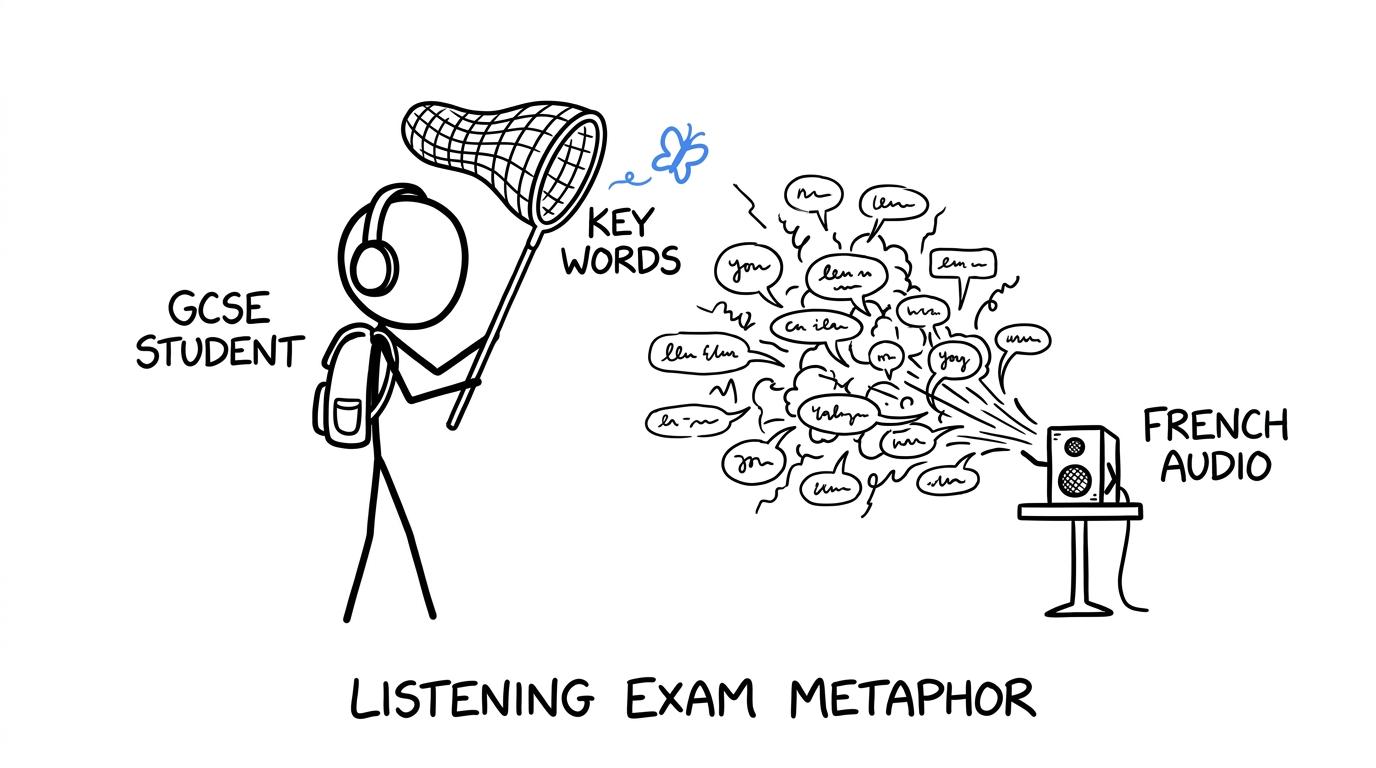 A student trying to catch key words from a fast French listening recording
Why students say GCSE French feels hard
Listening does not wait for you
Listening is the complaint that appears most consistently in student conversations. A reading passage stays on the page. Spoken French keeps moving.
You may know a word when it is written down but fail to recognise it when sounds join together. An unfamiliar voice, a change of pace or one missed phrase can then create the feeling that the entire recording has been lost.
The current specifications make sound recognition especially important. They include dictation, where students transcribe short spoken extracts, as well as listening comprehension. That means spelling and the relationship between French sounds and written forms deserve deliberate practice.
The solution is not simply to play increasingly difficult recordings. Use short clips and listen with a specific purpose: first for the topic, then for key details, and finally for exact sounds. Learning to recover after a missed word is part of the skill.
Speaking makes ordinary mistakes feel public
Many students find speaking harder emotionally than academically. A forgotten verb ending in a written paper is private. A pause in front of a teacher feels much larger, even though hesitation is normal when using another language.
Current speaking assessments vary in their precise format between Edexcel, AQA, OCR and Eduqas, so check your own specification. Tasks can include role-play, reading aloud, visual stimuli and unprepared conversation. The important point is that speaking cannot be revised entirely by reading notes.
Say answers aloud. Record yourself. Practise recovering with a simpler sentence when the perfect one disappears. Clear, comprehensible French is more useful than silence while searching for something elaborate.
Vocabulary is cumulative
Official subject content for the reformed GCSE sets defined vocabulary totals of 1,2001{,}2001,200 lexical items at foundation tier and a further 500500500 at higher tier, alongside specified grammar. That sounds intimidating when viewed as one list. It becomes more reasonable when divided across months of short retrieval sessions.
Students often describe French as difficult to catch up because vocabulary from earlier topics continues to matter. Words about family can reappear in a discussion of relationships; opinions learned for leisure can help with school or travel.
This is similar to the cumulative nature of algebra. If an earlier skill is uncertain, later work becomes heavier. Maths students can use MathsGenie's guide to stopping GCSE content from being forgotten to apply the same retrieval and spacing principles across both subjects.
Grammar asks you to notice several things at once
French grammar can require decisions about tense, person, gender, agreement and word order in a single sentence. At first, this feels like juggling.
The difficulty drops when common structures become automatic. High-frequency verbs, negatives, opinions, time phrases and reliable tense patterns provide a framework. You do not need to create every sentence from nothing; you need a flexible bank of language that you understand and can adapt.
What students who find French manageable do differently
Across student discussions, one theme appears repeatedly: consistency matters more than occasional heroic effort. This should not be mistaken for a guarantee of a particular grade. It is simply the most practical response to a subject built on recall and repeated exposure.
They revise little and often
Ten focused minutes of vocabulary recall on several days is usually more valuable than copying a large list once. A short session might include:
- retrieving words without looking
- saying them aloud
- checking spelling
- placing a few words into familiar sentence patterns
- returning to missed items later
The habit is transferable. MathsGenie's 20-minute GCSE maths revision routine shows how a small daily structure can combine recall, practice and immediate marking without taking over the evening.
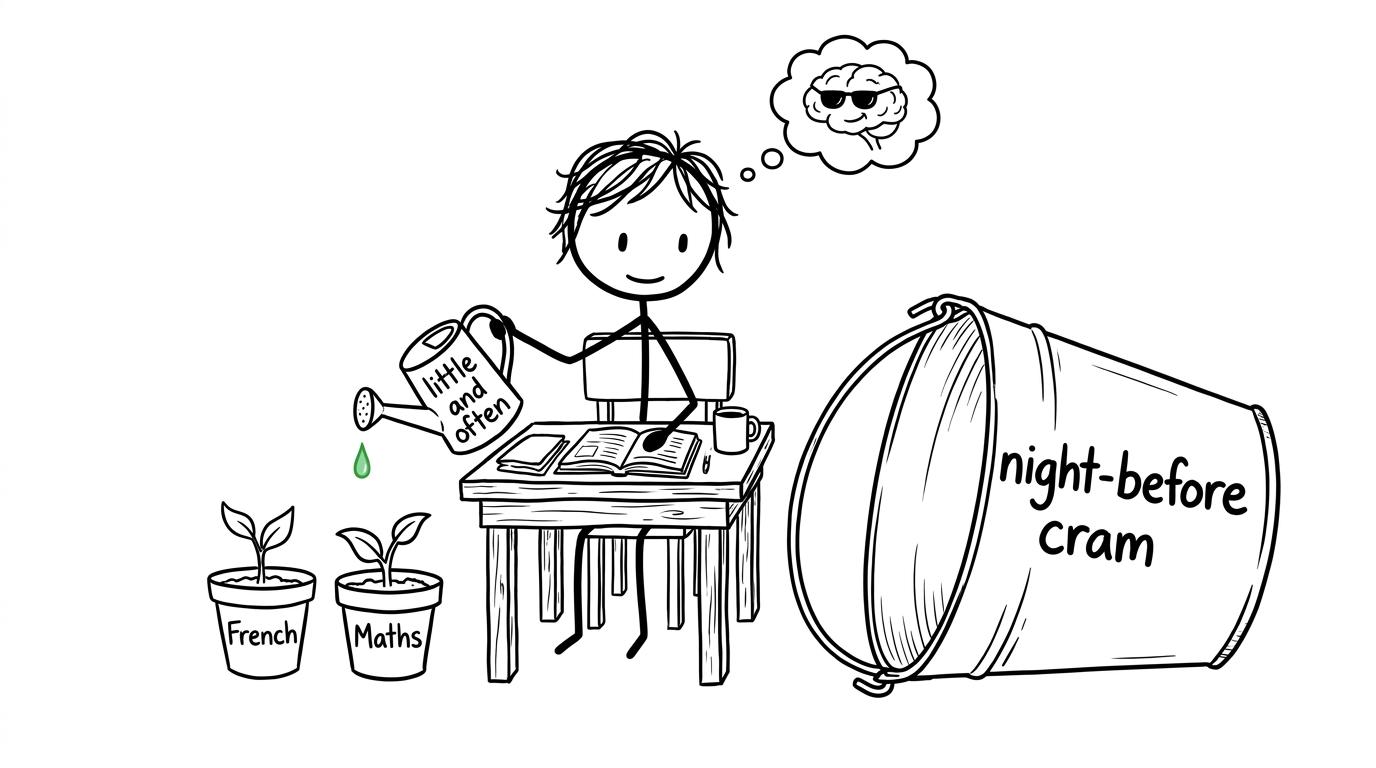 Two revision plants growing through little-and-often practice
They practise the weakest skill, not the favourite one
It is comfortable to revise the part you already like. Students who enjoy reading may keep reading while avoiding listening. Confident writers may spend time perfecting paragraphs but rarely speak spontaneously.
Use evidence instead. After a class assessment, record whether marks were lost through vocabulary, grammar, sound recognition, misunderstanding the task or running out of time. Maths students can use the same diagnostic approach with MathsGenie's guide to finding weak GCSE topics quickly.
Your feelings can identify anxiety. Marked work identifies the skill that needs attention. You need both pieces of information, but they are not the same.
They understand rather than memorise blindly
Prepared language can be helpful, particularly when it contains versatile opinions, reasons and tense structures. The danger is memorising a long answer without understanding its parts. One changed question can make the script unusable.
A stronger method is to learn adaptable building blocks. Practise changing the person, tense, topic or opinion. This turns memory into usable language.
The same principle sits behind turning GCSE notes into active recall: close the notes, produce something from memory, check it, and repair the exact gap.
Is GCSE French harder than GCSE maths?
There is no objective answer for an individual student because the subjects reward different strengths.
Maths often gives you a method that can be applied to a new problem. French asks you to retrieve language while interpreting meaning, and sometimes to do so in real time. A student who enjoys patterns may prefer maths. Someone comfortable with memory, communication and ambiguity may prefer French.
Yet their best revision methods overlap:
- practise actively rather than rereading
- revisit material after a gap
- use timed exam-style tasks
- mark work honestly
- record why marks were lost
- repeat weak skills using different questions
If maths is competing with French for revision time, begin at the GCSE Maths revision hub. It provides board-specific resources for Edexcel, AQA, OCR and Eduqas, helping you spend less time searching and more time practising.
A realistic GCSE French revision plan
A calm weekly routine is better than an ambitious timetable you abandon after two days.
Build daily contact
On most days, spend a short period retrieving vocabulary or listening to manageable French. Include pronunciation rather than treating vocabulary as a purely written task.
Rotate the four skills
Because each of the four assessment areas contributes 25%25\%25%, consistently ignoring one skill creates an avoidable weakness. A weekly rotation might include one focused session for each skill, plus a mixed review.
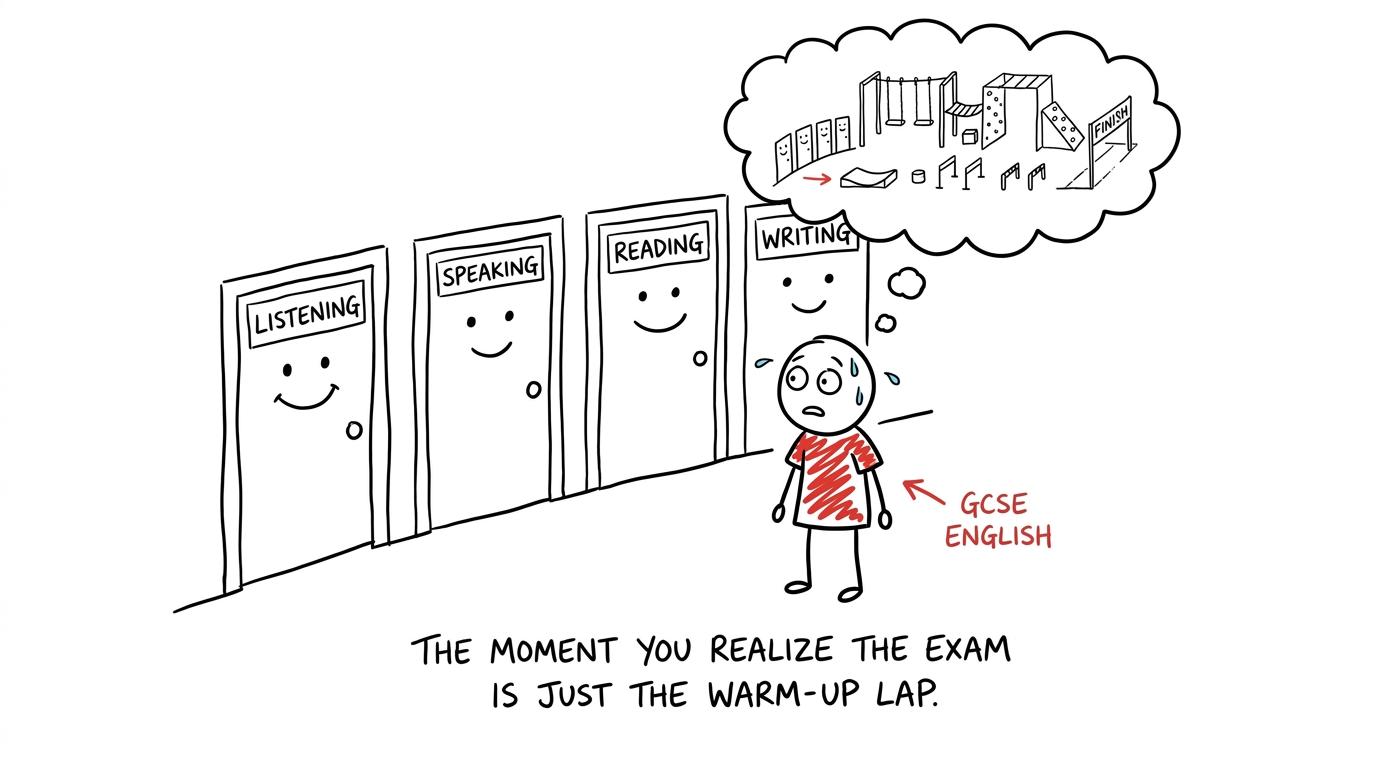 A student facing four friendly exam-skill doors
Use exam-board materials
Your teacher should confirm whether you follow Edexcel, AQA, OCR or Eduqas and whether you are entered for foundation or higher tier. Use the current specification and sample assessment materials for your course because task formats differ.
Do not judge your likely grade from one raw mark on an unrelated paper. Grade boundaries are set for particular exam series, and individual components do not receive separate GCSE grades.
Protect maths revision time too
French improves through frequent short contact, which makes it easier to fit around maths. Keep longer blocks for timed maths papers and use shorter gaps for language recall. MathsGenie's advice on when to start GCSE past papers can help you phase your maths preparation rather than attempting everything at once.
For Edexcel students, the Edexcel GCSE Maths past papers include mark schemes and solutions for structured exam practice. Students on other boards can choose the appropriate collection through the main revision hub.
Common mistakes that make GCSE French harder
Leaving listening until the final weeks
Listening improves through repeated exposure. You can learn an isolated word quickly, but recognising it at natural speed takes practice.
Revising only by rereading
Recognition is not recall. Cover the answer, retrieve it, say it, write it and then check it.
Trying to translate every word
In reading and listening, you often need the message and the relevant detail rather than a perfect translation of every sentence. Getting trapped by one unknown word can cost time and concentration.
Avoiding speaking because it feels awkward
Private practice still counts. Record short responses and listen back. The aim is not to sound flawless; it is to become understandable and more able to continue after a mistake.
Memorising answers without checking the question
A polished paragraph earns little if it does not address the task. Train yourself to identify the required content, time frame and viewpoint before answering.
Treating every subject as a last-minute problem
French and maths both reward repeated practice. If exams are close, use a focused schedule such as MathsGenie's one-week maths revision plan, while keeping daily French retrieval brief and consistent.
The honest verdict
So, is GCSE French hard? It is demanding because it combines memory, accuracy, comprehension and performance. Students commonly find listening fast and speaking uncomfortable, while those who maintain regular contact with the language tend to describe the course as much more manageable.
You do not need to feel confident before you practise. Confidence is often the result of recognising more words, surviving more listening tasks and recovering from more imperfect sentences.
Keep French frequent and focused. Then make your maths revision equally deliberate with MathsGenie's free GCSE resources: revision lessons, practice questions, mini tests, past papers, predicted papers, mark schemes and video solutions. Choose one weak area, practise it today, and let repetition make tomorrow's paper feel less unfamiliar.