GCSE Notes to Active Recall: Maths Revision That Works
GCSE maths notes aren’t enough. Learn how to turn notes into active recall using past papers, mini tests, worked examples and spaced practice.
GCSE maths notes can feel comforting. They’re tidy, highlighted, and full of definitions you recognise. But the night before a paper, that comfort has a habit of vanishing: you can see the method on the page, yet can’t do it when the question is phrased differently. That gap isn’t about intelligence. It’s about retrieval. If you want GCSE grades 9-1 to shift, your notes need to become active recall, where your brain practises pulling methods out under pressure, the same way it must in the exam hall.
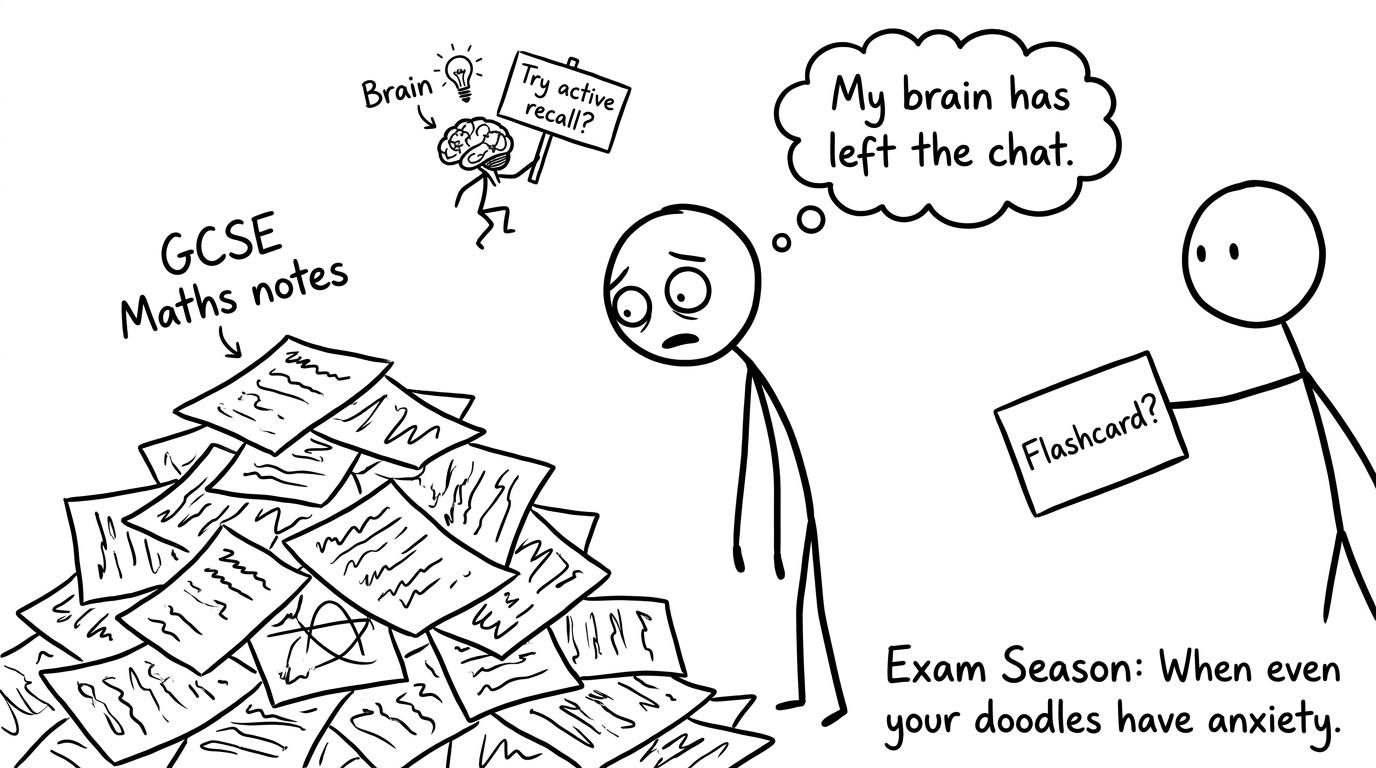 A student staring at a huge messy pile of revision notes labelled "GCSE Maths notes" while a tiny stick-figure "Brain" holds up a sign: "Try active recall?" Another stick figure offers a flashcard.
On YesGenie, you’ve already got everything you need to make that switch: bite-sized lessons, topic questions, mini tests, mark schemes, video solutions, past papers, and predicted papers. The skill is learning how to use those tools so your notes stop being a museum, and start being a gym.
The simple checklist: turning notes into active recall
Use this as your routine for any GCSE topic (foundation or higher tier, any exam board like Edexcel, AQA, OCR or Eduqas):
- Close your notes and write what you remember (definitions, steps, triggers).
- Convert each page into questions, not statements.
- Do one worked example from memory, then check against a model solution.
- Do exam-style questions until the method survives unfamiliar wording.
- Space your practice: revisit after 1 day, 3 days, 7 days.
- Use mark schemes to learn what earns marks, not what looks neat.
Helpful starting points on YesGenie:
- GCSE Past papers
- Edexcel GCSE Maths Predicted Papers
- Edexcel GCSE Maths Mini Tests
- Eduqas GCSE Maths Revision Guides
Why GCSE maths notes feel effective (and why they often aren’t)
Most GCSE students revise maths the same way they revise English quotes: read, highlight, re-read. That creates familiarity. Familiarity feels like knowing, because your brain recognises the page.
But GCSE maths marks come from something stricter: performing steps in the right order under new surface features. The question might hide the same idea inside a diagram, a context, or a rearranged equation. So the real skill is retrieval: can you pull the method out without prompts?
Active recall works because it forces a little struggle. And in maths, that struggle is the point. The calm you want in the exam comes from practising that feeling before the exam.
How to rewrite GCSE maths notes as active recall prompts
A good test: if your notes read like a textbook, they are passive. If your notes read like a set of questions you can answer, they are active.
Turn headings into “can I?” questions
Instead of writing:
- “Solving quadratics”
Rewrite as:
- “Can I solve x2+5x+6=0x^2+5x+6=0x2+5x+6=0 by factorising?”
- “Can I decide whether to factorise, use the quadratic formula, or complete the square?”
- “Can I check my solutions quickly?”
That last one matters: GCSE students often lose marks not because they can’t do a topic, but because they don’t have a checking habit.
Use the “trigger, method, check” format
For each topic, create three lines:
- Trigger: what clues tell you this topic is being tested?
- Method: the steps (short, in order).
- Check: one quick way to verify.
Example for linear equations:
- Trigger: unknown appears once, no powers above 111.
- Method: expand, collect like terms, isolate xxx.
- Check: substitute back.
This is the kind of thinking mark schemes quietly reward.
Active recall in action: two GCSE worked examples (from memory first)
The goal isn’t to copy a perfect solution. It’s to attempt from memory, then compare your attempt to a high-quality model and fix the gap.
If you need a model for a topic, start with a YesGenie revision guide and its video walkthrough, then return to retrieval practice.
Worked example: rearranging a formula
Rearrange V=43πr3V=\frac{4}{3}\pi r^3V=34πr3 to make rrr the subject.
Start by isolating r3r^3r3:
V=43πr3 V=\frac{4}{3}\pi r^3 V=34πr3Multiply both sides by 34π\frac{3}{4\pi}4π3:
3V4π=r3 \frac{3V}{4\pi}=r^3 4π3V=r3Now take the cube root:
r=3V4π3 r=\sqrt[3]{\frac{3V}{4\pi}} r=34π3VActive recall check: cube your final answer to see if you return to 3V4π\frac{3V}{4\pi}4π3V.
This kind of rearranging appears across higher tier GCSE papers, often wrapped in geometry contexts.
Worked example: expanding and factorising (and why structure matters)
Expand and simplify (2x−3)(x+5)(2x-3)(x+5)(2x−3)(x+5).
Multiply term-by-term:
(2x−3)(x+5)=2x⋅x+2x⋅5−3⋅x−3⋅5 (2x-3)(x+5)=2x\cdot x + 2x\cdot 5 - 3\cdot x - 3\cdot 5 (2x−3)(x+5)=2x⋅x+2x⋅5−3⋅x−3⋅5So:
=2x2+10x−3x−15=2x2+7x−15 =2x^2+10x-3x-15=2x^2+7x-15 =2x2+10x−3x−15=2x2+7x−15Active recall check: estimate with x=1x=1x=1.
Left side: (2⋅1−3)(1+5)=(−1)(6)=−6(2\cdot 1-3)(1+5)=(-1)(6)=-6(2⋅1−3)(1+5)=(−1)(6)=−6.
Right side: 2(1)2+7(1)−15=2+7−15=−62(1)^2+7(1)-15=2+7-15=-62(1)2+7(1)−15=2+7−15=−6.
You’ve verified the algebra without needing the mark scheme.
Upgrading notes into GCSE exam performance (YesGenie workflow)
Notes-to-recall is the first step. But GCSE maths is assessed with exam-style questions, timing, and mark allocation. Here’s a workflow that turns active recall into exam marks.
Use revision guides to build the first “retrieval script”
Pick one topic you keep forgetting, then use a revision guide as a clean reference. For example:
- 3d Pythagoras and Trigonometry (AQA) Revision Guide
- Vectors Proof Questions (Edexcel) Revision Guide
Read once, then close it and write your “trigger, method, check” from memory. That is your active recall card.
Move quickly to question banks and mini tests
Once you can recall the steps, you need variation. That’s how GCSE questions try to catch you: not with new maths, but new wrapping.
Use:
- Edexcel GCSE Maths Mini Tests for short, focused retrieval sessions.
- Resources hub when you want structured practice sets.
Mini tests are perfect for days when motivation is low: you still get retrieval, feedback, and momentum.
Finish with papers (and mark schemes like a coach)
Past papers and predicted papers train the skill of staying calm across mixed topics.
When you mark, don’t just count marks. Write one sentence per lost mark: “What did I not recall?” or “What cue did I miss?” That sentence becomes your next active recall prompt.
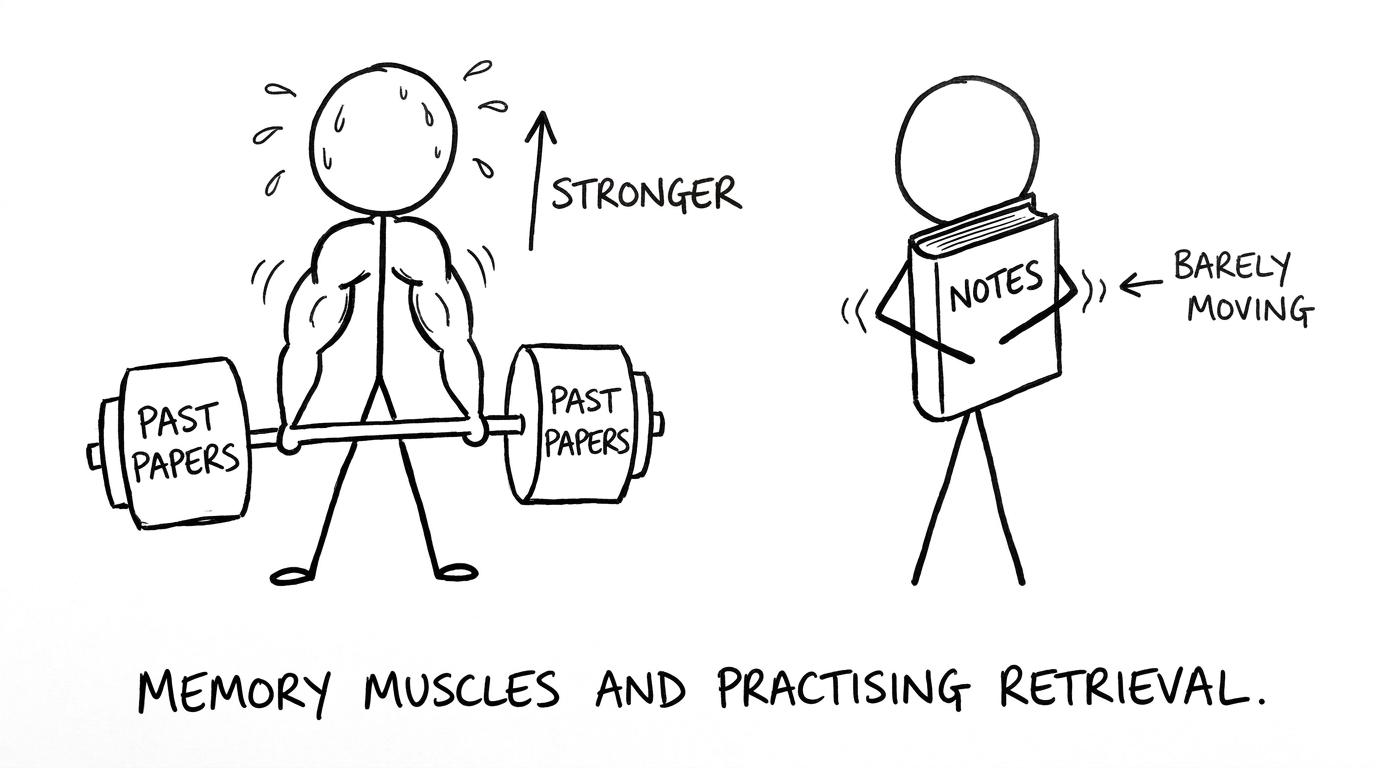 Two stick figures in a gym: one lifting a dumbbell labelled "Past papers" and getting stronger; the other hugging a book labelled "Notes" and barely moving.
Common mistakes students make with active recall for GCSE maths
- They keep the notes open. That turns recall into copying. Attempt first, then check.
- They make flashcards that are too vague. “Quadratic formula” isn’t a prompt. “When do I use x=−b±b2−4ac2ax=\frac{-b\pm\sqrt{b^2-4ac}}{2a}x=2a−b±b2−4ac and what’s the common sign error?” is.
- They only practise the easy version. GCSE higher tier loves adding one extra step, like rearranging before substituting.
- They avoid mark schemes. Mark schemes are where you learn the language of marks: working, accuracy, rounding, and exact values.
- They confuse doing questions with learning from questions. If you don’t write the reason you dropped marks, you’ll drop them again.
- They cram without spacing. One long session creates short-term performance. Spaced retrieval builds exam-day reliability.
Bringing it together: your next 7 days of GCSE active recall
If your GCSE maths notes are already written, you’re not behind. You’re simply at the stage where reading stops helping as much as retrieving. For the next week, pick two topics and run the same cycle: write prompts, attempt from memory, check with a model, then strengthen with exam questions.
Use YesGenie to make it frictionless:
- Start with revision lessons and revision guides to get one clean method.
- Use practice questions and mini tests to force retrieval under variety.
- Finish with past papers and predicted papers, then learn from the mark schemes and video solutions.
When you do that, “GCSE revision” stops being a vague promise and becomes a repeatable process. And marks follow processes.
Go to GCSE Past papers or Edexcel GCSE Maths Predicted Papers today, attempt one section without notes, and let active recall do what highlighting never could: make the method appear when you actually need it.