

How to Get Grade 9 GCSE Sociology
How to get grade 9 GCSE Sociology: build precise knowledge, stronger application, critical evaluation and a focused revision routine that lasts.
A sociology folder can look reassuringly complete. Every topic has notes. Important words are highlighted. Yet a practice question still comes back missing marks. The problem is rarely effort; it is that knowing content and producing a high-level exam answer are different skills.
If you want to know how to get grade 9 GCSE Sociology, the short answer is this: learn the specification precisely, retrieve knowledge without notes, apply it directly to each question, evaluate competing explanations and use past papers to identify recurring weaknesses. Grade 9 preparation is not simply more revision. It is a tighter feedback loop.
MathsGenie specialises in free GCSE and A Level maths revision, but the habits behind strong maths performance, active practice, careful marking, error analysis and retesting, transfer remarkably well to Sociology.
Your grade 9 Sociology checklist
A strong revision system should include:
- the correct specification for your exam board
- precise knowledge of concepts, studies, theories and research methods
- regular closed-book retrieval rather than repeated rereading
- practice organised by command word and mark tariff
- explicit application to the question or source
- balanced evaluation using evidence and alternative perspectives
- timed essays and full paper sections
- an error log built from mark schemes and teacher feedback
- planned revisits to weak material
The aim is not to sound complicated. It is to make every paragraph earn its place.
Understand what GCSE Sociology rewards
Across GCSE Sociology specifications, the assessment objectives are set nationally. AO1 assesses knowledge and understanding, AO2 assesses application, and AO3 assesses analysis and evaluation. Their overall weightings are 40%40\%40%, 40%40\%40% and 20%20\%20% respectively.
That balance matters. A student who memorises a textbook beautifully but does not adapt knowledge to the precise issue in the question is leaving a large share of the available marks exposed. Equally, evaluation without accurate sociological knowledge becomes unsupported opinion.
Research methods also deserve sustained attention. Ofqual requires at least 15%15\%15% of the qualification's marks to assess research methods across the assessment objectives. Methods should therefore be revised throughout the course, not saved for one rushed session near the examination.
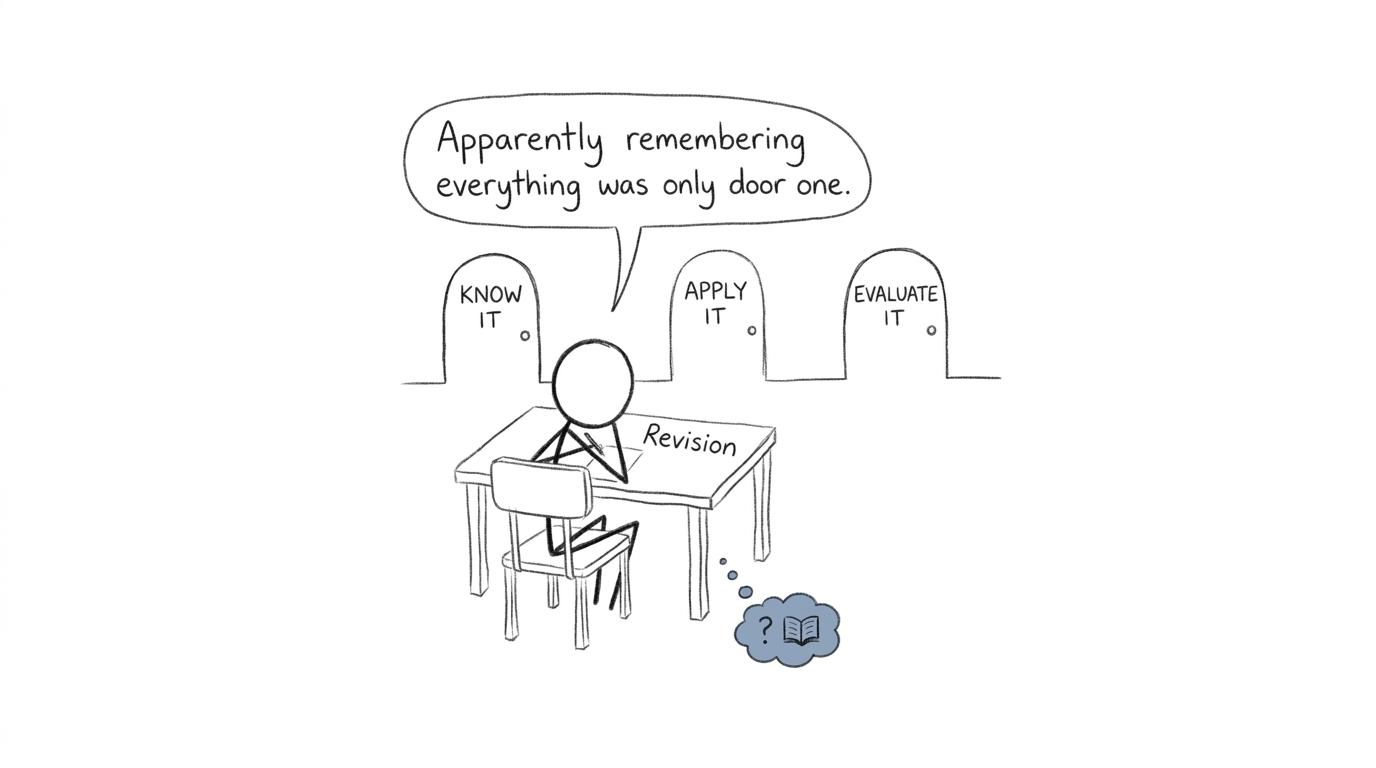 A student discovers that remembering everything is only the first door in Sociology revision
Check your board before building a plan
AQA GCSE Sociology has two written papers. Each lasts one hour and forty-five minutes, carries 100100100 marks and contributes 50%50\%50% of the qualification. Paper 1 covers families and education; Paper 2 covers crime and deviance and social stratification, with relevant theory and methodology appearing across the course.
Eduqas also uses two equally weighted written components, but its content and question structure are organised differently. Do not revise from a generic topic list and assume it matches your course. Confirm whether you take AQA, Eduqas or another specification, then download the current specification and use its wording as your master checklist.
Unlike GCSE Maths, the main GCSE Sociology specifications are not divided into foundation and higher tier. You should nevertheless confirm every examination detail with your teacher rather than relying on a revision website or an old paper.
Grade boundaries are set for each examination series, so there is no permanent percentage that guarantees grade 9. Focus on producing consistently excellent responses across the whole paper rather than chasing an unofficial fixed target.
Turn notes into knowledge you can retrieve
Rereading creates familiarity. Exams demand recall.
For each subtopic, reduce your notes to prompts covering:
- key concepts and accurate definitions
- major sociological perspectives
- named studies or evidence required by your course
- links between theory and the issue
- strengths, limitations and contrasting explanations
- relevant research methods
Then close the notes and answer the prompts from memory. Check immediately, correct omissions and return to them later. MathsGenie's guide to turning GCSE notes into active recall is written for maths students, but its central lesson applies here: a prompt should force you to produce knowledge, not merely recognise it.
Keep flashcards small. One card asking for an entire theory encourages a vague answer. Separate its assumptions, concepts, supporting evidence and criticisms so that gaps become visible.
A useful rhythm is to revisit material after a short gap, again later that week and then in mixed practice. The exact interval is less important than the principle: every return should involve retrieval. If you need a manageable structure on busy days, adapt the twenty-minute GCSE revision routine by replacing maths questions with Sociology recall and one short exam response.
Build answers around the question, not the topic
Grade 9 answers are selective. They use the knowledge that answers this question, rather than unloading everything remembered about the general topic.
Before writing, identify three things:
- the command word, such as describe, explain, discuss or evaluate
- the exact social issue or claim being examined
- any item, source or context that must be used
Each main paragraph should make a clear sociological point, support it with appropriate theory, evidence or a concept, and explain why that material answers the question. Application needs to be explicit. Do not expect the examiner to infer the connection.
This is where short, targeted practice becomes powerful. Instead of writing a full essay every evening, practise individual skills: selecting evidence, writing analytical links, comparing perspectives or forming a justified conclusion. Then combine them under timed conditions.
Make evaluation specific and comparative
Weak evaluation often sounds learned rather than useful: “This theory is outdated”, “The study is biased” or “Another perspective disagrees.” None of these statements explains how the criticism affects the argument.
Stronger evaluation asks:
- What assumption does this explanation make?
- Is the evidence representative, valid or reliable?
- Does another perspective explain the same pattern more convincingly?
- Does the explanation ignore class, gender, ethnicity or individual agency where relevant?
- How far does the criticism weaken the original claim?
Evaluation should change the direction of the argument. A counterpoint is not a decorative sentence at the end of a paragraph; it is part of deciding how convincing the explanation is.
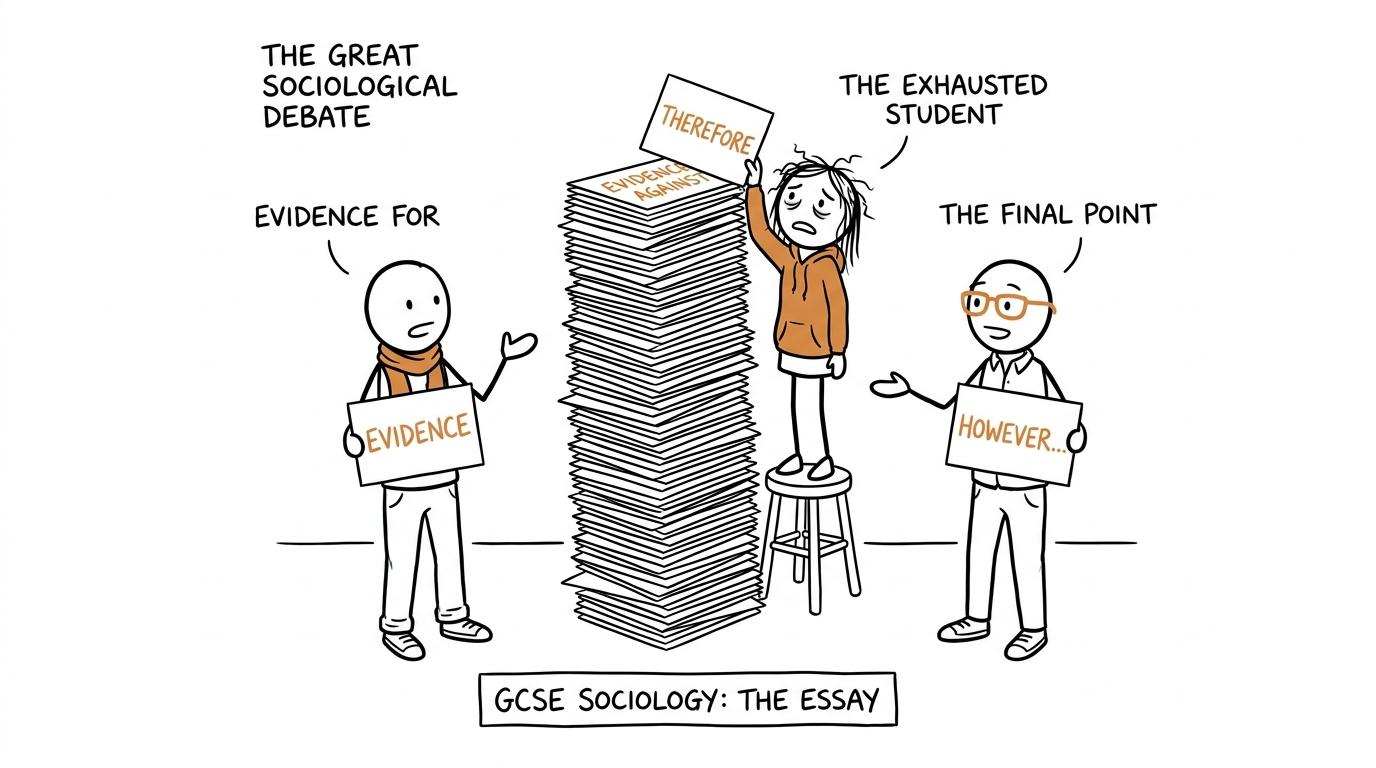 Two sociologists debate evidence while a student searches for a conclusion
Your conclusion should then answer the exact question. Weigh the explanations already discussed, identify the strongest evidence and make a reasoned judgement. Avoid introducing an entirely new theory in the final lines.
Use past papers as a diagnostic tool
Past papers do not improve grades merely because you complete them. The improvement happens when you analyse what went wrong and change the next revision session.
Use this cycle:
- answer a question without notes
- mark it using the correct board's mark scheme
- compare your response with any available examiner guidance or teacher feedback
- record the precise reason for each lost mark
- rewrite or improve the response
- attempt a similar question later without support
MathsGenie's guide to using GCSE past papers properly explains this paper, mark, fix and retest cycle. The questions there concern maths, but the feedback habit is equally valuable for Sociology.
Your error log should describe behaviours, not feelings. “Bad at families” gives you nowhere to go. “Used evidence but did not explain how it supported the view” gives you a specific action for the next answer.
Do not wait until every topic feels finished. Begin with individual questions and short timed sections, then progress to complete papers. The advice in when to start GCSE past papers can help you phase practice without using your newest papers too early.
Create a weekly grade 9 revision rhythm
A productive week combines memory, writing and feedback:
Two knowledge sessions
Retrieve concepts, theories, studies and methods without notes. Correct gaps immediately and schedule them for another test.
Two exam-skill sessions
Practise a particular command word or answer length. Focus on application in one session and evaluation in the other.
One timed section
Complete a substantial group of questions under controlled conditions. Mark it carefully and choose the two most important weaknesses to repair.
One repair session
Redo weak material and improve selected answers. Finish by testing the same skill on a fresh question.
A realistic plan survives busy school weeks. MathsGenie's GCSE revision timetable guide and one-month revision plan show how to balance focused sessions, timed work and error correction. Adapt the structure to your Sociology specification rather than copying the maths topics.
Common mistakes that hold students below grade 9
Revising only the enjoyable topics
Confidence can hide gaps. Use the specification and marked work to choose what needs attention, not what feels comfortable.
Memorising essays word for word
A memorised essay may not answer the wording or item on the paper. Memorise flexible knowledge and argumentative relationships, then build the response around the question.
Naming evidence without using it
A study or theorist earns its place only when you explain what it shows and why it supports or challenges the argument.
Treating evaluation as a list of generic criticisms
Comments about bias, age or sample size must be developed. Explain what the limitation does to the credibility or scope of the conclusion.
Ignoring research methods
Methods are assessed across GCSE Sociology and can appear in context. Revise practical, ethical and theoretical issues, as well as the strengths and limitations of particular methods.
Counting completed papers instead of corrected errors
Five hurried papers can teach less than one paper reviewed carefully. Use the mark scheme as a description of rewarded performance, not simply a way to produce a total.
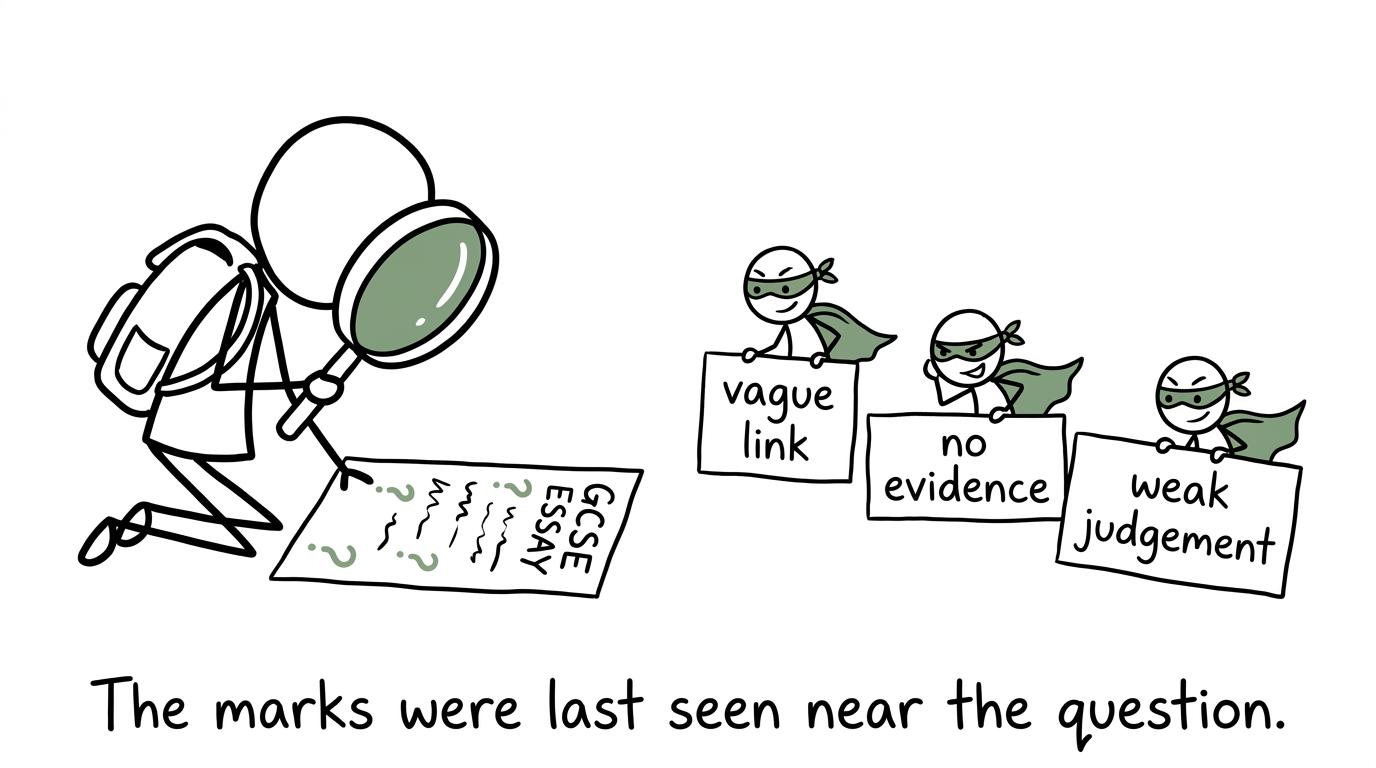 A revision detective searches for marks hiding behind vague links and weak judgements
Make your maths revision support the same habits
Sociology may be the immediate target, but GCSE revision works better when subjects share one dependable system. Use the MathsGenie GCSE Maths revision hub for free board-specific revision lessons, practice questions, mini tests, past papers, predicted papers, mark schemes and video solutions.
Keep the same routine in both subjects: attempt, mark, diagnose, repair and retest. In maths, the error might be an incorrect method. In Sociology, it might be an unsupported judgement. Either way, the grade rises when the mistake changes what you do next.
From busy revision to deliberate improvement
Getting grade 9 in GCSE Sociology is not about writing the longest answers or owning the neatest notes. It comes from precise knowledge, direct application, developed evaluation and honest use of feedback. Know your specification. Retrieve rather than reread. Practise under time. Make every lost mark leave a lesson behind.
Then bring the same discipline to your other GCSEs. Start with MathsGenie's free GCSE Maths revision resources, use revision lessons and practice questions to repair weak skills, and move into mini tests, past papers and predicted papers when you are ready to test them under pressure. Calm repetition is rarely dramatic. It is simply what makes strong performance dependable.











