

Turn GCSE Maths Notes into Active Recall (Edexcel)
GCSE Edexcel maths students: learn how to turn notes into active recall using YesGenie lessons, flashcards, past papers and mark schemes.
The moment your GCSE notes stop helping
Somewhere around the middle of GCSE revision, a strange thing happens. Your notebook looks impressive, colour-coded headings, neatly boxed formulae, worked examples that make sense when you read them. Yet when you sit down with an Edexcel-style question, your mind goes blank. It isn’t that you “don’t know” the topic. It’s that your GCSE notes are doing the remembering for you.
Active recall is the shift from recognising a method on the page to retrieving it under pressure. And because Edexcel GCSE Maths rewards method marks and clear steps, retrieval beats rereading almost every time.
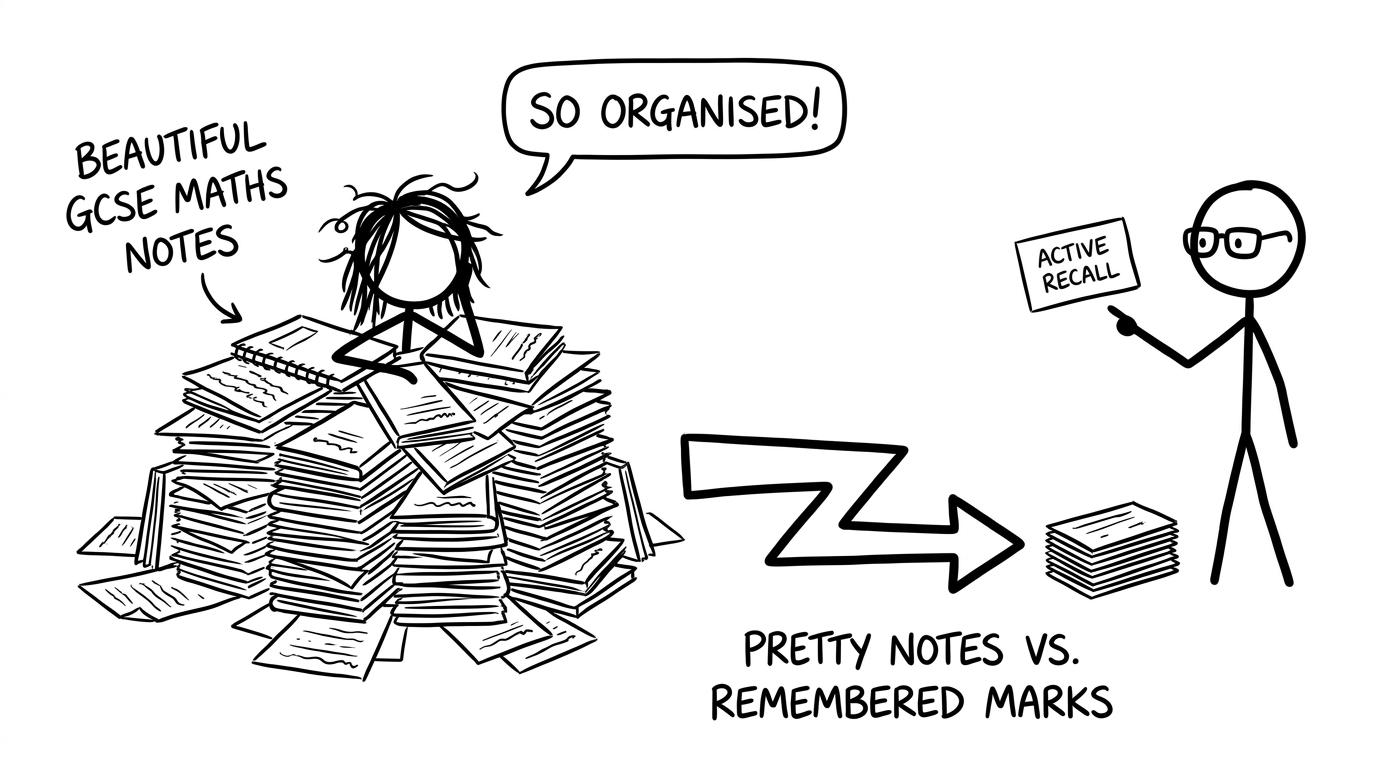 Pretty notes turning into flashcards
A quick checklist: turning GCSE notes into active recall
Use this as your simple rulebook. If your GCSE revision session doesn’t include most of these, you’re probably still “passively” revising.
- Close the notes and write the method from memory
- Convert each topic page into 5-10 short prompts
- Practise with exam-style questions, not just examples
- Mark with the mark scheme, then correct in a different colour
- Revisit the same prompts after 111 day, 333 days, 777 days (spacing)
- Mix topics (interleaving) so GCSE recall becomes flexible
You can do all of this inside YesGenie using Edexcel topic pages, flashcards, and exam practice.
Useful starting points:
- Edexcel GCSE Maths Revision
- Edexcel GCSE Maths Past Papers
- Edexcel GCSE Maths Predicted Papers
- Resources Hub (mini tests, predicted papers, more)
Why active recall works so well for Edexcel GCSE Maths
Edexcel GCSE questions are rarely asking “Have you seen this before?” They’re asking “Can you choose a method and carry it out clearly?” That’s retrieval.
Active recall trains three exam-critical habits:
You learn the first line
Many GCSE students lose marks because they don’t know how to start. Active recall forces you to practise the opener: the substitution, the rearrangement, the first diagram label, the first equation.
You rehearse method marks
Edexcel mark schemes reward structure. When you retrieve a method, you naturally practise the order of steps that earns marks.
You make knowledge usable under stress
In the exam, you won’t have your GCSE notes. Your brain becomes the notes. Active recall is how you build that.
How to convert a page of GCSE notes into recall prompts
Take a typical GCSE page: definitions, steps, a worked example, maybe a warning. Most students reread it. Instead, you want to turn it into questions your brain must answer.
A good prompt is short, specific, and leads to a clear response. Here are templates that work well for GCSE maths:
- “What are the steps for…?”
- “What does this word mean in exams?”
- “Which value do I divide by first?”
- “What do I write on the first line?”
- “How do I check the answer quickly?”
If you want a model for how clear notes can become clear prompts, use YesGenie revision guides and then self-test the same ideas using the built-in flashcards and practice.
Example topic to practise this with:
Worked example: fractions of an amount (and how to recall it)
This is a classic GCSE skill that appears in foundation and higher tier, often wrapped in words.
Your recall prompt: “When finding ab\frac{a}{b}ba of an amount, what do I do first, and why?”
What you should retrieve: divide by the denominator, then multiply by the numerator.
Now do it from memory.
Example
Find 35\frac{3}{5}53 of 808080.
Start with the method you recall:
35 of 80=80÷5×3 \frac{3}{5}\text{ of }80 = 80 \div 5 \times 3 53 of 80=80÷5×3Compute:
80÷5=16 80 \div 5 = 16 80÷5=16 16×3=48 16 \times 3 = 48 16×3=48So:
35 of 80=48 \frac{3}{5}\text{ of }80 = 48 53 of 80=48Quick check (also recallable): 15\frac{1}{5}51 of 808080 is 161616, so 35\frac{3}{5}53 must be 3×16=483 \times 16 = 483×16=48.
For more structured practice on this style of GCSE question, use topic-specific revision guides and questions:
Worked example: algebra recall that earns marks
Algebra is where “I understand it when I see it” becomes painfully common in GCSE.
Your recall prompt: “How do I expand and simplify 3(2x−5)−2(x+4)3(2x-5) - 2(x+4)3(2x−5)−2(x+4)?”
Retrieve the steps: expand brackets carefully, then collect like terms.
Example
Simplify 3(2x−5)−2(x+4)3(2x-5) - 2(x+4)3(2x−5)−2(x+4).
Expand:
3(2x−5)=6x−15 3(2x-5)=6x-15 3(2x−5)=6x−15 −2(x+4)=−2x−8 -2(x+4)=-2x-8 −2(x+4)=−2x−8Now add them:
6x−15−2x−8=4x−23 6x-15-2x-8=4x-23 6x−15−2x−8=4x−23So the simplified expression is:
4x−23 4x-23 4x−23Exam habit to recall: write one clean line that shows your expansion clearly, because that’s often where method marks live.
For targeted GCSE practice by board and topic, use a YesGenie GCSE maths area such as:
Make the mark scheme part of your active recall
A mark scheme isn’t just for checking. It’s a map of how GCSE marks are actually awarded.
Here’s the active recall routine that works:
- Attempt the question with notes closed.
- Mark it with the scheme.
- Rewrite the solution using the scheme’s language and structure.
- Turn the reason you lost marks into a new prompt.
If you build that habit on Edexcel papers, your GCSE notes naturally evolve into exam-proof methods.
A practical place to do this:
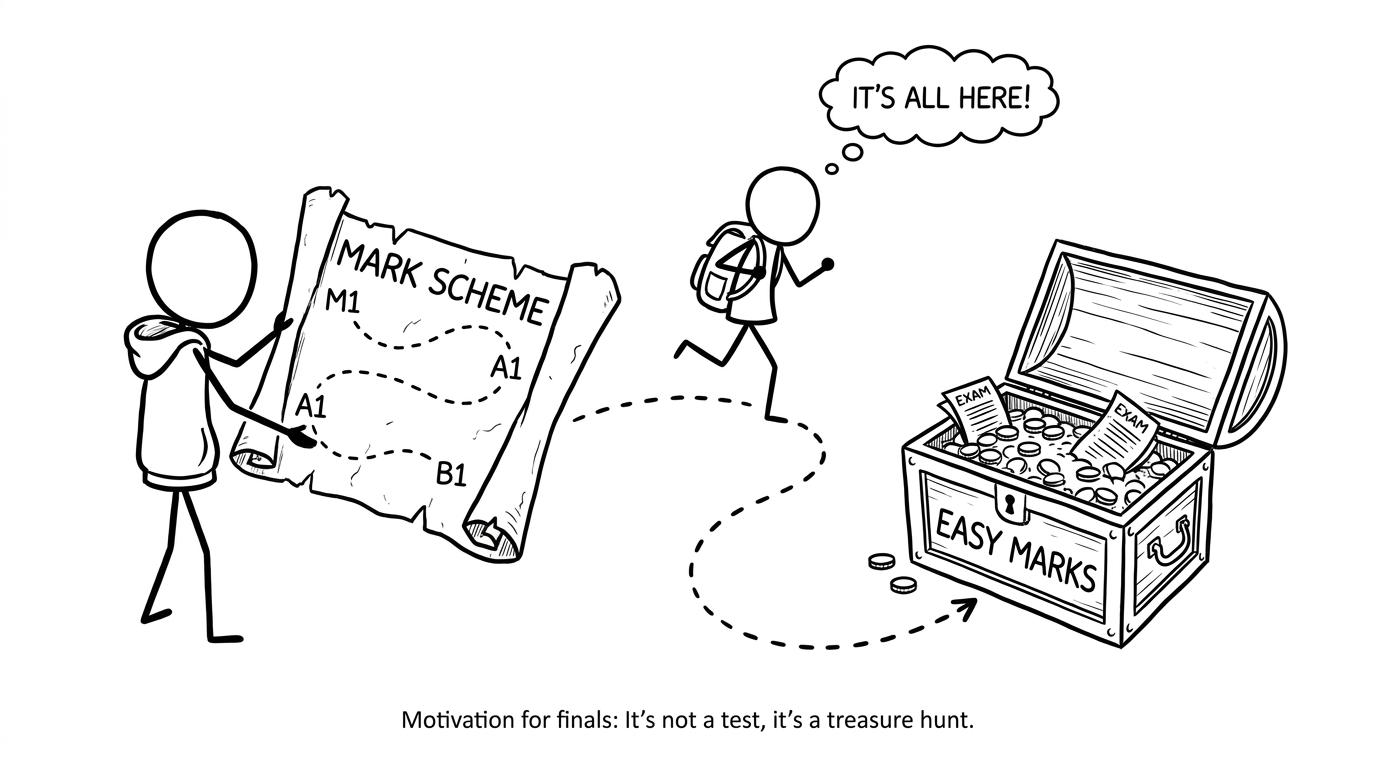 Mark scheme treasure map
The YesGenie system: lessons, flashcards, then papers
Students often ask for the “right order” for GCSE revision. The honest answer is: the order that makes you retrieve, correct, and repeat.
A simple YesGenie loop looks like this:
Use lessons to build the first version of the method
Lessons help you understand what’s going on. But don’t stop at understanding.
Explore the broader GCSE maths spaces if you need to compare styles across boards:
Use flashcards to force active recall
Flashcards are where your GCSE notes turn into prompts. The goal is not to make loads. The goal is to make useful ones that expose weak recall quickly.
Use mini tests and topic questions to build stamina
Short tests reveal whether you can retrieve methods back-to-back. That’s closer to a GCSE paper than a single practice question.
Find these through:
Use predicted papers to practise choosing methods
Predicted papers are powerful because they feel like “real” GCSE maths, but still guide your focus when time is limited.
For Edexcel:
How to turn a single GCSE topic into a 20-minute active recall session
If you have Edexcel mocks soon, this is a realistic structure.
Choose one micro-topic
Not “algebra”, but “expanding brackets” or “fraction of an amount”. A micro-topic gives you quick feedback.
Write the method from memory first
Before questions, write 4-6 bullet steps. If you can’t, that’s your signal: your GCSE notes were doing the thinking.
Do 4-6 exam-style questions
Aim for a mix: a straightforward one, a worded one, and one that links topics.
Mark, then correct with purpose
Every correction becomes a new prompt.
Schedule the next retrieval
Put the same prompts back in tomorrow. GCSE recall fades fast if you don’t revisit.
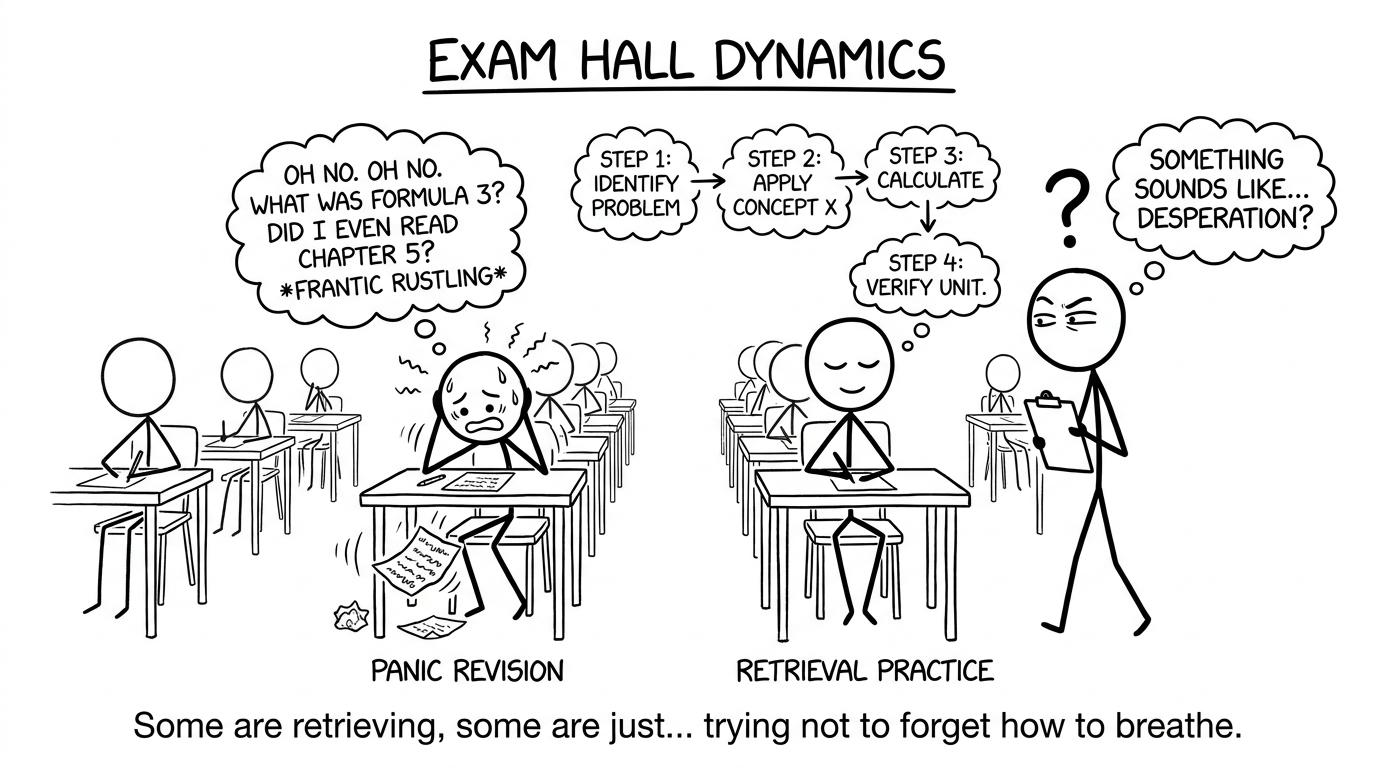 Exam hall retrieval practice
Common mistakes when turning GCSE notes into active recall
Making prompts too big
“Revise fractions” is not a prompt. “How do I convert 0.3750.3750.375 to a fraction?” is. GCSE active recall needs tight questions.
Checking the answer too early
If you peek at your GCSE notes after 10 seconds, you’re training avoidance. Struggle a little longer, then check.
Only practising what feels fluent
Fluency is comforting, but it lies. The topics you avoid are usually the ones that will cost you GCSE marks.
Not using mark schemes
Many students treat the mark scheme as judgement. Treat it as feedback. Edexcel mark schemes, especially, teach you the phrasing and structure that wins method marks.
Forgetting calculator habits
GCSE errors often come from calculator slips and rounding. Build a prompt like: “What do I round to, and when?” and practise it every time.
Closing: make your GCSE notes useful again
Your GCSE notes were never a waste. They were a first draft of understanding. But in the weeks that matter, mocks, final exams, the stretch from “I get it” to “I can do it”, you need recall, not comfort.
If you’re revising Edexcel GCSE Maths, let your notes shrink into prompts, let your prompts turn into retrieval, and let retrieval prove itself on questions and papers. Use YesGenie to keep the system simple: revision lessons to learn, flashcards for active recall, topic questions to practise, and Edexcel past papers and predicted papers to sharpen exam instincts.
Start here and build your loop today:










