How to Get Grade 6 GCSE Chinese: Revision Plan
How to get grade 6 GCSE Chinese with a focused Higher-tier plan for vocabulary, characters, listening, speaking, writing, past papers and feedback.
The frustrating thing about GCSE Chinese is that progress can feel invisible. You learn characters, forget some, improve your listening, then freeze when somebody asks an unexpected question. If you are wondering how to get grade 6 GCSE Chinese, the short answer is this: enter Higher tier, practise all four language skills every week, retrieve vocabulary from memory, and use marked exam work to identify exactly where marks are being lost.
A grade 6 does not demand flawless Chinese. It does require a dependable performance across listening, speaking, reading and writing, including some extended language, justified opinions and accurate references to different time frames. The habits that produce this are rarely dramatic. They are small, measurable and repeated.
Your grade 6 checklist
Start with these priorities:
- Confirm your exam board, specification and Higher-tier entry with your teacher.
- Diagnose your weakest of the four skills rather than revising by instinct.
- Learn vocabulary in sentences and topic groups, not as one enormous list.
- retrieve characters by writing them from memory.
- Listen to short recordings repeatedly and analyse what you missed.
- Practise spontaneous speaking, not only memorised answers.
- Write under time limits and check every required bullet point.
- Use official past papers, mark schemes and examiner guidance from your board.
- Keep an error log and revisit recurring weaknesses within a few days.
This resembles effective maths revision more than it first appears. Both subjects reward active practice, immediate feedback and precise correction. MathsGenie's guide to finding your weakest GCSE topics provides a useful diagnostic process that can be adapted to Chinese skills.
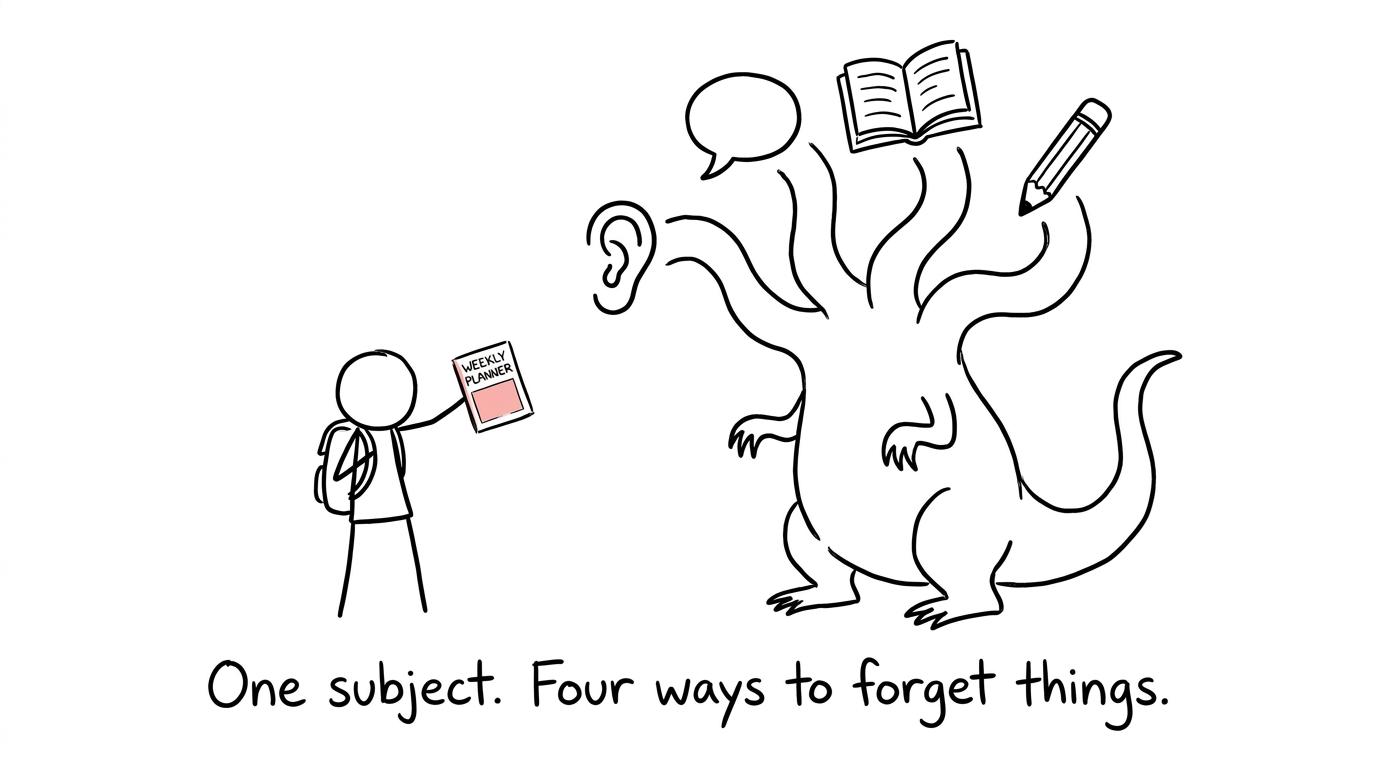 A student preparing to face the four skills of GCSE Chinese
Understand what a grade 6 requires
Current AQA GCSE Chinese (Spoken Mandarin) and Pearson Edexcel GCSE Chinese qualifications assess listening, speaking, reading and writing. Each skill contributes 25%25\%25% of the qualification. Both have Foundation and Higher tiers, and students take every component at the same tier.
Foundation tier is limited to grades 1-5, so a grade 6 requires Higher-tier entry. Discuss this with your teacher rather than assuming that improving mock results will automatically change your entry.
The official modern foreign language grade descriptors give a useful picture of the target. Around grade 6, students should be able to:
- understand overall messages, details and opinions in some extended material;
- cope with familiar and some less familiar contexts;
- sustain speech and respond to questions;
- express and justify ideas;
- write coherent extended responses;
- use some complex language with generally secure accuracy;
- translate while preserving the main message.
That description matters more than chasing a fixed percentage. Grade boundaries are set after papers have been marked and can change between exam series. A previous boundary can help you interpret practice, but it is not a guaranteed target for your examination.
Diagnose the skill that is holding you back
Students often say they are “bad at Chinese”, but that is too broad to guide revision. You may understand written vocabulary yet fail to recognise it at natural speaking speed. You may know what you want to say but lose accuracy when writing characters. Those are different problems.
Complete one recent Higher-tier paper or assessment for each skill where possible. Mark it using the official materials supplied by your exam board and classify each lost mark:
- Vocabulary gap: the word or phrase was unknown.
- Recognition gap: you knew it when shown the answer but did not recognise it in context.
- Character gap: you knew the pronunciation or meaning but could not read or write the character.
- Grammar gap: word order, particles, comparisons or time references were insecure.
- Exam-technique gap: you missed an instruction, bullet point, negative or required detail.
- Timing gap: you knew enough but did not finish.
This turns a disappointing score into a revision plan. The same principle sits behind MathsGenie's GCSE revision timetable: prioritise evidence from mistakes, then schedule the weakest areas more frequently.
Replace rereading with active retrieval
Rereading vocabulary can create familiarity without reliable recall. The page looks recognisable, so it feels as though the language has been learnt. The exam then removes the page.
A better routine begins with memory. Cover the answer and try to retrieve the meaning, pronunciation, character or complete sentence. Check it immediately, correct it, and test it again after a delay. Educational evidence supports retrieval when it includes appropriate challenge, feedback and repeated recall over time.
For Chinese, rotate several directions of retrieval:
- English meaning to Chinese word or phrase;
- Chinese character to meaning;
- spoken word to character or meaning;
- topic prompt to a complete spoken sentence;
- question to an unrehearsed personal response.
Keep cards short. A card containing an entire revision guide is a small book, not a retrieval prompt. The MathsGenie twenty-minute revision routine shows how a brief recall-practice-feedback cycle can fit around a busy GCSE week.
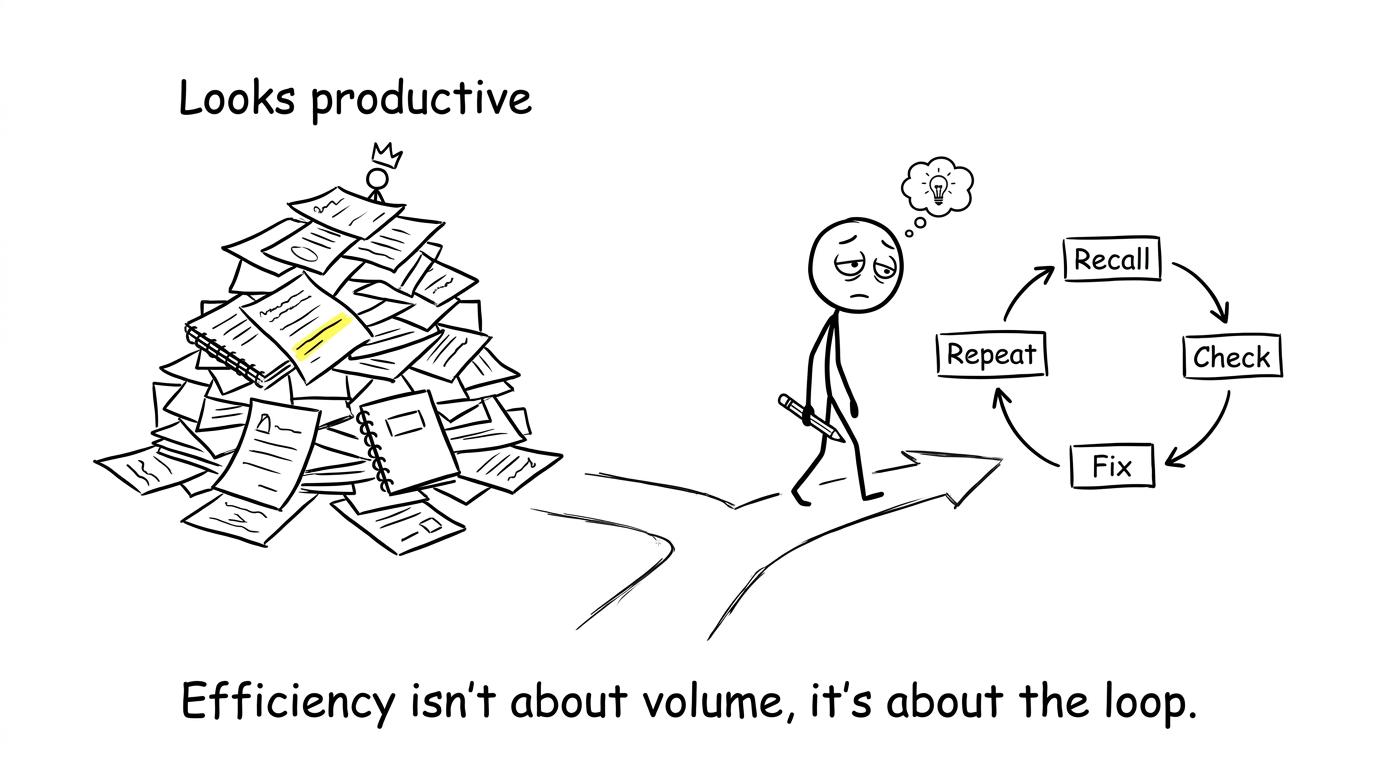 A student choosing active recall over an impressive pile of highlighted notes
Build vocabulary that survives the exam
A grade 6 vocabulary bank needs breadth, but isolated nouns are not enough. Learn words inside flexible sentence frames that let you describe, compare, explain and justify.
Organise your vocabulary around the themes in your own specification. Within each theme, include:
- common nouns and verbs;
- opinions and reasons;
- positive and negative descriptions;
- connectives;
- question forms;
- quantity and frequency expressions;
- language for past, present and future events;
- a smaller set of ambitious phrases you can use accurately.
Prioritise useful language over decorative complexity. One secure structure that works across school, holidays and family topics is more valuable than several impressive expressions you cannot adapt.
Characters need separate attention. Look, cover, write, check and correct. Notice components and recurring patterns, but always finish by producing the full character without support. Keep commonly confused characters together so that the distinction becomes deliberate.
Train listening as a daily recognition skill
Listening often improves slowly because students treat every recording as a one-off test. Instead, use a short section several times, with a different purpose each time.
First listen for the overall topic and attitude. Next, identify specific details such as who, when, where, frequency and reasons. Then inspect the transcript if one is available, mark the language you failed to recognise, and listen again without reading.
Pay special attention to:
- negatives and changes of opinion;
- time markers;
- numbers and dates;
- similar-sounding words;
- distractors that mention more than one possible answer;
- familiar vocabulary spoken faster than expected.
Record recognition errors in your vocabulary system. If a word can only be recognised on paper, it is not yet secure listening vocabulary.
Make speaking genuinely spontaneous
Memorised answers can provide a foundation, but Higher-tier speaking requires interaction. An examiner may vary a question, ask for a reason or move the conversation in an unexpected direction.
Practise with topic prompts rather than full scripts. Give an answer, add a reason, include a detail and prepare for a follow-up. Record yourself so that you can hear pauses, unclear tones and repeated vocabulary.
A productive speaking session includes:
- a role-play or short transactional exchange;
- a picture-based response where relevant to your board;
- extended answers on a specification theme;
- unexpected follow-up questions;
- one repair strategy for moments when you need to clarify or rephrase.
Do not sacrifice communication by forcing complex language into every sentence. Range helps only when your meaning remains clear.
Turn reading into evidence hunting
Higher-tier reading is not simply character recognition. You must identify messages, details, opinions and implications across longer passages.
Before translating every line, establish the context. Identify names, time references, repeated ideas, connectives and changes in viewpoint. Then return to the exact evidence required by the question.
When translating into English, preserve meaning rather than copying Chinese structure mechanically. Check pronouns, negatives, quantities and time. One overlooked marker can reverse the message of a sentence.
Write for the task, not for your prepared essay
A strong prepared paragraph is only helpful if it answers the question set. Before writing, convert every bullet point into a brief checklist and leave time to confirm that each one has been covered.
Aim for controlled variety:
- clear opinions with reasons;
- relevant detail;
- more than one time frame where the task invites it;
- varied but secure vocabulary;
- accurate connectives and word order;
- some complex structures that you can control.
After completing a response, check high-risk areas rather than rereading passively. Look specifically for missing content, incorrect characters, time references, repeated vocabulary and sentences whose meaning has become unclear.
Use past papers as a feedback system
Past papers are most valuable when they change what you do next. Complete a suitable Higher-tier section under the correct conditions, mark it carefully, update your error log and schedule a focused repair session.
The sequence should be:
- attempt;
- mark;
- classify;
- correct;
- practise the underlying skill;
- retest with different material.
Do not repeatedly complete papers while carrying the same errors forward. MathsGenie's guide to when to start GCSE past papers explains why shorter sections can come before full timed papers. The advice on using GCSE mark schemes effectively also transfers well across subjects.
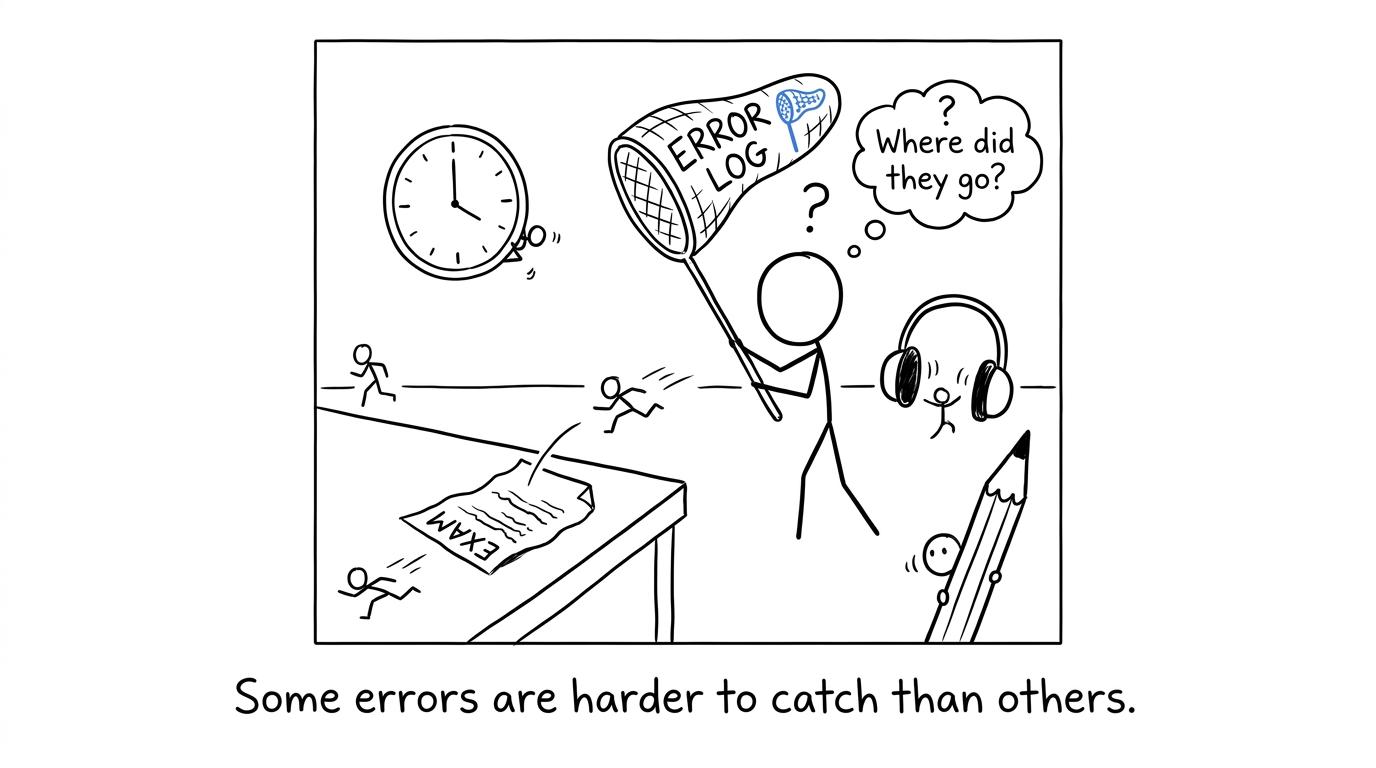 An error log catching marks before they escape
A weekly routine that can move you towards grade 6
A balanced week might contain four short sessions and one longer exam session:
- Session one: vocabulary retrieval and character production.
- Session two: listening, transcript analysis and repeated listening.
- Session three: speaking questions recorded without a script.
- Session four: a timed reading or writing task followed by correction.
- Longer session: mixed Higher-tier exam practice and error-log review.
Keep sessions specific. “Revise Chinese” is vague; “retrieve travel vocabulary, then answer five unexpected holiday questions aloud” creates an observable result.
If examinations are close, the MathsGenie one-month GCSE revision plan offers a useful framework for moving from diagnosis to timed work without trying to fix everything at once.
Common mistakes when aiming for grade 6
Revising only the strongest skill
Reading may feel safer than speaking, but each skill contributes substantially to the final qualification. Give additional time to weaknesses without abandoning the other components.
Memorising answers word for word
Scripts can collapse when the wording changes. Learn reusable structures and practise adapting them to fresh questions.
Treating recognition as recall
Recognising a highlighted word is easier than producing or understanding it independently. Test with notes closed before checking.
Ignoring tones and pronunciation
Communication matters in speaking. Record yourself, compare carefully with reliable model audio and act on your teacher's feedback.
Using complex language inaccurately
Complexity should extend secure communication, not replace it. Build ambitious phrases gradually and keep the surrounding language controlled.
Chasing last year's boundary
Boundaries vary. Use previous papers to monitor progress, but focus on stronger performance in all four skills rather than one historic raw mark.
Make steady practice your advantage
A grade 6 is usually built through accumulation. One more phrase retrieved accurately. One listening distractor understood. One speaking answer extended without a script. One recurring character error removed.
Use official Chinese materials from your exam board and guidance from your teacher for subject-specific practice. For the rest of your GCSE timetable, MathsGenie remains your free maths revision base. Start at the GCSE Maths revision hub, use revision lessons and practice questions to repair individual topics, then move into mini tests, past papers, predicted papers, mark schemes and video solutions. Edexcel students can begin with the organised collection of Edexcel GCSE Maths past papers.
The subjects differ. The successful habit does not: attempt, check, correct and return.