GCSE Mark Schemes: Use Them to Improve (Even in English)
GCSE mark schemes can raise your grades fast. Learn how to read method marks, analyse errors, and turn feedback into targeted revision on YesGenie.
GCSE revision can feel like this: you work hard, you do a paper, you check the answers, and somehow the marks still don’t climb. The part nobody tells you is that the biggest upgrade often isn’t more questions; it’s using the mark scheme like a map, not a verdict. This matters even if we’re talking about GCSE English Language, because the habit is the same: learn what examiners reward, then practise producing it on purpose. And if you’re a maths student (or an A Level student supporting a younger sibling), the GCSE mark scheme is your most underused revision tool.
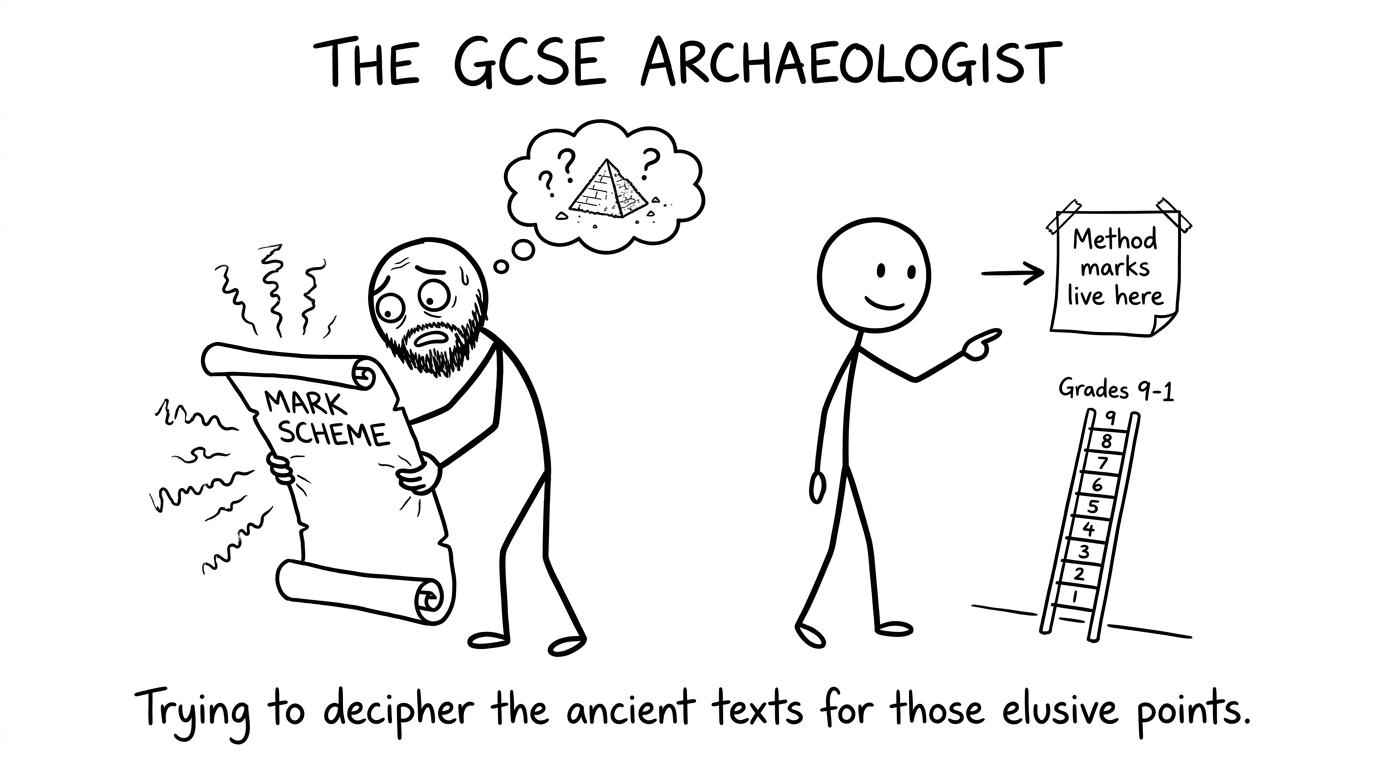 A student facing the mark scheme like an ancient scroll
The quick checklist: how to use a GCSE mark scheme properly
Use this every time you finish a question set, mini test, or past paper.
- Attempt first: no mark scheme until you’ve committed to an answer.
- Mark with a pen: award yourself marks exactly as the scheme says.
- Classify the loss: was it knowledge, method, accuracy, or communication?
- Rewrite the solution: create a “model response” in your own words.
- Practise the weakness: do 3-5 similar questions immediately.
- Re-test later: revisit after 48 hours to lock in the fix.
On YesGenie, you can do this with real papers and mark schemes via GCSE Past Papers and then follow up with focused practice using the Eduqas GCSE Maths Question Bank (swap board/topic as needed).
Why mark schemes change your grades (in maths and GCSE English)
A mark scheme is an agreement. Not between you and your teacher, but between you and the examiner. It’s the clearest statement of what “good” looks like under time pressure.
In GCSE maths, that agreement is often explicit: method marks, accuracy marks, follow-through marks. In GCSE English Language, it’s less mechanical, but it’s still an agreement: assessment objectives (AOs), levels-based descriptors, and what counts as evidence.
If you’re revising maths, you already have an advantage: you’re used to seeing marks as earned in steps. That mindset transfers. When you read a GCSE English mark scheme, look for the same thing: what steps make an answer more rewardable? Not “is it good?” but “what did they credit, specifically?”
What to look for inside a GCSE mark scheme
The maths side: method marks, accuracy marks, and follow-through
Most GCSE maths mark schemes (Edexcel, AQA, OCR, Eduqas) use shorthand that tells you how marks are awarded. For example:
- MMM marks: you used a correct method (even if the final answer is wrong).
- AAA marks: you got the correct answer (often dependent on the method).
- BBB marks: independent marks for a correct statement/value.
- ft (follow-through): you can carry a wrong value forward and still earn later marks.
This is exactly why mark schemes raise GCSE grades: they show you where marks live.
The English side: AOs and “what counts”
In GCSE English Language (AQA and others), mark schemes often combine:
- Assessment objectives (like AO1, AO2, AO3, AO4).
- Level descriptors (what a top-band answer does repeatedly).
- Indicative content (examples of what students might write).
If you’re a maths student, treat this like a specification checklist. Your job isn’t to copy the indicative content. Your job is to copy the features that get credit: inference, quotation selection, analysis of language/structure, evaluation, and clear writing.
A mark-scheme-first method you can use for GCSE English (built from maths habits)
Maths students often improve quickly because they review mistakes with discipline. Here’s the same loop, but designed for GCSE English Language.
Attempt, then annotate (don’t read the scheme too early)
If you read the mark scheme first, you’ll feel confident, but it’s a fake confidence. In GCSE revision, you need to produce under exam conditions.
So: answer the question, then open the mark scheme and highlight where you hit the descriptors. If a descriptor says “perceptive analysis”, underline the exact sentence where you did that. If you can’t underline it, you didn’t do it.
Convert vague feedback into a concrete target
“More analysis” is vague. Mark schemes are not.
A concrete target looks like:
- “For every quotation, add one sentence on the effect on the reader.”
- “Name a method (metaphor, contrast, semantic field) and link it to meaning.”
- “In evaluation, use a short counterpoint (‘Some readers might…’) to show balance.”
That’s the GCSE equivalent of “show your working”.
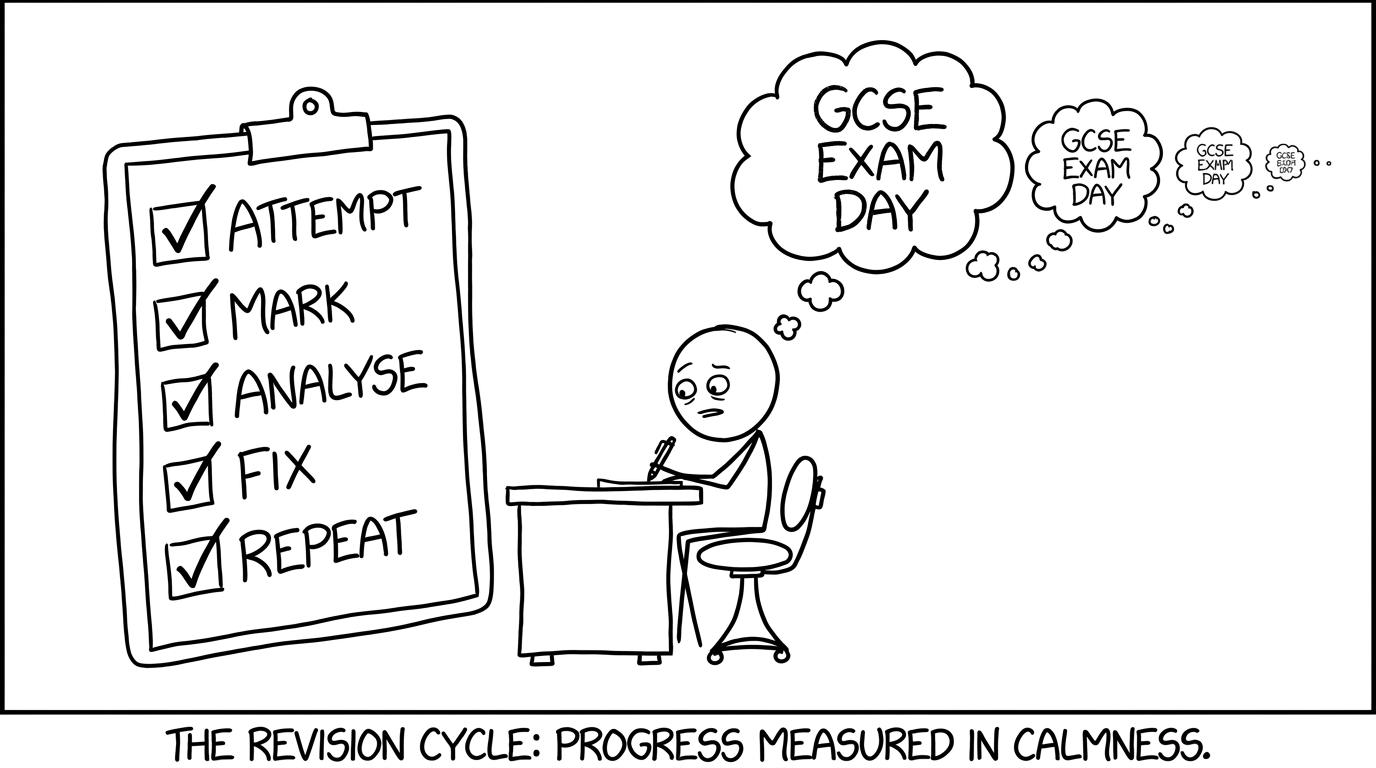 A revision loop checklist calming a student
Worked example: using a GCSE maths mark scheme to gain marks you usually lose
Because you’re a maths student, let’s make the method concrete with a typical mark-scheme pattern. Suppose a question is:
Solve 3x+5=203x + 5 = 203x+5=20.
A common mark scheme layout would effectively reward:
- M1M1M1 for rearranging correctly.
- A1A1A1 for the correct value of xxx.
Your working:
3x+5=203x + 5 = 203x+5=20 3x=153x = 153x=15 x=5x = 5x=5Now imagine you made a slip and wrote 3x=253x=253x=25 but then did x=253x=\frac{25}{3}x=325. You’d likely lose the accuracy mark, but if the method step is visible you might still pick up the method mark on similar multi-step questions. The lesson for GCSE improvement is simple: your working is not decoration, it is where marks are stored.
Then transfer that to GCSE English: the equivalent of “working” is quotation + explanation + effect + link back to the question. If you skip the link, you often lose the “accuracy mark” of relevance.
The “mark scheme mirror”: rebuild your answer until it matches the credit
After marking, don’t just write “careless mistake” and move on. Use this three-part repair:
Rewrite as a model solution (maths)
If you lost marks, rewrite the shortest correct solution. Keep it exam-speed.
Example: Find 34\frac{3}{4}43 of 282828.
Correct model:
34×28=3×7=21\frac{3}{4} \times 28 = 3 \times 7 = 2143×28=3×7=21If you originally did 34+28\frac{3}{4} + 2843+28, your fix isn’t “remember fractions”. Your fix is: “I must multiply by the fraction; dividing by 444 first reduces errors.”
Rewrite as a model paragraph (English)
Do the same in GCSE English Language. Pick one paragraph and rebuild it to hit the top descriptors:
- choose a sharper quotation
- name a language method
- analyse meaning and effect
- link to the writer’s intention
- link back to the question
That’s the English version of a clean solution line.
Using YesGenie mark schemes and resources to sharpen this process
YesGenie is built for this kind of loop: attempt, mark, analyse, practise.
Use these resources as your structure:
- GCSE Past Papers for real exam papers with mark schemes.
- Edexcel GCSE Maths Past Papers if you’re on Edexcel and want everything organised by series.
- Edexcel GCSE Maths Mini Tests for shorter, mark-scheme-friendly sessions when you’re tired.
- Edexcel GCSE Maths Predicted Papers when you need exam-style practise focused on likely topics.
- Resources to mix in predicted papers, mini tests, and other revision tools.
- Eduqas GCSE Maths Revision if your school uses Eduqas and you want the full hub.
- For A Level students supporting their GCSE sibling (or keeping skills sharp), Edexcel A Level Maths Revision keeps the same “attempt then mark” discipline.
Even when today’s task is GCSE English Language, keeping your maths revision engine running matters. Strong routines travel between subjects.
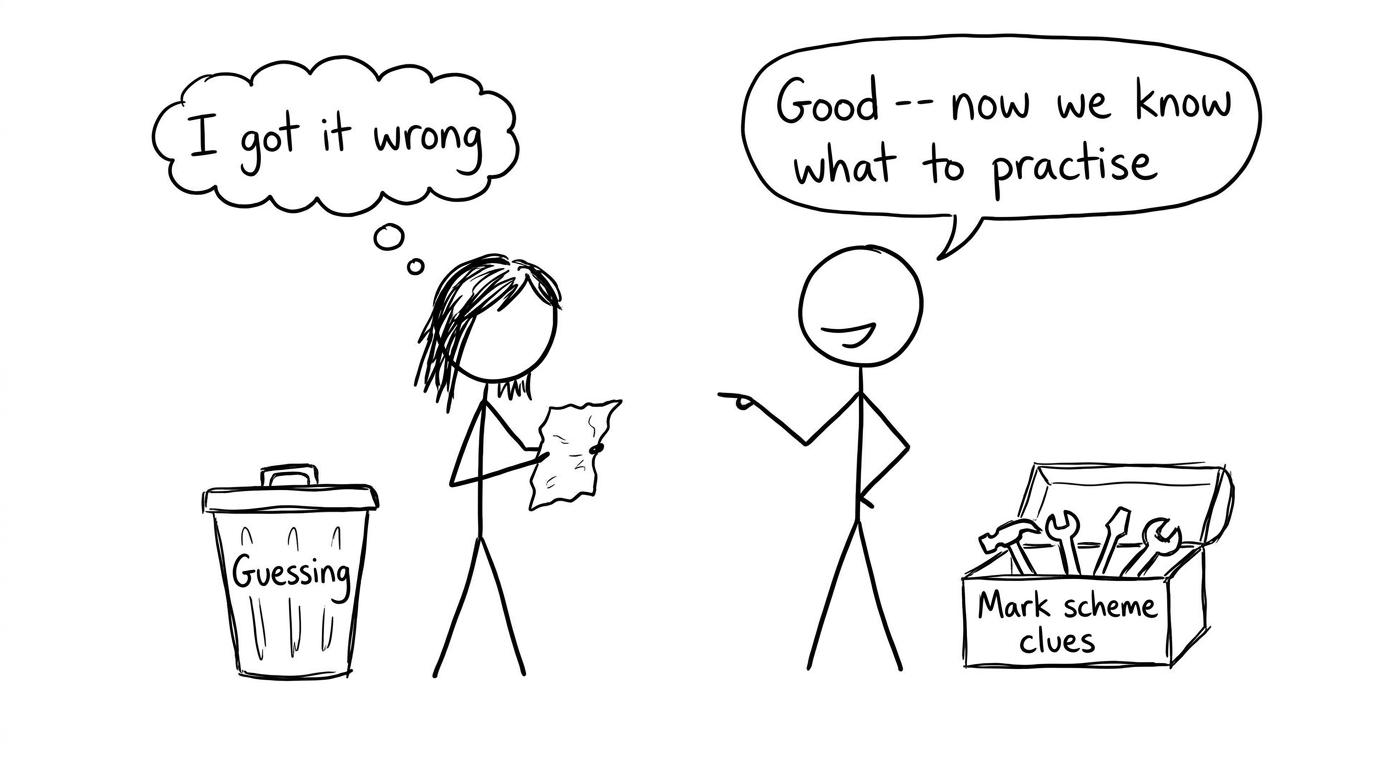 Two figures reframing mistakes as useful data
Common mistakes when using mark schemes (and how to fix them)
- Reading the mark scheme before attempting: you train recognition, not recall. Fix: attempt first, even if it’s messy.
- Only checking the final answer: you miss where GCSE marks are awarded. Fix: mark line-by-line and circle each lost mark.
- Calling everything “careless”: that avoids the real reason. Fix: label errors as knowledge, method, accuracy, or exam technique.
- Not rewriting the correct version: you leave the wrong method in your memory. Fix: rewrite the model solution/paragraph immediately.
- Not doing follow-up practice: insight without repetition fades. Fix: do 3-5 similar questions from the question bank.
- Ignoring command words and AOs in English: you write well, but not for the question. Fix: map each sentence to an AO feature.
Closing: treat the GCSE mark scheme like a coach, not a critic
A mark scheme doesn’t care how hard you tried. That can feel harsh. But it’s also liberating, because GCSE improvement becomes mechanical in the best way: find what earns marks, copy the pattern, repeat until it’s yours.
If you want that process to be simple, keep everything in one place: practise with GCSE Past Papers, tighten your weak spots with Edexcel GCSE Maths Mini Tests, and build exam readiness with Edexcel GCSE Maths Predicted Papers. YesGenie gives you the revision lessons, practice questions, mark schemes, and video solutions so your GCSE revision isn’t just more work; it’s better work. Open a paper, mark it properly, and let the mark scheme show you the next small step up.