

How Stressful Is GCSE Biology Compared with Other GCSEs?
How stressful is GCSE Biology? See what students report, why experiences differ, and how maths skills and a practical revision plan can reduce pressure.
A Biology revision guide can look harmless until you open it. Then come the cell structures, biological processes, required practicals, unfamiliar vocabulary and data questions, all competing for space in your memory.
So, how stressful is GCSE Biology compared with other GCSEs? The honest answer is that Biology often feels moderately to highly stressful because of its volume of content, although it is not consistently ranked as the hardest GCSE. Some student surveys place it among the most anxiety-inducing subjects; other polls put Chemistry, Physics, Maths or essay-based subjects above it.
The apparent contradiction matters. Stress is personal. It depends on your memory, confidence with unfamiliar questions, exam technique and workload across all your subjects. Biology may feel intense without being your most difficult GCSE.
GCSE Biology stress at a glance
Here is the short version:
- Biology is commonly described as content-heavy.
- Students must recall knowledge and apply it in unfamiliar contexts.
- Practical methods, data interpretation and mathematical skills are assessed in written papers.
- Official GCSE requirements mean at least 10%10\%10% of marks in separate Biology must assess mathematical skills.
- At least 15%15\%15% of marks must relate to practical work.
- Student reports do not produce one reliable national stress ranking.
- Biology is often perceived as less conceptually difficult than Chemistry or Physics, but more demanding for memorisation.
- A structured revision routine usually makes the workload feel more controllable.
The useful question is therefore not simply, “Is Biology stressful?” It is, “Which part of Biology is creating the stress, and what can I do about it?”
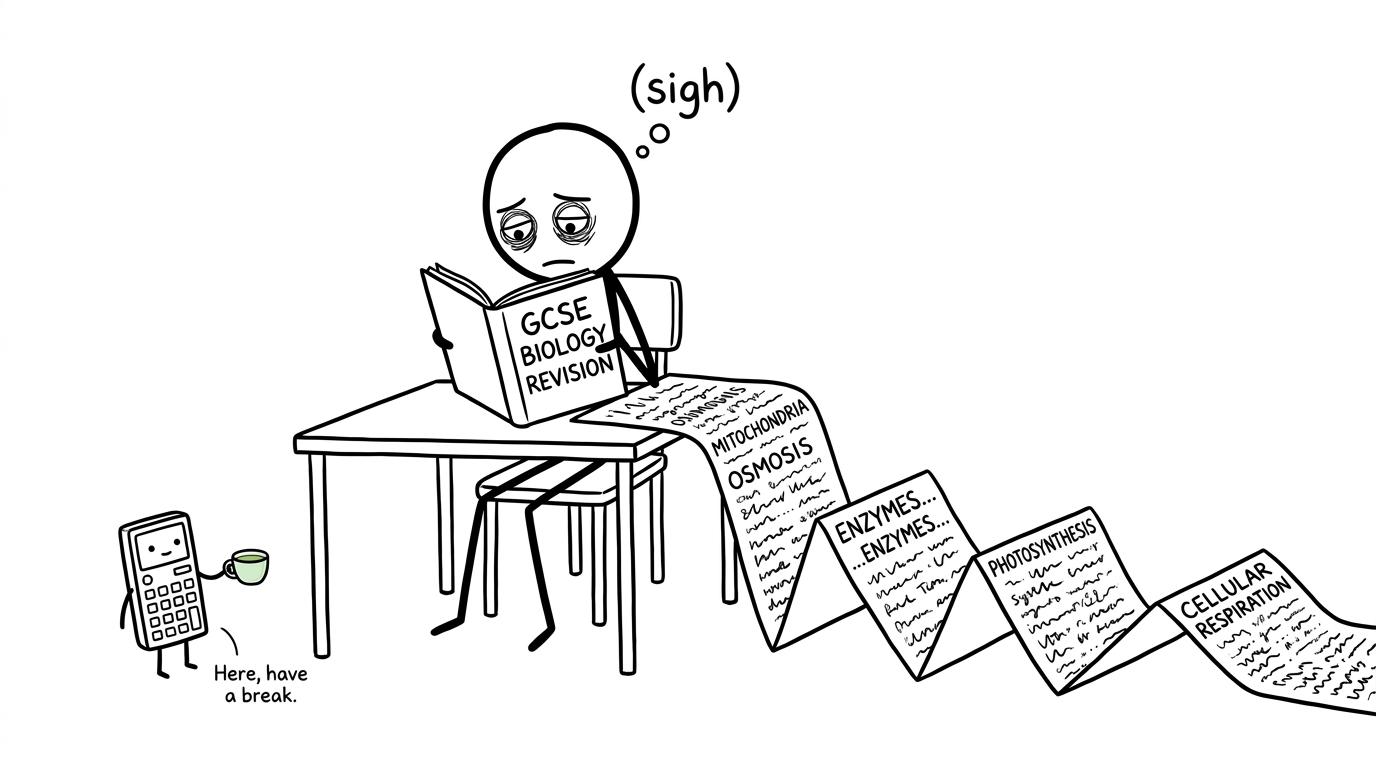 A Biology revision book produces an unexpectedly long trail of vocabulary
Where GCSE Biology tends to rank for stress
There is no official national league table ranking GCSE subjects by stress. Ofqual regulates qualifications and publishes assessment requirements, but it does not label one GCSE more stressful than another. Rankings found online normally come from student polls, commercial surveys or interpretations of examination results.
Those sources tell different stories.
A commercial UK student survey reported in 2025 placed Biology first among subjects causing exam anxiety, with more than two in five respondents identifying it as their most stressful subject. Chemistry and Maths followed in that particular survey. However, a separate self-selected poll collected over an earlier two-year period placed Biology tenth among the hardest GCSEs, with Chemistry receiving considerably more votes.
Meanwhile, the Royal Society’s Science Education Tracker 2023 found that Biology was the most enjoyed science among students in Years 10 to 13. It ranked third for enjoyment across eleven subjects, ahead of Chemistry and Physics.
Taken together, these findings suggest something more useful than a simple ranking: students frequently notice Biology’s workload, but many also find its content interesting and more accessible than the other separate sciences. Enjoyment and stress can exist together.
| Comparison | What students commonly experience |
|---|---|
| Biology versus Chemistry | Biology often involves more descriptive content; Chemistry may feel more abstract and calculation-heavy. |
| Biology versus Physics | Biology usually contains less demanding maths; Physics can create more pressure through equations and multi-step calculations. |
| Biology versus Maths | Biology rewards accurate scientific recall as well as application; Maths relies more heavily on selecting and executing methods. |
| Biology versus English | Biology answers are often more tightly defined; English can feel stressful because extended responses allow more interpretation. |
| Biology versus History or Geography | All can be content-heavy, but Biology also combines factual recall with practical and numerical analysis. |
These are patterns, not rules. A student who enjoys calculations may find Physics calmer than Biology. Someone with strong factual recall may experience the reverse.
Why GCSE Biology can feel stressful
The course contains many connected details
Biology is not just a list of definitions. Students need to understand systems, processes and relationships: how enzymes respond to conditions, how substances move across membranes, how hormones coordinate the body and how organisms interact within ecosystems.
Knowing each fact separately is not always enough. Examination questions can combine ideas or place familiar knowledge in an unfamiliar context. This is why rereading notes may create confidence without producing reliable marks.
The wording must be scientifically precise
Everyday language can be close to the correct answer without being precise enough for the mark scheme. “The cell takes in water” may not communicate the same detail as an explanation involving movement through a partially permeable membrane and a concentration gradient.
That precision creates pressure because students can understand the broad idea yet still lose marks. Regular exam-question practice helps reveal which key terms are essential.
Practical work still matters in written exams
Separate GCSE Biology specifications must include at least eight specified practical activities. Practical competence is not simply forgotten once the experiment ends: written examinations assess methods, variables, measurements, conclusions and evaluation.
Across the qualification, at least 15%15\%15% of marks must assess knowledge and understanding related to practical work. That is why revising only the result of an experiment is not enough. You should also know why each step was taken, what was measured and how the method could be improved.
Biology includes more maths than some students expect
Official rules require at least 10%10\%10% of marks in separate GCSE Biology to assess mathematical skills. The exact questions vary across Edexcel, AQA, OCR and Eduqas specifications, but common skills include:
- ratios, fractions and percentages;
- calculating means;
- using standard form;
- substituting into equations;
- interpreting tables and graphs;
- calculating rates;
- working with area, volume and magnification;
- selecting appropriate significant figures.
A student may therefore understand the biological concept but lose marks through an incorrect scale, unit or calculation. Strengthening these topics through the free GCSE Maths revision hub can improve confidence in both subjects.
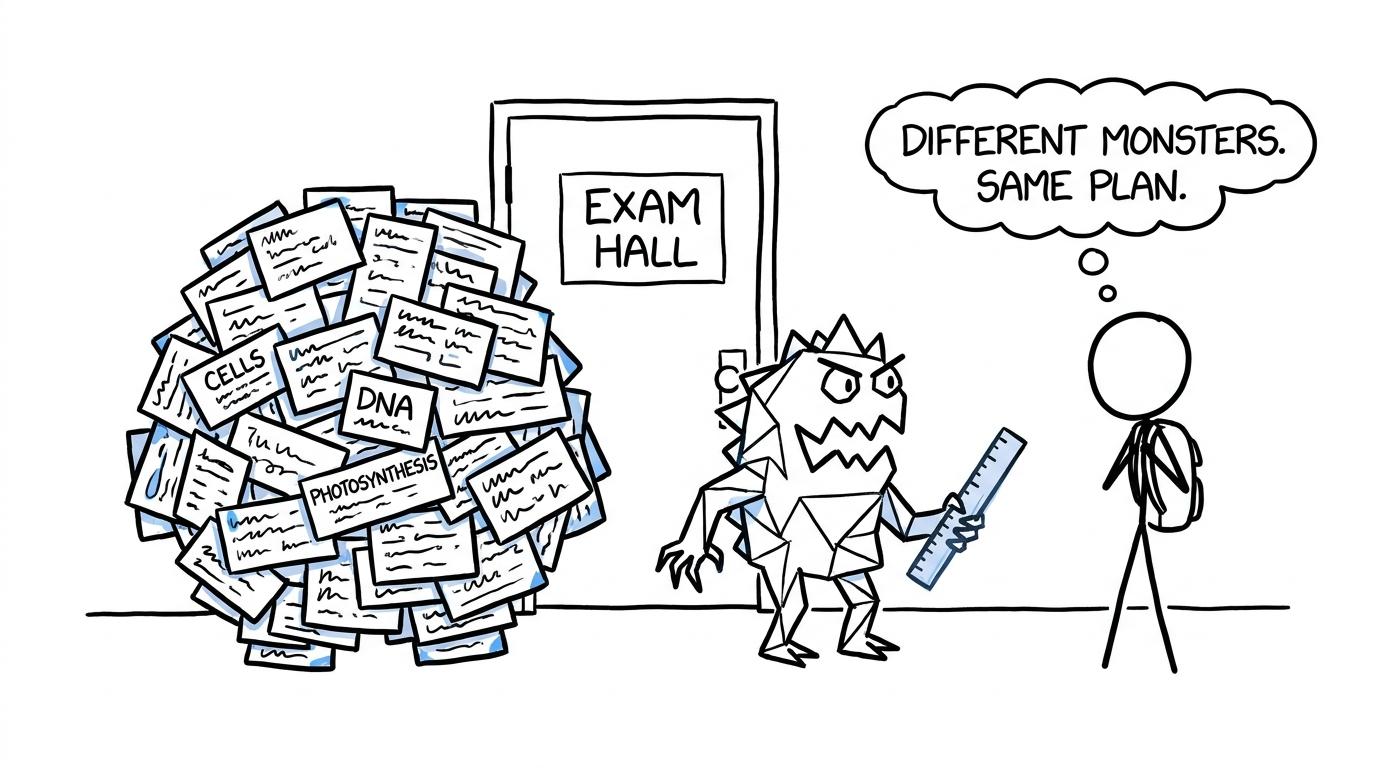 Biology and Maths appear as two very different revision monsters
Is Biology more stressful for separate or Combined Science students?
Students taking separate sciences receive an individual Biology grade and generally study more Biology content than students taking Combined Science. That additional depth can increase the revision load.
Combined Science, however, is not automatically less stressful. Students must manage Biology, Chemistry and Physics together, and their final outcome is reported as two GCSE grades. The pressure may come from switching rapidly between different scientific styles rather than from Biology alone.
Tier also matters. Foundation and higher papers target different ranges of demand. For separate sciences in England, foundation tier covers grades 1 to 5, while higher tier covers grades 4 to 9, with an allowed grade 3 in certain circumstances. Your school enters you for a tier, and entries for papers within the same qualification must be consistent.
Always revise from the specification and materials for your own exam board. Similar topics can be organised or assessed differently by Edexcel, AQA, OCR and Eduqas.
How maths students can reduce Biology stress
The best response to a content-heavy subject is not necessarily more revision time. It is a clearer feedback loop.
Separate knowledge gaps from exam mistakes
When marking a Biology question, classify the problem:
- Knowledge: you did not know the relevant fact or process.
- Application: you knew it but could not use it in the new context.
- Language: the answer lacked an essential scientific term.
- Practical: you confused variables, controls or evaluation.
- Maths: the calculation, graph, unit or rounding was incorrect.
This is the same diagnostic habit that improves GCSE Maths. The GCSE Maths revision timetable explains how to turn lost marks into specific revision priorities rather than revising everything again.
Use short, repeatable sessions
A manageable Biology session might include retrieval of one process, several focused questions and immediate marking. It should be small enough to repeat without needing a heroic burst of motivation.
MathsGenie’s 20-minute maths revision routine uses the same principle: choose one narrow skill, practise it, mark it and record the next step. This structure can be adapted to Biology without pretending the subjects are identical.
Protect your maths revision time
Biology stress sometimes expands to fill every available evening. Students reread chapters because the task has no natural finishing point, leaving less time for subjects where active practice is essential.
Give each session a defined outcome. Then keep your wider timetable balanced. If exams are approaching, a one-month GCSE maths revision plan or focused one-week maths revision plan can prevent one anxious subject from consuming the entire schedule.
Practise the shared numerical skills
Graphs, percentages, ratios, standard form and significant figures transfer between Biology and Maths. Revising them once, carefully, can strengthen both subjects.
Do not merely recognise a method when watching a solution. Attempt questions independently, check the mark scheme and revisit errors later. The guidance on stopping forgotten GCSE Maths content shows how retrieval and spaced practice make knowledge more dependable.
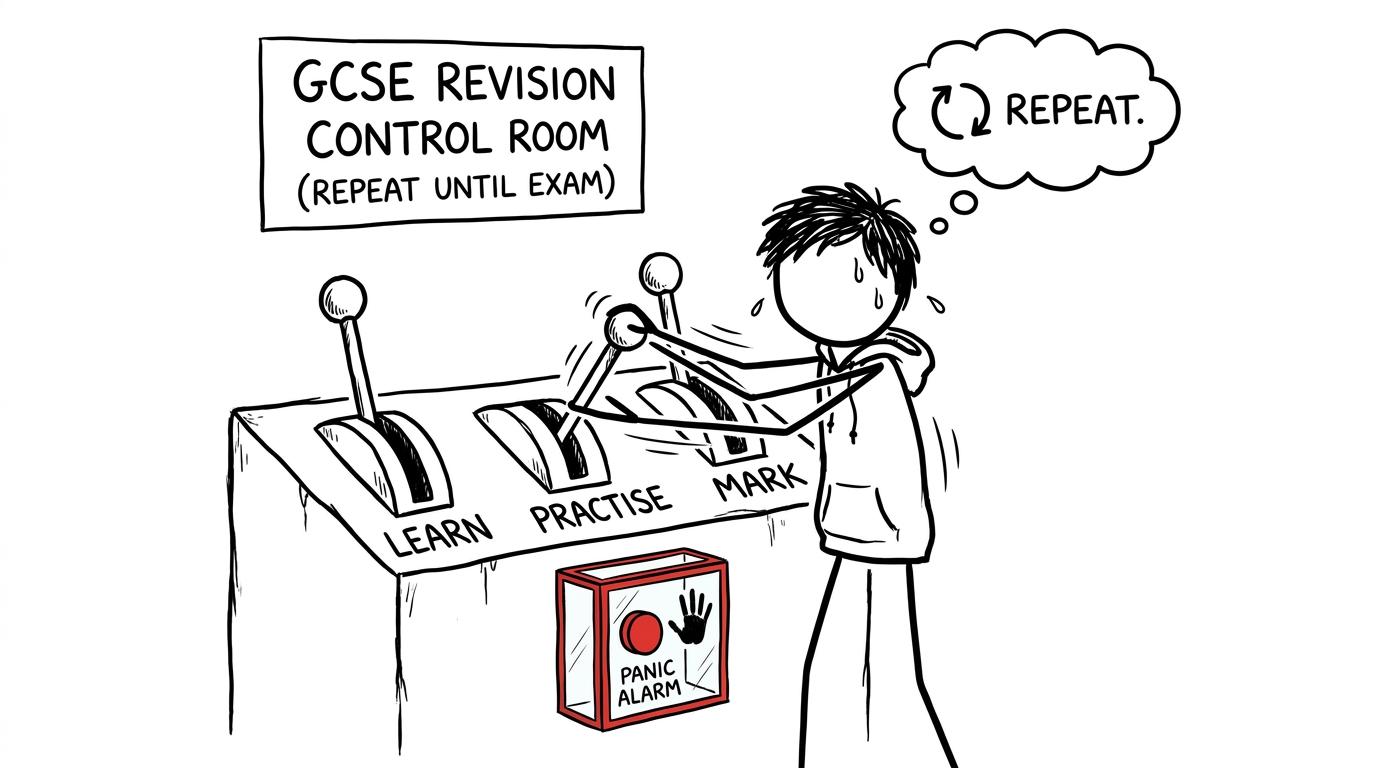 A calm revision control room uses learn, practise and mark levers
Common mistakes that make Biology feel harder
Treating stress rankings as predictions
A survey cannot tell you which subject you will find hardest. Use rankings as evidence of common concerns, not as a forecast of your grade.
Revising by reading alone
Reading feels smooth because the information is visible. Exams require retrieval. Close the book, write what you remember and then answer questions.
Memorising without understanding connections
Isolated facts are fragile. Link each biological structure to its function, each process to its stages and each practical method to its purpose.
Ignoring calculations until the end
Numerical questions are part of Biology, not an optional extra. Delaying them preserves anxiety. Regular short practice is more effective than a final calculation marathon.
Completing papers without analysing errors
A total mark tells you how the paper went. It does not tell you what to do tomorrow. Mark carefully, identify the cause of each lost mark and retest the weakest area.
Letting panic dictate the night before
Last-minute overwork can crowd out sleep and make recall less reliable. Use a limited checklist, prepare your equipment and stop at a sensible time. MathsGenie’s night-before GCSE Maths plan provides a calm structure for final preparation.
The calmer conclusion
How stressful GCSE Biology feels depends less on its position in an online ranking than on the fit between the course and your current skills. Student reports are mixed: Biology can rank very highly for anxiety, yet it is also widely enjoyed and is not consistently identified as the hardest GCSE.
Its pressure usually comes from three places: content volume, precise application and the combination of practical work with data and calculations. Once you identify which of those is affecting you, the subject becomes less mysterious.
Keep your overall revision balanced. Start with the free MathsGenie GCSE Maths resources, use revision lessons to rebuild weak methods, complete practice questions and mini tests, then move towards past papers and predicted papers. Mark everything with the mark schemes and use video solutions when a method still feels unclear.
Stress grows when the next step is vague. A clear plan makes it smaller.










