GCSE: Stop Forgetting Edexcel Maths Content
GCSE revision for Edexcel students: stop forgetting maths with spaced practice, worked examples, mini tests and past papers on YesGenie.
If you’re revising for GCSE Maths and it feels like the content leaks out of your head overnight, you’re not broken; you’re human. One day you can solve simultaneous equations calmly, and the next day the method feels like it belongs to someone else. This is especially common for Edexcel students because the course is wide, the papers are long, and the same skill can appear in three different disguises.
The good news is that forgetting isn’t the enemy of GCSE revision. It’s a signal. It tells you what needs spacing, what needs retrieval, and what needs exam-style practice. This post shows you how to stop forgetting GCSE Maths content by building a simple, repeatable routine using YesGenie’s free revision lessons, flashcards, mini tests, topic questions, mark schemes, and Edexcel past papers.
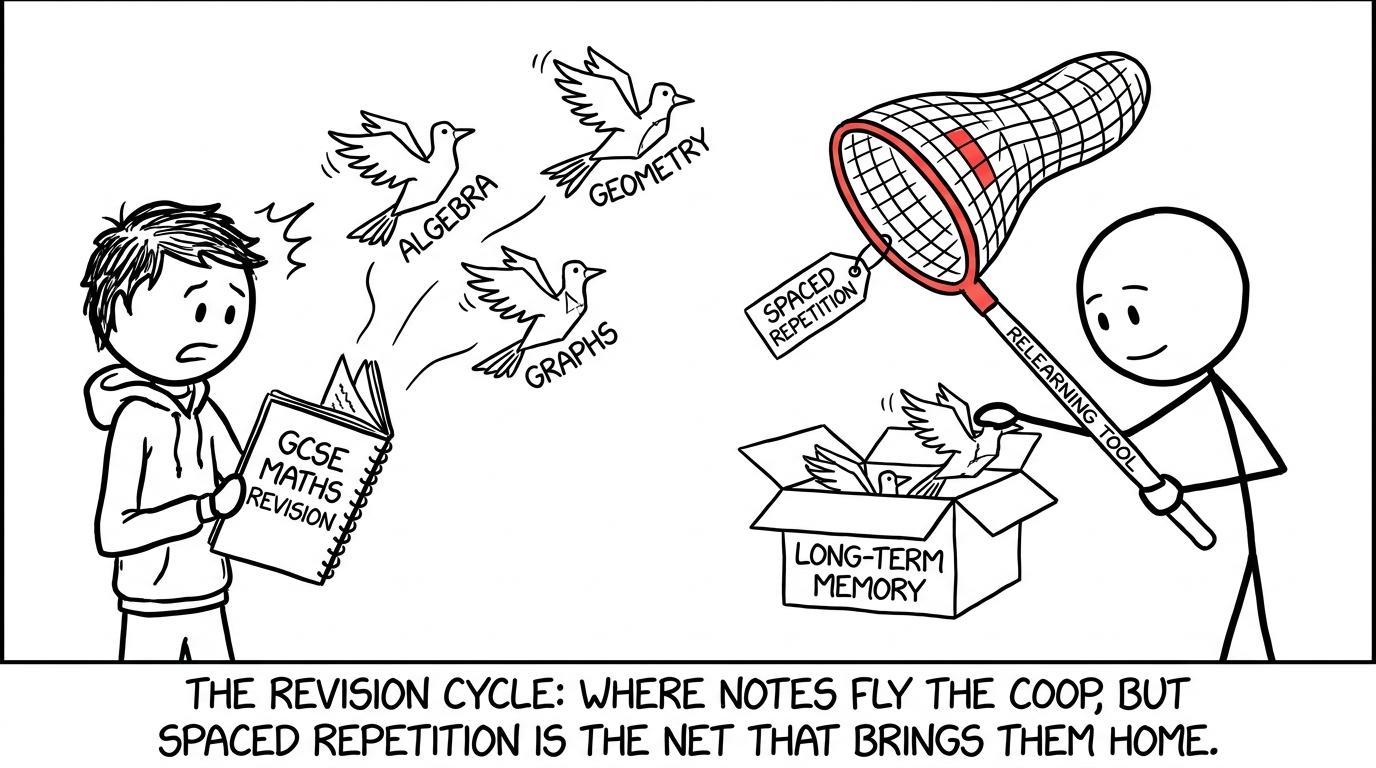 A student catching flying revision topics with a spaced repetition net
The anti-forgetting checklist (what actually works)
Use this as your GCSE memory plan for Edexcel Maths:
- Learn a method once (short lesson + a couple of examples).
- Retrieve it the next day without notes (flashcards or a mini test).
- Space it: come back after 3 days, then 7, then 14.
- Mix topics (algebra + ratio + graphs), because Edexcel papers mix them.
- Use mark schemes to fix your “nearly-right” habits.
- Convert topics into papers early (45-minute tests, then full past papers).
Useful starting points on YesGenie:
- Edexcel GCSE Maths Revision Hub
- Edexcel GCSE Maths Revision Guides
- Edexcel GCSE Maths Past Papers
- Edexcel GCSE Maths Predicted Papers
- Resources: Mini Tests and 45-minute papers
Why you forget GCSE Maths (and why it’s not a problem)
Most Edexcel GCSE forgetting happens for three quiet reasons.
First, you revise by recognising, not retrieving. Reading notes feels smooth because the page is doing the thinking for you. But Edexcel questions don’t ask, “Do you recognise this?” They ask, “Can you produce a method under time pressure?”
Second, you practise one topic in a big block. You might do 30 ratio questions on Monday, get confident, then never touch ratio again until April. The confidence was real, but it was context-dependent. Memory likes returns.
Third, you learn a method without the “why”. When you forget one step, the whole method collapses. For GCSE Maths, you don’t need a university explanation, but you do need a small anchor idea for each topic.
YesGenie’s structure helps because it nudges you into the behaviours that beat forgetting: short lessons, active-recall flashcards, mini tests, and exam questions with video solutions.
Build a GCSE revision loop for Edexcel (in 25 minutes)
This loop is designed for the evenings when you don’t have energy, but you still want the work to stick.
Learn (8 minutes)
Pick one small skill from the Edexcel list, not a whole unit. Use a revision guide page, then do a couple of straightforward questions. For example, if you keep forgetting ratio setups, start with a focused explanation.
A useful general ratio page (even if you’re Edexcel) is:
The point is not the exam board label. The point is the method.
Retrieve (8 minutes)
Close everything. On paper, write the method from memory, then answer one exam-style question. If you can’t start, that’s not failure: it’s the exact moment revision becomes effective.
Mark (4 minutes)
Use a worked solution or mark scheme. Ask: “Which line would Edexcel award marks for?” If your working is messy, you may know the maths but still leak marks.
Example of a worked solution page you can use to see what good exam working looks like:
Space (5 minutes)
Put that topic into your next-day list and your next-week list. If you’re using the YesGenie revision planner, this becomes almost automatic: plan, revisit, and track.
Worked example: the kind of forgetting Edexcel loves to punish
Edexcel GCSE questions often reward students who can keep a method stable when the numbers change slightly. Here’s a classic example where forgetting one principle costs a lot of marks.
Solving a linear equation with fractions
Solve:
3x−14=x+52 \frac{3x-1}{4}=\frac{x+5}{2} 43x−1=2x+5Step 1: Clear the denominators by multiplying both sides by 444 (the LCM of 444 and 222).
4×3x−14=4×x+52 4\times \frac{3x-1}{4}=4\times \frac{x+5}{2} 4×43x−1=4×2x+5So:
3x−1=2(x+5) 3x-1=2(x+5) 3x−1=2(x+5)Step 2: Expand.
3x−1=2x+10 3x-1=2x+10 3x−1=2x+10Step 3: Collect like terms.
3x−2x=10+1 3x-2x=10+1 3x−2x=10+1 x=11 x=11 x=11Why this stops forgetting: the anchor idea is “fractions become easier when you remove denominators first”. When you remember the anchor, the steps follow.
To keep this stable, practise the same idea in different clothing using the Edexcel topic list:
Worked example: Edexcel ratio under pressure (the setup matters)
Sharing an amount in a ratio
Sam and Tia share £45 in the ratio 3:23:23:2. How much does Sam get?
Step 1: Find total parts.
3+2=5 3+2=5 3+2=5Step 2: Sam’s fraction of the total is 35\frac{3}{5}53.
Step 3: Multiply.
35×45=27 \frac{3}{5}\times 45=27 53×45=27So Sam gets £27.
Memory anchor: “parts add first”. If you skip that, everything else becomes guesswork.
For ratio practice in exam style, YesGenie’s topic resources on the Edexcel hub make it easy to do a small set, mark, then return later:
Turn topics into papers sooner (because GCSE memory is context-based)
A strange truth about GCSE Maths is that you can “know” a topic and still not recognise it when it’s blended with others. Edexcel is particularly good at mixing topics: a geometry question that needs algebra, or a graphs question that needs rearranging.
So don’t wait until you’ve “finished the course” to do papers. Use smaller paper formats first:
- Use Resources: Mini Tests and 45-minute papers to build stamina.
- Then move to Edexcel GCSE Maths Past Papers so you learn the rhythm of Paper 1 (non-calculator) versus Papers 2 and 3 (calculator).
- Closer to exams, use Edexcel GCSE Maths Predicted Papers to rehearse unfamiliar combinations and timing.
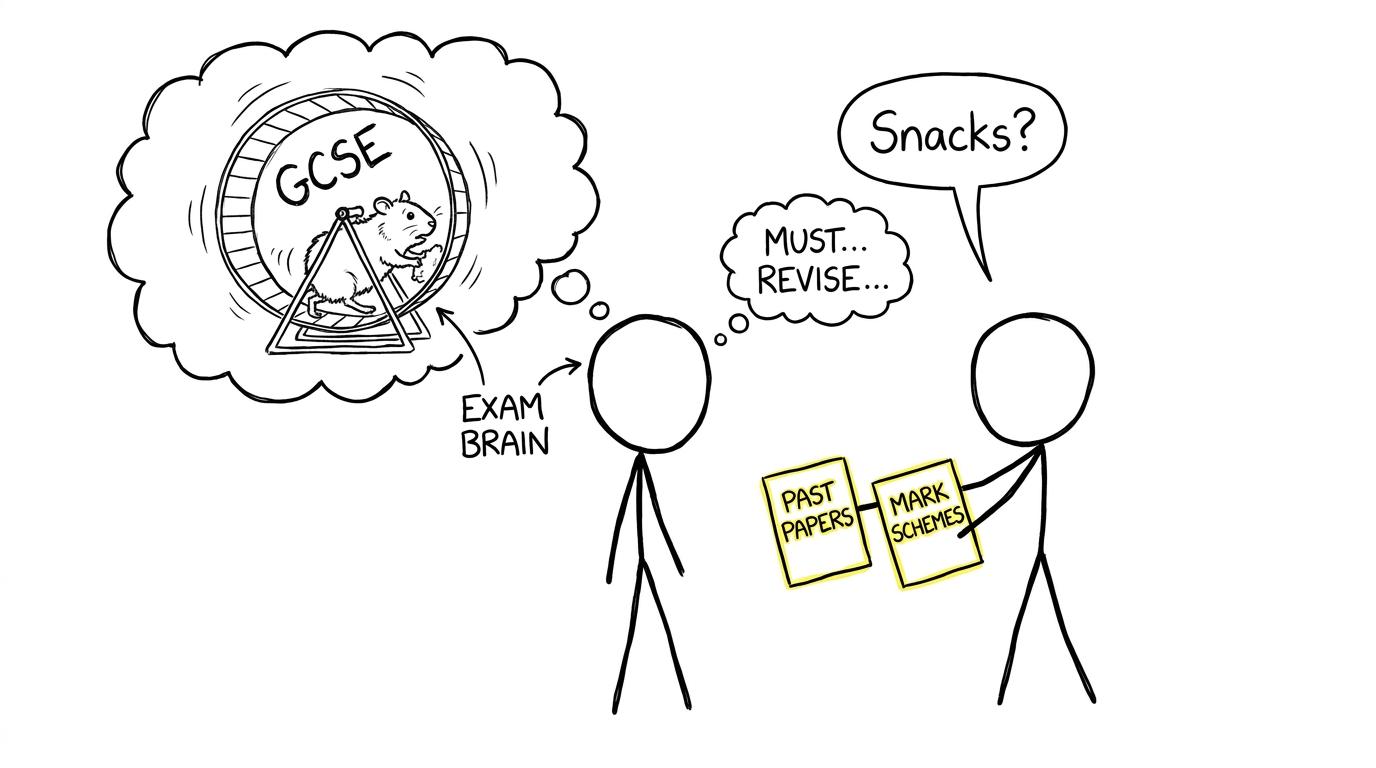 Exam brain hamster being fuelled by past papers and mark schemes
Common mistakes that cause GCSE forgetting (and how to fix them)
Re-reading instead of retrieving
If your revision is mostly reading, you will keep forgetting GCSE methods. Switch one session per day into “blank page” work: write the steps, then check.
Doing only “nice” questions
Students avoid messy questions because they feel slow. But messy questions are where Edexcel hides marks. Use topic booklets and exam questions, not just textbook-style drills.
Ignoring mark scheme language
Edexcel mark schemes reward specific lines of reasoning. For example, in algebra, a correct final answer with no working may lose method marks. Use worked solutions to learn what counts as a mark.
Not revisiting after getting it right
The fastest way to forget GCSE content is to stop revising a topic the moment it feels easy. “Easy today” is not “available in three weeks”. Schedule returns.
Mixing up calculator habits
On calculator papers, mistakes often come from rounding too early, or entering brackets incorrectly. Even a simple skill like calculator use needs deliberate practice:
A simple Edexcel GCSE spacing plan (Foundation and Higher)
If you’re Foundation tier
Your memory wins come from accuracy and confidence on core skills: fractions, ratio, percentages, linear graphs, area/volume, averages, probability. Use short daily retrieval, and do lots of medium-difficulty exam questions.
If you’re Higher tier
You still need the foundation skills, but forgetting often happens on “linking topics” such as algebraic manipulation inside geometry, or functions and graphs, or multi-step proportion. Your spacing plan should deliberately revisit the hardest 10 topics every week.
Either way, anchor your work to the Edexcel structure:
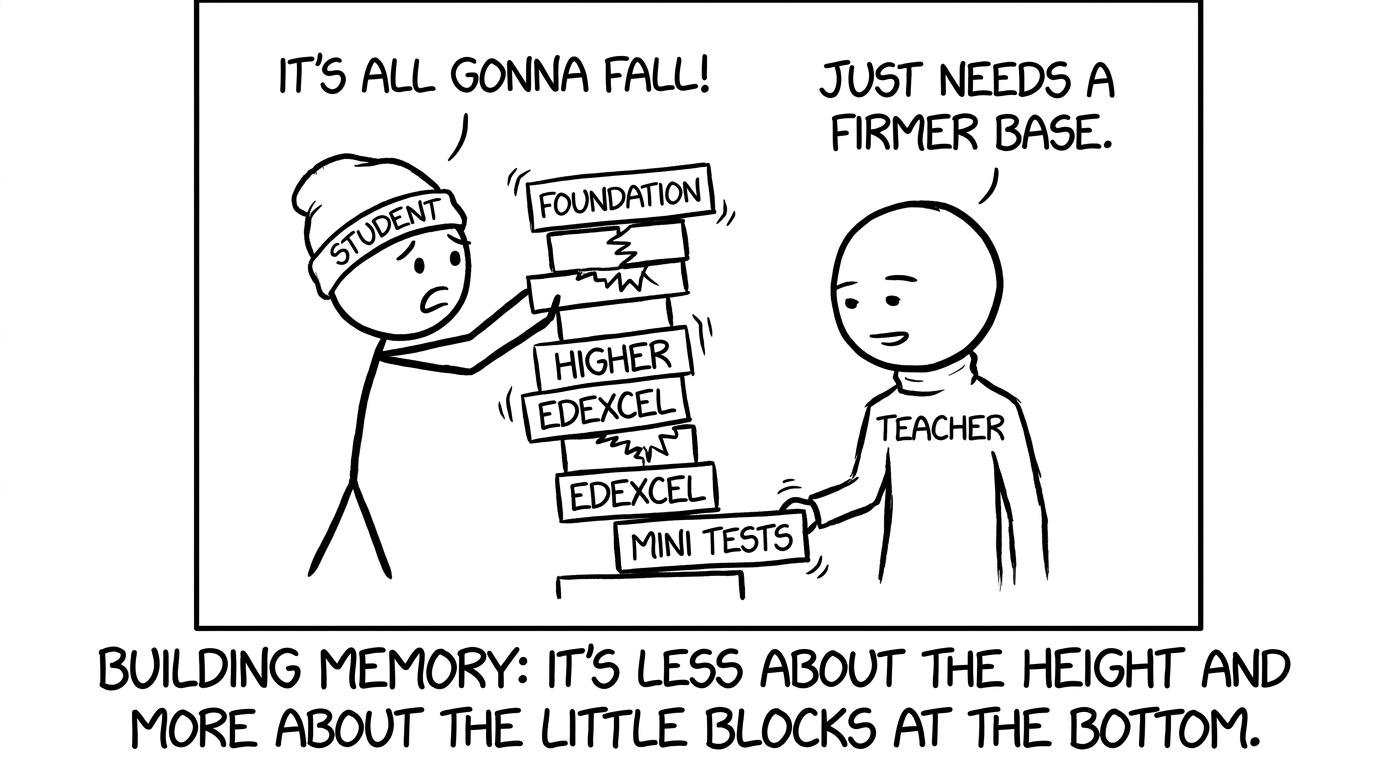 Flashcards as a wobbling Jenga tower stabilised by mini tests
Closing: stop forgetting GCSE Maths by revising like the exam
Edexcel GCSE Maths doesn’t reward the student who once understood a topic in November. It rewards the student who can retrieve it in May, under time pressure, with unfamiliar wording, and still show the working that earns method marks.
So make your revision reflect that reality: spaced returns, active recall, mixed practice, and frequent papers. Start on Edexcel GCSE Maths Revision Hub, build your topic confidence with Edexcel GCSE Maths Revision Guides, then prove it with Edexcel GCSE Maths Past Papers and Edexcel GCSE Maths Predicted Papers. Use mark schemes and video solutions to learn how the marks are actually awarded.
If you want one promise to hold onto: you don’t need a perfect memory for GCSE Maths. You need a system that keeps bringing the maths back, until it stops feeling like revision and starts feeling like yours.