

Have I Revised Enough for GCSE German? A Real Test
Have I revised enough GCSE German? Use timed tasks, vocabulary recall, speaking checks and an error log to judge readiness calmly and realistically today.
The difficult thing about revision is that anxiety has no finish line. You can know hundreds of German words, complete several papers and still wonder whether everyone else has done more. If you are searching “have i revised enough gcse german”, the useful answer is this: you have revised enough when evidence shows that you can retrieve the language, apply it across all four skills and perform consistently under realistic conditions.
Hours alone cannot tell you that. Neither can the thickness of your notes. Readiness is better measured through timed tasks, honest marking, repeated testing and a shrinking list of weaknesses.
This is the same evidence-led approach that makes GCSE maths revision effective. The subject changes, but the principle survives: test, mark, repair and retest.
The quick GCSE German readiness checklist
You are approaching exam readiness when you can:
- identify your exam board, tier and exact assessment format;
- recall core vocabulary without seeing the English first;
- understand the main message and important details in unfamiliar listening and reading extracts;
- speak without relying on a fully memorised script;
- write accurately across more than one time frame;
- complete each type of task within the available time;
- recognise your recurring errors and explain how you are fixing them;
- produce similar results on different days, not just once.
You do not need to feel completely confident before every item is true. Confidence often arrives after performance improves, not before it.
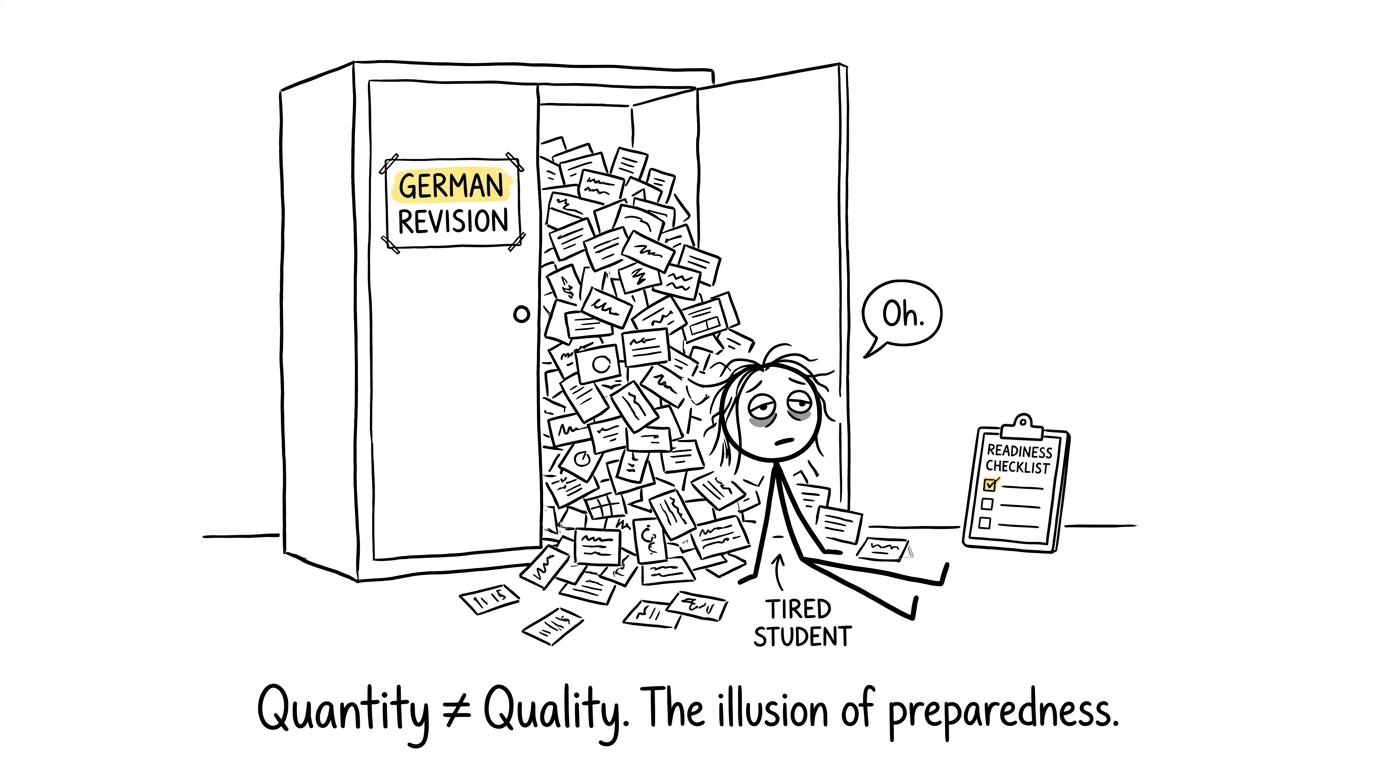 A student discovers that a mountain of German flashcards is not the same as a readiness checklist
Start with the exam you will actually sit
Before judging whether you have revised enough, check your current specification and ask your teacher to confirm your tier. Do not rely on an old revision video or a sibling’s description of the course.
For examinations from summer 2026, the current AQA GCSE German specification is 8662 and the current Pearson Edexcel qualification is 1GN1. Both assess listening, speaking, reading and writing, with each component worth 25%25\%25% of the qualification. Their current assessments also include features such as dictation and reading aloud. Exact task lengths, preparation arrangements and mark totals differ, so your own exam board’s specification and sample assessment materials must be your reference point.
That detail matters. A student can spend weeks learning vocabulary yet remain underprepared for reading aloud, dictation or an unprepared speaking exchange. Revision is only complete when it covers the form of the assessment as well as its content.
Create a one-page assessment map containing:
- every component you will take;
- the task types within each component;
- the time allowed;
- your tier;
- the resources you can use in preparation;
- the areas your teacher says need attention.
This is your boundary. Without it, “enough” remains an emotion. With it, “enough” becomes something you can inspect.
Measure coverage, retrieval and performance separately
Students often combine three different questions into one. Separating them makes the answer clearer.
Have you covered the required content?
Coverage means you have revised the themes, prescribed vocabulary, grammar and sound-symbol relationships required by your specification. Use your exam board checklist rather than a generic online vocabulary collection.
Mark each area as secure, developing or not yet covered. Be specific. “School” is too broad; “giving and justifying opinions about school rules” is useful. “Grammar” is too broad; “forming the perfect tense with common verbs” gives you an action.
Coverage is necessary, but it is the weakest form of evidence. Seeing a topic before does not mean you can use it in an exam.
Can you retrieve it without support?
Close the book. Hide the answer. Remove the word bank. Then test whether the language comes back.
Useful retrieval checks include:
- translating a mixed selection of words in both directions;
- producing verbs or opinion phrases from prompts;
- writing a short response without opening your notes;
- answering speaking questions in an unpredictable order;
- listening once before checking a transcript;
- returning to the same material several days later.
Recognition can create false confidence. A German word may look familiar on a flashcard while remaining unavailable in conversation. Retrieval exposes that difference.
MathsGenie uses the same logic in its guide to finding your weakest GCSE topics: gather evidence first, label the weakness precisely and retest it after targeted practice.
Can you perform under exam conditions?
The final test is transfer. Can you use what you know when the question is unfamiliar, the clock is moving and your notes are elsewhere?
Complete a representative task from each skill under the correct conditions. Use current sample materials or papers appropriate to your specification. Mark written work against the official criteria where possible, but ask your teacher to assess speaking and extended writing because self-marking cannot reliably capture every judgement.
One good result is encouraging. Repeated results are evidence. Look for stability across different tasks and different days.
Use an evidence dashboard instead of counting hours
Revision time matters, but an hour can contain focused retrieval or forty minutes of rearranging coloured pens. Record outcomes rather than simply recording attendance.
Your dashboard can contain five lines:
- Coverage: areas still untouched or uncertain;
- Recall: vocabulary and grammar retrieved accurately after a delay;
- Listening and reading: task performance plus the reason for each error;
- Speaking and writing: teacher feedback and repeated language errors;
- Timing: tasks completed calmly within the allowed time.
After each test, classify the problem. Was it missing vocabulary, misunderstood grammar, weak pronunciation, incomplete detail, poor time management or a misread instruction? This is far more useful than writing “German went badly”.
The process mirrors using GCSE past papers properly. A paper is mainly a diagnostic until its mistakes have been repaired. The learning happens when you understand the error and prove that it does not return.
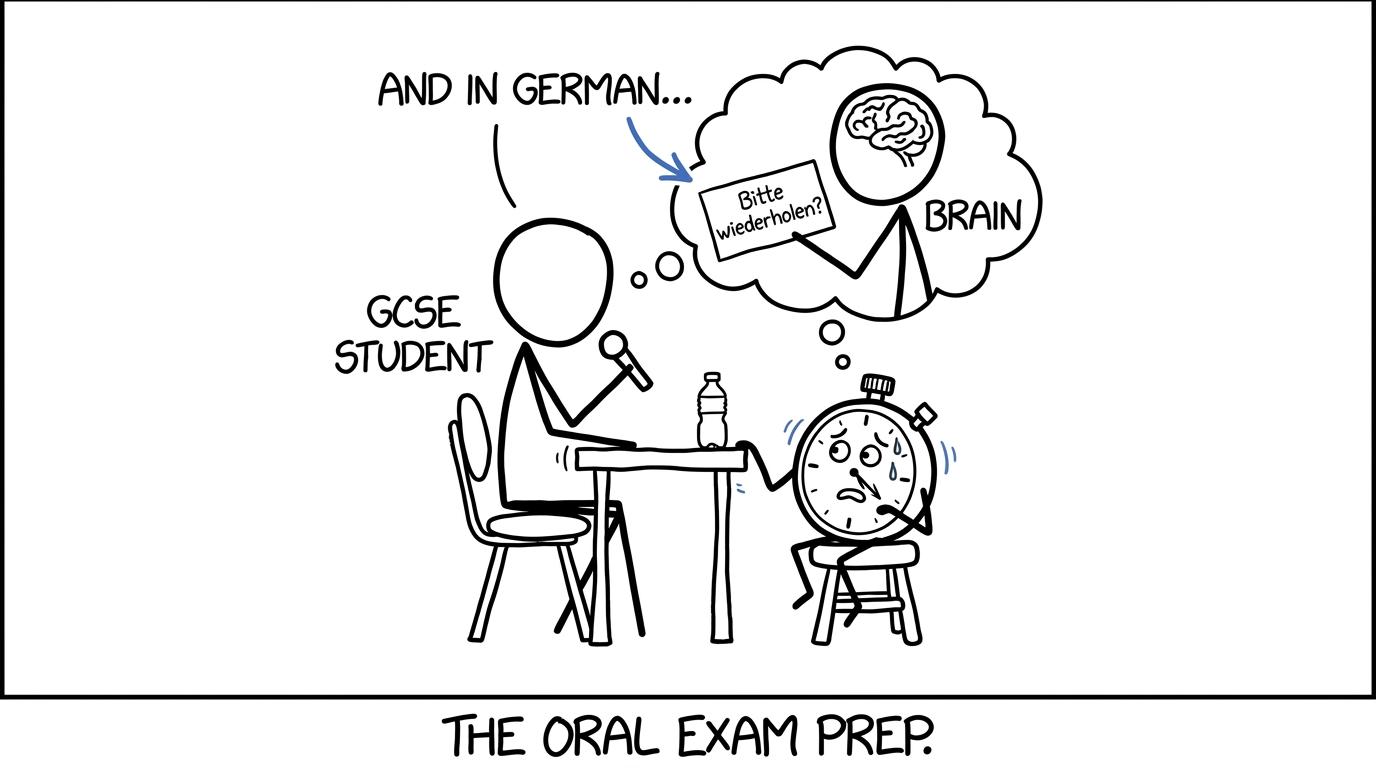 A student interviews their own brain during a miniature German speaking test
Test all four GCSE German skills honestly
Listening
Listening readiness is not measured by understanding a familiar classroom recording after hearing it repeatedly. Use unfamiliar material at the appropriate level and follow the playback conditions for your exam board.
Check whether you can identify the overall message, distinguish important details and recover when one phrase is unclear. For dictation, track whether mistakes come from vocabulary, spelling or confusion between similar sounds.
Speaking
A memorised answer may sound impressive until the wording of the question changes. Ask a teacher, classmate or family member to select questions unpredictably. Practise responding, extending an answer and asking for repetition appropriately.
Record yourself occasionally. Listen for clarity, hesitation, verb forms and whether your answer actually addresses the question. You are not aiming to sound like a native speaker. You are aiming to communicate clearly and meet the assessment criteria.
Reading
Reading practice should include unfamiliar texts, not only passages you have annotated before. Separate vocabulary gaps from interpretation errors. Sometimes the unknown word is not the problem; the problem is overlooking a negative, time marker or contrasting opinion.
Practise extracting meaning without translating every word. Then check shorter details carefully where the question demands precision.
Writing
Writing readiness means being able to generate and organise language without reproducing one memorised paragraph. Check your exam board’s current tasks and marking criteria, then practise relevant lengths and formats.
Review whether you answer every part of the task, communicate clearly, use accurate core grammar and show an appropriate range of language. Build a personal correction list containing errors you genuinely make rather than an enormous generic grammar checklist.
Decide what “enough” means for your target
Enough revision does not mean perfection. It means that your remaining weaknesses are understood, prioritised and unlikely to overwhelm the whole assessment.
A practical readiness rule is to look for three things:
- Breadth: no major component or specification area has been ignored;
- Consistency: performance remains reasonably stable across several attempts;
- Recovery: when you make an error, you can identify it and correct the underlying weakness.
Your target grade also matters. Someone trying to secure core communication at foundation tier has a different priority from a higher-tier student pursuing the top grades. Ask your teacher how your recent work compares with the relevant criteria. Do not convert one practice mark into a guaranteed grade because grade boundaries can vary between exam series.
When German shares revision time with maths, science and other subjects, use a realistic plan rather than allowing the most worrying subject to consume every evening. MathsGenie’s GCSE maths revision timetable and one-month revision plan show how to balance diagnosis, targeted practice and timed assessment. The same planning rhythm can organise German, even though the learning materials themselves must match your German specification.
Common mistakes when judging GCSE German readiness
Counting hours instead of testing ability
Long revision sessions can feel virtuous while producing little evidence. Replace some note-making with closed-book recall and unseen tasks.
Revising only the skill you enjoy
Students who like writing may avoid listening; confident readers may postpone speaking. Because listening, speaking, reading and writing are separately assessed, the neglected skill remains a real gap.
Treating vocabulary recognition as mastery
If you always see German and recall the English, you may be unable to produce the German when writing or speaking. Test both directions and revisit words after a delay.
Memorising answers too rigidly
Prepared language is useful, but inflexible scripts can collapse when a question changes. Practise adapting familiar vocabulary to different prompts.
Completing tasks without repairing mistakes
A pile of finished papers is not proof of improvement. Mark, diagnose, practise the exact weakness and retest it. The MathsGenie one-week revision plan demonstrates how short repair cycles can turn feedback into action.
Continuing until exhaustion
More revision is not automatically better revision. Near the exam, a short recall check and proper sleep are usually more sensible than beginning several new topics. The principles in the GCSE night-before plan transfer well: fix a few recurring errors, prepare what you need and stop at a planned time.
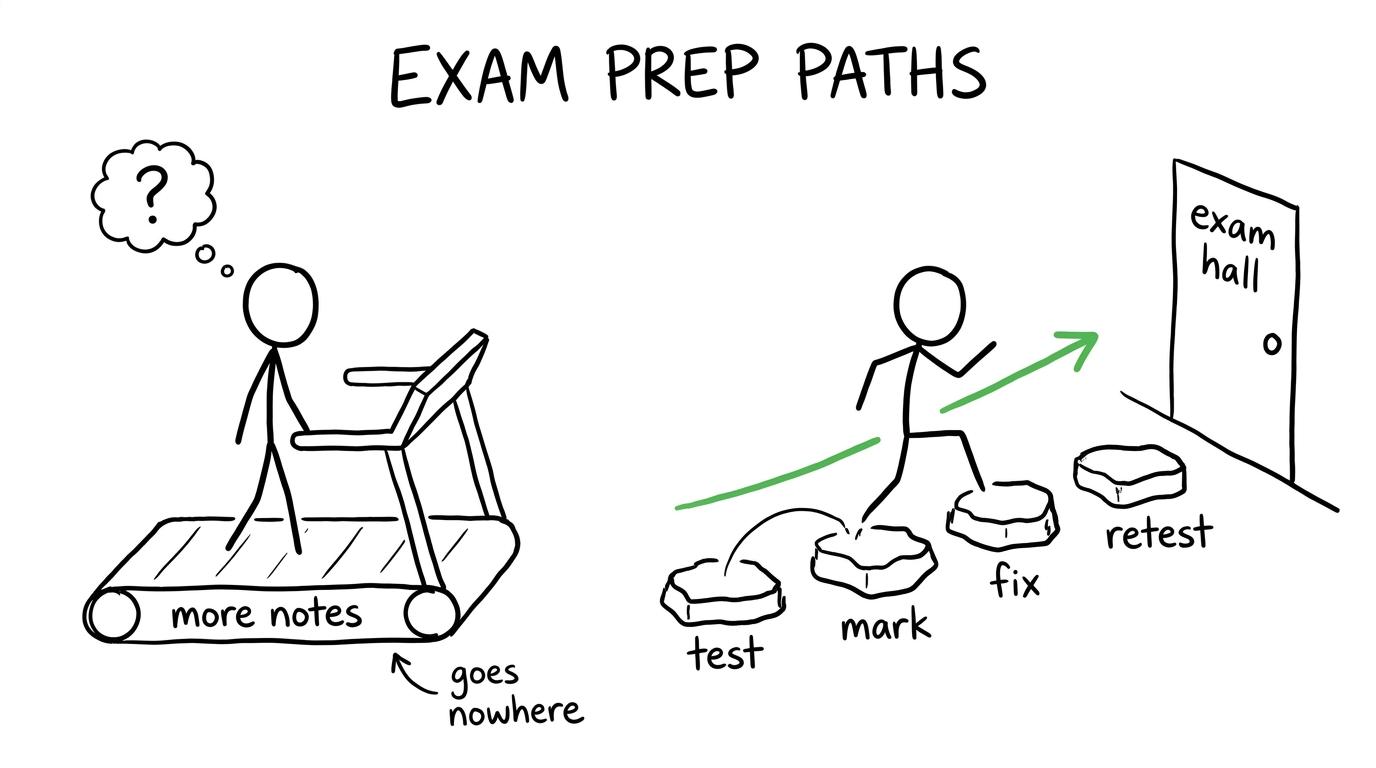 A student escapes a revision treadmill by choosing test, mark, fix and retest stepping stones
A calm final decision
Ask yourself one final question: if the exam were tomorrow, which specific task would worry me most?
If you can name it, your next revision session has a purpose. If several major areas remain untouched, you need more coverage. If the content is familiar but disappears without notes, you need retrieval. If you know the language but run out of time, you need realistic timed practice.
You have revised enough when your evidence is consistent, your major gaps have been addressed and further work offers only small improvements rather than urgent repairs. Nervousness may remain. That does not cancel the evidence.
Apply the same honest standard across your GCSEs. For maths, start with the MathsGenie GCSE revision hub, then use free revision lessons, practice questions, mini tests, past papers, predicted papers, mark schemes and video solutions to test what you can actually do. If you take Edexcel, the Edexcel GCSE Maths past papers provide a clear place to begin.
Revision becomes calmer when it stops being a contest in hours and becomes a trail of evidence. Test. Mark. Fix. Retest. Then trust what the results are telling you.










