GCSE Resit Success Story: From Grade 3 to Grade 5
GCSE resit success story: follow an illustrative grade 3 to 5 journey, with practical routines for passing Maths and English Language at college.
A grade 333 can feel painfully close. It says that much of the knowledge is already there, yet one more result is needed before certain courses, apprenticeships or jobs become easier to access. For students returning to GCSE Maths and English Language at college, that small gap can carry a surprising amount of weight.
This GCSE resit success story follows an illustrative student called Sam, who moves from a grade 333 to a grade 555 in Maths while also passing English Language. Sam is not a real individual. The story is a composite, created to reflect common resit experiences without presenting an invented testimonial or guaranteed outcome.
The resit year at a glance
Sam's progress rests on a manageable cycle:
- accept the starting grade without treating it as a permanent label;
- identify specific weaknesses in Maths and English Language;
- attend college lessons consistently;
- complete short revision sessions between lessons;
- mark work and record recurring errors;
- practise under timed conditions;
- use teacher feedback to choose the next task;
- protect sleep and prepare calmly for each exam.
In England, students on relevant 161616 to 191919 study programmes who have not achieved grade 444 or above in GCSE Maths or English are generally expected to continue studying an appropriate qualification. Full-time students holding grade 333 are normally expected to study towards the relevant GCSE. Individual programmes and exam entries are managed by colleges, so students should confirm their route with their course team.
September: replacing embarrassment with evidence
A grade is compressed information. It reports an overall result, not every strength and weakness behind it. Sam can calculate percentages reliably but loses marks on algebra, ratio and multistep problems. In English Language, ideas are often sensible, yet answers need closer analysis, clearer paragraphing and better time control.
For Maths, Sam begins with the free GCSE Maths revision hub, selecting the correct exam board and working through topic questions. The first sessions are diagnostic rather than heroic. Some questions are completed comfortably. Others expose gaps that had been hidden by repeatedly revising familiar material.
For English Language, Sam follows the college specification and teacher guidance closely. Reading and writing tasks vary between Edexcel, AQA, OCR and Eduqas, so generic advice cannot replace knowing the correct paper structure, assessment objectives and timing.
October: making revision too small to avoid
Resit motivation is unreliable. After a full college day, a plan to revise for two hours can become a plan to start tomorrow. Sam responds by reducing the size of the first step.
On three weekdays, the target is only 202020 minutes of Maths. One session might contain a short revision lesson and several practice questions. Another might revisit errors from class. The 20-minute Maths revision routine provides a useful structure when time and energy are limited.
This is the point many students miss: consistency is not impressive when viewed on a single Tuesday. Its value becomes visible months later. A realistic GCSE Maths revision timetable helps Sam fit revision around vocational coursework, travel and part-time work rather than pretending those demands do not exist.
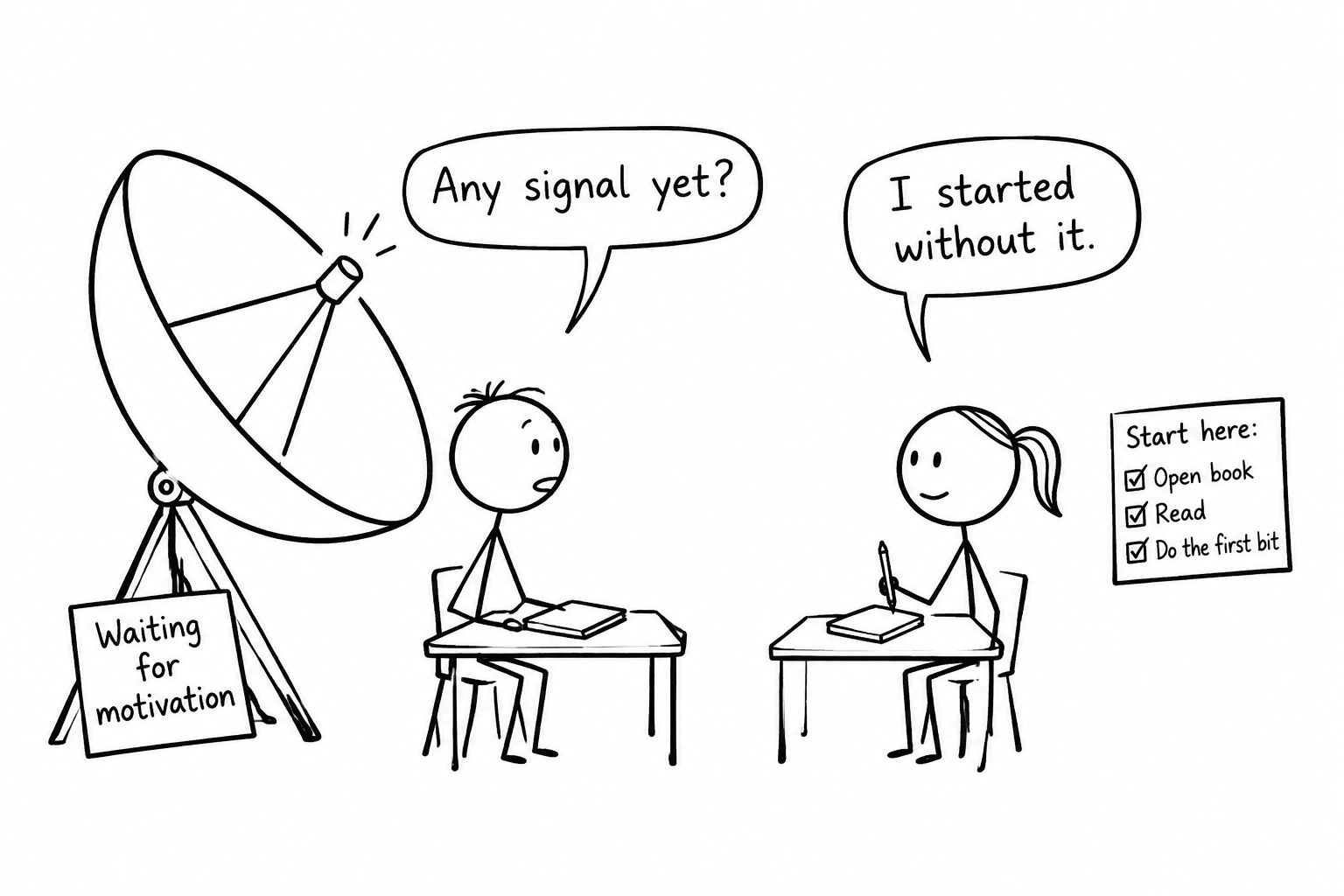 XKCD-style comic showing one student waiting for motivation while another begins with a tiny checklist
November: treating mistakes as instructions
Sam's early Maths work contains familiar errors: a negative sign disappears, a formula is recalled incorrectly, and a calculator answer is copied without checking whether it is sensible. At first, marking feels like judgement. Gradually, it becomes navigation.
A simple error log records four things:
- the topic;
- what went wrong;
- the correct method;
- one action before the next attempt.
For example, “ratio” is too broad to guide revision. “I added the parts correctly but divided by the wrong total” is useful. It points directly towards the next practice set.
MathsGenie's revision lessons, practice questions, mark schemes and video solutions make this feedback cycle easier. Sam attempts questions before watching a solution, marks the answers honestly and then retries similar questions without support. The purpose is not to recognise a method on screen. It is to reproduce that method independently.
English errors are logged differently. Sam records whether marks were lost through weak evidence, limited explanation, unclear organisation, inaccurate sentences or unfinished responses. Teacher feedback is essential because extended writing cannot be improved through an answer sheet alone.
Winter: surviving the dip in resit motivation
The middle of a resit year can be harder than the beginning. The disappointment of results day is less immediate, but the final exams still feel distant. Progress is happening quietly and can be difficult to notice.
The GCSE revision with no motivation guide supports starting with a tiny task. It also helps Sam separate low motivation from a genuinely overloaded schedule. If attendance, health, caring responsibilities or anxiety are interfering with revision, the answer is not simply “try harder”. It is important to speak to a tutor, teacher or college support team early.
Spring: moving from topics to whole papers
Topic practice builds skills in isolation. Exams ask students to select those skills without being told which method to use. Sam therefore begins timed sections before progressing to full papers.
After each Maths paper, questions are placed into three groups:
- secure and correctly answered;
- understood after reviewing the mark scheme;
- still unclear and needing a lesson or teacher explanation.
This prevents a common mistake: completing paper after paper without repairing the same weaknesses. The guide to using the right number of GCSE past papers explains why quality of review matters more than an impressive total.
Sam uses past papers, mark schemes and video solutions through MathsGenie's free revision resources. Predicted papers can provide extra exam-style practice closer to the exam, but they are not forecasts that remove the need to revise the full specification.
For English Language, Sam alternates between timed reading responses and writing tasks. The focus is not on memorising elaborate phrases. It is on answering the precise question, selecting evidence efficiently, organising ideas and leaving enough time to check technical accuracy.
The final month: narrowing the focus
A month before the exams, Sam does not restart the entire course. The error log now reveals a smaller group of recurring Maths topics. These receive most attention, while secure skills are kept active through mixed questions and mini tests.
The one-month GCSE Maths revision plan gives this period a clear rhythm: target weaknesses, practise mixed material, complete papers and review every attempt. Students with less time can use a focused one-week Maths revision plan, although a shorter plan cannot replace months of teaching and practice.
Results day: what the grades actually represent
The illustrative outcome is a grade 555 in GCSE Maths and a grade 444 in English Language. Passing the GCSE resit matters, but the results are not the product of a sudden transformation in exam week.
A grade 555 is not guaranteed by following Sam's routine. Exam outcomes depend on starting points, attendance, teaching, individual circumstances and performance across the assessed papers. What the routine offers is something more honest: a way to improve the quality and consistency of preparation.
Common mistakes during a GCSE resit
Revising only comfortable topics
Familiar questions create confidence but may not address the marks holding a student below grade 444. Use assessment evidence to choose topics.
Watching solutions without attempting questions
A clear video can create the feeling of understanding. Attempt the question first, then use the explanation and retry it independently.
Completing papers without reviewing them
A paper is a diagnostic tool, not just a score. Record errors and practise the underlying topics before attempting another.
Ignoring the correct English specification
English Language paper structures differ by exam board. Use materials and timings matched to the qualification entered by your college.
Treating one missed session as failure
A disrupted week does not erase previous work. Restart with the next small task rather than designing a punishing catch-up schedule.
Practical takeaways from the story
The distance from grade 333 to grade 555 is not crossed in one leap. It is crossed through a sequence of corrections, many of which seem small at the time.
Start with the MathsGenie GCSE Maths hub, choose your exam board and complete one topic assessment today. Use the revision lessons, practice questions, mini tests, past papers, predicted papers, mark schemes and video solutions to turn each mistake into a specific next step.